Submitted by Jose Chavez, Blog Growth Expert at Ready To Rank.
A sewer line that blocks in the same place every few months is rarely bad luck. In older walk-ups it's usually tree roots in clay pipe, and the building pays for it one call-out at a time.
What you'll find in this guide
Why older strata buildings block in the same spot, again and again
How to tell whether a pipe is common property or part of a lot, in NSW and the other main states
What a CCTV drain report should show the committee
When relining makes more sense than clearing, and which fund pays
A notice you can copy and send owners before the inspection
It's the third call-out this year. The ground-floor shower is backing up again, the plumber pulls another clump of roots out of the line, and the invoice goes to the owners corporation. Nobody has done anything wrong, and nothing has been fixed either.
Recurring blocked drains in strata buildings tend to run like this for years. Each clear is small enough to approve without a meeting, so the real questions never reach the committee: why does this line keep blocking, whose pipe is it, and what would it take to stop paying for the same job?
This guide works through those questions in order. NSW gets the most detail, with notes on Victoria, Queensland and Western Australia further down.
Why older strata buildings keep blocking in the same spot
Many walk-ups built between the 1950s and the 1980s still run on their original terracotta (clay) sewer pipes. Clay doesn't rust or rot, which is why so much of it is still in the ground. The weak point is the joints. Clay pipe comes in short lengths, and every join is a place where the seal can crack, shift or wear.
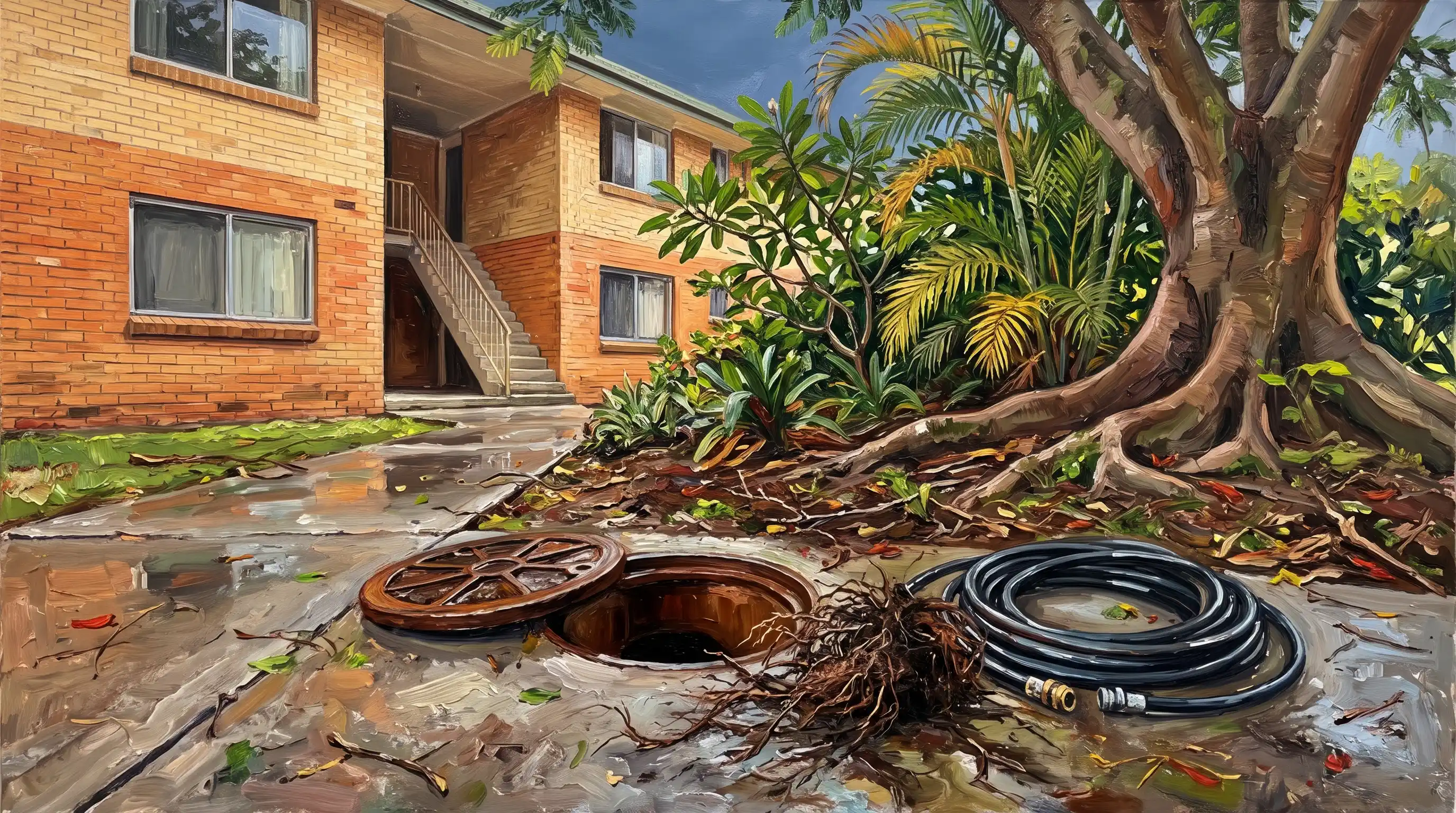
Tree roots go looking for water. A hairline gap at a joint lets moisture out, fine roots find it, and over a few years they grow into a mat that catches everything flowing past. Older sites tend to have big established trees close to the building, and the sewer line often runs right past them. Reactive clay soils add to it, swelling in wet weather and shrinking in dry spells, which works joints loose over decades.
Most committees first suspect what residents are flushing, and wet wipes do real damage. But when the same line blocks in the same spot no matter who lives there, roots or a damaged pipe are the likelier cause.
High-pressure jetting cuts the roots back and gets the line flowing. It doesn't close the joint the roots came through, so they grow back, often thicker. That's why the plumber keeps returning to the same spot.
Signs the problem is the pipe rather than what is going down it:
Blockages in the same line, or the same ground-floor lot, months apart
Gurgling from floor wastes or toilets when units upstairs drain
A sewer smell near an outdoor inspection opening or garden bed
Soggy, sinking or unusually lush patches of lawn along the line
Root fragments in what the plumber pulls out
Whose pipe is it? Lot versus common property in NSW
In NSW, a pipe that serves more than one lot is usually common property, and the owners corporation must keep it in good repair. A pipe that serves only one lot, and doesn't sit inside a common property wall, floor or ceiling, usually belongs to that lot.
The Strata Schemes Development Act 2015 treats pipes that aren't for the exclusive benefit of one lot as common infrastructure, and section 106 of the Strata Schemes Management Act 2015 makes the owners corporation responsible for maintaining and repairing common property. Location doesn't settle it. A sewer line running under one owner's courtyard is still common property if three units drain through it.
Architecturean older walk-up, roof to sewerThin blue pipes stay inside one lot. The clay stack and line carry every lot's waste, so the building fixes them. Touch a part.
Pipe or fitting
Usually the job of
Why
Main sewer line serving several lots
Owners corporation
Serves more than one lot
Pipes inside a common property wall, floor or ceiling
Owners corporation
Located in common property
Branch pipe serving one lot, downstream of its stopcock
Lot owner
Exclusive benefit of one lot
Toilet, basin, sink and the S-bend under it
Lot owner
Fixtures within the lot
The NSW Government's common property memorandum sets out these splits in detail. It only binds a scheme that has adopted it as a by-law under section 107, but it is a fair guide to how NSW reads these lines. Your registered strata plan and by-laws can change the answer, so check both before you assign a cost. For the wider picture, see our guide to who is responsible for repairs in a strata building.
How the other states treat shared sewer lines
The wording changes from state to state, but the principle is similar. A pipe serving more than one lot is generally the building's to repair. A pipe serving only one lot, and sitting within that lot, is generally the owner's. The plan decides the edge cases.
In Victoria, the Owners Corporations Act 2006 puts the repair duty on the owners corporation, and the plan of subdivision decides what counts as common property, so start there.
Queensland spells it out more than most. Utility infrastructure is common property unless it serves only one lot, sits within that lot and isn't inside a boundary structure such as a floor, wall or ceiling. Under section 177, exclusive use by-laws also can't give an owner exclusive use of utility infrastructure that is common property. The Queensland Government's page on utility infrastructure maintenance covers the detail.
What a useful CCTV report shows the committee
A CCTV drain inspection sends a small camera through the pipe and records what it finds. For a committee, the report matters more than the footage. A good one should show:
Where the camera went in, and the distance to each problem from that point
What the pipe is made of, and roughly how old it's likely to be
Whether each problem is roots, a cracked or offset joint, a collapse, or a sag where water and waste sit (plumbers call this a "belly")
Whether the problem sits in a common line or one lot's branch
Options with costs, not just a single recommendation
If the same line keeps blocking, ask a licensed plumber to run a camera through it on the next call-out and hand over the footage. A marked-up report showing where each defect sits is what tells the committee whether it's a common property line or one lot's branch.
Ask for the video file as well as the stills, and keep both with your building records. They answer the next owner's question before it's asked, and they're the evidence you'll want if the job goes into the capital works plan.
Clear, reline or dig up?
Once you know what's in the pipe, there are three broad options. Prices vary with access, pipe size and how much of the line is affected, so get each option quoted from the same inspection.
Decision treewhich fix does the camera point to?Start at the camera. Each junction asks one question, and each pipe end is a fix. Touch one.
Option
What it does
Disruption
When it fits
Clearing (jetting)
Cuts roots and flushes the line
Low, usually a few hours
A one-off blockage, or buying time while you plan
Relining
Forms a new pipe inside the old one, sealing the joints
Low to moderate, little or no digging
Root intrusion and cracks in a line that's still in shape
Dig and replace
Removes the damaged section and lays new pipe
High, breaks up paving, driveways or gardens
A collapsed section, or a sag relining can't fix
Relining suits most root problems in clay lines, because it seals the joints the roots came through. It won't fix a section that has collapsed or sunk badly, so the camera report decides whether it's even an option.
When relining quotes come in, check that each one states:
The length of pipe being lined, and where it starts and ends
How many branch connections will be reopened after lining
The warranty term, and who holds it
Whether a second CCTV inspection after the work is included
Quotes that skip these details are hard to compare, and harder to hold anyone to later.
Paying for it: admin fund, capital works fund and recovering costs
Repeated clearing usually comes out of the administrative fund, and it adds up quietly because no single invoice looks large. A relining job is a larger, one-off repair that belongs in the capital works fund and your 10-year capital works plan.
Put the numbers side by side. Add up what the building has spent clearing the line over the past two or three years, and compare it with the relining quote. If the same clear is happening two or three times a year, relining may cost less over the life of the plan, and owners stop living with the backups. If the fund is short, a special levy is the usual route, and the CCTV report is what will get it through the vote.
The chart shows the shape of that comparison at three clears a year. Its numbers are made up and round, so swap in your own invoices and your own quote.
Bar chartten years of clearing against one relineOne slip is one $650 call-out, three a year. The blue pipe is one $11,000 reline. Made-up round numbers. Touch a year.
Recovering costs from one lot is the exception, not the rule. In NSW it can come up where an exclusive use by-law makes an owner responsible for a courtyard and the tree whose roots caused the damage. In Queensland, exclusive use by-laws can't cover utility infrastructure that is common property, which narrows that route. Either way, the wording decides it, so get advice before sending anyone a bill.
A notice you can send owners before the inspection
Owners notice a camera crew in the garden. A short notice beforehand saves the committee a round of emails. Copy this, fill in the brackets and send it about a week ahead.
Committee checklist before the next call-out
01
Log every blockage: date, lot and cost
02
Camera inspection and a written report
03
Check the plan: lot pipe or common property?
04
Quote relining and dig-up from the same report
05
Compare with what clearing has cost
06
Schedule the fix in the capital works plan
The order to work through when the same line keeps blocking.
Log it, film it, then decide. That order is what stops a building paying for the same drain twice a year.