
Repairs & Maintenance
Who Is Responsible for Repairs in a Strata Building? Common Lot vs. Common Property Explained
When something breaks in your apartment, who pays? The answer depends on whether it's common property or part of your lot, and the boundary isn't always where you think it is.
· 5 min read
On this pageAcross AustraliaOn this page
- Across Australia
- The practical read
- The basic rule
- What is common property?
- Where it gets confusing
- Stronger maintenance enforcement under the 2025 reforms
- Common dispute scenarios
- The leaking bathroom
- The crumbling balcony
- The noisy plumbing
- How to resolve disputes
- How this looks in UnitBuddy
- Related reading
- Sources and further reading
Across Australia
The boundary test is local. NSW uses the registered strata plan and common property memorandum. Victoria works from the plan of subdivision and owners corporation rules. Queensland depends heavily on whether the scheme is a building format plan or standard format plan. WA, SA, Tasmania, the ACT and NT each have their own plan and title language.
Before arguing about who pays, get the plan, identify the failed item, and check whether your state treats that item as common property, lot property, utility infrastructure or an owner improvement.
The practical read
- Most repair fights start because people argue symptoms instead of ownership boundaries.
- Plans, by-laws, renovation history and expert reports usually matter more than assumptions.
- If common property is involved, the owners corporation cannot simply vote the problem away.
Most repair arguments start with the wrong question. Owners ask who noticed the problem first; the plan asks where the failing part actually sits.
A pipe bursts behind a bathroom wall. A window seal fails and rain comes in. A balcony membrane cracks. Who pays depends on the location and ownership of the failed part.
The item may be common property, making it the owners corporation's responsibility, or part of the individual lot, making it the owner's responsibility. Plans and renovation history can make that boundary difficult to apply.
The basic rule
Under section 106 of the Strata Schemes Management Act 2015 (NSW), the owners corporation has a duty to properly maintain and keep in a state of good repair the common property and any personal property vested in the owners corporation.
As a lot owner, you're responsible for maintaining everything within your lot that isn't common property.
The complication is knowing where common property ends and the lot begins.
What is common property?
Common property is everything in the strata scheme that isn't part of an individual lot. It's defined by the strata plan: the registered plan that shows the boundaries of each lot.
Typical examples of common property include:
- The building's structural elements: foundations, load-bearing walls, roof, external walls
- Common area spaces: lobbies, hallways, stairwells, lifts, car park driveways
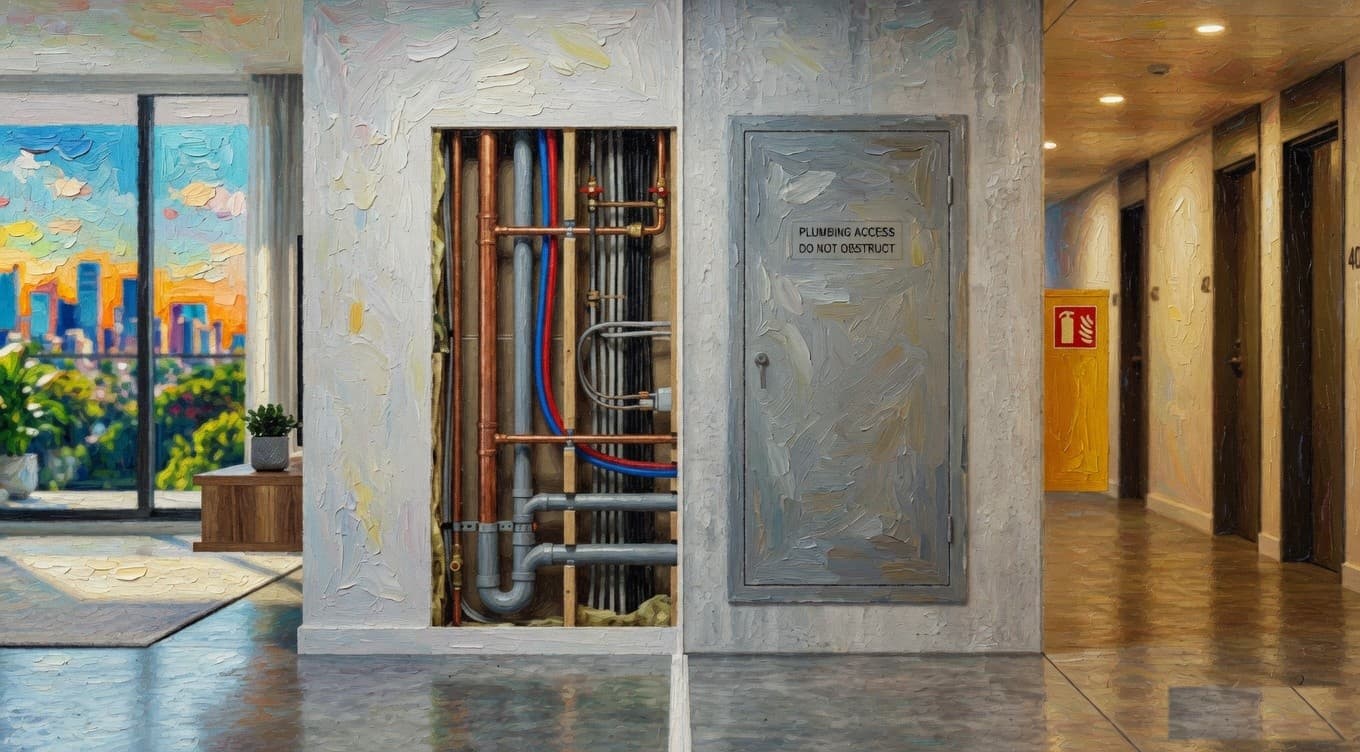
- Building systems: fire safety systems, main plumbing risers, electrical mains, intercom systems
- External elements: facades, balcony slabs (the structural concrete, not necessarily the surface), windows (in some cases)
- Shared facilities: pools, gyms, gardens, BBQ areas
Where it gets confusing
The boundary between common property and individual lots varies depending on how the strata plan is drawn. In some buildings, the boundary is at the inner surface of walls. In others, it's at the centre of walls. This seemingly minor difference has huge practical implications.
| Item | Typically Common Property | Typically Lot Owner | Notes |
|---|---|---|---|
| Main water pipes (risers) | Yes | Pipes that serve multiple lots are common property | |
| Branch pipes within your lot | Yes | Pipes from the riser to your taps are usually your responsibility | |
| External windows | Usually yes | Depends on strata plan; often common property in NSW | |
| Internal walls | Yes | Non-structural internal walls are usually part of your lot | |
| Balcony structural slab | Yes | The concrete slab is common property | |
| Balcony tiles/surface | Varies | Varies | May depend on strata plan and any by-laws |
| Waterproofing membranes | Usually yes | Often considered part of the building structure | |
| Kitchen and bathroom fixtures | Yes | Your taps, sinks, toilets are your responsibility | |
| Front door | Varies | Varies | Often the exterior side is common property, interior is lot |
| Smoke alarms | Yes (within lot) | Owner must maintain; building fire system is common property |
Stronger maintenance enforcement under the 2025 reforms
The Strata Schemes Legislation Amendment Act 2025 significantly strengthened the enforcement of the section 106 duty. Key changes include:
- NSW Fair Trading can investigate potential breaches of the duty to maintain common property, demand documents, enter premises, issue compliance notices and accept enforceable undertakings.
- Owners now have six years, up from two, to take legal action against the owners corporation for failure to maintain common property.
- If a defect poses a risk to safety or access, the owners corporation must act immediately, regardless of any ongoing legal proceedings.
| Item | Status | Next |
|---|---|---|
| Lot 12 bathroom leak | Quote in | Manager |
| Lift door jamming | On site | Contractor |
| B2 fire-door closer | Needs vote | Committee |
| Basement boom gate | Closed | Contractor |
Common dispute scenarios
The leaking bathroom
Water leaking from one lot into another is the most common strata dispute. The key question is: where is the leak coming from? If it's from a common property pipe (a riser or branch on the common property side of the boundary), the owners corporation pays. If it's from a lot owner's fixture (a cracked shower base, failed tap washer, or broken washing machine hose), the lot owner pays.
In practice, finding the source often requires investigation, and the cost of investigation itself can be contentious.
The crumbling balcony
Balcony repairs are a classic grey area. The structural slab is common property, but the tiles, railings and waterproofing may or may not be. If your balcony's waterproofing fails and water enters the building structure, the owners corporation typically bears the repair cost. But if the failure was caused by the lot owner's modifications (like drilling into the membrane), the owner may be liable.
The noisy plumbing
Old buildings with ageing common property plumbing that creates noise in individual lots present a question of who should pay for upgrades. If the noise is caused by common property infrastructure, the argument for owners corporation responsibility is strong.
How to resolve disputes
If you believe the owners corporation is responsible for a repair and they disagree, you have several options. Start by putting your request in writing with photos and a clear explanation of why you believe it's a common property issue. If the committee doesn't act, escalate to your strata manager. If that fails, you can apply to NCAT for mediation or adjudication.
Under the 2025 reforms, you can also lodge a complaint with NSW Fair Trading, which now has investigation and enforcement powers specifically for section 106 breaches.
- Photograph defect and gather plan
- Written request to committee
- Escalate to strata manager
- Apply to NCAT for orders
- Lodge Fair Trading complaint
How this looks in UnitBuddy
UnitBuddy tracks maintenance spending and compares it with similar buildings. Committees can see whether the building is spending too little on maintenance, while owners can use the same data when asking for work to be brought forward.
Related reading
Sources and further reading
- NSW Government: changes to strata laws
- NSW Government: guide to strata law changes for committees and owners
- QLD: New strata owner: what is common property and what does body corporate insurance cover?, via LookUpStrata
- Maintenance and common property factsheet, via LookUpStrata
Keep the scheme file in one place the committee and the manager can both open. Features, pricing, or book a tour.