
Repairs & Maintenance
Efflorescence Explained: What the White Powder on Your Building Means and When to Worry
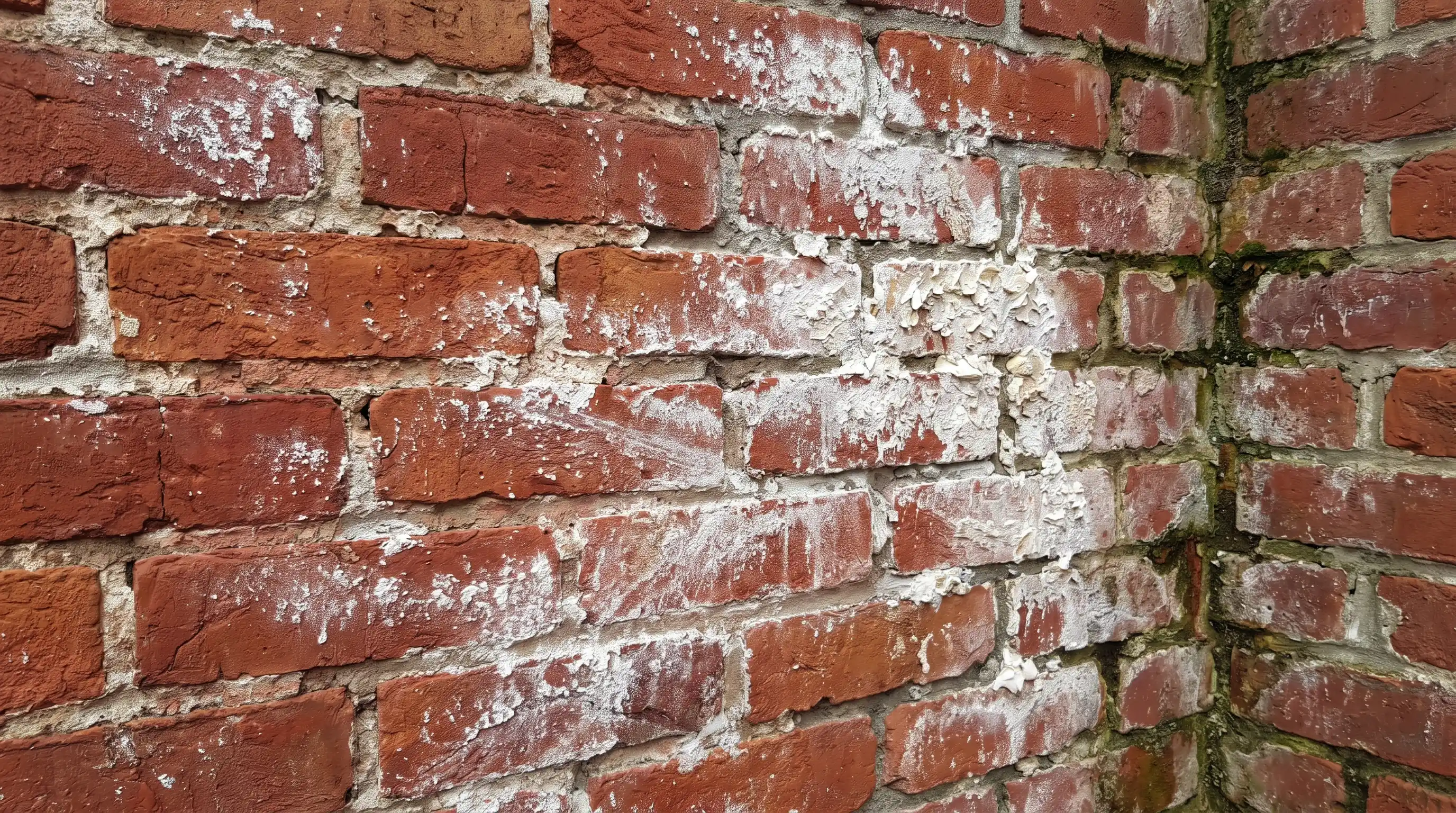
Efflorescence is the white, salty deposit that appears on brickwork, concrete, render and tile grout. It is rarely harmful on its own, but it only forms where water is moving through the building. Here is what it is, where it comes from, how to tell it apart from look-alikes, how to remove it properly, and when an owners corporation should treat it as a defect.
· 14 min read
On this pageStart hereOn this page
- Start here
- What efflorescence is
- Where the salts come from
- Where the water comes from
- New building bloom versus a water problem
- The different kinds of white deposit
- Soluble salt efflorescence
- Lime bleeding and calcium carbonate deposits
- Concrete stalactites
- Calcification on balconies and tiles
- Calcium stains (not efflorescence)
- Vanadium stains (coloured, not white)
- Subflorescence: the damaging one
- Is efflorescence harmful?
- How to identify what you're looking at
- How to remove efflorescence properly
- Soluble efflorescence on brick, block and render
- Calcium carbonate, lime runs and calcium stains
- Vanadium stains
- Why sealers and paint are not the fix
- Preventing efflorescence
- Is efflorescence a building defect?
- Who pays to fix it in a strata building
- What committees should do
- What UnitBuddy tracks
- Sources and further reading
Start here
- Efflorescence is a white, powdery or crystalline deposit of salts left on the surface of brick, concrete, mortar, render, stone or tile grout after water evaporates from it.
- It needs three things at once: soluble salts, water to dissolve them, and a path through the material to a surface where the water can evaporate. Take away the water and it stops.
- On a building less than a year old it is usually "new building bloom": construction water drying out. It generally fades by itself.
- On an older building, efflorescence that is new, growing or keeps coming back usually means water is getting in somewhere it shouldn't: a failed flashing, a leaking balcony, a bridged damp-proof course, a cracked slab, a planter box or a broken pipe.
- The deposit itself is mostly cosmetic. The water behind it is not. Persistent efflorescence on a balcony, car park slab or basement wall can sit alongside membrane failure, concrete leaching and reinforcement corrosion.
- Brush it off dry. Don't hose it, don't paint over it, and don't seal it until the water source is fixed. Sealing a wet, salty wall can push the salts inside the masonry, where they do real damage.
- In Queensland, calcification or efflorescence caused by water from a deck or balcony within 12 months of completion is listed as a defect in the QBCC's Standards and Tolerances Guide. Western Australia's guide lists it as defective without that time limit.
What efflorescence is
The word comes from the Latin efflorescere, "to blossom out", which describes it well. Salts carried inside a wet wall or slab "bloom" on the surface as fine white crystals once the water dries off.
The Brick Industry Association puts the mechanism simply: water containing dissolved salts is brought to the surface of the masonry, the water evaporates, and the salts are left behind. The salt solution can travel through the pores of the brick or mortar, along the line between brick and mortar, or across the face of the wall.
Three conditions have to exist at the same time:
- Soluble salts within or touching the material. They can be in the mortar, concrete, grout, soil, trim, backing blockwork or occasionally the bricks themselves.
- Water in contact with those salts long enough to dissolve them.
- A pore structure and a driving force. The material has to be porous enough for the solution to move, and something has to push it, usually a temperature or humidity difference that draws moisture toward the drier surface.
Most building materials will always contain some salts, and no exposed wall can be kept perfectly dry. So the practical approach is to cut each factor down, and the one you can control most is water.
Where the salts come from
The usual assumption is that the bricks are to blame, because that is where the white shows up. The research says otherwise. The Brick Industry Association and Think Brick Australia both identify the cement in mortar, grout and concrete as the main source. Bricks can contain soluble salts, but it is much more common for salts to come from the cement-based materials in contact with them. Measurements cited by the BIA found concrete products can contain two to seven times as much soluble material as fired clay.
The common salts and their likely sources, adapted from the BIA's Technical Note 23A:
| Salt | Most likely source |
|---|---|
| Calcium carbonate | Mortar, concrete, or concrete backing |
| Calcium hydroxide | Cement |
| Sodium and potassium carbonates | Mortar |
| Sodium and potassium sulfates | Reactions between cement and brick |
| Calcium sulfate | Brick |
| Sodium chloride | Seawater or sea spray |
| Potassium chloride, vanadyl chloride | Hydrochloric acid used to clean brickwork |
| Vanadyl sulfate | Light-coloured bricks |
| Manganese and iron oxides | Brick, or iron in contact with the wall |
Other sources worth knowing about in Australia:
- Groundwater and saline soils. Groundwater picks up salts as it moves through the soil. Where masonry is in contact with the ground, it can wick that water up by capillary action. Parts of Western Sydney, Adelaide and inland Victoria have saline soils, and the NSW, Victorian and South Australian heritage agencies have published a whole guide on salt damp because of it.
- Sea spray. Coastal buildings get chloride salts delivered from outside.
- Contaminated sand and fill. The heritage salt damp guide describes a case where heavy efflorescence turned out to be magnesium sulfate from contaminated quarry sand used as a bedding layer under paving.
- Garden beds, planters and fertiliser. Both the QBCC and WA guides note that owners watering plants can contribute to efflorescence. Fertiliser adds its own salts.
- Cleaning products. Brickwork cleaned with too much acid and too little water can be left with new soluble salts.
Where the water comes from
This is the question that matters. In an apartment building, the usual suspects are:
- Rain getting into the wall. Failed or missing flashings, cracked copings, perished sealant around windows, and blocked weep holes. The BIA lists sealant joints around frames as among the most frequent sources of water entry.
- Balconies, podiums and planter boxes. Water that gets through grout sits on the membrane, picks up salts from the screed and adhesive, and comes out at the balcony edge or on the wall or soffit below.
- Roofs, gutters and box gutters overflowing or leaking into the wall below.
- Rising damp. Ground moisture climbing a wall because the damp-proof course is missing, failed, or bridged by a raised garden bed, a new path or render taken down to the ground.
- Below-ground walls and slabs. Basement and car park walls with failed or missing external waterproofing let groundwater through.
- Cracks in suspended slabs. Rain or washdown water on a podium or upper car park deck seeps through cracks and joints to the level below.
- Plumbing. Leaking pipes, faulty drains and badly aimed irrigation are on the BIA's list of causes to check once the obvious ones are ruled out.
- Condensation. Warm, humid air from showers, cooking and pools can condense inside wall cavities in cold weather. The BIA says this is usually not enough to cause efflorescence, but it can be in high-humidity rooms.
- Construction water. Water in the mortar and concrete when the building was put up, plus any rain that soaked unprotected brickwork during construction.
New building bloom versus a water problem
The age of the building when the white first appeared is the first clue.
Under a year old: new building bloom. The BIA defines new building bloom as efflorescence on brickwork less than a year old. It usually appears fairly evenly across a wall and comes from normal drying after construction. The salts are mostly free alkalis that moved from the wet mortar into the bricks. In most cases it fades as the wall dries and wind and rain clean it naturally.
Over a year old: look for the water. The BIA says efflorescence that appears more than a year after completion can generally be put down to excessive water penetration or poor drainage. When efflorescence appears on an established building that was previously clean, the usual explanation is a new source of water.
The pattern helps too:
- Even across a whole new wall: probably bloom.
- Concentrated under a sill, coping, balcony edge or parapet: water getting in at that detail.
- A band low on the wall with a tide mark: rising damp, often a bridged or failed damp-proof course.
- Lines or drips on a car park soffit, especially along cracks: water through a slab above.
- Grout lines on a balcony or shower: water sitting under the tiles.
- Streaks running down from a point: a localised leak, such as a pipe penetration, downpipe or overflow.
- Returning after rain, or after the planters are watered: that water is your source.
The different kinds of white deposit
"Efflorescence" gets used for several related things. They behave differently, so it helps to know which one you are looking at.
Soluble salt efflorescence
The classic white, powdery or fluffy deposit. Think Brick describes it as "not a stain" but a powdery deposit that forms on porous materials. It is mostly sulfates and carbonates of sodium, potassium, calcium and magnesium. It dissolves in water, brushes off, and often vanishes after rain, then comes back as the wall dries.
Lime bleeding and calcium carbonate deposits
Concrete and cement mortar contain calcium hydroxide, a by-product of cement setting. When water moves through, it dissolves the calcium hydroxide and carries it to the surface. There, it reacts with carbon dioxide in the air:
Calcium carbonate is effectively limestone. It is not soluble in water, so it will not brush or hose off. It forms hard white crusts, runs and drips, often from cracks, joints and the ends of balcony slabs. Industry sources call it "lime bloom" when it forms early from the concrete's own mix water.
Concrete stalactites
Where water keeps dripping through a crack in a slab, the calcium carbonate builds up into small stalactites hanging from the soffit. They are a familiar sight in older car parks. A Royal Society of Chemistry article on them notes they can grow about 1 cm a year, compared with about 1 cm in a thousand years for cave stalactites, and the drips are strongly alkaline (around pH 10 to 11). Brown or yellow streaking in the deposit can mean iron, possibly from corroding reinforcement.
A stalactite is not a problem in itself. It is proof that water has been passing through the same crack for a long time.
Calcification on balconies and tiles
The QBCC and WA guides use the term calcification for hard white deposits in tile grout and on walls beside or below balconies. It is the same calcium carbonate process, driven by water trapped in the tile bed.
Calcium stains (not efflorescence)
Think Brick separates out calcium stains: a hard, milky white film on brickwork that disappears when wet but does not dissolve in water. They usually come from calcium silicate formed by cement and clay in the mortar, often after poor acid cleaning, rain on fresh brickwork, or wet sponging of joints. They need chemical cleaning, not brushing.
Vanadium stains (coloured, not white)
Light-coloured and cream bricks often contain vanadium salts. These can show as yellow, green or reddish-brown stains. Think Brick says they are not permanent or harmful and don't indicate a defective brick. Strong hydrochloric acid can turn them black and much harder to remove, which is why acid should never be the first thing used on cream bricks. The WA guide treats visible vanadium staining at completion as defective.
Subflorescence: the damaging one
When evaporation happens just below the surface rather than at it, the salts crystallise inside the pores. This is called subflorescence or cryptoflorescence. The heritage salt damp guide explains that the force of crystallising salts is enough to break apart even strong masonry. It causes fretting and crumbling of soft mortar, and flaking or delamination of brick and stone faces. This is "salt attack".
The difference between harmless efflorescence and damaging subflorescence is mostly where the water evaporates. That is why sealing over salty masonry can turn a cosmetic problem into a structural one. More on that below.
Is efflorescence harmful?
On its own, usually not. The BIA describes it as "usually not harmful to brick masonry". MC-Bauchemie, a concrete chemicals manufacturer, says that in most cases it is a visual defect that doesn't reduce the mechanical properties of concrete.
The concern is what it tells you. It means water is moving through the building, and the water can do several kinds of damage:
- Salt attack. Where salts crystallise inside the material, mortar and brick faces erode. Below the damp-proof course and on coastal or saline sites, that is why Australian Standards require bricks with the right salt attack resistance grade.
- Leaching of concrete. Dulux Protective Coatings' technical note on concrete efflorescence warns that continual moisture migration can wash out soluble compounds and weaken the cement matrix. It also says the alkalinity of the concrete may drop, reducing its ability to protect the reinforcing steel from corrosion. Corroded reinforcement expands and causes spalling, often called "concrete cancer".
- Tile failure. On balconies and in showers, efflorescence on grout lines is often the first visible sign that water is getting past the grout. Water sitting in the tile bed degrades the adhesive and puts the membrane under strain. Tiles loosen and sound hollow.
- Coating failure. Dulux says efflorescence "should not be coated over". Paint and coatings won't bond to a salty surface, and moisture still in the concrete pushes up behind the coating and blisters it.
- Mould and damp smells in basements and storerooms, which Dulux also links to moisture moving through concrete.
As a rough guide:
| What you see | Usually means | Urgency |
|---|---|---|
| Even white bloom on a new building's brickwork | Construction water drying out | Low. Monitor through the first year |
| Small patch that comes and goes after heavy rain | Wetting at an exposed detail | Low to medium. Check flashings and sealant |
| Efflorescence that keeps growing or returns in the same place | Ongoing water entry | Medium. Find the source |
| White lines on balcony grout, hollow tiles | Water trapped under tiles, possible membrane problem | Medium to high |
| Crusts, drips or stalactites on a car park or balcony soffit | Water passing through cracks in a slab | Medium to high. Get an engineer to check for rust staining and spalling |
| Fretting mortar, flaking bricks, tide mark low on walls | Salt attack and rising damp | High. The damage is progressive |
| Rust-coloured staining with the white, or cracked and drummy concrete | Possible reinforcement corrosion | High |
How to identify what you're looking at
A few simple checks can narrow it down before you call anyone in. Wear gloves and eye protection.
- Rub it. Soluble efflorescence is dry and powdery, and crumbles between your fingers. Mould smears and usually has a colour or a musty smell. A hard crust that won't rub off is likely calcium carbonate or a calcium stain.
- Wet it. Soluble salts dissolve and the white disappears, then usually comes back as the surface dries. Calcium stains also vanish when wet but return unchanged because they never dissolved.
- Drop a little household vinegar on it. Calcium carbonate fizzes as the acid reacts with it. Sulfate salts don't.
- Check the colour. Yellow, green or brown on light-coloured bricks points to vanadium. Rust-brown in a white deposit points to iron.
- Note where and when. Photograph it with the date, and again after the next heavy rain and the next dry spell. The heritage salt damp guide recommends inspecting after a dry spell, because rain can wash salts back into the wall and make things look better than they are.
- Look up. Find what sits directly above the white: a sill, a balcony, a planter, a downpipe, a crack, a pipe.
If the cause isn't obvious, a laboratory can identify the salts using methods such as X-ray diffraction or ion chromatography. That tells you whether they came from cement, soil, seawater or cleaning products, which points to the water source.
How to remove efflorescence properly
Fix the water first. Every source agrees on this. The BIA says to find and correct the causes before attempting removal. Dulux says efflorescence stops only when moisture stops moving through the concrete. Cleaning a wall that is still getting wet is wasted money: the salts will come back.
Soluble efflorescence on brick, block and render
- Dry brush it with a stiff brush.
- Collect the salts with a dustpan or vacuum. Think Brick recommends this so the salts don't wash back into the wall or into porous paving below.
- If needed, wipe the residue with a cloth wrung out until just damp, rinsing it often in clean water.
- Don't hose it off. Think Brick says rinsing with water only lets the salt soak back into the bricks and reappear when they dry. The BIA says washing should only be done, if at all, in warm, dry weather.
- On new buildings, it is often best to leave bloom to weather away while the wall dries out.
Calcium carbonate, lime runs and calcium stains
These won't brush or wash off, so they usually need a proprietary masonry cleaner or a diluted acid applied by a contractor who knows what they are doing.
- Test a small area first. Think Brick and the BIA both stress this.
- Pre-wet the surface so the acid stays on the face and isn't drawn deep into the material.
- Rinse thoroughly afterwards.
- Avoid strong hydrochloric acid on light-coloured bricks, where it can bring out vanadium stains and turn them black.
- Acid also attacks mortar, concrete and some stone, and acid cleaning residues can leave chloride salts behind. It is not a DIY job on common property.
For concrete surfaces that are going to be coated, Dulux's procedure is mechanical: wire brushing, dry abrasive blasting or high-pressure water. After water-based cleaning, let the concrete dry and brush off anything that comes back. Then check the moisture content before coating. Dulux uses less than 6% on a standard moisture meter as its threshold.
Vanadium stains
Think Brick lists sodium hypochlorite (pool chlorine or bleach) for mild cases. Other options are oxalic acid followed by a sodium bicarbonate neutralising wash, or caustic soda solutions, all applied to dry brickwork. The neutralising step after oxalic acid is often skipped, and Think Brick warns that this can lead to worse staining. Leave it to a brick cleaning contractor.
Why sealers and paint are not the fix
Clear water repellents and sealers are often sold as efflorescence cures. The BIA warns against using them as the only treatment. If water is still getting into the wall from behind, the sealer stops the salts at its inner edge, usually 3 to 6 mm below the surface. The water escapes as vapour, and the salts crystallise inside the masonry instead of on it. That is subflorescence, and the BIA says the pressure it creates can spall bricks.
A breathable sealer applied after the leak is fixed and the wall has dried can be part of a good repair. A sealer applied instead of fixing the leak can make things worse. Dulux makes the same point about coatings on concrete: even after the salts are removed, moisture still in the slab will blister the coating off.
Preventing efflorescence
For new buildings and major works, the BIA, Think Brick and the heritage salt damp guide point to the same measures:
- Keep water out of the wall. Sound flashings, sloped copings and sills, well-maintained sealant joints, clear weep holes and a properly detailed cavity that drains.
- Separate brickwork from salty materials. A clear cavity between the brick skin and concrete or blockwork behind it, a damp-proof coating on concrete backing, and flashing under trim to act as a capillary break.
- Waterproof below ground. A membrane on the earth side of basement walls, and a damp-proof course a short distance above ground to stop ground salts climbing the wall.
- Choose the right bricks. Under AS/NZS 4455.1, bricks are graded Protected, General Purpose or Exposure according to how well they resist salt attack (tested under AS/NZS 4456.10). AS 3700 requires masonry to be durable enough for its exposure, which generally means Exposure grade below the damp-proof course on saline sites and in walls close to the coast.
- Use cleaner materials. Washed sand, clean water, and cements and blends that release less free lime. Boral notes that its slag and fly ash blended cements release less free lime than plain portland cement and are less prone to efflorescence.
- Look after materials on site. Stack bricks off the ground and cover them, and cover unfinished walls when it rains. Think Brick lists unprotected brickwork during rain and poor storage among the most common causes.
- Cure concrete properly and keep water off new slabs where possible.
For existing apartment buildings, prevention is maintenance:
- Replace perished sealant around windows and at movement joints before it fails.
- Keep gutters, box gutters, balcony outlets and stormwater pits clear.
- Keep garden beds, mulch and paving below the damp-proof course.
- Control irrigation near walls, and set rules for balcony planters.
- Re-grout or reseal balcony tiles at the first sign of grout failure.
- Treat car park and podium slab cracks before they turn into a leak path.
Is efflorescence a building defect?
It depends on the cause, the location and how old the building is.
Queensland. Item 14.8 of the QBCC's Standards and Tolerances Guide (December 2023) says that within the first 12 months from completion, calcification or efflorescence caused by water coming from a deck or balcony is a defect. That covers efflorescence on the walls below or beside the deck or balcony, or in the mortar joints of its tiling.
Western Australia. The WA Guide to Standards and Tolerances (2019) takes a similar line. Item 14.08 says calcification or efflorescence caused by water from a deck or balcony is defective, without a 12-month limit, but notes that owners watering plants may contribute and that this may not be the builder's fault. On masonry generally, item 3.20 says efflorescence is typically non-structural and may not be defective. It adds that the cause must be investigated to rule out failed or missing flashings, a failed damp-proof course or design issues, any of which would make it a defect. Item 3.11 treats vanadium staining visible at completion as defective.
Other states. New South Wales and Victoria have their own standards and tolerances guides, which grew from the same original template and include an efflorescence item for masonry. Check the current version for your state. These guides are reference documents rather than law, but tribunals and building inspectors use them.
The practical point is the same everywhere: efflorescence is evidence. New building bloom on a six-month-old building is normal. Efflorescence that turns out to be caused by a missing flashing, a failed balcony membrane or a car park slab letting water through can be part of a defect claim, and the cause is often covered by statutory warranty. Under the NSW Home Building Act 1989, a waterproofing defect can be a major defect, which carries a six-year warranty period instead of two.
Statutory warranty periods don't wait for the white powder to get worse. If your building is still within its warranty window, photograph and date the efflorescence, get a report on its cause, and notify the builder in writing.
Who pays to fix it in a strata building
The efflorescence follows the water, so responsibility follows the source of the water and the part of the building that has failed.
- External walls, facades, slabs, basement walls and car park structure are almost always common property. Investigating and repairing them is the owners corporation's job, paid from the admin fund or the capital works or sinking fund.
- Balcony membranes and tiles depend on the state and the strata plan. In NSW, membranes are usually common property. In Queensland and some other plans, much of a balcony's surface may belong to the lot. Our waterproofing guide goes through the state-by-state rules.
- Lot owner causes include over-watered balcony planters, blocked balcony drains, a leaking washing machine, or renovation work that damaged a membrane. The lot owner may be liable for resulting damage to common property under the by-laws and general law.
- Insurance generally covers sudden events, not gradual seepage or wear and tear. A leak that has been producing efflorescence for months is the textbook example of the gradual damage most strata policies exclude.
What committees should do
- Record it. Photograph each area with the date and location, and note when it first appeared. Repeat after heavy rain and after a dry spell.
- Check the building's age. Under a year old, ask the builder about new building bloom and keep watching. Inside the statutory warranty period, put the builder on notice in writing as soon as you suspect water entry.
- Look above and behind it. Check flashings, sealant, sills, copings, balcony outlets, planter boxes, gutters, downpipes and nearby plumbing.
- Get the right expert. A building consultant or waterproofer for walls and balconies, and a structural engineer for car park slabs, stalactites, rust staining or drummy concrete.
- Fix the source, then clean. Don't let a contractor seal, paint or acid wash an area before the leak is fixed and the substrate has dried.
- Tell owners what not to do. No pressure washing, no acid, no paint over efflorescence on common property, and no planters draining onto walls.
- Put it in the capital works plan. Recurring efflorescence along a facade or across a car park deck is a sign that sealant renewal, membrane replacement or concrete repairs are coming. Budget for them before they become a special levy.
What UnitBuddy tracks
UnitBuddy keeps the photos, inspection reports, contractor quotes and correspondence with the builder against the part of the building they relate to. Each one is dated, so a committee can show when efflorescence first appeared and how it progressed, which matters in a defect claim. Committees can set reminders for follow-up inspections after rain, sealant renewal and warranty deadlines, and link the repairs to the capital works plan. When the committee changes, the history stays with the building.
Efflorescence is easy to dismiss as a cleaning problem, and on a new building it often is. On an older one, it is the building showing you where water is getting in. Brush it off, but find the source, and fix that first.
Sources and further reading
- Technical Note 23A: Efflorescence – Causes and Prevention, Brick Industry Association (2019)
- Clay Masonry Cleaning Manual (Manual 13), Think Brick Australia
- Tech Note 1.3.4: Concrete Floors – Efflorescence, Dulux Protective Coatings (2026)
- Salt attack and rising damp: a guide to salt damp in historic and older buildings, David Young for the Heritage Council of NSW, Heritage Victoria and others
- Standards and Tolerances Guide, Queensland Building and Construction Commission (December 2023), item 14.8
- Guide to Standards and Tolerances 2019, Government of Western Australia, items 3.11, 3.20 and 14.08
- Efflorescence in concrete, MC-Bauchemie
- Concrete stalactites, Royal Society of Chemistry, Education in Chemistry
- Slagment product data sheet, Boral
- Home Building Act 1989 (NSW), NSW Legislation
Keep the scheme file in one place the committee and the manager can both open. Features, pricing, or book a tour.