
Repairs & Maintenance
Stormwater Pits and Roof Drainage: The Silent Capital Risk Lurking Below
A blocked driveway grate, a leaf-choked roof outlet, or a dead sump pump can turn a routine storm into a $30,000 to $200,000 basement-flood claim in an apartment building. The drainage system in a mid-rise strata scheme is out of sight, under-budgeted, and rarely tested. This is the pre-winter program, the capital items missing from most 10-year plans, and the maintenance evidence that turns a contested insurance claim into a paid one.
· 12 min read
On this pageWhat you'll find in this guideOn this page
- What you'll find in this guide
- How water drains in a mid-rise apartment building
- Top 5 ways stormwater systems fail
- A. Blocked roof outlets and box gutters
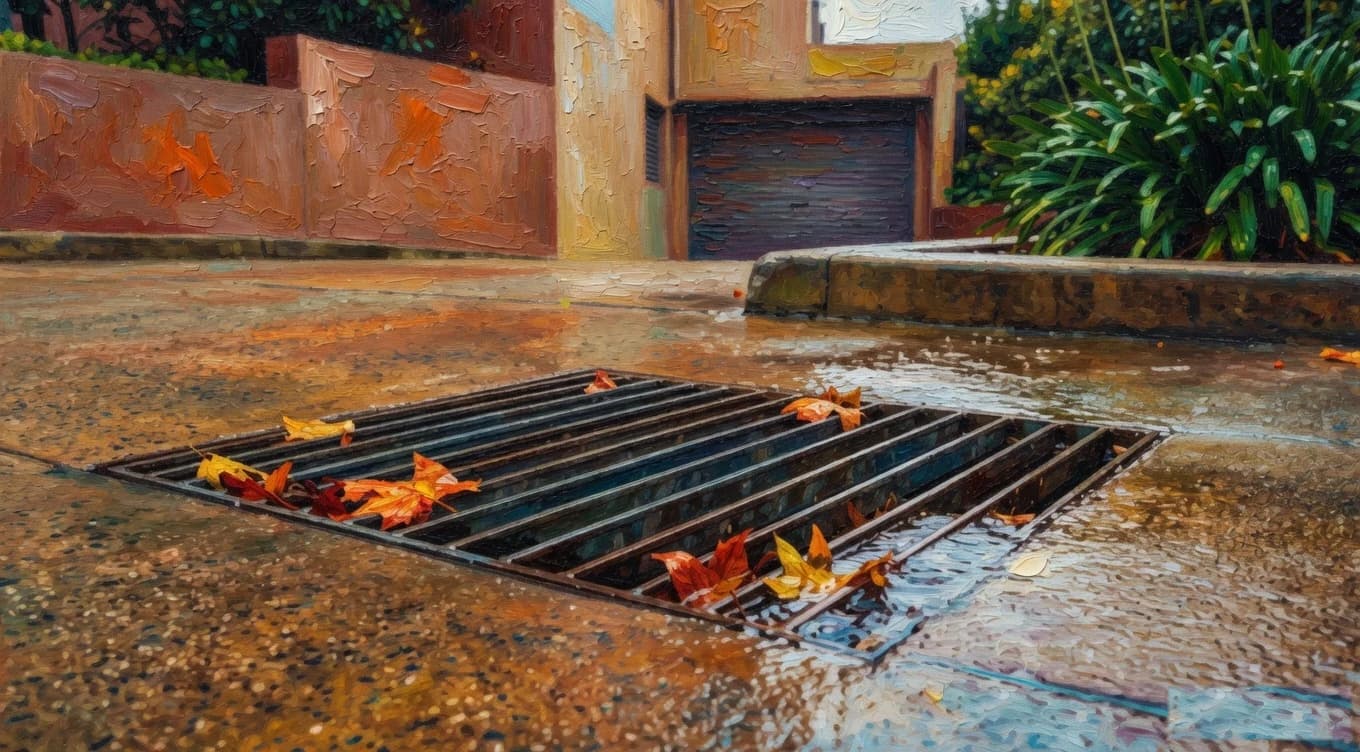
- B. Blocked driveway grate or trench drain
- C. Sump pit and pump problems
- D. Failed council connection
- E. Broken pit lids (trip hazard)
- How to avoid all this — the pre-winter program
- "100-year storms" aren't what you think
- Insurance and drainage — don't get caught short
- What capital plans miss
- Who actually owns this responsibility?
- Committee's quick checklist before winter
- The legal duty is to keep the system working, not to wait for a flood
- What the insurance assessor will actually ask
- When an engineer is cheaper than another winter
- A winter-readiness program that survives a committee change
- Who can help?
- How UnitBuddy helps
- Further reading
What you'll find in this guide
- A walk-through of drainage systems in a typical Australian mid-rise apartment building — roof box gutters, outlets, downpipes, overflow scuppers, ground-level pits, driveway trench drains, sump pits, and the council stormwater connection.
- Five recurring ways these systems fail, with real Australian cost examples — from a $300 lid swap to a $200,000 basement flood in the carpark below.
- A pre-winter maintenance routine that actually stops this stuff — usually for $1,500 to $5,000 a year, depending on the building.
- Why "100-year storms" now regularly overwhelm buildings that were supposed to handle them, and why insurers are getting tough.
- The capital costs most 10-year plans ignore, with actual dollar figures so you're not blindsided.
- A committee's cheat sheet and the maintenance records that turn a denied insurance claim into a paid one.
Here's the thing: when a flexi hose bursts in an apartment, the frantic phone calls start within five minutes. But a blocked stormwater pit on common property doesn't make a sound…until a heavy rain exposes it. That one overlooked maintenance task spells disaster — $30,000 to $200,000 gone in a flash for flooded basement carparks, fried switchboards, written-off cars, and weeks of painful remediation.
Drainage systems are probably the most neglected, least-inspected, and most quietly destructive part of an apartment building. They hide in plain sight — up on the roof behind parapet walls, buried in courtyards and garden beds, locked in basement plant rooms, or under paving leading toward the street. Nobody thinks about drainage until the water starts rising in the carpark, and at that moment, it's already too late.
This is not about standalone houses with a backyard downpipe. It's about strata schemes: common property roofs, shared basement levels, body corporate maintenance obligations, and insurance claims that hit every owner's levy.
How water drains in a mid-rise apartment building
Ask a group of lot owners or committee members about the building's lifts, or the fire system — they'll give you a fair answer. Ask where a single raindrop goes, from roof to street, and most people are stumped. That information gap alone causes most of the failures that follow.
Here's how it works:
- Box gutters collect water at the roof's edge. They feed into outlets — drains notorious for trapping leaves, petals and dirt. Outlets get blocked all the time. When this happens, water builds up, turning the gutter into a shallow swimming pool, which pushes your roof membrane past breaking point.
- Downpipes then carry water from the outlets to the ground-level pits or directly to the council system. Older ones are cast iron (they corrode on the inside); newer ones are PVC. Downpipes themselves rarely fail, but connections at both ends leak.
- Overflow scuppers act as safety vents — a backup slot through the parapet slightly higher than the regular outlet. If it's painted over or blocked during renovations, it's useless, and water just sits above your membrane until it finds a way in.
- Balcony drains are a story in themselves — covered in the bathroom and balcony waterproofing guide. In many buildings, if these block, water backs up and can affect lots above and below.
- Stormwater pits are concrete or composite burial chambers scattered all over ground level — garden beds, courtyards, driveways. All the water from above ends up here, then exits via underground pipes that eventually hit the council main. Most of these inspection lids haven't been lifted in years.
- Driveway grates and trench drains run across the basement ramp entrance — this is the main line of defence against water flowing into the carpark. If this blocks, the basement is toast.
- Sump pits and pumps live in basements that are lower than the street stormwater line. Any water down here must be pumped out. Sump pumps run on float switches that are notorious for sticking, and most are never properly tested after installation.
- The buried council connection carries it all out to the street. Tree roots love it, ground movement cracks it, decades of grime choke it, and sometimes whole sections collapse from poor construction.
The journey is simple: rain hits, the roof catches, outlets feed the pipes, pits handle the runoff, pumps shift water from the depths, the main connection dumps it on the street. If anything breaks or blocks, there's going to be trouble.
- Rain hits the roof
- Box gutter collects water
- Outlet feeds the downpipe
- Downpipe runs to ground-level pit
- Pit network drains by gravity
- Council connection discharges to the street main
Top 5 ways stormwater systems fail
A. Blocked roof outlets and box gutters
This is the most common problem. Leaves, flowers, and debris build up on the outlet grates. The gutter fills and water sits there, straining a membrane that's built to drain, not to hold water like a dam. It seeps into cracks and joints, and then you have leaks into ceiling cavities and top-floor apartments.
Cost to prevent: $2,000 to $8,000 a year gets a roofer up there to clear everything, photograph the state of the membrane, and check overflow scuppers.
Cost if you skip it: $20,000 to $100,000+, once water gets into ceilings, insulation, and electrical. If it tracks down through apartments, the bill climbs even higher.
B. Blocked driveway grate or trench drain
This is the heavy hitter — usually the most expensive failure of all. When the trench drain at your basement carpark entry blocks (leaves, mulch, construction rubbish, you name it), the water goes straight into the carpark.
The result? Flooded vehicles and storage cages, ruined switchboards and lifts, fried fire equipment, telecom gear drowned, bikes and personal stuff wrecked…the list goes on.
Cost to prevent: A few hundred dollars' worth of annual pit cleaning as part of the full building clear-out.
Cost if you skip it: $30,000 to $200,000+, with insurance battles ahead.
C. Sump pit and pump problems
Below-street-level basement carparks rely on sump pumps to get rid of water. If the float switch sticks, the motor fails, or the line blocks, there's no sign until water appears on the floor.
Most apartment buildings skip high-water alarms in sump pits. The first clue you have — water in the basement.
Cost to prevent: $300 to $800 twice a year for proper pump and pit tests and cleaning.
Cost to replace a failed pump: $1,500 to $5,000, depending on size and setup.
Cost if you skip it: $30,000+, and if you have no pump log, the insurance claim is a fight.
D. Failed council connection
Tree roots, ground movement, sediment — over time, the buried main fails. It's invisible until a storm tests it and the line chokes or breaks.
Cost to catch it: $800 to $2,500 for a full-length CCTV camera inspection every 5–10 years on older buildings.
Cost to fix: $5,000 for a simple jet-clean; $50,000 or more to dig it up and replace.
E. Broken pit lids (trip hazard)
Not as dramatic but very common. Broken or missing lids — rusted iron, UV-brittle plastic, crumbling concrete rims — leave holes pedestrians or cars fall into on common property.
Cost to replace a lid: $300 to $1,500 each.
Cost if someone trips: Claims range from $5,000 for a sprain to $50,000 or more for a bad injury. This is real public-liability exposure for the body corporate.
How to avoid all this — the pre-winter program
Honestly, this maintenance is basic and cheap compared to the damage even one failure causes in a strata building.
Before winter (late autumn — typically April and May), hire a specialist. They'll:
- Lift every pit and grate, vacuum out the muck, take photos, check all pipes, replace and seal the lids. The driveway trench and any grated inlets get the same.
- Cost: $1,500 to $5,000 for a block of 40–80 apartments. The best value insurance you can buy.
- Roofs need a yearly walkover too: clear outlets and gutters, check scuppers, photograph the membrane's problem areas. Write it all up.
- Cost: $1,500 to $4,000 typically.
- Get a CCTV check of the council connection every 5 to 10 years — stops surprises.
- Cost: $800 to $2,500 per inspection.
- Sump pump test: twice a year, float simulation, pump cycle, measure discharge, remove sediment.
- Cost: $300 to $800 each visit.
- High-water alarm in pits: $500 to $2,000 per pit one-off. The first prevented flood pays for all of them.
For a 60-lot apartment building, you can run the full program for under $10,000 a year. One avoided basement flood pays this back ten times.
"100-year storms" aren't what you think
Apartment buildings are designed to a level — usually to handle a 1-in-20-year storm for normal drains, and a 1-in-100 for things like overflows and trench drains. But the design is built on several big assumptions:
- Outlets are clear,
- Overflow devices work,
- Downpipes and pits are clean,
- Pumps are ready,
- The pipe to the street isn't half-blocked.
If even a couple of those fail, your building can't shed water like it was designed to — suddenly, a 1-in-20 storm behaves more like a 1-in-5. And climate change? "100-year storms" now hit more often in many regions. Go ask any insurer in Northern NSW or South-East QLD post-2022.
Insurers have noticed: now, they write in flood exclusions, higher premiums, and separate excesses. The buffer you thought you had at construction doesn't exist without rock-solid maintenance. The strata insurance premium guide covers the broader pricing picture.
Insurance and drainage — don't get caught short
Strata insurance covers "sudden and accidental" water damage. If a storm overwhelms a well-maintained system, you're covered. But if you've skipped maintenance and the system clogs up on a routine storm, insurers might walk away.
- Many policies slap on flood exclusions, or special excesses if you're in flood-prone areas.
- Keep your maintenance records — photos, pit clean invoices, pump logs, inspection reports. Have this paperwork ready and you get paid. Skip it and be prepared for scrutiny and maybe a denied claim.
This is the same pattern that runs through the flexi hose post and the neighbour water leak post. Documentation is the difference between a paid claim and a fight.
What capital plans miss
Most 10-year plans allow for roofs, lifts, paint jobs, lobbies, M&E kit, but ignore detailed drainage lifecycle items. That's a mistake. Make space in your plan for:
- Roof membrane recoats/replacement every 15–25 years ($30,000–$150,000+)
- Sump pump replacement every 10–15 years ($2,000–$8,000 per pump)
- Trench/grate replacements at 20–30 years ($5,000–$30,000)
- Council line repairs after CCTV reports ($10,000–$50,000)
- High-water alarms ($500–$2,000 per pit)
- Lid replacements (budget a few hundred dollars per year for all pits)
Covering these means you're not scrambling for special levies after a disaster. Buildings that plan ahead stay in control; buildings that don't learn the hard way and pay multiple times over. The apartment building maintenance cost guide covers what an honest 10-year plan looks like.
Who actually owns this responsibility?
In almost every state:
- Roofs, box gutters, outlets, downpipes, ground-level pits, driveways, trench drains, sump pits, pumps, and the main connection to the street — all common property, all the body corporate's responsibility.
- Balcony drains depend on state rules and plan — sometimes owner, sometimes body corporate.
Bottom line — the building owns stormwater risk and owns the solution. The body corporate cannot push drainage maintenance to lot owners for common-property systems.
Committee's quick checklist before winter
- Last full pit and grate clean? Make sure there's a written report and date-stamped photos — should be in the last year.
- Last roof inspection? Within 12 months, with photos of every outlet, scupper, and the membrane condition.
- Sump pit pump test? Within last 6 months, record of a working cycle test.
- CCTV report of council connection? In the last 5–10 years.
- High-water alarms? Installed, regularly tested, and results recorded.
- Fire system test? If the plant room floods, you lose fire and stormwater at the same time.
- Insurance policy reviewed for flood cover and the right excess.
Miss anything on this list and you're not guessing — you're gambling. The next storm decides your fate: a normal, boring night, or a headline insurance battle and six-figure losses.
Take care of drainage — no one notices when it works, but the cost when it fails is anything but silent.
The legal duty is to keep the system working, not to wait for a flood
In New South Wales the owners corporation must properly maintain and keep common property in a state of good and serviceable repair under section 106 of the Strata Schemes Management Act 2015. That duty is not a suggestion and it is not limited to items that look worn. Roof box gutters, outlets, downpipes, courtyard pits, driveway trench drains, basement sump pits and the private stormwater line to the street are almost always common property. Leaving them uninspected until the next big rain is a breach waiting for a wet weekend.
Victoria puts the same idea in section 46 of the Owners Corporations Act 2006: the owners corporation must repair and maintain the common property. Queensland’s Body Corporate and Community Management Act 1997 and Western Australia’s Strata Titles Act 1985 reach the same result through the body corporate or strata company’s duty to maintain common property. The labels change. The owner of the roof drainage does not.
Two practical consequences follow. First, a committee cannot “save money” by skipping the annual pit clean and then treat the resulting basement flood as an unavoidable act of God. If the grate was last lifted three years ago and the photos show leaf mulch to the invert, an insurer and a tribunal will both ask why. Second, a lot owner whose car or storage cage is written off because common-property drainage failed can, in NSW, bring a statutory damages claim under section 106(5). The Court of Appeal confirmed that pathway in Vickery v The Owners – SP 80412 [2020] NSWCA 284. The limitation period is six years from when the owner first became aware of the loss.
Balcony drains sit on a different line. Whether the drain body is lot or common depends on the registered plan and the state rules. The waterproofing guide covers that split. Everything from the roof outlet to the street connection is, in a typical mid-rise, the scheme’s problem.
What the insurance assessor will actually ask
Strata building policies pay for sudden and accidental water damage. They do not pay, or they pay after a fight, when water entered because the system had been allowed to silt up. That distinction is not marketing language. It is the difference between a storm that overwhelmed a maintained system and a routine rain event that found a pit full of mulch.
Expect the assessor to ask for:
- The last pit and grate clean invoice, with date-stamped photos of the invert, not just the lid.
- The last roof inspection, showing every outlet and overflow scupper, not a one-line “roof appears serviceable”.
- The sump-pump service log, including a recorded cycle test and the date the float was last freed and tested.
- Any CCTV report on the private line to the council connection, and what was done about the defects it showed.
- The policy wording on flood, stormwater and gradual seepage, and the excess that applies to water claims.
If those documents do not exist, the claim is already weaker than the building thinks. A $40,000 basement dry-out can become a declined claim plus a special levy, plus a section 106 argument from every owner whose vehicle was written off. That is how a $2,000 skipped maintenance line becomes a six-figure year.
Flood wording is a separate trap. Many policies exclude riverine flood or apply a high excess in mapped flood precincts, while still covering stormwater surcharge from the building’s own system. The committee should know which of those two events the policy actually covers before the next East Coast low, not during it. The insurance landscape and why premiums keep rising posts set out how water claims now price the whole building.
When an engineer is cheaper than another winter
A once-a-year pit clean is maintenance. A recurring basement flood after “ordinary” storms is a design or capacity problem. The two get mixed up, and buildings waste money on the wrong one.
Call a hydraulic or civil engineer, not another plumber with a sucker truck, when any of the following is true:
- The same pit or trench drain overflows in storms that are not exceptional.
- The roof membrane has ponding more than 24 hours after rain, even with outlets clear.
- The basement takes water at the ramp even after the trench grate has been proven clear.
- Neighbouring works, a raised footpath or a new council kerb have changed how street water meets the driveway.
- The original hydraulic design assumed a 1-in-20 or 1-in-100 storm that the building now sees every second year.
A short hydraulic review on a mid-rise typically costs $3,000 to $8,000. The report should state the design rainfall the system was built for, the current capacity, the bottleneck (outlet, pipe grade, pit volume, pump duty, or the council connection), and a ranked list of works with costs. That document does two jobs. It tells the committee whether the next dollar should go to cleaning, to a larger trench drain, to a second pump, or to a backflow valve. And it is the evidence an insurer, a capital-works planner and a later tribunal will all understand.
Works that change the appearance or use of common property — a new surface drain across a courtyard, a raised kerb, an external pump enclosure — may need a special resolution in NSW under section 108, or the Victorian equivalent in section 52. Like-for-like repair of an existing pit does not. Get the distinction right before the quote is accepted, or the building can end up with a lawful invoice and an unlawful approval.
A winter-readiness program that survives a committee change
The program is simple. The failure mode is that it lives in one committee member’s head.
Late summer or early autumn. Roof walk: every box gutter, outlet, overflow scupper and balcony drain photographed. Outlets cleared. Membrane condition noted. Any ponding flagged for a waterproofer, not a gutter cleaner.
Four to six weeks before the wet season. Every ground-level pit lid lifted. Invert photographed. Silt, roots and broken lids recorded. Driveway trench drain jetted. High-water alarms tested and the test written down.
Every six months. Sump pumps cycle-tested. Floats freed. Duty and standby both run to cut-out. A missed alarm is a basement event, so the alarm test is not optional.
Every five to ten years. CCTV of the private line to the council connection. Defects scheduled into the 10-year capital works plan required in NSW by section 80, not left as a surprise invoice.
After every significant storm. A 20-minute walk of the ramp, the lowest basement bay, the plant room and the roof overflow points. A one-page note: what happened, what blocked, what was done. That note is the start of the next year’s program.
Budget the recurring work from the administrative fund. Budget the pump replacement, trench renewal and membrane recoat from the capital works fund under section 79 in NSW, or the equivalent sinking fund elsewhere. Mixing the two is how buildings “cannot afford” a $4,000 clean and then raise a $180,000 special levy.
Keep the invoices, photos, pump logs and CCTV reports in the building’s own records, not in a manager’s inbox. When the next assessor asks what was done last winter, the answer should be a dated folder, not a memory.
Who can help?
When a strata building needs reliable plumbing — whether it's a blocked stormwater line, a sump pump failure, or an urgent drain clear-out before winter — getting an honest, licensed plumber on site fast matters as much as sorting out who pays. Plumberoo Plumbing works across residential, commercial and strata properties in Sydney, with 24-hour availability, leak detection, pipe relining, fixed-price quotes and detailed reports your committee can file, forward to insurers or attach to maintenance records. Licensed under NSW Fair Trading, fully insured. (02) 9191 8787 · plumberooplumbing.com.au
How UnitBuddy helps
UnitBuddy is the building's own software. The drainage program is one of the clearest cases of why an apartment building benefits from its records living somewhere it owns: the annual pit clear-out invoices and photographs, the roof inspection reports, the CCTV report on the council connection, the sump pump test log, the high-water alarm test records, and the rolling maintenance calendar that schedules the next round before winter.
The asset register surfaces upcoming capital items so the roof recoat, the sump pump replacement, and the trench drain renewal appear in the 10-year plan rather than as a surprise special levy. When the next big rain event arrives and an insurance assessor asks for the maintenance history, the evidence is in one place and is dated.
Further reading
- Apartment Building Maintenance Costs: The Real Operating Picture on UnitBuddy
- Flexi Hoses: The $27,500 Apartment Claim Almost Everyone Could Prevent on UnitBuddy
- Waterproofing Bathrooms, Showers and Balconies in Australian Strata on UnitBuddy
- Water Leak From Above: Who Pays in Australian Strata on UnitBuddy
- Why Strata Insurance Premiums Have Skyrocketed on UnitBuddy
Last updated: 24 May 2026. UnitBuddy publishes general information for Australian strata owners and committees. It is not legal, plumbing or insurance advice.
Keep the scheme file in one place the committee and the manager can both open. Features, pricing, or book a tour.