
Repairs & Maintenance
What an Apartment Building Actually Costs to Run: Plumbing, Pumps, Lifts, Gates and the Rest
Most levy debates happen without anyone in the room being able to list, in dollars, what the building actually spends on the boring stuff. This is the working catalogue: plumbing, booster pumps, lifts, gates, fire systems, switchboards, intercoms, common-area HVAC. Typical cost bands, what drives them, and the contracts behind them.
· 11 min read
On this pageWhat this guide coversOn this page
- What this guide covers
- The shape of the operating budget
- Lifts: the biggest single line item in most buildings
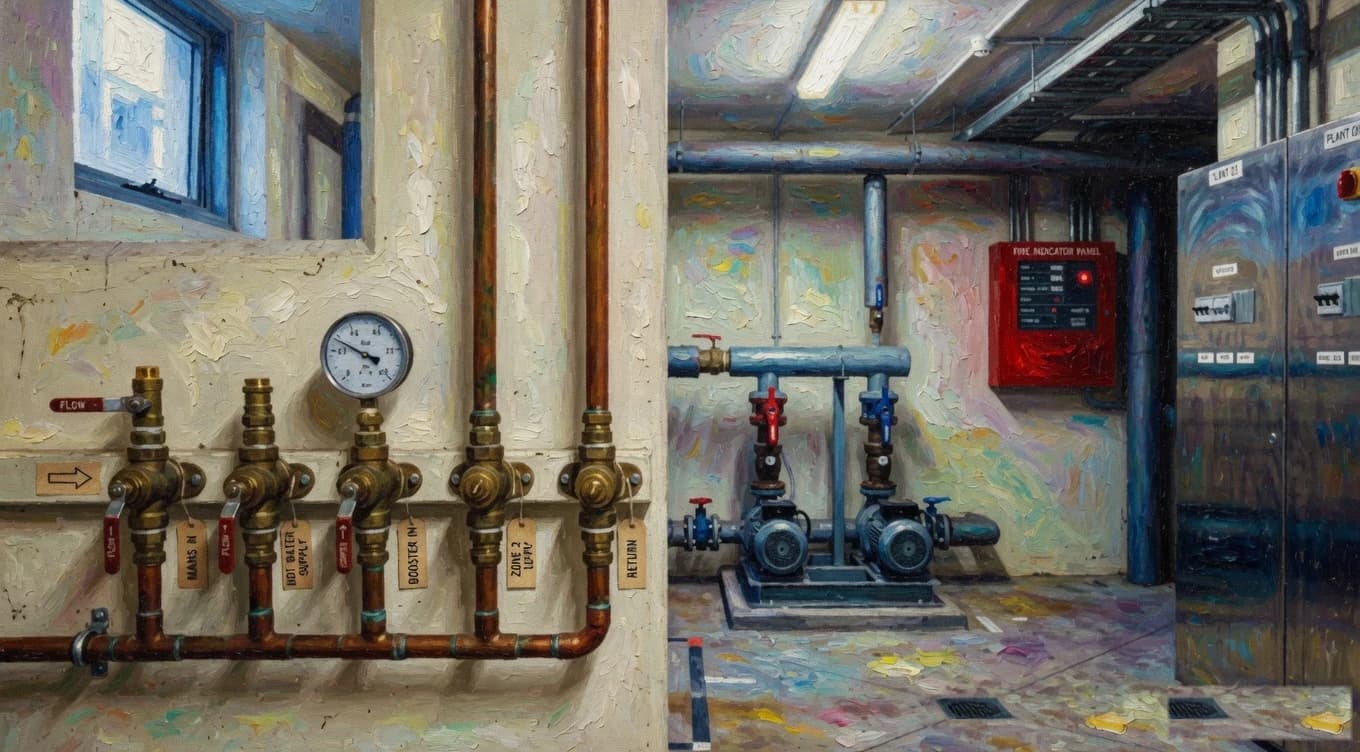
- Booster pumps and sewer-ejector pumps
- Fire systems: AS 1851 and what the bill covers
- Garage doors, boom gates and security gates
- Intercoms, access control and CCTV
- Common-area HVAC and ventilation
- General plumbing: the catch-all line
- What sits in operating vs capital works
- Where buildings usually overpay
- The asset register
- The duty is to maintain, not to wait for the cheapest year
- Administrative fund versus capital works, with real numbers
- How to stop overpaying without starving the building
- How UnitBuddy fits
- Further reading
What this guide covers
- The recurring maintenance line items every mid-rise building pays for, with typical annual cost bands.
- Why a small number of mechanical assets (lifts, booster pumps, fire systems) account for most of the bill.
- The contract structures behind each line (preventative service agreement, callout, capital replacement) and where buildings usually overpay.
- The asset register and renewal schedule that turns this from a guessing game into a forecastable budget.
- Where these costs sit relative to the administrative and capital works funds.
A common moment in a committee meeting: someone asks why levies are going up, the manager points at "maintenance," nobody around the table can name the ten largest line items in the building's operating budget, and the conversation ends with a vote that nobody is confident about.
The fix is not a longer meeting. It is a working catalogue of what the building buys, what those things cost in the open market and which of them are negotiable.
The shape of the operating budget
For a typical 40 to 80 lot residential building in a capital city, recurring maintenance and operating costs usually fall in these bands per year (excluding insurance, utilities for common areas, and strata management fees, which are tracked separately):
- Lift servicing and repairs: $6,000 to $25,000 per lift, depending on age and contract.
- Fire system compliance (AS 1851 routine servicing): $4,000 to $15,000.
- Booster and sewer pumps: $1,500 to $8,000 routine, plus event-based repairs.
- Garage door, boom gate and security gate servicing: $1,500 to $6,000.
- Intercom, access control and CCTV: $2,000 to $7,000.
- Common-area HVAC (foyer, lift motor rooms, basement ventilation): $1,500 to $10,000.
- General plumbing (blockages, leaks, tap repairs, hot water): $3,000 to $20,000.
- Electrical (common-area lighting, switchboard testing, emergency lighting): $2,000 to $8,000.
- Gardening, cleaning and pest: $15,000 to $60,000.
- Building management or caretaker (if engaged): $20,000 to $120,000.
The first eight lines are the mechanical and compliance backbone of the building. Most committees underestimate how concentrated their spend is in this group, and most overspend in one of two places: lift contracts and reactive plumbing.
Lifts: the biggest single line item in most buildings
A passenger lift in a residential building has a service life of roughly 20 to 30 years, with a major modernisation typically falling somewhere between years 18 and 25. Routine servicing runs monthly. The contract is what drives the cost.
There are three common contract structures:
- Basic service. Routine attendance only. Repairs and parts billed separately. Cheap headline rate, higher and more variable total cost. Common for older lifts where the contractor wants to limit exposure.
- Comprehensive. Routine servicing plus most parts and repairs included. Higher fixed price, lower variability. The committee writes one cheque a month and the contractor absorbs most events.
- Hybrid. Routine servicing plus capped repair allowance. Sits between the two. Often the best value if the lift is mid-life and well documented.
The largest cost moments in a lift's life are not routine: they are the motor controller replacement (often $30,000 to $80,000), the door operator failure ($8,000 to $20,000), and the modernisation ($150,000 to $400,000 for a single passenger lift, more for goods lifts or multiple-lift banks). These belong in the capital works fund, not the operating budget.
The largest avoidable cost is the renewing-without-tendering pattern. A committee that has run with the same contractor for ten years, never tested the market, and accepts annual price rises in line with whatever the contractor proposes, is usually paying 20 to 40 per cent more than market. The remedy is a competitive quotation every three to five years against a written scope. The scope matters: lift contracts vary widely in what is and is not included.
Booster pumps and sewer-ejector pumps
Every mid-rise building has at least one booster pump set that lifts mains water pressure to the upper floors. Buildings with basement parking or basement amenities usually have a sewer-ejector pump set that lifts waste from below the council main up to street level.
Both are unglamorous, both are critical, and both tend to fail dramatically when ignored.
Routine servicing of a duplex booster pump set is typically $800 to $2,000 per year. A failed booster pump in a hot Sydney summer leaves the upper floors without water within a few hours, and the after-hours callout to replace it runs $4,000 to $12,000. A sewer-ejector pump failure is worse: untreated wastewater backs up into the basement plant room within hours.
Two cost levers most committees miss:
- Run-hour logging. Pumps that are being run hard (because of a leak somewhere, or because the building has gone from 60 per cent occupied to 95 per cent occupied) wear out faster. A logged run-hour reading taken every quarter surfaces the trend before the failure.
- Spares on the shelf. A spare pump head or impeller stored in the plant room turns a $10,000 after-hours emergency into a $1,500 scheduled replacement. The cost of holding the spare is usually less than one avoided callout.
Fire systems: AS 1851 and what the bill covers
Fire system compliance is governed by AS 1851 (Routine Service of Fire Protection Systems and Equipment) and the relevant state regulation. The servicing schedule covers:
- Monthly inspection of hydrants, hose reels, extinguishers, exit signage and fire doors.
- Six-monthly testing of fire indicator panels, smoke detectors and emergency warning systems.
- Annual full-system test including pump testing and sprinkler discharge sampling.
- Five-yearly tests of pressure vessels and hydrant flow.
The annual cost depends on building size and the systems installed. A 60-lot building with a fire indicator panel, hydrants, hose reels, sprinklers in common areas, and emergency lighting will typically pay $6,000 to $15,000 a year for routine servicing alone.
The defects that fall out of that servicing are billed separately and are where buildings often see surprise costs: a flat battery in an emergency exit light, a faulty smoke detector, a corroded hydrant valve, a sprinkler head that has lost its plug. Individually small, collectively material. Budgeting a reactive allowance of around 20 to 30 per cent on top of the routine contract is realistic for an older building.
The compliance certificate (the Annual Fire Safety Statement in NSW, the Essential Safety Measures Statement in Victoria, the BFSR in Queensland) is the legal output. It is also the document insurers ask for at renewal. A building that cannot produce a current statement is a building that will pay more for insurance and a building whose committee members are personally exposed.
Garage doors, boom gates and security gates
The boring mechanical infrastructure that most residents only notice when it breaks. A typical mid-rise building has one or two roller garage doors at the basement entrance, sometimes a boom gate inside, often a pedestrian gate on the street, and frequently a swing gate to a separate garden or pool area.
Routine servicing of each is modest: $200 to $600 per visit, usually two visits a year. The event-driven costs are larger:
- Garage door springs and motors. A torsion spring failure is $400 to $900. A motor replacement is $1,500 to $4,000. Average life is 8 to 15 years depending on cycles.
- Roller door curtain damage. Almost always caused by a vehicle hitting a partially-closed door. Replacement curtains run $3,000 to $9,000.
- Boom gate arms. Snapped arms from a tailgating vehicle or a wind gust: $200 to $600 each. Buildings with a single boom on a busy basement see two to four arm replacements a year.
- Access control upgrades. Migration from old fobs to mobile credentials, or replacement of a failed reader, is $500 to $4,000 per access point.
The cost lever is the after-hours service agreement. A building that can get a contractor on-site within four hours when the basement door fails at 11 PM (and 80 cars are trapped inside or out) is buying availability as well as labour. The contract should state response time explicitly, and the committee should test it before signing.
Intercoms, access control and CCTV
The category that has shifted most dramatically over the past five years. Most buildings built before 2015 have an analogue intercom system at end of life, and most committees discover this when a handful of handsets fail within a few months of each other.
Costs:
- Analogue intercom maintenance (existing system): $1,500 to $4,000 per year.
- Handset replacement (analogue): $200 to $500 per unit.
- Full replacement with an IP intercom system: $40,000 to $150,000 depending on building size and cabling.
- CCTV servicing: $1,000 to $4,000 per year for routine, plus storage and recorder replacement every 5 to 8 years.
The trap to avoid is the partial upgrade: replacing the door station with an IP-capable unit while keeping the analogue handsets in the apartments. This is usually a cost overrun waiting to happen, because each handset eventually needs an interface module or a complete replacement when the analogue stock runs out.
Common-area HVAC and ventilation
Most residential buildings do not air-condition the lobby. They do have mechanical ventilation in basements, lift motor rooms, garbage rooms, and sometimes corridors. The ventilation is regulated, and the routine servicing is part of the AS 1851 program in most buildings.
Where committees overspend is in lift motor room cooling. A failed motor-room air conditioner causes the lift to shut down on a hot day. Replacing the unit reactively in midsummer is $4,000 to $9,000; replacing it as a planned upgrade in autumn is half that.
General plumbing: the catch-all line
This line item swings the most year to year. A building with no incidents might spend $3,000; a building with two sewer-stack blockages and a hot water plant failure can clear $30,000.
The recurring components are:
- Common-area tap and fitting repairs.
- Roof and balcony drain clearing.
- Stormwater pit clearing.
- Sewer line blockages (covered separately in the wet wipes guide).
- Common hot water plant servicing for buildings with central hot water.
- Tank cleaning for buildings with rainwater or fire-service tanks.
A useful budget control is a planned drain clearing program. Stormwater pits cleared annually before the wet season prevent the basement-flood emergency that costs $20,000 in pump-outs, drying and remediation.
What sits in operating vs capital works
A working distinction many committees blur:
- Operating (administrative fund): routine servicing, callouts, consumables, contracts, day-to-day repairs.
- Capital works (sinking fund): major replacement of long-life assets. Lift modernisations, repaint cycles, roof replacement, pump unit replacement, fire system panel replacement, intercom system replacement.
A 10-year capital works plan should include line items for each of the major assets above with expected replacement years and replacement costs in today's dollars. Without that, the levy debate becomes a referendum on the manager's instincts rather than a forecast.
The sinking fund vs capital works fund explainer covers how the two funds interact across jurisdictions.
Where buildings usually overpay
A pattern across audits:
- Lift contracts that have never been tendered. The single largest avoidable cost in most buildings.
- Reactive plumbing. No planned drain clearing, no flexi-hose program, no shower waterproofing strategy. Each event costs five to ten times what a planned program would cost.
- Insurance excess driven by repeated water claims. A consequence of point 2.
- Bundled "all in" contracts with a building manager. Often hide costs the committee never sees itemised. Worth requesting an itemised quarterly report.
- Schedule B and C charges on the strata manager's invoice. Disbursements and commissions that the committee never approved. The hidden fees post covers this in detail.
The asset register
The single document that turns this from anxious budgeting into routine planning is a building-wide asset register. The entries are mundane: each major asset, install date, last service date, next service date, contractor, contract reference, expected replacement year, expected replacement cost.
A building with a current asset register has a 10-year capital works plan that writes itself. A building without one is guessing.
The duty is to maintain, not to wait for the cheapest year
Every Australian jurisdiction puts a statutory duty on the owners corporation, body corporate or strata company to keep common property in repair. In New South Wales it is section 106 of the Strata Schemes Management Act 2015. In Victoria it is section 46 of the Owners Corporations Act 2006. Queensland’s Body Corporate and Community Management Act 1997 and Western Australia’s Strata Titles Act 1985 do the same work. The duty is not “when the levy feels comfortable.”
That is why a committee that defers a known roof leak, a failed sump pump or a dead garage-door sensor is not being frugal. It is converting a four-figure repair into a five-figure claim, and in NSW it is opening a six-year damages window for affected lot owners under section 106(5), confirmed in Vickery v The Owners – SP 80412 [2020] NSWCA 284. The special levies post is what happens when the deferral lasts long enough.
Improvements are a different vote. A like-for-like pump replacement is maintenance. A new colour scheme, a lighting retrofit that changes the look of the corridors, or a new amenity is an improvement and generally needs a special resolution — section 108 in NSW, section 52 in Victoria. Mixing the two on one invoice is how buildings either over-approve a repair or under-approve a renovation.
Administrative fund versus capital works, with real numbers
The administrative (or administrative fund / OC fees) budget is the year you are in: contracts, insurance, cleaning, utilities, compliance tests, call-outs, consumables. The capital works fund in NSW, or the sinking fund elsewhere, is the decade you are in: roofs, lifts, paint, membranes, switchboards, intercoms, pump sets, garage operators.
In NSW section 79 lists what the capital works fund is for, and section 80 requires a 10-year plan. Other states have their own sinking-fund or maintenance-plan rules. The sinking fund vs capital works and healthy capital works fund guides are the companions to this section.
Indicative annual operating spend, metro mid-rise, per lot, 2025–26, excluding the insurance premium (which now often rivals the rest of the admin fund combined):
- Lifts: $250 to $700, depending on age, stops and whether the contract has ever been tendered.
- Fire and essential services: $200 to $550, driven by AS 1851 scope and defects from the last statement.
- Cleaning and waste: $180 to $450.
- Grounds and common-area presentation: $80 to $250.
- Plumbing and drainage, planned plus reactive: $80 to $300. Reactive-only buildings sit at the top.
- Electrical, lighting, doors and access: $60 to $220.
- Pest, HVAC/ventilation, minor building: $40 to $150.
A 60-lot building therefore often spends $50,000 to $150,000 a year on maintenance before insurance, management and utilities. The buildings at the low end have current contracts, a drain program and few water claims. The buildings at the high end have never tendered the lift, have no pit-clean, and are training the insurer.
Capital, on a 10-year view, is lumpy. A lift modernisation can be $150,000 to $400,000. A repaint $80,000 to $250,000. A roof or membrane $40,000 to $200,000. Those numbers belong in the plan with a year attached. They do not belong in next year’s admin fund as a surprise.
How to stop overpaying without starving the building
Tender the large contracts on a written scope, not a phone call. Lifts, cleaning, fire and the door package should each go out at least every three to five years, with last year’s invoices attached so the new tenderer is bidding against a fact. A contract that has never been tendered is priced for the incumbent’s convenience.
Separate planned from reactive on the quarterly report. If reactive plumbing is more than about a third of the plumbing line, the planned program is too thin. The stormwater, wet wipes and flexi hose posts are the three programs that usually flip that ratio.
Do not pay capital work from the admin fund because the sinking fund “looks low.” Raise the capital levy, or raise a special levy, and say so. Raiding the admin fund is how the insurance premium is then paid late.
Keep an asset register with install year, last service, next service, contractor, contract end date, replacement year and replacement cost in today’s dollars. The 10-year plan is that register with dates. Without it, every AGM is a guess, and guesses become special levies.
Finally, read the manager’s invoice. Schedule B and C charges, insurance commissions and bundled “all in” building-manager lines are where silent dollars sit. The hidden fees post is the checklist. A maintenance budget that is honest about contracts and silent about commissions is only half a budget.
How UnitBuddy fits
UnitBuddy is the building's own software. It holds the asset register, the contractor list, the service history, the compliance certificates and the capital works schedule in one place that the committee and owners can see. Quotes for recurring contracts sit alongside the contract that was eventually signed, so the next tender starts from evidence rather than memory.
For the committee, the practical use is the monthly view: what was serviced, what was billed, what is due in the next 90 days, and what the building is on track to spend against budget. For owners, the use is transparency: the recurring costs are itemised, the contracts are visible, and the levy conversation has a shared starting point. Maintenance is the largest controllable cost line in most buildings, and the one that benefits most from a written record.
Further reading
- Why Strata Insurance Premiums Have Skyrocketed
- Flexi Hoses: The $80,000 Apartment Claim Almost Everyone Could Prevent
- Sinking Fund vs Capital Works Fund
- Hidden Fees in Strata Management Contracts
Keep the scheme file in one place the committee and the manager can both open. Features, pricing, or book a tour.