
Repairs & Maintenance
Flexi Hoses: The $27,500 Apartment Claim Almost Everyone Could Prevent
An $8 piece of plumbing causes around one in five Australian water damage claims. Insurers are increasingly declining claims for hoses that show wear and tear. This is the lot vs common property responsibility, the maintenance program a committee should run, and why the cost ends up on the building's premium regardless of who burst the hose.
· 11 min read
On this pageThe numbersOn this page
- The numbers
- Why flexi hoses fail
- Lot or common property? Most people are confused
- The insurance trap
- What does a good committee maintenance program do?
- Add a pressure-limiting valve at the mains
- Roll out building-wide hose replacement
- Bi-annual visual checks
- Isolation taps
- Vacant lots
- What individual owners need to do
- Why everyone needs to care
- Lot hose, common hose: the legal split that decides the first invoice
- Insurance will pay some bursts, then it will price every hose in the building
- What a committee can require, and what it can only invite
- A five-year program that survives a change of committee
- Who can help?
- How UnitBuddy helps
- Further reading
Here's the thing—just about every apartment in Australia has one of these flexible braided hoses. You'll find them behind toilets, under sinks, connected to washing machines or dishwashers. They're cheap—maybe $8 each—and look pretty harmless. But these little hoses are behind a huge chunk of all the insurance claims that send strata premiums through the roof.
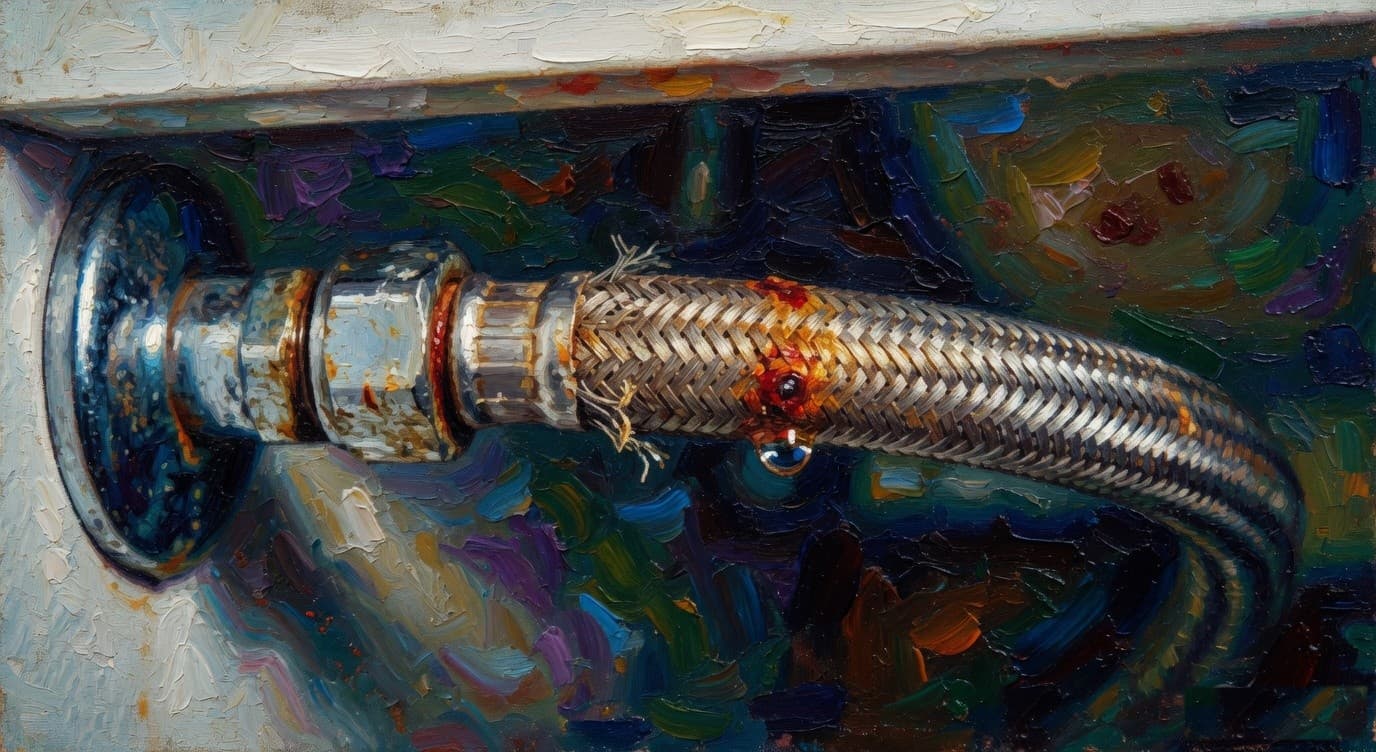
Insurance companies have been sounding the alarm about flexi hoses for years. Why? Because these hoses don't fail loudly—they age quietly. The shiny braid hides rust, wear, and chemical damage. Inside the steel mesh, the rubber lining gets tired from constantly expanding and contracting. Eventually, it bursts—often when no one's home. Water sprays everywhere, soaking floors, walls, power points, and the apartment below.
Spend $8 on a hose, ignore it for a decade, and you could end up with a bill big enough to ruin your month (or year).
The numbers
It is common. Somewhere between 20% and 24% of all Australian household water damage claims come from these hoses splitting.
CHU Underwriting Agencies? They see flexi hose failures in more than 45% of their strata water damage claims.
Strata Community Insurance paid over $50 million in water damage claims in just three years, much of it linked back to these hoses.
QBE's 2021 data put the average water leak claim at $5,000. More recent numbers show that in apartments—where leaks don't respect walls or floors—the typical claim is now over $27,500.
Some examples:
- A bathroom hose split upstairs while the owners were away. Water blasted through three floors. Repair bill: $80,000. Five apartments empty for about a month. Temporary accommodation cost: $350–$500 per unit, each week.
- In Brisbane, an ensuite hose burst and set off an $11,000 excess on the building's policy.
- An investor-owned apartment sat empty while the laundry hose failed. The insurer set aside about $15,000 to handle the damage.
Cheap part, major expense, slow to spot, impossible to contain to just one apartment.
Why flexi hoses fail
Many things can go wrong:
Age — They're built to last 5 to 10 years. There's usually a warranty or date stamped on the collar—check that first. If your hose went in before 2011, it might not even meet Australian standards. If it's getting up in years, replace it no matter how good it looks.
Pressure cycling — Every time you turn the tap on or off, the rubber inside stretches and relaxes. High water pressure brings the end closer, faster. Installing a pressure-limiting valve on your building's main line is one of the smartest things a committee can do. It helps every hose in every apartment last longer.
Heat — Hoses on hot water lines fail faster.
Installation faults — Plenty of failures aren't about age—they come from bad installs. Over-tightened, kinked, twisted, stretched too far, or clobbered by chemicals under the sink. Get the installation right and your hose could last a decade. Get it wrong and it'll fail in two or three years.
Chemicals — Drain cleaners, bleach, oven sprays left under the vanity eat away at metal and rubber.
No maintenance — Most people forget they exist. Rust, bulges, kinks, or fraying usually means the hose is already in failure mode.
Lot or common property? Most people are confused
Flexi hoses are inside your apartment, connecting to your fixtures: taps, toilets, dishwashers, washing machines. That means you own them—they're not communal, they're not the body corporate's problem.
Almost everywhere in Australia:
- Pipes up to your apartment's isolation valve: common property (body corporate looks after those)
- Pipes and hoses AFTER that valve: your job as the owner
The body corporate can't force you to swap out hoses. All they can do is send out info and reminders.
If you skip maintenance and your flexi hose floods your place (or the neighbour's), you could be stuck with the bill. Sometimes, strata insurance covers it. Sometimes it doesn't. Even when it does, it puts a black mark on your building's record.
Body corporates have no way to check hoses in everyone's kitchens and bathrooms. Owners are the only line of defence.
But here's the kicker: insurance companies don't care about boundaries. One split hose? The whole building's premium takes a hit. That's why good committees organize building-wide replacement programs—they can't force you, but they can make it a lot easier to get things sorted.
The insurance trap
Strata insurance covers "sudden and accidental" damage. Those words matter.
If the hose bursts out of the blue, nothing looked wrong, insurance usually pays.
But if your hose has been rusty, fraying, or fifteen years old and you did nothing? That's wear and tear. Most policies don't cover that, and insurers will push back or refuse to pay.
Assessors look at everything: rust, kinks, age markers, past plumbing reports, the building's failure history, the hose's age—everything.
If your building has two or three hose claims in a short time span, insurers may stop covering future hose leaks altogether. They'll say "You knew about the risk and didn't act."
There have been actual cases where insurers denied six-figure claims over this. Owners assumed the policy would pay, insurers pointed to wear exclusions, and it all ended in dispute, with owners sometimes getting nothing, or only part of the damage covered.
What does a good committee maintenance program do?
This is one of the smartest investments a committee will ever make. In just a couple of years, good programs shrink the building's insurance claims history.
Add a pressure-limiting valve at the mains
This reduces strain on every hose, fitting, and joint. It's a few grand well spent. Get your plumber to check—if static pressure is above 500 kPa, you probably need it.
Roll out building-wide hose replacement
The body corporate coordinates, owners opt in, pay their share—like group smoke alarm servicing.
Example: In a 30-lot building, a coordinated job costs $200–$400 per lot, while going solo is $400–$700 each. It's voluntary, but if you explain the savings and how it stops big insurance spikes, most people agree.
Bi-annual visual checks
Every six months, look for:
- Rust, especially at collars or bends
- Fraying metal braid
- Any kinks or twists
- Bulges or swelling
- Discoloured rubber
- Odd noises when water runs
See anything? Don't wait. Replace the hose. Parts cost $8–$20, install $80–$300, which is way less than $27,500 in repairs.
Isolation taps
Everyone should know where their valve is. If a hose fails, shutting it off in seconds can be the difference between a $5,000 nuisance and a $50,000 catastrophe.
Stick a sign in the lobby or laundry with the main building valve location. Neighbours who know where it is can stop things before disaster strikes.
Vacant lots
If you're between tenants or going away, turn off the water at your isolation valve. Remind owners in writing.
The loop: Inspect twice a year. Flag old hoses. Schedule replacements, photograph and date each new hose, log them in your record—this is evidence for the insurer next time you renew.
- Bi-annual visual inspection
- Aged or rusted hose flagged
- Replacement scheduled with plumber
- New hose photographed and dated
- Logged in building maintenance record
- Evidence available for next renewal
What individual owners need to do
- Check all flexi hoses once a year. Read the warranty date—past date? Replace it now. Almost expired? Schedule a swap in the next few months.
- Buy decent hoses—avoid the bottom-shelf bargain for anything under mains pressure on an upper floor.
- Use a licensed plumber.
- Keep harsh chemicals away from hoses. Store them elsewhere.
- Going on holiday? Turn off the isolation tap and run a faucet to depressurize.
- See water stains or damp patches near wet areas? Don't ignore it. Slow leaks can turn into disasters—and insurers spot them as "wear and tear."
Why everyone needs to care
People often think, "The insurance will pay; it's the body corporate's problem." Not quite.
Hoses inside the unit are the owner's responsibility. The body corporate doesn't have to step in.
If there's a claim, it hits the building's insurance. Three flexi hose incidents in five years and every owner's levy goes up—sometimes a lot. That's the reality.
One neglected $8 hose. Suddenly, it's everyone's expensive headache.
Lot hose, common hose: the legal split that decides the first invoice
A braided hose under a kitchen sink, behind a toilet cistern or on a washing machine is almost always inside the lot. The lot owner maintains it. The owners corporation does not become the plumber because the water later ran into common property or the apartment below.
The scheme does own the hoses on common property: a common laundry, a shared BBQ sink, a cleaner’s tap, a basement wash-bay, a gym or pool change-room. Those sit under the duty to keep common property in repair. In New South Wales that is section 106 of the Strata Schemes Management Act 2015. In Victoria it is section 46 of the Owners Corporations Act 2006. Queensland’s Body Corporate and Community Management Act 1997 and Western Australia’s Strata Titles Act 1985 reach the same result.
If a common-property hose bursts and the scheme had never inspected it, affected owners can, in NSW, claim damages under section 106(5). Vickery v The Owners – SP 80412 [2020] NSWCA 284 confirmed that pathway. The limitation period is six years from when the owner first became aware of the loss. A $12 common-laundry hose is not a footnote. It is a documented maintenance item.
The isolation valve on the lot side of the meter or riser is the usual practical boundary. Upstream of that valve is the scheme’s pipe. Downstream, including the flexi, is the lot’s. Confirm it on the registered plan before anyone is told they must pay. Do not guess from the vanity cupboard.
Insurance will pay some bursts, then it will price every hose in the building
Strata building policies cover sudden and accidental water damage to the building. They commonly exclude wear, tear, rust and gradual deterioration. A hose that has been stained, bulging or past its stamped date for years is the exhibit an assessor uses to argue exclusion. A hose that fails without warning, with a recent photo showing a clean braid, is a claim.
Three lot-hose claims in five years still land on the building’s premium, even when each owner was “responsible.” That is how an $8 part becomes a levy problem. The insurance market overview and why premiums keep rising posts set out the pricing. At renewal, the committee needs a written replacement program rather than a promise to “remind people.”
Contents insurance pays the lot’s furniture, carpets and temporary accommodation when the policy responds. It does not pay the building fabric. Owners who have no contents cover discover this on the night the upstairs laundry hose opens.
What a committee can require, and what it can only invite
The scheme cannot walk into every bathroom and swap hoses without access rights and, usually, a by-law or a written program owners opt into. It can:
- Write to every owner and occupier with the failure numbers, the date-stamp rule, and a list of licensed plumbers.
- Offer a bulk replacement: one plumber, one day per floor, owners invoiced per lot. Take-up of 60 to 80 per cent is common when the letter includes last year’s claim figure.
- Replace every common-property hose on a five-year cycle and keep the photos.
- Install or service a building pressure-limiting valve. That is common-property work under the maintenance duty, funded from the administrative fund.
- At insurance renewal, hand the broker the program and the falling incident count.
A by-law that requires owners to replace flexi hoses at a stated age, and to give access for inspection, is enforceable through the ordinary notice path: section 146 in NSW, section 155 in Victoria, section 182 in Queensland. Do not invent a “hose fine.” Use the by-law and, if needed, the tribunal. Victorian committees sometimes ask whether they can compel an inspection after a major leak. The answer depends on the rules and on access provisions in the Owners Corporations Act 2006. Get advice before forcing entry.
Short-stay lots and vacant investor lots are the weak points. Put the hose rule in the listing pack and in the agent’s onboarding. A hose that fails in an empty apartment runs until the downstairs ceiling collapses.
A five-year program that survives a change of committee
Year 0. Photograph every common-property hose. Replace anything undated, rusted or older than five years. Write to lots with the same rule and a bulk-booking date.
Every year. Visual check of common hoses. Letter to lots that have not confirmed replacement. Holiday shut-off reminder before Christmas and Easter.
Every five years. Building-wide common-hose swap, even if they “look fine.” Offer the same plumber to lots at the bulk rate.
Every insurance renewal. One page: incidents this year, program steps, pressure-valve service date, photos on file.
Keep the invoices and photos in the building’s own records. When the next assessor asks what was done about flexi hoses, the answer is a dated folder.
Who can help?
When a strata building needs reliable plumbing — whether it is a lot-owner flexi hose, a common-property leak or an urgent blocked drain — getting an honest, licensed plumber on site fast matters as much as sorting out who pays. Plumberoo Plumbing works across residential, commercial and strata properties in Sydney, with 24-hour availability, leak detection, pipe relining, fixed-price quotes and detailed reports your committee can file, forward to insurers or attach to maintenance records. Licensed under NSW Fair Trading, fully insured. (02) 9191 8787 · plumberooplumbing.com.au
How UnitBuddy helps
UnitBuddy holds the building's maintenance calendar and contractor records. For a committee running a flexi hose replacement program, the platform supports tracking which lots have opted in, which have notified independent replacement, and which still need follow-up. The compliance and risk module surfaces the building's claims history alongside the maintenance program, so a committee can demonstrate the link between the two when negotiating the next insurance renewal.
The pressure-limiting valve installation, the coordinated procurement records, and the bi-annual inspection schedule all sit in the same place. The next time an insurance broker asks what the body corporate is doing to manage water damage risk, the answer is a documented program rather than a verbal assurance.
Further reading: Water leaks from above covers what to do when the leak comes from a neighbouring lot. Why strata insurance premiums have skyrocketed covers the broader premium picture and the levers a committee has. Contents vs. strata insurance covers what each policy pays for when a hose fails. What strata insurance covers covers the wear-and-tear exclusion and how it operates in practice.
Further reading
- VIC: Can an owners corporation require lot owners to have their flexi hoses inspected?, via LookUpStrata
- NSW: Burst flexi-hoses in apartments: who is responsible and what insurance covers it?, via LookUpStrata
Last updated: 12 May 2026. UnitBuddy publishes general information for Australian strata owners and committees. It is not legal, plumbing or insurance advice.
Keep the scheme file in one place the committee and the manager can both open. Features, pricing, or book a tour.