
Repairs & Maintenance
Wet Wipes Are Costing Your Building Thousands a Year (And the Insurance Bill Is the Smaller Half)
A flushed wet wipe is the most expensive habit in modern apartment plumbing. Sewer-ejector pumps, macerators and stack lines all fail because of them. Here is what a single blockage actually costs, why "flushable" claims are misleading, and the building-wide response that works.
· 9 min read
On this pageWhat this guide coversOn this page
- What this guide covers
- Where wipes cause apartment-specific failures
- The cost of a single blockage event
- "Flushable" wipes: what the label means
- Why this is a building problem, not a personal problem
- The response that works
- Copy-ready notice for the building's noticeboard
- Copy-ready notice for short-term rental properties
- Where this sits relative to other plumbing programs
- Lot, stack and pump: who pays
- “Flushable” is a marketing word, not a defence
- Insurance will pay some of this, and then it will price all of it
- A building-wide response that goes beyond a poster
- Who can help?
- How UnitBuddy fits
- Further reading
What this guide covers
- Why wet wipes cause apartment-specific plumbing failures that single-dwelling homes rarely see.
- The three building components that fail because of wipes: sewer-ejector pumps, macerators, and high-rise stack lines.
- What a single blockage costs, including the parts of the bill most committees never see.
- Why "flushable" on the packet is meaningful only in a narrow technical sense that does not apply to apartment plumbing.
- The signage, communications and contract changes that materially reduce the rate of failure.
Water utilities across Australia removed an estimated 75,000 tonnes of wet wipes from sewer systems in the past year. Sydney Water alone reports clearing around 1,000 tonnes of wipes from its network annually, at a cost in the tens of millions of dollars passed through to bills. The shared cost is one part of the picture. The apartment-specific cost is the other, and it lands on individual buildings.
A flushed wet wipe in a single-family home rarely causes a problem in that home; it travels downstream and becomes the council's problem. In a mid-rise apartment building, the same wipe is much more likely to cause an immediate, building-wide failure, because the building has plumbing infrastructure that single-family homes do not.
Where wipes cause apartment-specific failures
Three components fail because of wipes.
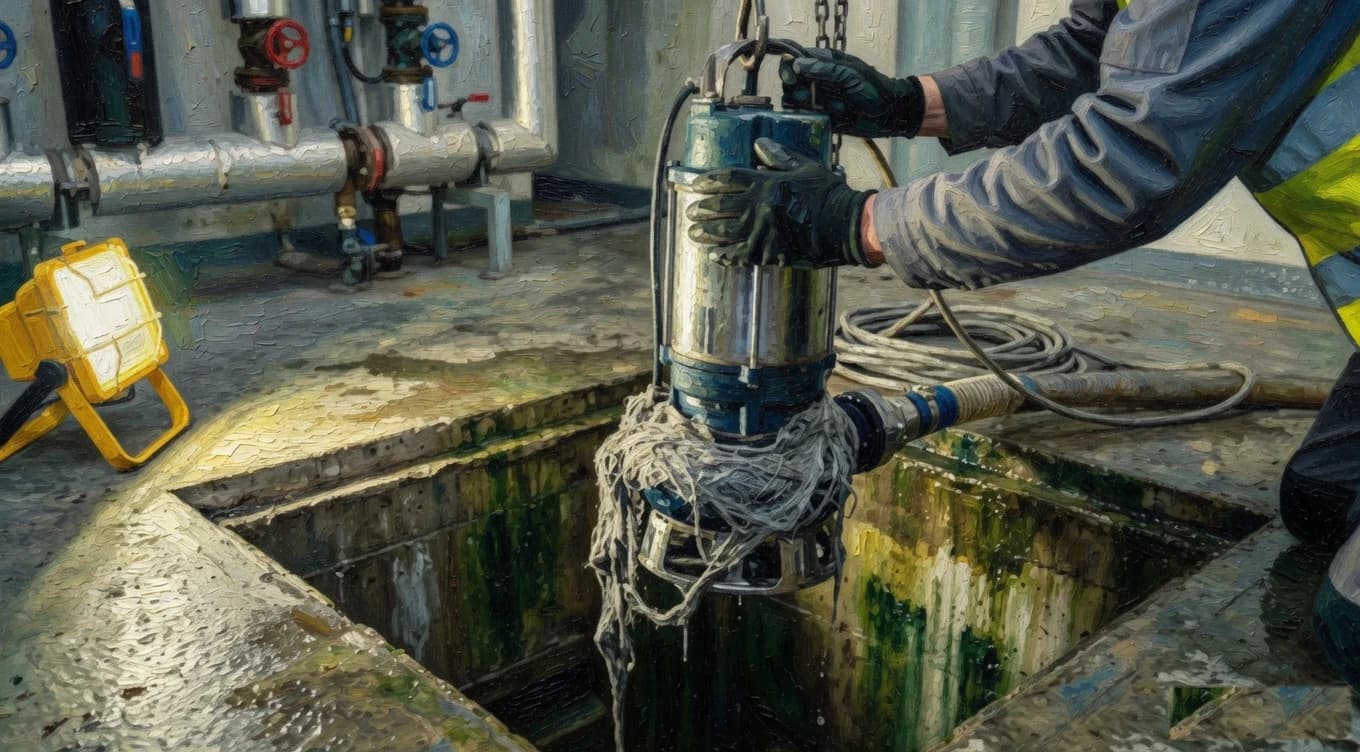
Sewer-ejector pumps. A building with basement parking or basement amenities cannot drain wastewater by gravity. It collects waste in a pit below the level of the council main and pumps it up. The pumps that do this work have a macerating impeller designed to chop solids before they pass into the discharge line. They are designed for human waste and toilet paper. They are not designed for fibre-bound non-woven cloth, which is what a wet wipe is.
A flushed wipe binds around the impeller, forms a mat with other wipes, and eventually stalls the pump. Stalled pumps trip on overcurrent. With the duty pump tripped, the duplex switches to the standby. When the standby trips on the same blockage, the alarm sounds, and untreated wastewater begins backing up in the basement plant room within hours.
Cost of a single ejector pump call-out and clear: $1,200 to $4,000. Cost of an impeller replacement after a stall: $2,500 to $6,000. Cost of a pump unit replacement after a seized motor: $8,000 to $20,000. Cost of basement remediation if the alarm is missed: $30,000 and up.
In-apartment macerators. Many apartments retrofitted in older buildings, and some new builds with bathrooms below the sewer line, use macerator pumps behind the toilet (commonly Saniflo or Sanivite units). These have a smaller motor and a finer blade than building-scale ejector pumps, and they fail catastrophically with a single wipe.
A failed macerator means the toilet does not flush at all. The replacement cost is $1,500 to $3,500 plus plumber labour, and the resident is usually without a working toilet for two to seven days while the unit is replaced. Some manufacturer warranties exclude failures caused by inappropriate items, and the wipe is exhibit A.
High-rise stack lines. Mid- and high-rise buildings have vertical sewer stacks that collect waste from multiple floors. The stack joins the building's main horizontal discharge at the lowest level. Bends in the stack, junctions with branch lines, and the boot at the base are points where wipes accumulate.
A partial stack blockage shows up as a slow flush, gurgling drains, or a smell that nobody can locate. A full stack blockage shows up as wastewater backing up into the lowest-floor units, which is a five-figure incident before any insurance involvement.
The clearing cost depends on the access point and the severity. A jet-clean of the stack from the roof is $1,500 to $4,000. A camera inspection to confirm the cause is another $500 to $1,500. A boot-trap or junction repair where the buildup has caused physical damage runs $5,000 to $20,000.
The cost of a single blockage event
A representative breakdown of an ejector-pump failure in a 50-lot building:
- After-hours plumber call-out (Sunday 2 AM): $850
- Pump pit access, pump removal, manual clear of impeller: $1,200
- Replacement impeller and seal kit: $900
- Reinstallation, testing and recommissioning: $700
- Camera inspection of discharge line to confirm no downstream blockage: $600
- Disposal of waste and contaminated material: $300
- Building manager attendance overtime: $250
- Disinfection of pump room floor: $350
Single event total: around $5,150.
That is the visible bill. The invisible costs include the building's insurance excess if a claim is made (typically $2,500 to $7,500), the premium impact at the next renewal (a building with two pump-room incidents in a year sees a measurably worse renewal), and the committee time spent dealing with the incident.
A building with two events a year is therefore paying $10,000 to $15,000 a year in event-driven plumbing costs alone, with the longer-term insurance consequences on top.
"Flushable" wipes: what the label means
This is the area where consumer messaging has done the most damage.
In Australia, the "flushable" claim is governed by the ACCC's interpretation of consumer law. Following a 2019 Federal Court decision against Pental and a 2020 finding against Kimberly-Clark, manufacturers cannot claim a wipe is "flushable" unless it meets specific dispersibility standards under the IWSFG (International Water Services Flushability Group) guidelines or equivalent.
The technical standard is narrow. A wipe that breaks down in a slosh-box test over a defined number of cycles can be labelled flushable. The reality of apartment plumbing is more demanding:
- Apartment ejector pumps run intermittently. A wipe sits in the pit for minutes or hours before being pumped. The slosh-box test runs continuously.
- The impeller chops then immediately discharges. There is no time for the dispersion that the test relies on.
- Mid- and high-rise stack lines have bends, junctions and reductions where wipes catch regardless of their dispersibility rating.
- Multiple wipes from multiple flushes bind together. The test measures a single wipe.
The practical position is that no wipe of any kind should be flushed in an apartment building. The label distinction does not survive contact with building plumbing. Australian water utilities are unanimous on this; the building's plumber is unanimous on this; the insurance industry is unanimous on this. The advice to residents needs to be unanimous too.
The list of items that cause the same problem and should be on the same notice: baby wipes (flushable or otherwise), makeup remover wipes, antibacterial surface wipes, hygiene wipes, dental floss, cotton buds, cotton wool pads, tampons, pads, condoms, kitty litter, hair, paper towels, tissues, food scraps.
Toilet paper is the only paper product designed to break down fast enough to clear apartment plumbing reliably.
Why this is a building problem, not a personal problem
A common reaction from owners is that wipe blockages are caused by individual residents, and the building's response should be to identify and bill the responsible lot. This rarely works.
By the time a blockage is cleared, the wipes have travelled, broken apart, and mixed with material from multiple lots. Tracing a blockage to a single lot is technically possible (camera inspection of branch lines, sometimes DNA analysis of biological material) but expensive and slow. Most disputes about responsibility end without a clear finding.
The economically rational response is to treat wipe blockages as a building-wide problem with a building-wide solution. The cost of the blockages is borne by the building either way; the question is whether the building takes steps to reduce the frequency.
The response that works
A four-part program that materially reduces wipe-related failures within a year.
1. Pump-room signage and alarms. Every pump pit should have a high-water alarm wired to a building manager phone or after-hours number. The cost of installation is $500 to $1,500 per pump set; the cost of one missed alarm is in the tens of thousands. The signage in the pump room should record contractor contacts, isolation valve locations, and the date of the last service.
2. Resident-facing communications campaign. Once a year, run a focused communication about what should and should not be flushed. The format that works:
- A short letter or noticeboard post explaining the building has had n incidents in the past 12 months, what each cost, and what the cumulative impact has been on levies or insurance.
- A list of items to put in the bin, not the toilet. Including everything in the "wipes and the like" list above.
- Where the building's bins are and how the bin schedule works.
- A reminder that residents can be liable for damage caused by inappropriate items flushed from their lot.
The framing matters: a hectoring tone produces nothing; a numbers-first explanation of cost and consequence produces a behaviour change in many residents.
3. Bathroom-mounted signage in common-area toilets. If the building has common-area toilets (pool change room, gym, function room), a small sign above each toilet listing what may and may not be flushed is cheap and effective. The same template can be offered to lot owners for installation in their own bathrooms, particularly for short-term rental properties where the resident turnover is high.
4. Annual stack jet-clean. Most plumbing contractors will offer a discounted annual stack jet-clean as part of a planned maintenance contract. Cost is typically $1,500 to $4,000 for a mid-rise building. The benefit is that any buildup at known accumulation points is cleared before it becomes a blockage. A building running this program has materially fewer emergency call-outs than one that runs reactively.
Copy-ready notice for the building's noticeboard
The following text is sized for a single A4 sheet and can be posted in the lift lobby, on each floor's noticeboard, and in the bin room. Replace the bracketed details with the building's specifics.
Copy-ready notice for short-term rental properties
For owners of short-term rental units, a bathroom-mounted notice in the property reduces the risk substantially. A working version:
Where this sits relative to other plumbing programs
The wet wipes program is one of three plumbing-cost programs that materially reduce the building's claims history and operating cost:
- Flexi hose replacement, covered in the flexi hoses post.
- Waterproofing inspection on bathrooms and balconies, covered in the waterproofing post.
- The wipes and stack-blockage program described here.
Each is unglamorous; each has a measurable return inside two to three years; each is rarely run consistently in buildings without active committees.
Lot, stack and pump: who pays
The toilet, the cistern and an in-apartment macerator sit inside the lot. The vertical stack, the junctions, the boot at the base, the basement ejector pit and the pumps that lift waste to the council main are common property in a typical building-format plan. That split decides the first invoice.
A wipe that stalls a Saniflo in one bathroom is that owner’s plumber and, often, that owner’s insurer. A wipe that mats on a common ejector impeller, or that lodges at the stack boot and backs waste into the lowest lots, is a common-property failure. The owners corporation must keep that infrastructure working. In New South Wales the duty is section 106 of the Strata Schemes Management Act 2015. In Victoria it is section 46 of the Owners Corporations Act 2006. Queensland’s Body Corporate and Community Management Act 1997 and Western Australia’s Strata Titles Act 1985 reach the same result.
The scheme still pays the emergency plumber first. Recovery from a lot is a second step, and only if the by-laws (or the general law of negligence) support it and the evidence identifies the source. A camera still of a wipe mat at the boot is not, by itself, proof it came from lot 12. A camera still plus a hopper of branded “flushable” wipes in that lot’s bathroom, plus a tenant who confirms the habit, is a case.
If the stack failed because it had not been jetted for a decade, the owners corporation is in a poor position to recover. Section 106 is a duty to maintain. A building that never services the pumps cannot treat every stall as a resident’s fault. Run the annual jet-clean, keep the invoice, then talk about recovery.
Lot owners whose ceilings or carpets are damaged by a common-property backup can, in NSW, claim damages under section 106(5). Vickery v The Owners – SP 80412 [2020] NSWCA 284 confirmed that pathway. The limitation period is six years from when the owner first became aware of the loss. That is why the incident file matters to more people than the committee.
“Flushable” is a marketing word, not a defence
Water Services Association of Australia (WSAA) and the major utilities have been clear for years: a product that survives a lab flush test is not the same as a product that disintegrates in a long, shallow, low-flow apartment stack. Sydney Water, Melbourne Water and urban utilities elsewhere still pull tens of thousands of tonnes of wipes out of networks every year. The packet word does not bind the owners corporation, the plumber or the insurer.
A by-law that says “do not flush wet wipes, including products labelled flushable” is enforceable as a scheme rule. It does not become unfair because a supermarket shelf disagrees. Australian Consumer Law can be used against a manufacturer for a misleading “flushable” claim. That is a regulator or class-action problem, not a reason for the building to accept the next impeller rebuild as an operating cost of modern life.
Put the rule in the by-laws if the current set is silent. A house rule on a noticeboard helps behaviour. A registered by-law is what a section 146 notice in NSW, a section 155 notice in Victoria, or a section 182 notice in Queensland can point to. Short-stay lots need the same rule in the listing and on the cistern. Turnover is the risk.
Insurance will pay some of this, and then it will price all of it
A sudden backup that damages a lot can be a valid building claim. A third stall in twelve months of the same ejector, with no jet-clean on file, is how the broker starts talking about a water-damage excess, a higher premium, or a condition that the scheme implement a plumbing program. The insurance market overview gives the wider picture. Wipes are one of the few claim causes a committee can reduce.
Keep, for every event: the plumber’s report (cause, rather than only “cleared blockage”), photos of what came out of the pump or stack, the invoice split between labour and parts, which lots were affected and what notice went to residents afterwards. At renewal the broker can use a falling incident count. Without the file, every event looks like the last one.
Pump replacement and a stack reline are capital works. In NSW they belong in the capital works fund under section 79 and in the 10-year plan under section 80. After-hours clears and the annual jet-clean are administrative-fund costs. Mixing them is how buildings “cannot afford” a $2,500 clean and then special-levy a $20,000 pump.
A building-wide response that goes beyond a poster
- Confirm on the registered plan which pipes and pumps are common. Do not guess from the basement door.
- Put a specific wipes by-law on the next general-meeting agenda if one does not exist.
- Issue the noticeboard and short-stay bathroom notices in this article, with last year’s dollar figure filled in.
- Contract an annual stack jet-clean and a six-monthly ejector service, with a written report each visit.
- Log every blockage. After two events from the same lot, start the notice-to-comply path rather than another polite email.
- At insurance renewal, hand the broker the log and the program. Ask what it does to the excess.
The habit will not disappear. The cost can be made boring. Boring plumbing is the aim.
Who can help?
When a strata building needs reliable plumbing — whether it is a lot-owner flexi hose, a common-property leak or an urgent blocked drain — getting an honest, licensed plumber on site fast matters as much as sorting out who pays. Plumberoo Plumbing works across residential, commercial and strata properties in Sydney, with 24-hour availability, leak detection, pipe relining, fixed-price quotes and detailed reports your committee can file, forward to insurers or attach to maintenance records. Licensed under NSW Fair Trading, fully insured. (02) 9191 8787 · plumberooplumbing.com.au
How UnitBuddy fits
UnitBuddy is the building's own software. For the wipes program, the practical use is the incident log. Each blockage, each clear, each invoice and each communication to residents sits in one place. A committee that can show a downward trend in incidents after the program started has the evidence to renew the program, to raise the issue at the AGM, and to negotiate insurance renewal on the basis of demonstrated risk reduction.
The notice templates above can sit alongside the building's other resident communications, ready to update with the current year's numbers and reissue. The contractor records, the after-hours response history and the stack jet-clean schedule sit in the same place, so the program persists across changes of committee or manager.
Further reading
- Flexi Hoses: The $80,000 Apartment Claim Almost Everyone Could Prevent
- Waterproofing Bathrooms and Showers in Australian Strata
- Water Leak in Strata: Who Pays?
- What an apartment building costs to run
Keep the scheme file in one place the committee and the manager can both open. Features, pricing, or book a tour.