
Repairs & Maintenance
Why Balcony Glass Doors Explode, and Who Pays When Yours Does
Toughened glass can shatter with nobody touching it, sometimes years after it was installed. This guide explains nickel sulphide and the other causes, why the heat-soak rule usually skips balcony doors, and how NSW strata law, insurance and builder warranties split the bill.
· 12 min read
On this pageWhy toughened glass breaks by itselfOn this page
- Why toughened glass breaks by itself
- Nickel sulphide stones
- The other causes
- How rare is it, really?
- What to do in the first 24 hours
- Is the door yours or the owners corporation's?
- Who pays: builder, insurer or the scheme
- If the building is young, start with the builder
- Otherwise, the building policy
- When the owner pays
- The replacement has to be safety glass
- What a committee should do after the first one
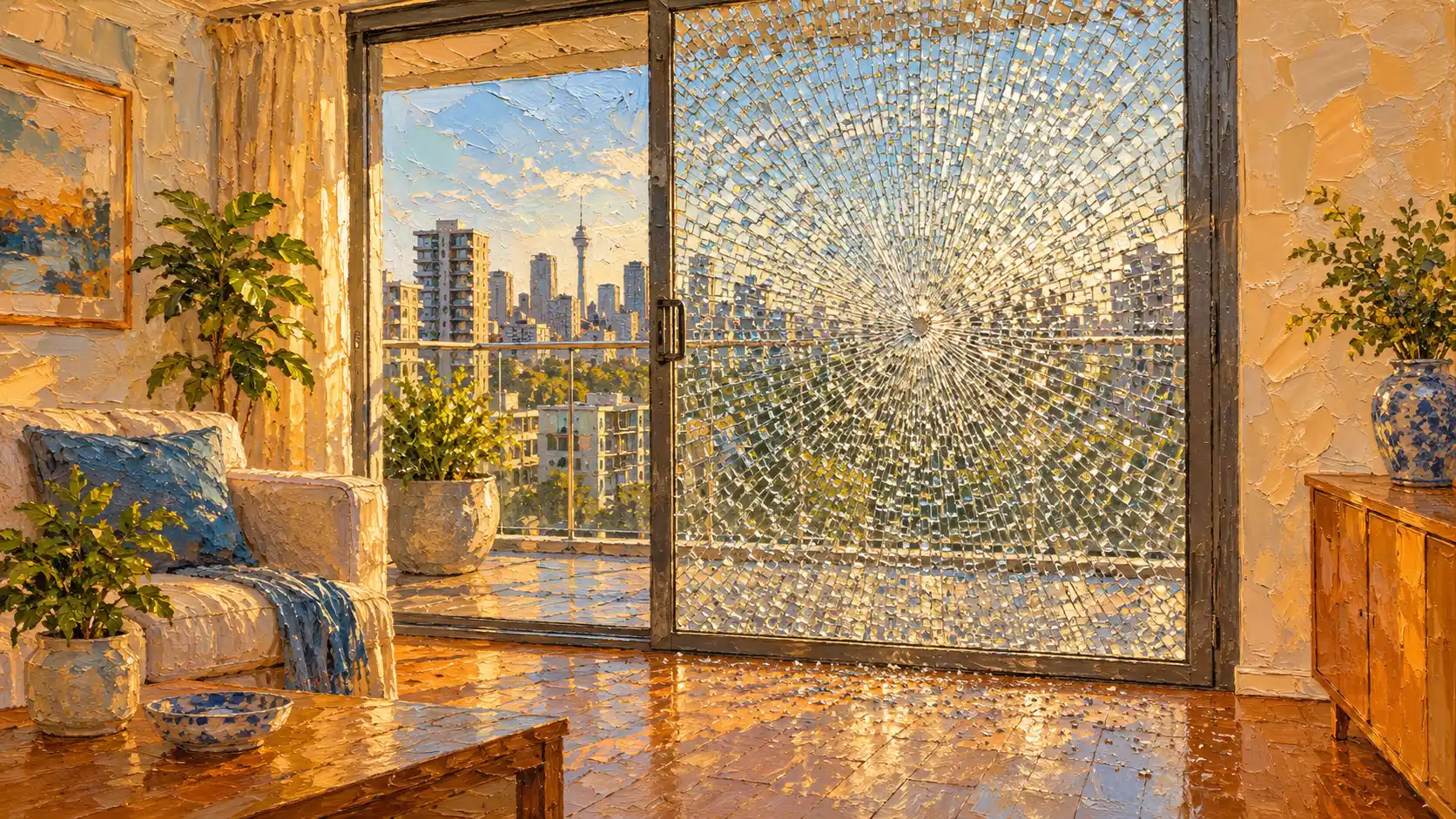
It usually happens when nobody is near it. A bang like a gunshot at 3am, or while you're at work. You come home to a balcony door that has turned into a frosted sheet of tiny cubes, or one already lying in a heap on the tiles. Nobody threw anything. There was no storm.
That is toughened glass doing what it was designed to do when it fails. The failure itself often comes from a flaw that was locked inside the pane on the day it was made.
Most owners assume a break like this is rare enough to be a fluke. Per pane, it is rare. But a 150-lot tower has thousands of panes of toughened glass, and over the life of a building one or two going off by themselves is not surprising at all. When it happens, the questions are practical. Is it safe? Is the door yours or the owners corporation's? Does insurance pay, or the builder? And does the replacement have to be different glass?
Why toughened glass breaks by itself
Toughened (tempered) glass starts as ordinary float glass. The factory heats it past 600°C and then blasts the surfaces with cold air. The outside sets first and ends up in compression, while the core stays in tension. That balance is what makes it several times stronger than ordinary glass, and it is why it breaks into small blunt cubes rather than knives.
It is also why it can fail all at once. Anything that upsets the tension in the core releases the whole pane.
Nickel sulphide stones
This is the cause behind most "nobody touched it" breaks. Float glass makers add sodium sulphate to clear bubbles out of the molten glass. If nickel gets into the batch from raw materials, handling or the furnace itself, the two combine into nickel sulphide (NiS) stones, often only 0.1 to 0.3 mm across. You cannot see them.
In ordinary glass they do no harm. Toughening is the problem. The heat shrinks the stone into a smaller crystal form, and the rapid quench traps it there. Over months or years it slowly grows back to its normal size. If the stone sits in the tensioned core, that growth is enough to break the pane. Wintech's technical note describes failures arriving without warning, often years after installation.
The other causes
Not every spontaneous break is a stone. The Civic Shower Screens exploding glass overview and most glaziers list the same suspects.
- Binding in the frame. Glass needs setting blocks underneath and a gap around the edges. Fit it tight and it gets squeezed every time it heats up, flexes in the wind or the building moves.
- Edge damage. Toughened glass is strong in the middle and weak at the edges. A chip from installation, or a door slammed into its stop for years, can grow until the pane lets go.
- Heat stress. When the sunny centre of a pane runs much hotter than its shaded edge, the edge goes into tension. Tints, coatings, double glazing and dark film or blinds hard against the glass all make it worse.
- Glass too thin for the wind load. This matters more on high floors and exposed corners.
Window film deserves a mention, because owners often add it to sliding doors for heat. Dark film raises the glass temperature. Film makers' breakage warranties usually apply only to approved film and glass combinations, and some are capped. One Madico residential warranty limits glass replacement to US$500 per window. If the door is common property, film is also a change the owners corporation should approve first.
How rare is it, really?
Nobody publishes a reliable "one in X doors" figure, and you should be wary of anyone who quotes one. The numbers that do exist count stones per tonne of glass, and they don't agree.
| Estimate | Source |
|---|---|
| One NiS stone per 8 to 13 tonnes of raw glass, varying by manufacturer and coming in batches | Civic Shower Screens |
| One critical stone per 4 tonnes of toughened glass, a figure Wintech says it has never seen evidence for | Wintech |
| Fewer than one critical failure per 400 tonnes, on average, after heat soaking to EN 14179 | Wintech |
Civic processes about 20 tonnes of glass a week and says it sees fewer than one NiS breakage a month. The useful point for an owners corporation is the batching. Stones cluster. If one pane from a delivery breaks, its siblings from the same batch carry a higher risk than the building average.
What to do in the first 24 hours
- Keep people away. Shattered toughened glass can hold together in a crazed sheet for hours, then fall. Keep kids and pets off the balcony and nobody walks on it barefoot. On a high floor, check that nothing is about to drop onto a balcony or footpath below.
- Photograph everything before anyone sweeps. Take wide shots, close-ups of the frame, and the pattern in whatever glass is still in place. Note the time, the weather and whether the sun was on the door.
- Keep the fragments from where it started. An NiS break usually radiates from one point, with two small pieces shaped like butterfly wings at the centre. Bag that piece if you can find it. A butterfly pattern alone isn't proof, because other causes can make one. A lab can confirm NiS from the origin fragment with an electron microscope (Wintech). Without the fragment, nobody can prove anything.
- Report it to the strata manager or committee in writing, with the photos, and ask them to arrange a make-safe. Don't book your own glazier for a common property door unless the owners corporation agrees, or you may end up paying.
- Ask the glazier to record where the break started. A break that starts at the edge points to impact, edge damage or binding, which are installation problems. A break from the middle of the pane with a butterfly points to a manufacturing flaw.
- Make safe and photograph the break
- Check the strata plan: lot or common property?
- Builder warranty, insurance claim or scheme cost?
- Replace with safety glass, ideally heat soaked or laminated
Is the door yours or the owners corporation's?
In NSW, start with the strata plan. For plans registered after 1 July 1974, the lot boundary is usually the inner face of the walls, floors and ceilings. Glass in an external wall, including the door between your living room and the balcony, sits outside that boundary and is common property. Older plans can use a centre-line rule, and some plans carry notations that move the line. A quick title search for the plan settles it.
The NSW common property memorandum points the same way. It is set out in clause 27 of the Strata Schemes Management Regulation 2016 and a scheme can adopt it as a by-law under s 107. It lists balcony "doors, windows and walls" as the owners corporation's responsibility, unless the plan was registered before 1 July 1974. It only binds your scheme if your by-laws adopt it, but it is a fair guide to how NSW reads these boundaries.
If the door is common property, s 106 of the Strata Schemes Management Act 2015 makes repairing it the owners corporation's job. A committee can't shift that onto you with an ordinary resolution or an email. Only a common property rights by-law under s 108 can do that. The exception to look for is a renovation by-law. If you or a previous owner replaced the sliding door under a by-law that made the lot owner responsible for maintaining it, that by-law probably governs.
Other states draw the line differently. In Victoria, for example, a strata consultant answering a LookUpStrata reader put a cracked balcony slider on the lot owner. Don't assume an answer from another state applies to your building.
Our guide to common property versus lot property covers how to read the plan.
Who pays: builder, insurer or the scheme
If the building is young, start with the builder
A spontaneous break in a building's first couple of years is a defect question before it is an insurance question. The statutory warranties in the Home Building Act 1989 give the owners corporation 2 years for defects and 6 years for major defects. A shattered door is unlikely to count as a major defect, so plan on the 2-year window. The clock doesn't stop while people argue.
For buildings of four or more storeys, the strata building bond scheme in Part 11 of the Act holds 2% of the contract price for defects found in the interim and final inspections. A balcony door that explodes in year one belongs in that defect report, along with any sister panes from the same batch.
Ask the builder for the glass compliance documents now. Toughened glass should carry an AS/NZS 2208 mark, and any heat-soaked glass should come with a certificate. In 2017 several Melbourne towers had balcony glass explode, and the company investigating suspected imported glass with heat-soak certificates that had been falsified, dated to when the paperwork was requested rather than when the glass was made (Canberra Times, 2 July 2017). At one Malvern building the builder couldn't produce any compliance documents at all.
Glass processors' own warranties are short and often exclude NiS. Civic's covers NiS breaks for 12 months.
Otherwise, the building policy
Section 160 requires the owners corporation to insure the building, and glass breakage is a standard listed event in strata policies. A sudden break with no wear and tear is usually what the policy is built for. The arguments are about the excess, and whether the insurer calls it a defect. Read your scheme's policy wording for the glass excess before lodging, because for a single door the excess can be close to the cost of the job.
If your by-laws let the owners corporation recover the excess from the owner whose lot benefits, expect the strata manager to raise it. Our guide to what strata insurance covers explains how those claims usually run.
When the owner pays
The cost lands on you if the door is lot property under your plan or a by-law, if you or your tenant broke it, or if a film or modification you added caused the break. Your contents or landlord policy may respond in those cases. The evidence from the first 24 hours matters here too. An edge break next to a door stop looks very different from a butterfly in the middle of the pane.
The replacement has to be safety glass
A door is a human impact zone under AS 1288, the standard for glass in buildings. Replacing the glass in a door means the new pane must meet the current standard. Adjusting rollers or replacing a handle doesn't trigger an upgrade, but new glass does (ASQB on LookUpStrata). In an older building with ordinary float glass in the doors, that is a forced upgrade to toughened or laminated glass.
Here is the part most owners don't know. The rule that pushes builders to heat soak toughened glass is narrower than people assume. Since BCA 2010, and now in AS 1288, vertical glazing more than 5 m above floor or ground level must be heat soaked or "suitably protected" against NiS breakage. The Australian Glass and Window Association says a balcony that projects from the building counts as that protection.
A balcony door is, by definition, a door onto a balcony. Its glass stands on the balcony floor, nowhere near 5 m above it, and the balcony would count as protection anyway. So the heat-soak rule usually doesn't reach balcony doors at all, even on the 30th floor. Plain toughened glass is compliant.
That doesn't make plain toughened glass the right choice. When you replace a pane, ask the glazier to quote two upgrades:
- Heat-soaked toughened glass. The pane is reheated to around 290°C and held there, so most panes with a dangerous stone break in the factory instead of in your living room. It reduces the risk a lot but doesn't eliminate it.
- Laminated or toughened laminated glass. A plastic interlayer holds the pieces in the frame if it breaks. This is what AS 1288 now requires for glass barriers protecting a fall of more than 5 m (Australian Window Association).
The price difference on one door is small next to the cost of a second call-out.
What a committee should do after the first one
One break might be bad luck. The committee's position changes once it knows.
In Ridis v Strata Plan 10308 [2005] NSWCA 246, a resident was seriously injured when old annealed glass in a front door shattered. The Court of Appeal held by majority that the owners corporation didn't have to commission an expert or upgrade glass whose danger it had no reason to know about. Committees sometimes quote Ridis as a reason to do nothing.
That reasoning has limits. In SP 36613 v Doherty; Doherty v SP 36613 [2021] NSWCATAP 285, the NCAT Appeal Panel distinguished Ridis and ordered a scheme to replace an unsafe rooftop balustrade under s 106, because the owners corporation knew or should have known it was unsafe. A door that has already exploded, or a second failure from the same delivery, is exactly the kind of knowledge that ends the "we didn't know" argument.
So after the first break, a sensible committee will:
- have a glazier inspect the sister doors from the same floor and batch for edge chips, missing setting blocks, binding and frames out of square
- ask the builder or developer for the glass certificates, while the warranty window is still open
- set a replacement standard for future work, such as heat-soaked or laminated glass in all balcony doors
- add balcony glazing to the capital works plan and to any defect inspection scope
- tell residents what a crazed pane looks like and to keep clear of it
Keeping a single maintenance log of each break, with photos, dates and which unit, is what lets you spot a batch problem before the third door goes.
What changed in strata this month? Read the strata news for your state, with every figure sourced.
Keep the scheme file in one place the committee and the manager can both open. Features, pricing, or book a tour.