
Repairs & Maintenance
Hot Water Systems in Strata: Who Owns Them, Who Pays and What Happens When One Bursts
A heater that serves one lot is usually that owner's job. A central plant that serves the building is the owners corporation's. Here is how the plan, the by-laws and the NSW common property memorandum decide it, who pays when a tank bursts, and how central hot water should be billed.
By Buddy · · 13 min read
On this pageThe owner briefingOn this page
- The owner briefing
- Quick answers
- Who pays for a hot water system in strata?
- Is the hot water system common property?
- My hot water system burst and damaged the unit below. Who pays?
- How is central hot water billed in an apartment building?
- Two kinds of system, two sets of rules
- What decides ownership: plan, by-laws and the memorandum
- Replacing a hot water system
- Approval
- Gas or heat pump
- Plumbing and electrical rules
- Noise
- When a tank bursts
- Central hot water billing
- Upgrades and rebates
- State by state
- Owner checklist
- Committee checklist
- A report you can copy
- How UnitBuddy fits
- Related reading
- Sources and further reading
The owner briefing
- A hot water system that serves only your lot is usually yours to repair and replace, even when it sits outside your lot. A central plant that serves many lots belongs to the owners corporation.
- When a tank bursts, the building's insurance usually handles the damage below. The argument is about the excess and whether anyone was negligent.
- Central hot water should be billed on what each lot uses. If you pay for heating water through levies, by lot entitlement, ask why.
Hot water is one of the few building services that can be private in one building and shared in the one next door. A 1990s walk-up might have a gas storage tank on every balcony. A 2010s tower might have one plant room on the roof feeding 200 apartments, billed by a company you never chose. Who fixes it, who pays and who approves a replacement depend on which one you have.
Quick answers
Who pays for a hot water system in strata?
If the system serves only your lot, you usually do: repair, replacement and the plumber. If it is a central plant serving more than one lot, the owners corporation maintains and replaces it from levies. In NSW the common property memorandum sets out this split if your scheme has adopted it. In Queensland, s 180(4) of the Standard Module says the same thing in plain words.
Is the hot water system common property?
A central plant almost always is. A heater serving one lot may sit on common property, such as a balcony or roof, and still be the owner's responsibility under the memorandum in NSW or the Standard Module in Queensland. Your registered plan and by-laws decide the rest. Common lot vs common property explains how to read the plan.
My hot water system burst and damaged the unit below. Who pays?
Usually the strata building policy responds to sudden damage to the building, subject to the excess. Who pays the excess depends on your state and by-laws. Victoria and Queensland have rules or official guidance. I couldn't find a NSW rule. If the owner ignored a leaking tank, they may also be liable for the damage itself. See when a tank bursts.
How is central hot water billed in an apartment building?
Each apartment has a hot water meter. The provider measures the gas or electricity used to heat the whole building, then charges each lot a share based on its meter reading. In Victoria that provider must hold an energy licence. In NSW, sellers of hot water through embedded networks have new obligations from 1 July 2026. See central hot water billing.
Two kinds of system, two sets of rules
Individual systems. A storage tank or instantaneous heater, gas or electric, that serves one lot. It might be in a laundry cupboard, on a balcony, on the roof or in a car space.
Central plant. Boilers or heat pumps, storage tanks and a circulating loop that supply many lots. It usually has a master gas or electricity meter and a hot water meter for each apartment.
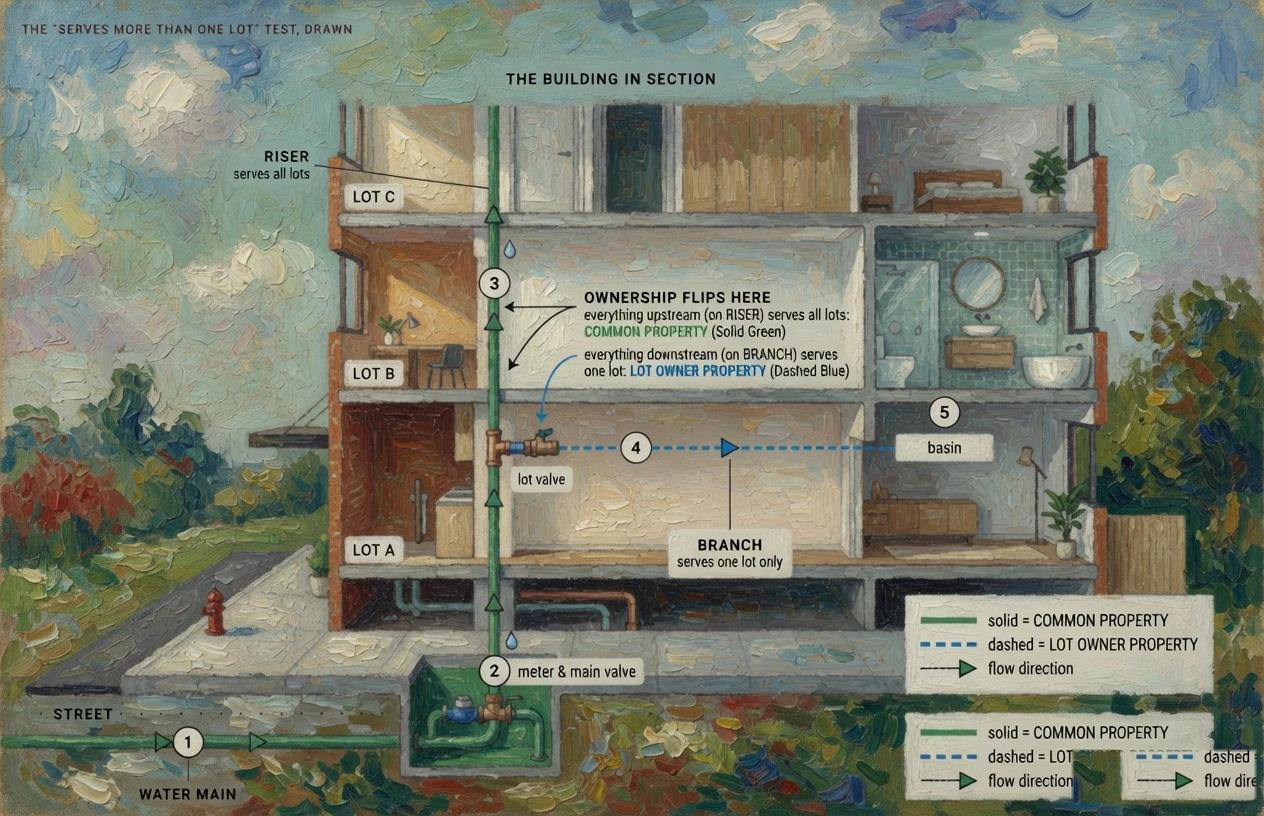
The difference matters more than where the heater sits. In NSW the owners corporation must maintain and repair common property under s 106 of the Strata Schemes Management Act 2015. A central plant is part of that duty. A heater that serves one lot usually is not.
- Hot water fails or leaks
- Plumber checks which lots it serves
- One lot or many?
- One lot: owner repairs and replaces
- Many lots: owners corporation repairs
- Check plan, by-laws and memorandum
What decides ownership: plan, by-laws and the memorandum
Three documents settle most hot water arguments, in this order.
The registered plan. It shows lot boundaries. A heater inside your lot's cubic space is lot property. A plant room is common property. A heater bolted to a common property balcony or roof sits in a grey zone, and that is where the by-laws come in.
The by-laws. Some schemes have a by-law, often made when an owner renovated or installed something on common property, that says who maintains it. In NSW a by-law approving a change to common property under s 108, or a common property rights by-law under s 142, can put the upkeep on one owner. Read yours before anyone calls a plumber.
The NSW common property memorandum. It is an optional list of who maintains what. A scheme can adopt it by by-law under s 107, and it is prescribed by the Strata Schemes Management Regulation 2016. NSW Fair Trading says a scheme can choose to adopt it if its by-laws don't already define common property. It does not apply automatically. It mentions hot water twice:
- The owners corporation maintains, repairs and replaces a "hot water service located outside of the boundary of any lot or where that service serves more than one lot" (item 6(i)).
- The lot owner maintains, repairs and replaces a "hot water service exclusive to a single lot (whether inside or outside of the cubic space of that lot)" (item 6(g)).
Those two items overlap. A heater on common property that serves only your lot is both "outside the boundary of any lot" and "exclusive to a single lot". I read item 6(g) as the answer, because it deals with exactly that case. But I wouldn't bet a $3,000 replacement on my reading. If your building has heaters outside the lots, make a by-law that says who owns them and who replaces them. One page now saves a tribunal application later.
Elsewhere the rule is clearer. Queensland's s 180(4) of the Body Corporate and Community Management (Standard Module) Regulation 2020 makes the lot owner responsible for utility infrastructure, including on common property, that relates only to supplying their lot. Hot water systems are named in the list. The Queensland Government's guidance gives the same example. In Victoria, the owners corporation repairs and maintains common property under s 46 and services under s 47 of the Owners Corporations Act 2006. I couldn't find a Victorian provision that names hot water, so the plan and rules decide.
Replacing a hot water system
Most replacements are like for like: same spot, same fuel, similar size. Inside your lot that is usually just a plumbing job. It gets harder when the new unit changes common property.
Approval
- NSW. NSW Fair Trading lists installing a heat pump as a minor renovation. That needs a vote with more than 50% of votes cast in favour, or committee approval if a by-law allows it (s 110). Work that changes structure or waterproofing is a major renovation and needs a special resolution. Changes to common property need approval under s 108.
- Queensland. An owner can ask the body corporate to authorise an improvement to common property for their lot under s 187 of the Standard Module.
- Victoria. Consumer Affairs Victoria says a lot owner must not repair, alter or maintain common property, or a service that benefits more than one lot, unless the owners corporation has expressly authorised it. Rules can't unreasonably ban sustainability items on a lot's exterior, and solar hot water is one of the examples in s 138B.
Ask before you buy. A new gas line, a new circuit from the main switchboard, or holes through a common wall or slab are all changes to common property.
Gas or heat pump
A heat pump heats water with electricity, using a fan and compressor like a reverse-cycle air conditioner. In an apartment, check four things:
- Airflow. A cupboard that suited a gas tank may not suit a heat pump.
- Power. It needs a suitable circuit, and older buildings may be short of capacity. Our heat and ventilation guide covers switchboard limits.
- Condensate. It drips water, which needs a drain, not a neighbour's balcony.
- Noise. See below.
Plumbing and electrical rules
Use a licensed plumber, plus a licensed gasfitter or electrician for the connection. The Queensland Government says a temperature control device must be fitted to all new and replacement systems so hot water reaches taps at no more than 50°C. It also says solar and heat pump systems must be installed by someone with a QBCC solar and heat pump endorsement. Other states have their own plumbing rules. Ask your plumber what applies, get the compliance certificate and give a copy to the owners corporation.
Noise
In NSW, the EPA says a heat pump water heater must not be heard in a neighbour's residential room before 8 am or after 10 pm on weekends and public holidays, or before 7 am or after 10 pm on other days, under the Protection of the Environment Operations (Noise Control) Regulation 2026. Set the timer to run in the middle of the day, which also suits solar. In other states, check your environment regulator's rules before you put a heat pump near a bedroom window.
When a tank bursts
Storage tanks often give warning first: a dripping relief valve, rust at the base, water in the tray. Act on those. When a full tank lets go, the water goes straight into the floor below. Here is how the bill usually splits.
Turn it off. Water at the isolation valve, then power or gas. Then tell the owners corporation in writing, with photos, and tell the occupier below.
The building damage. In NSW the owners corporation must insure the building under s 160. Strata building policies commonly cover sudden escape of water. They commonly exclude wear, rust and gradual leaks. A tank that wept for months is the exclusion an assessor looks for. Check your own policy wording.
The heater itself. Don't expect the building policy to pay for the failed heater. If it served only your lot, the replacement is your cost.
The excess. This is where most arguments start, and the answer depends on the state:
- Victoria. Consumer Affairs Victoria says an owners corporation may separately levy a lot owner for the excess on a claim that relates solely to that owner's lot. It may also levy the excess where a claim was caused by a culpable or wilful act, or gross negligence, of the owner, their tenant or a guest. The power is in s 23A of the Owners Corporations Act 2006.
- Queensland. The Queensland Government says the owner normally pays where only one lot is affected, unless the body corporate decides that is unreasonable. Where two or more lots, or a lot and common property, are affected, the body corporate normally pays unless it decides otherwise. The excess must not place an "unreasonable burden" on individual owners.
- NSW. I couldn't find a section of the Strata Schemes Management Act 2015 that says who pays the excess. A strata insurance broker writing on LookUpStrata says the same. Check your by-laws. Your scheme may have one on excesses.
Negligence. If the owner ignored a leaking tank, the downstairs owner may have a claim against them for the damage itself. In NSW, s 153 bars using a lot in a way that causes a nuisance or hazard to another occupier. A sudden failure of a well-kept tank is a different case. Then the insurer usually carries it and the argument is only about the excess.
If it's the central plant. A burst in the plant room is the owners corporation's problem. In NSW, an owner who suffers loss because the owners corporation failed to maintain common property can claim damages under s 106(5). The water leak guide sets out what you can recover.
Central hot water billing
With a central plant, someone has to split the heating cost fairly. There are three common setups.
A bulk hot water provider. A company owns the billing rights, reads each lot's hot water meter and bills each lot. The Energy and Water Ombudsman Victoria says these companies must hold an energy licence, the Energy Retail Code applies, a conversion factor turns meter readings into charges, and bills shouldn't include a daily supply charge. It also says the owners corporation is generally responsible for the tank and heating equipment, and only it can switch provider. The South Australian ombudsman describes a percentage method: your share of the building's hot water times the gas used to heat it.
An embedded network. The developer often signed a long contract with an operator. Our embedded networks guide covers the contracts and how to review them. In NSW, reforms that started on 1 July 2026 require sellers of hot water and centralised air-conditioning through embedded networks to join the Energy and Water Ombudsman NSW and publish their prices, according to a Mills Oakley summary of 2 July 2026. IPART is setting maximum prices and a billing standard. In June 2026 it proposed billing hot water on the energy used to heat it rather than per litre. When I checked in November 2026, I couldn't confirm the caps were in force. NSW buyers also now see embedded networks disclosed on the s 184 certificate. Our s 184 guide explains it.
The owners corporation pays the bill. In some older buildings the gas for the plant goes on the common property account and is paid from levies. Then every lot pays by lot entitlement, whether it holds one person or five. In Queensland, a lot owner is liable for a utility service that is separately measured and charged to their lot (s 195 of the Body Corporate and Community Management Act 1997). Where use can't be measured, owners share the cost by contribution schedule lot entitlement. A body corporate that takes on the bill can levy each lot by measured use if it can measure it (s 196).
If your building heats water from levies with no meters, I think sub-metering is worth costing. Paying for a neighbour's long showers through your levy isn't sharing. It's a subsidy nobody voted for.
Upgrades and rebates
Swapping a central gas plant for heat pumps is a capital works decision. Get it engineered and put it in the capital works plan rather than waiting for a boiler to fail in July.
For individual systems, two incentives I could confirm:
- National. Air source heat pumps of no more than 425 litres can be eligible for small-scale technology certificates if the model is on the Clean Energy Regulator's register and installed exactly as listed. Ask the installer to show how the certificates are reflected in the price.
- Victoria. Solar Victoria offers a rebate of up to $1,000, or $1,400 for a locally made product, for eligible heat pump and solar hot water systems (page updated 20 October 2026). It is for owner-occupiers with household taxable income under $150,000 and a property worth under $3 million, replacing a system at least three years old.
Other states run programs from time to time. Check your state energy department before you sign, and get the rebate terms in writing.
State by state
| State | Heater serving one lot | Central plant and billing | Insurance excess |
|---|---|---|---|
| NSW | Owner, if the memorandum is adopted under s 107 (item 6(g)); otherwise the plan and by-laws | Owners corporation maintains under s 106; embedded network obligations from 1 July 2026; disclosed on the s 184 certificate | No rule found in the Act; check by-laws |
| Vic | Plan and rules decide; I found no hot water provision | Owners corporation maintains common property and services (s 46, s 47); bulk hot water sellers need an energy licence (EWOV) | Owners corporation may levy the excess on a lot-only claim (s 23A) |
| Qld | Owner, even on common property (Standard Module s 180(4)) | Separately metered: lot pays (s 195); otherwise shared by lot entitlement or levied by use (s 196) | One lot: owner, unless unreasonable. More than one lot or common property: body corporate (Qld Government) |
| WA | Not confirmed; read the plan and by-laws. Common property duty in s 91 of the Strata Titles Act 1985 | Not confirmed; check the Act | Not confirmed; check the Act |
| SA | Not confirmed; read the plan and articles. Common property duty in s 25 of the Strata Titles Act 1988 | Ombudsman describes a percentage method (EWOSA) | Not confirmed; check the Act |
| Tas | Not confirmed; read the plan and by-laws. Common property duty in s 81(1)(c) of the Strata Titles Act 1998 | Not confirmed; check the Act | Not confirmed; check the Act |
| ACT | Not confirmed; read the plan. Maintenance duty and plan in s 24 of the Unit Titles (Management) Act 2011 | Not confirmed; check the Act | Not confirmed; check the Act |
| NT | Not confirmed; read the plan. Common property management in s 27 of the Unit Title Schemes Act 2009 | Not confirmed; check the Act | Not confirmed; check the Act |
"Not confirmed" means I couldn't find a hot water or excess rule, not that none exists.
Owner checklist
Committee checklist
A report you can copy
How UnitBuddy fits
Hot water disputes turn on facts nobody wrote down: which heater serves which lot, when it was installed, what the by-law says, who approved the replacement. In UnitBuddy the committee can keep the hot water systems in the building's asset list, store the by-laws, approvals, plumber reports and compliance certificates in the shared record, and plan a central plant's replacement in the capital works plan. We don't sell hot water, run claims or hold money. We keep the record that settles who pays.
Related reading
- Water leaks from above: who pays and how to force a repair
- Embedded networks: why you pay above-market rates for electricity, gas and hot water
- Common lot vs common property explained
- Flexi-hose failures and strata water damage
Sources and further reading
- NSW Government: common property memorandum (PDF)
- NSW Fair Trading: common property memorandum for strata schemes
- NSW Fair Trading: renovations in strata
- NSW EPA: preventing neighbourhood noise
- Queensland Government: utility infrastructure maintenance
- Queensland Government: insurance premium and excess
- Business Queensland: hot water systems
- Consumer Affairs Victoria: owners corporation insurance
- Energy and Water Ombudsman Victoria: bulk hot water
- Energy and Water Ombudsman SA: bulk hot water systems (PDF)
- Clean Energy Regulator: register of solar water heaters
- Solar Victoria: hot water rebate
- Hot water system leak: who pays the strata insurance excess?, via LookUpStrata
- Gas hot water systems in strata: lot owner or strata responsible?, via LookUpStrata
What changed in strata this month? Read the strata news for your state, with every figure sourced.
More guides like this

Guides
Strata Repairs and Defects in Australia: Who Fixes What and Who Pays (2026)
Leaks, waterproofing, mould, roofs, drains, glass, gates, fire safety and new-building defects: who has to fix each one, who pays, what to do first and how to make a slow owners corporation act. State-by-state, written for owners and committees.
19 November 2026 · 18 min read

Repairs & Maintenance
Dividing Fences in Strata: Who Pays Between Lots, Common Property and the Neighbours Next Door
A strata scheme can have three kinds of fence, and each one has its own rule. This is how to tell which fence you have, who pays for it, how a fencing notice works, and what changes in each state.
19 November 2026 · 12 min read
Repairs & Maintenance
Lift Out of Order Again? Strata Lift Breakdowns, Maintenance Contracts and Who Pays
The lift is common property, so the owners corporation fixes it and the levies pay. Here is what a lift maintenance contract should cover, how long an outage can reasonably last, what to do when it drags on, and how to plan for replacement, state by state.
19 November 2026 · 13 min read