
Finance & Levies
Embedded Networks Explained: Why You're Paying Above-Market Rates for Electricity, Gas and Hot Water
More than 49,000 NSW households are locked into embedded utility networks that bypass the standard retail market, usually paying significantly more than they would otherwise. From April 2026, this must be disclosed on every Section 184 certificate. This is what owners need to know.
· 9 min read
On this pageIn plain EnglishOn this page
- In plain English
- What an embedded network is
- How embedded networks get signed
- Why the rates are usually above market
- What are your rights as a resident?
- The April 2026 disclosure reform
- What owners corporations can do
- What buyers should be doing
- The state-by-state picture
- Where UnitBuddy fits
- Sources and further reading
In plain English
- Embedded networks often start as developer deals and end as resident costs.
- Disclosure helps buyers see the issue, but it does not automatically end the contract.
- The strongest committees benchmark rates, read the contract, and negotiate with evidence.
You move into a new apartment. The building has a single hot water plant on the roof. Your monthly bill comes from a company you have never heard of. The rate is higher than what your friend pays in a comparable apartment down the road. You can't switch retailers. You can't negotiate. When you ask the strata manager, you are told the contract was signed by the developer fifteen years ago and runs for another decade.
You have just discovered that you live inside an embedded network, and you are one of more than 49,000 NSW households (per research published in late 2024) caught in the same arrangement. Across Australia, the figure runs into the hundreds of thousands. From 1 April 2026, the existence of embedded networks must be disclosed on every Section 184 certificate issued in NSW, finally giving buyers the information they have always been entitled to. But the underlying contracts remain in place, and the financial impact on residents is substantial.
The legal status of the network is only part of the issue. Residents also need to know whether the deal still makes commercial sense.
What an embedded network is
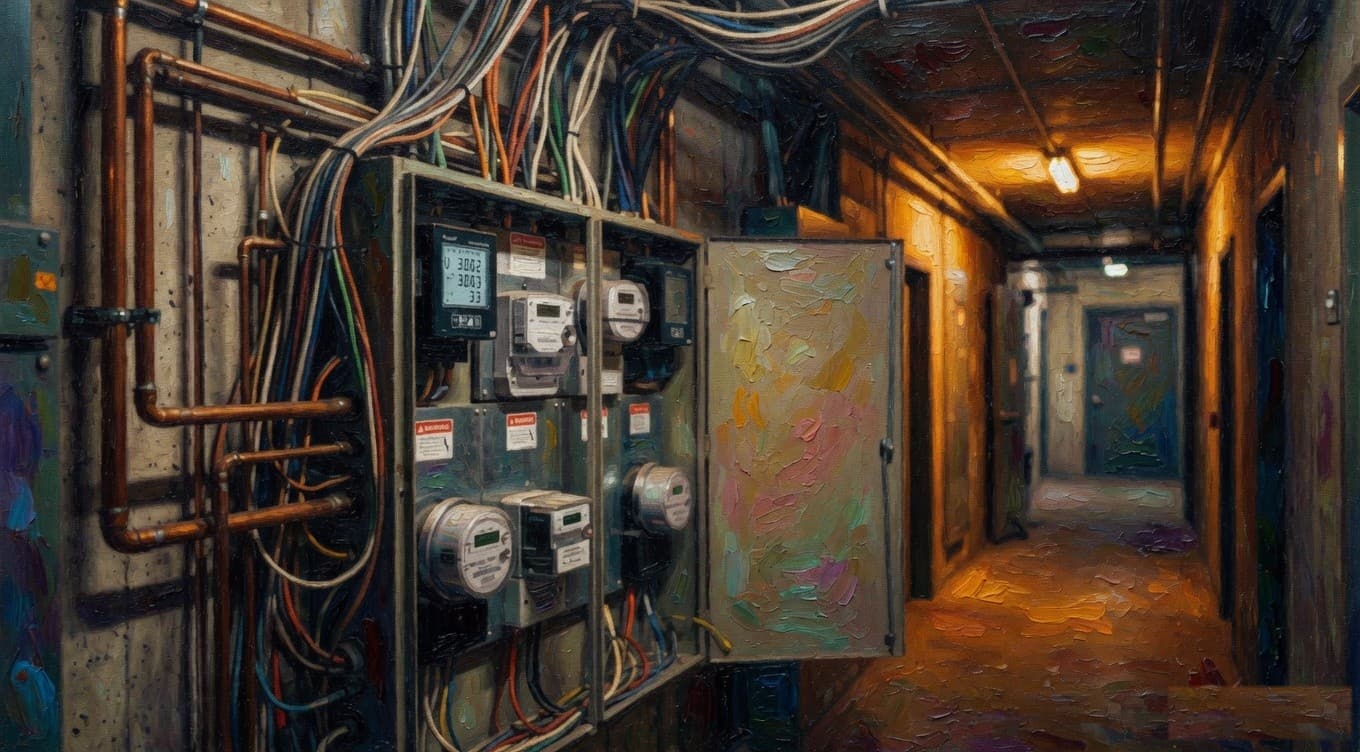
An embedded network is a private utility distribution system inside a building or precinct. Instead of each apartment having its own connection to the public electricity, gas, hot water or internet network (and being able to choose its own retail provider on the open market), the building has a single bulk connection, and an operator distributes the service internally to each apartment.
The operator buys at wholesale rates. The operator resells to residents at rates set by the operator's contract with the building. The difference between the wholesale cost and the resale rate is the operator's margin. In a competitive retail market, residents would be free to choose a different retailer at any time. Inside an embedded network, they cannot.
Embedded networks are most common for hot water (where a single rooftop plant serves the whole building), electricity (particularly in newer high-rise developments), gas (where reticulated gas is supplied through a private network), and increasingly, internet (where a single fibre service is distributed to apartments).
In some configurations, a network can offer genuine value: a well-priced bulk supply contract negotiated by an aligned operator, passed through to residents at competitive retail rates. In most configurations, particularly those signed during the original development phase, the financial outcome for residents is significantly worse than the standard retail market.
How embedded networks get signed
Embedded networks are typically signed by the developer at the time the building is constructed, before any apartments are sold. The contract is between the developer and the network operator. Its terms (the rates, the term, the exclusivity, the renewal options) are set at the point of signing and bind the future owners corporation.
The developer's incentive structure is usually misaligned with the future residents' interests. Network operators offer developers upfront payments, infrastructure cost subsidies (paying for the wiring, the metering, the hot water plant), or other commercial benefits in exchange for long-term exclusive supply contracts. The developer captures the immediate benefit; the long-term cost is borne by the residents who buy the apartments.
Contract terms commonly include exclusivity (no competing supplier may be brought in), terms of 10-25 years, automatic renewal provisions that extend the contract beyond its initial term, rate-setting mechanisms tied to operator-controlled benchmarks, and termination provisions that require substantial buy-out payments to exit.
When the building is handed over to the residents, the OC inherits the contract. By the time most owners discover what they have signed up to, the financial damage has been done.
Why the rates are usually above market
The financial outcome for residents depends on three factors: the wholesale rate the operator pays for the bulk supply, the operator's margin, and the operator's pass-through of any infrastructure or maintenance costs.
In a competitive retail market, retail margins are kept low by competition. In an embedded network, there is no competition (the operator is the only available supplier), and the margin is set by the original contract. Operators in this position have, predictably, set margins that are higher than those in the competitive market.
Operators also typically pass through infrastructure costs (the cost of maintaining the embedded network's wiring, meters and equipment) at rates negotiated in the original contract. These costs are often higher than the equivalent network charges in the standard market.
Add the absence of choice for residents, the absence of any retail competition, and the long contract terms that prevent the OC from renegotiating, and the result is that residents in embedded networks consistently pay more than residents in comparable buildings on the standard retail market.
The Australian Energy Regulator's research, supported by the Energy and Water Ombudsman NSW (EWON) data, has documented this pattern repeatedly. The 2024 research by Lynne Sherry and others quantified the gap at hundreds of dollars per household per year for many networks, sometimes more.
What are your rights as a resident?
The legal protections available to residents of embedded networks have improved over the past decade, but remain weaker than those available to residents in the standard retail market.
In the standard market, residents are protected by national consumer protection rules under the National Energy Retail Law and equivalent state-based regimes. Retailers must comply with detailed obligations on pricing, billing, hardship support, and dispute resolution. Residents can switch retailers at any time. The national Energy Made Easy comparator provides transparent price comparison.
In embedded networks, residents are partially covered. The Australian Energy Market Commission's authorisation framework requires embedded network operators to be exempt sellers under the National Energy Retail Law. Exempt sellers must comply with most of the same protections as retail providers, but enforcement is weaker, and the rates are not subject to the same market discipline.
Residents in NSW can lodge complaints with EWON, which has jurisdiction over embedded networks. EWON receives several thousand embedded network complaints annually, with rate disputes the most common category. Residents can also complain to NSW Fair Trading where billing practices breach the underlying contracts.
The most significant practical protection now available to residents is the right to information. Once an embedded network is identified, the contract terms can be reviewed, the rates can be benchmarked against the standard market, and the financial impact can be quantified.
The April 2026 disclosure reform
The most important recent change for owners is the requirement, commencing 1 April 2026 in NSW, that the existence of embedded networks be disclosed on the Section 184 certificate for every lot.
This means that prospective buyers can now see, at the point of due diligence and before exchange of contracts, whether the apartment they are considering is locked into an embedded electricity, gas, hot water or internet contract. The disclosure includes the operator, the term, and basic details of the arrangement.
The downstream effect of this reform is significant. Buildings with embedded network arrangements will, over time, attract less buyer interest than comparable buildings without them. The price discount that emerges in the market will create financial pressure on owners corporations to address the underlying contracts: by renegotiation, by termination, or by structural change.
For existing owners, the disclosure requirement creates immediate transparency. The OC must now formally disclose the arrangement, the strata manager cannot avoid the question, and the financial picture becomes visible.
What owners corporations can do
The options available to owners corporations to address embedded network arrangements depend on the contract terms.
- Locate and read the contract
- Benchmark rates against market
- Renegotiate, exit, or rebuild
- Cost the buy-out or rewire
- Resolve plan at general meeting
The first option is renegotiation. Operators often have commercial reasons to renegotiate, particularly where competing operators are willing to offer better terms or where the OC has the leverage of a credible threat to terminate. A formal request for review of rates, supported by market benchmarking, can produce meaningful concessions.
The second option is termination under the contract. Most embedded network contracts contain termination provisions, but these typically include substantial buy-out payments calculated on the basis of foregone revenue over the remaining term. The buy-out amount can be hundreds of thousands of dollars for a large building.
The third option is termination on contract review grounds. Where the original contract was signed by the developer in circumstances that involved a clear conflict of interest, was on terms substantially worse than market, or contained provisions that are unconscionable, there may be grounds to challenge the contract under general contract law or under specific strata legislation. NSW's October 2025 reforms gave NCAT expanded power to vary or end management agreements in similar circumstances; analogous provisions may apply to embedded network contracts in some cases.
The fourth option is structural change. In some buildings, it is possible to dismantle the embedded network entirely (installing individual connections, removing the operator's role) and return the building to the standard retail market. This is technically and financially complex, and requires substantial OC investment, but it produces the best long-term outcome for residents.
The fifth option is to wait out the contract. Many embedded network contracts run for 10-25 years and will eventually expire. The OC's strategy in the meantime is to ensure that the contract is not automatically renewed, that any renewal options are exercised in the OC's interest, and that the residents are informed about their position.
What buyers should be doing
For prospective buyers, the embedded network question is now a standard due diligence item.
The Section 184 certificate, from April 2026, will identify whether the building has any embedded network arrangements. Read this section carefully. If an embedded network is disclosed, request the underlying contract through the conveyancer. Review the rates, the term, the renewal provisions, and the termination provisions.
Benchmark the rates against the standard retail market for the relevant area and service. The Australian Energy Regulator's Energy Made Easy and equivalent state-based comparators provide the data. A 10-15% premium over standard market rates is common; a 30-50% premium is not unheard of.
Factor the financial impact into the purchase decision. Over the term of the contract, an embedded network arrangement can cost a household tens of thousands of dollars compared to the standard market. This is real value that should be reflected either in the purchase price or in the buyer's decision to proceed.
The state-by-state picture
The regulatory framework varies between jurisdictions, but the underlying issue is national.
| Jurisdiction | Disclosure Requirement | Ombudsman | Recent Reforms |
|---|---|---|---|
| NSW | S184 certificate disclosure from 1 Apr 2026 | EWON | Disclosure regime; ongoing AER review |
| VIC | Energy and Water Ombudsman jurisdiction | EWOV | 2025 review of embedded network framework |
| QLD | Energy and Water Ombudsman jurisdiction | EWOQ | Limited specific reforms |
| WA | State-based regime; Economic Regulation Authority | EWOWA | Limited specific reforms |
| SA | National framework applies | EWOSA | Limited specific reforms |
| ACT | National framework applies | ACT Civil and Administrative Tribunal | Limited specific reforms |
| NT | Territory energy framework applies | Local energy regulator / ombudsman pathway | Limited specific embedded-network reforms |
| TAS | State energy framework applies | State ombudsman pathway | Limited specific embedded-network reforms |
Where UnitBuddy fits
UnitBuddy's contracts and disclosures module captures the building's embedded network arrangements (the operator, the contract term, the rate-setting mechanism, the termination provisions) and surfaces this information for the OC, for buyers reviewing certificates, and for residents seeking to understand their position. The system also tracks rate changes over time, making it possible to identify above-market rate movements and supporting the case for renegotiation or challenge.
For owners corporations exploring renegotiation or termination, the platform provides the data foundation that the OC's solicitor or contract advisor needs to make an informed assessment.
Sources and further reading
- NSW Government: changes to strata laws
- NSW Government: guide to strata law changes for committees and owners
- NAT: Pitfalls and benefits of embedded networks for strata buildings in Australia, via LookUpStrata
- NSW: Embedded Network Reforms 2025: what you need to know, via LookUpStrata
Keep the scheme file in one place the committee and the manager can both open. Features, pricing, or book a tour.