
Repairs & Maintenance
Heat, Ventilation and Summer Readiness in Australian Strata Buildings
Split-system approvals, condensate disputes, plant rooms running too hot, lifts that fail in heatwaves, and the welfare protocols every committee should have ready before December. A practical guide to summer in an Australian apartment building.
· 13 min read
On this pageWhat this guide coversOn this page
- What this guide covers
- The summer-readiness audit
- The lot-vs-common-property line for AC
- State-by-state approval pathways
- New South Wales
- Victoria
- Queensland
- Western Australia
- South Australia
- Tasmania
- Australian Capital Territory
- Northern Territory
- What a good AC approval pack contains
- Condenser locations and what each one means
- Condensate drainage: the most common AC dispute
- Noise rules and night-time complaints
- Plant rooms: the hidden heat risk
- Lifts and heatwaves
- Common-area cooling: when it's worth doing
- Mould, humidity and ventilation
- Window restrictors and child safety
- Welfare protocols for heatwaves and outages
- Power-load constraints and why summer exposes them
- Solar PV and rooftop heat
- Common objections and extra checks
- Committee summer-readiness checklist
- Heat is a building problem as well as a lot problem
- How UnitBuddy fits
What this guide covers
- Heat in apartment buildings is a building issue as well as a comfort issue. Lifts, plant rooms, ventilation, AC approvals, condensate drainage and resident welfare all sit partly with the owners corporation.
- The most common AC dispute in Australia isn't noise. It's condensate water dripping into a neighbour's lot or onto common property below.
- Split-system AC installations almost always touch common property. Approval pathways differ by state, and the wrong pathway is grounds for the work to be removed at the owner's cost.
- Plant rooms (fire-pump rooms, comms rooms, lift motor rooms, UPS cabinets) fail more often during heatwaves than at any other time of year. UPS battery life roughly halves for every 10°C above 25°C.
- The 2009 Victorian heatwave produced 374 excess deaths, many in apartments without cooling. In buildings with elderly residents, welfare communication during heat events is no longer optional.
Australian apartment buildings are getting hotter in more complicated ways than houses. A west-facing facade radiates into a top-floor lot for hours. A central corridor with no openable windows traps stack heat all summer. Up on the roof, the plant area sits at 50°C and the chiller condensers throttle. Residents apply for split-system AC. The committee approves three of them, refuses one for noise, and a year later a downstairs owner is taking photos of water marks on their balcony ceiling.
Detached houses treat summer as a household problem. Strata can't. Building fabric, common-property systems and the approval framework decide what residents can install, what they can run, and how the building copes when the weather turns. Anyone who's been on a committee through one bad heatwave knows the difference between buildings that prepared and buildings that improvised. This guide walks through the whole picture: standards, approvals, costs, plant, lifts, welfare and the committee work that should happen before December, not during the next 40°C week.
The summer-readiness audit
The audit isn't a single inspection. It's a coordinated walk-through with the building's existing contractors (mechanical, electrical, lift, fire) done in spring, with a written record. The cost is modest. Finding the same problems on a 42°C Saturday is not.
| Area | What to check | Why it matters |
|---|---|---|
| Common corridors and lobbies | Mechanical and natural ventilation against AS/NZS 1668.2 and AS 1668.4; door closers; smoke-door operation | Trapped heat reduces lift motor reliability and amplifies cooking and bathroom humidity |
| Plant rooms | Ambient temperature, exhaust fans, filters, alarms, AS 3666 records for cooling-tower water | Equipment failure cascades into pumps, comms, fire systems, UPS |
| Lifts | Motor-room temperature, recent fault history, heatwave outage protocol | Outages cluster during heatwaves; vulnerable residents are stranded |
| Roof and facade | Insulation, flashings, reflective coatings, shade structures, solar PV condition | Top-floor lots and rooftop plant absorb the heat load |
| AC and condensate | Existing approvals, drain pipework, drip trays, noise readings | Condensate drips and night-time noise are the two most common complaints |
| Window restrictors | NSW SSMA 12.5cm restrictor compliance in buildings 2+ storeys | Child-safety obligation; non-compliance is a building risk |
| Resident welfare | Opt-in vulnerable-resident contact list; heatwave and outage notice templates | Heatwaves kill people in apartments without cooling (see Vic 2009) |
The audit feeds three deliverables: the AC approval pack the committee will hand applicants in November, the maintenance schedule for the building's mechanical contractor, and the welfare protocol for January and February.
The lot-vs-common-property line for AC
This is the part most committees and most owners get wrong, and it's the source of nearly every dispute that ends at a tribunal.
The internal head unit of a split-system sits inside the lot. The owner installs it, owns it, maintains it. Nothing on common property is touched.
Almost every other component touches common property. The condenser typically sits on a balcony slab (which may be common property), an external facade (almost always common property), a roof area, or a dedicated plant deck. Refrigerant pipework runs through wall cavities, and the wall itself is usually common property in NSW and Victoria. The condensate drain has to go somewhere: into the lot's wet-area plumbing, into a balcony floor waste, or onto a roof. Each option has consequences. The electrical supply may need a sub-circuit upgrade at the lot's switchboard.
In practice, assume any split-system installation will touch common property somewhere, and assume the approval pathway applies. An owner who installs without approval can be ordered to remove the unit and reinstate the facade at their own cost, even if the unit is otherwise compliant.
State-by-state approval pathways
The mechanism is similar across states (minor common-property change, owner consent, conditions attached) but labels and thresholds differ.
New South Wales
AC installation is normally a "minor renovation" under s110, requiring a general-meeting ordinary resolution. Cosmetic-only work (which AC isn't) sits at s109. Major works affecting structure, waterproofing or external appearance, for example coring a hole through a load-bearing facade, sit at s108 and need a special resolution. NCAT can grant approval where the owners corporation unreasonably refuses.
Victoria
Alterations to common property require OC consent. A condenser fixed to a facade, a pipe penetration through external cladding, or condensate routed to a common drain are all alterations. The OC sets reasonable conditions, and an owner who proceeds without consent can be required to reinstate.
Queensland
"Improvement to common property by occupier" is the relevant pathway. The committee can approve up to a value threshold; above that, a general-meeting resolution is required. The body corporate may impose conditions covering maintenance, removal at end of life and indemnity for damage.
Western Australia
Common-property alterations need scheme consent. Many WA schemes use a standard AC application form covering condenser location, electrical, drainage and acoustic specification.
South Australia
Strata Titles Act 1988 and Community Titles Act 1996 produce broadly similar outcomes: corporation consent for changes to common property, conditions attached.
Tasmania
The Strata Titles Act 1998 framework requires by-law authorisation or special resolution for alterations of common property. Smaller schemes often handle AC by registered by-law.
Australian Capital Territory
Common-property changes are a unanimous or special resolution depending on the type of change. Most condenser installations sit in the "special privilege" category by resolution.
Northern Territory
Read the schedule under the Unit Title Schemes Act 2009 or Unit Titles Act 1975 depending on plan vintage. AC normally requires consent recorded as a special-privilege resolution or by-law.
The common thread: the right approval pathway protects the owner (who gets a documented right to keep the unit there) and the building (which gets enforceable conditions on noise, drainage, maintenance and removal).
What a good AC approval pack contains
The committee shouldn't invent a fresh process for every applicant. Build the pack once, attach it to every meeting agenda from October onwards, and save the design effort.
A useful pack requires:
- A scaled location plan showing the indoor unit, the condenser, the pipe route and the condensate route.
- Specifications: model, capacity (kW), sound power level (dB(A)) and refrigerant type.
- Electrical contractor licence details and confirmation of compliance with AS/NZS 3000 wiring rules, including any sub-circuit or switchboard upgrade.
- A condensate management plan: drip tray, tundish, drain pipe sizing, route, and termination point.
- Penetration and waterproofing detail for any facade or balcony coring, signed by the contractor.
- Acoustic statement against the relevant state noise framework.
- A maintenance and end-of-life clause: the lot owner maintains the unit, removes it at end of life and reinstates common property.
- An indemnity for water damage caused by condensate failure.
Buildings that hand applicants a clear pack get cleaner installations. Buildings that improvise get retrofits and tribunal applications.
- Owner submits AC application
- Approval pack: location, drainage, noise
- Committee reviews under state pathway
- Conditions: maintenance, indemnity, removal
- Install with drip tray and tundish
- Condenser added to per-lot register
Condenser locations and what each one means
The location decision isn't aesthetic. It drives noise, drainage, maintenance access and approval complexity.
| Location | What it suits | Watch-outs |
|---|---|---|
| Balcony slab (lot or common property) | Single-head splits in low-rise schemes | Noise to neighbours; condensate to floor waste; balustrade airflow |
| External facade bracket | Mid-rise lots with no balcony plant zone | Coring requires structural sign-off; reflectance and weather exposure shorten unit life |
| Roof or rooftop plant deck | Larger VRF and multi-head systems | Long pipe runs, structural load on roof, waterproofing at penetrations, and rooftop ambient temperatures throttling capacity |
| Walkway or service corridor | Older buildings with dedicated plant zones | Noise into adjacent lots; airflow restriction; common-property occupation |
| Ground-level plant yard | Townhouse and villa schemes | Boundary noise to neighbours; security; visual amenity |
Done properly, a 2.5–5 kW split system with new pipework runs roughly $2,000–$4,000 per lot. A multi-head or VRF system serving a larger lot can run from $8,000 to $30,000 or more depending on capacity, ducting and structural work. A condensate drip tray with a tundish, the simplest preventative measure against the most common dispute, adds $200–$400 to a job and is rarely fitted unless the approval pack requires it.
If the facade is structural concrete, expect a structural engineer's report ($1,500–$4,000) before any coring. Some councils also require a permit fee for facade penetrations on heritage or contributory buildings.
Condensate drainage: the most common AC dispute
A residential split-system can shed several litres of condensate water on a humid summer day. That water has to go somewhere. Four common terminations: a tundish into the lot's wet-area plumbing, a balcony floor waste, an external drip with a splash plate, or a dedicated condensate drain to a common stormwater point.
The dispute pattern is consistent. The condenser is mounted on the facade. Condensate runs out of a short stub pipe and drips onto the balcony, the wall or the unit below. The lot owner says they didn't know. The neighbour photographs water staining, mould around the soffit, or, at the extreme end, a damaged ceiling. The dispute lands at NCAT, VCAT or the equivalent.
The legal position is straightforward. Water from a lot owner's installed appliance damaging another lot or common property is the lot owner's liability. Strata insurance may cover the damaged surface, depending on cause and policy wording, but the underlying responsibility, and the next premium impact, sits with the lot that produced the water. Same logic that governs flexi-hose claims.
The cure is preventative and cheap. Require a drip tray under the indoor unit and a properly piped condensate drain on every approval. Require an annual condensate-line clean. Specify a tundish so a blocked line is visible before it overflows. The total addition is small and removes a common AC complaint from the building's run-rate.
Noise rules and night-time complaints
Noise from condensers is the second most common AC complaint, and the framework is more specific than most committees realise.
In NSW, the Protection of the Environment Operations Act 1997 and the EPA's Noise Policy for Industry combine with residential noise regulations. The practical rule of thumb that EPA officers and acoustic consultants apply: a residential AC condenser shouldn't exceed about 5 dB above the prevailing background noise level, measured at the affected receiver, particularly at night. Victoria runs an equivalent EPA framework with comparable thresholds. Other states reference similar background-plus rules through council local laws.
A 5 dB exceedance is small. More often than not, older condensers exceed it without anyone realising. The approval-pack remedy is to require the manufacturer's sound power data sheet, and to require a certificate of compliance from an acoustic consultant where the condenser is within a few metres of a habitable-room window of another lot.
When complaints arrive after installation, the path is: written complaint to the committee, factual measurement (a calibrated reading at the receiver, not an iPhone app), comparison against the framework, and a remediation order if exceeded. Remediation can be as small as an acoustic enclosure ($800–$2,500) or as large as relocation. Resolving this without measurement creates the worst outcomes for everyone.
Plant rooms: the hidden heat risk
Plant rooms are the part of the building residents never see and committees pay most often to repair. Fire-pump rooms, comms rooms, lift motor rooms, UPS cabinets, switchrooms and chiller plant zones all degrade above 35°C ambient. On a 40°C day, the temperature inside an unventilated rooftop plant room is regularly 50–55°C.
Numbers worth knowing:
- UPS battery life roughly halves for every 10°C above 25°C. A UPS specified for ten years at 25°C delivers around five years at 35°C and around 2.5 years at 45°C.
- Lift motor rooms and lift control cabinets are specified to operate up to about 40°C. Beyond that, the lift will progressively de-rate, slow, or fault.
- Comms equipment (NBN, lift dialler, intercom, security NVR) loses reliability above 40°C ambient.
- Cooling-tower water systems, relevant in larger schemes, must be maintained under AS 3666.1, AS 3666.2 and AS 3666.3 to manage Legionella risk, with documented dosing and inspection records.
Plant-room ventilation is governed by AS/NZS 1668.2 for mechanical ventilation and AS 1668.4 for natural ventilation thresholds. Many older buildings comply on paper but fail in practice. The louvres are blocked, the exhaust fan is wired off, or additional equipment has been installed since the original ventilation calc.
The summer audit should include a temperature reading inside each plant room on a hot day as well as a review of the paperwork. Adding a thermal alarm linked to the building management system or to the strata manager's phone is a low-cost change that prevents long failure windows.
Lifts and heatwaves
Lift outage call-outs spike during heatwaves. Reasons are physical: motor-room overheating, control-board faults, door-sensor misalignment from thermal expansion, and battery-backup failures.
A building with mostly elderly residents and a single lift should have a written heatwave protocol: who's contacted, how a stranded resident is reached, where bottled water is stored, which residents are on the welfare list. Lift outages of 24–48 hours are common during peak summer, and the people most affected are exactly the people least able to take the stairs.
Two preventative items pay for themselves: a small split system or ventilation upgrade in the lift motor room (so the lift doesn't de-rate at the worst possible moment), and a service contract that includes priority response during declared heat events.
Common-area cooling: when it's worth doing
Most buildings should be cautious about adding AC to common areas. Operating budgets are unforgiving and comfort gains are modest. There are specific cases where intervention is justified though:
- An enclosed lobby that hits 35°C and is the daily route for elderly residents.
- A gym or community room that becomes unusable for a third of the year.
- A garbage room where heat accelerates odour and pest issues.
- A concierge desk staffed by occupied workers (employer obligation).
Before installing cooling, run cheaper interventions first. NCC Part F4 confirms minimum ventilation requirements for habitable rooms and is a useful reference even for common-area design. Door closers, exhaust upgrades, automatic vents, window film, shading structures and LED relamping (LEDs run cooler than halogens) frequently bring the space back into a comfortable range without recurring energy cost. If cooling is still required, scope it against a measured complaint history, not a single vocal request.
Mould, humidity and ventilation
Heat and humidity overlap with mould risk. A bathroom exhaust that ducts into a ceiling cavity rather than to atmosphere is a humidity source for the building. A corridor with no make-up air becomes humid every time a stack of bathrooms exhausts simultaneously. A laundry without effective venting traps moisture in walls.
Preventative work is mechanical, not cosmetic. Exhaust upgrades, duct cleaning, make-up air paths, door undercuts, and where appropriate, dehumidification in problem zones. Mould treatment without ventilation work is a recurring cost. Ventilation work with mould treatment is closer to a permanent fix.
Window restrictors and child safety
NSW deserves a separate note. Under the Strata Schemes Management Act 2015 and accompanying regulations, owners corporations in buildings two storeys or higher were required to install compliant window safety devices on common-property and lot windows accessible to children, by 13 March 2018. The device must restrict the window opening to no more than 12.5 cm and must withstand a defined outward force.
Cost is modest, typically $30–$100 per window installed, but the obligation is hard. A building that hasn't completed its program is exposed to enforcement, civil action and the worst possible kind of incident. Other states haven't adopted the rule with the same statutory force, but the practical case for restrictors in family-occupied buildings is the same everywhere.
Summer is the season when windows are open most. Confirm the restrictor program is complete before the heat arrives, not in February.
Welfare protocols for heatwaves and outages
The 2009 Victorian heatwave produced 374 excess deaths over a single week. A disproportionate share occurred in apartments without effective cooling, often among elderly residents living alone. The 2019–20 summer in NSW and the 2024 South Australian heatwave produced similar, if smaller, patterns.
Committees aren't health services and shouldn't pretend to be. But a building can do four practical things at near-zero cost:
- Maintain an opt-in welfare contact list. Residents who want a check-in during a declared heatwave or extended outage opt in voluntarily; the list is held by one nominated committee member with a backup.
- Keep template notices ready: heatwave warning, lift outage, water shutdown, power outage. The template is filled in and posted within an hour, not drafted from scratch on the day.
- Identify a cooled common area (a community room, a foyer, a basement space) that residents can use during peak afternoon hours if their lot is uncomfortable.
- Coordinate with the building's strata manager and any onsite building manager so the response is the same whether or not committee members are away.
The welfare protocol doesn't need to be elaborate. It needs to exist on paper before the heat does.
Power-load constraints and why summer exposes them
Older buildings designed for 1990s loads frequently cap each lot's main supply at around 60–100 amps single-phase. That budget covered cooking, hot water and a small reverse-cycle unit. It doesn't cover a modern 7 kW reverse-cycle AC running with induction cooking and EV charging at the same time. Buildings see this as repeated breaker trips at the lot level, and at the building level, as a main switchboard at or above its rated capacity on summer evenings.
Switchboard upgrades aren't trivial. Replacing a lot's switchboard and meter panel typically runs $3,000–$10,000. A whole-of-building main-switchboard upgrade with new feeders, metering and distribution can run from $80,000 to several hundred thousand for larger schemes. The cost is real and the lead time is long. Utility connection slots are often months out.
The summer-readiness audit should include a live load reading at the main switchboard during a hot evening peak. If the building is at or above 80% of rated capacity now, the upgrade conversation needs to be on the agenda before the next AC application is approved.
Solar PV and rooftop heat
Rooftop solar reduces summer peak draw on the building's main supply at exactly the time demand is highest, and it shades the roof membrane underneath, reducing heat load on the top floor. Both effects are useful for summer readiness.
Installation cost depends heavily on roof access, switchboard suitability and whether the system serves common property only or includes embedded-network distribution to lots. For a typical 30-lot building, a 30–50 kW common-property PV system runs $40,000–$80,000 installed. Cool-roof coatings (high-reflectance paint applied to existing membrane) are a separate option at roughly $25–$50/m² applied. Rooftop greening and shade structures are more expensive but address the heat-island effect more durably.
Solar is rarely the cheapest summer-readiness intervention. It's one of the few that pays back over time rather than depreciating.
Common objections and extra checks
"Air-conditioning is a lot-owner problem." Comfort inside the lot is usually the owner's responsibility, fair enough. But the building still controls condenser locations, penetrations, drainage, electrical capacity, noise and facade consistency. A committee that refuses to set a clear pathway creates more disputes than one that publishes a strict approval pack.
"We have never had a heat incident." Past summers are a weak guide. To be honest, lift failures, plant-room overheating and vulnerable-resident welfare risks often appear only during the first severe event. Treat heat-readiness like fire-readiness: quiet when it works, expensive when it's improvised.
Check the electricity sequence. AC approvals, EV charging, common-area cooling and solar all touch the same electrical infrastructure. Before approving a wave of condenser installs, the committee should ask whether the switchboard, consumer mains and load-management plan can handle the next five years of demand.
Don't ignore renters. Tenants often report heat, mould and ventilation problems first, but the approval and repair authority sits with owners and the committee. The building needs a way for tenants to escalate habitability issues without relying on informal messages through a managing agent.
Committee summer-readiness checklist
- Run the audit in spring (mechanical, electrical, lift, fire) with a written record.
- Publish the AC approval pack and attach it to every meeting agenda from October.
- Confirm condensate drainage and drip-tray requirements on every existing AC unit.
- Take ambient-temperature readings inside every plant room on a hot day; install thermal alarms where reasonable.
- Review lift fault history; confirm motor-room cooling; agree a heatwave response protocol with the lift contractor.
- Confirm the window-restrictor program is complete (NSW: required by 13 March 2018).
- Check AS 3666 cooling-tower records if applicable; confirm AS/NZS 1668.2 and AS 1668.4 ventilation paths in plant areas.
- Maintain an opt-in welfare contact list and a set of template notices.
- Take a live load reading at the main switchboard during summer evening peak.
- Confirm acoustic compliance against the state noise framework for all condensers within a few metres of habitable-room windows.
- Document everything; record decisions in minutes; store contractor advice with the building's compliance records.
Heat is a building problem as well as a lot problem
Comfort inside a lot is usually the owner’s. The condenser on the facade, the penetration through the slab, the condensate that stains the ceiling below, the lift that dies when the motor room overheats, and the common corridor with no air, are not. The owners corporation must keep common property working. In New South Wales that is section 106 of the Strata Schemes Management Act 2015. In Victoria it is section 46 of the Owners Corporations Act 2006. Queensland’s Body Corporate and Community Management Act 1997 and Western Australia’s Strata Titles Act 1985 say the same. A plant-room air-conditioner that has been dead since November is a maintenance item, not a summer surprise.
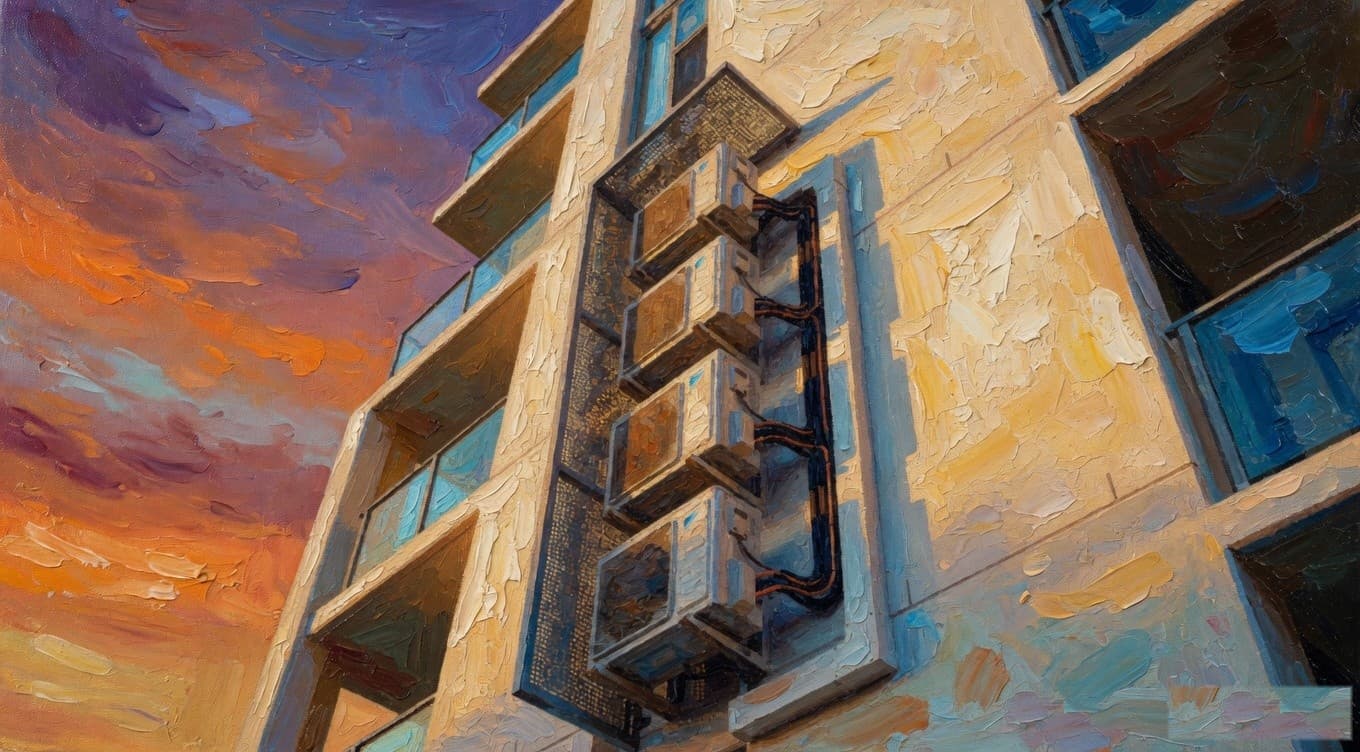
A split-system condenser on a common wall or balcony is an alteration. In NSW it is usually more than a cosmetic change. Waterproofing and facade work sit outside section 110 minor renovations. Changing the appearance of the facade engages section 108. Victoria uses section 52. Publish one approval pack: location plan, condensate path, electrical sign-off, acoustic certificate, and who maintains the penetration. Approvals that stop at “yes, you can put an AC in” are how downstairs ceilings stain.
Window safety devices remain a NSW scheme duty under section 118 even in a heatwave. Residents will prop windows. Restrictors that were removed “for breeze” are still a defect.
Condenser noise at night is both a by-law issue and, in NSW, an environmental-noise issue under the Protection of the Environment Operations Act 1997 and the Noise Control Regulation 2017. Victoria uses the Environment Protection Act 2017. The noisy neighbour sequence still applies: ask, write, then a section 146 or section 155 notice if the pattern continues.
A main-switchboard upgrade is capital works — section 79 and the section 80 plan in NSW. Approving a wave of condensers and EV chargers without a load reading is how the building buys a summer of trips and then a special levy. Solar on the roof is a separate special-resolution project if it changes common property; the solar post is the companion.
A welfare list is not a health service. It is a contact sheet and a template notice. It does not replace triple-zero. Record who opted in. Do not record diagnoses in the minutes.
Keep the AC register, the plant-room temperature log and the lift contractor’s heat protocol in the building’s own records. The next January will not wait for a new secretary to find last year’s email.
How UnitBuddy fits
A 38-lot building in inner-west Sydney went into the January 2024 heatwave with seven approved condensers, three unapproved, and nobody on the committee sure which was which. By day three, the lift was out, an elderly resident on the sixth floor hadn't been heard from in a day, and a downstairs owner was photographing condensate stains on her ceiling. The chair spent an afternoon piecing together emails. That's the kind of week UnitBuddy is built to prevent next year.
For heat and ventilation specifically, that includes:
- The standard split-system AC approval pack (condenser location plan, condensate drainage detail, AS/NZS 3000 electrical sign-off, AS/NZS 1276 noise certificate, structural advice for facade penetrations and fixings) held as a reusable template the committee issues to every applicant.
- A per-lot condenser register tracking what was approved, where, on what conditions, with the maintenance and end-of-life removal obligations attached.
- Plant-room temperature logs and AS 3666 cooling-tower water records sitting alongside the fire-pump and lift maintenance file.
- The window-restrictor compliance record (NSW SSMA s118) with installation dates per lot and replacement intervals.
- A heatwave welfare protocol (vulnerable-resident opt-in list, lift-outage notification template, common-area access plan, contractor on-call list) that survives committee turnover instead of leaving with one engaged member.
- Capital works planning for the upgrades summer eventually forces (switchboard upsizing, plant-room ventilation, cool-roof coatings, common-area cooling) with the engineering reports and quotes on file.
- The complaints and incident log for condensate damage, AC noise breaches and ventilation failures, attached to the lots and stacks they affect.
So when a new owner applies to install AC, the committee can pull up what's been approved before, where, and on what conditions. The lift contractor proposes a motor-room cooling upgrade, and the temperature log is already on file. The broker asks at renewal what the building is doing about heat-related risk, and the answer is a documented program rather than a verbal assurance. Heatwave warning issued? The welfare list and the template notice are one click away rather than buried in a former chairperson's email.
UnitBuddy is built to support committees and the strata managers who work with them. The strata manager runs the meetings, the levies and the statutory filings. UnitBuddy holds the operational layer (the approval templates, the contractor records, the temperature logs, the welfare list, the capital works pipeline) that makes summer readiness institutional knowledge rather than one volunteer's spreadsheet.
Last updated: 5 May 2026. UnitBuddy publishes general information for Australian strata owners and committees. It is not engineering, health or legal advice.
Keep the scheme file in one place the committee and the manager can both open. Features, pricing, or book a tour.