
How NSW strata works
What You Own: Your Lot and Common Property
Where your lot ends decides who pays for nearly every repair in a NSW strata building. How to find the boundary line, what sits on each side, and what to do when the owners corporation stalls.
11 min read · Last checked
When you buy a standalone house on Torrens title, the rule for repairs is painfully simple: if it breaks, you pay. Strata changes that completely. When you buy an apartment or townhouse in New South Wales, you actually buy two things at once:
- Your lot — the private space inside your unit (plus any car space or storage cage marked as part of your lot on the plan).
- A share of the common property — everything outside the individual lots, owned jointly by everyone in the building through the owners corporation.
Knowing exactly where your lot ends and common property begins is the single most useful skill a NSW apartment owner can learn. That invisible line decides who pays when a shower leaks into the ceiling below, when a balcony sliding door jams, when a hot water tank dies, or when a window frame rots through. Get it wrong and you either pay thousands for a repair that belonged to the building, or waste months arguing over a bill that was yours all along.
The short version
- Your lot is usually the air and surface finishes inside the box. For NSW strata plans registered on or after 1 July 1974, the boundary generally sits along the inner face of your perimeter walls, floor and ceiling.
- Everything outside that inner face is common property. External walls, concrete slabs, roofs, shared plumbing stacks, external windows and original waterproofing membranes usually belong to everyone.
- The owners corporation has a strict legal duty to repair common property under section 106 of the Strata Schemes Management Act 2015. Being short on cash is not a legal defence.
- Your registered strata plan and by-laws can shift the line. Always check both before accepting an invoice or sending one.
Inside the box vs the building shell
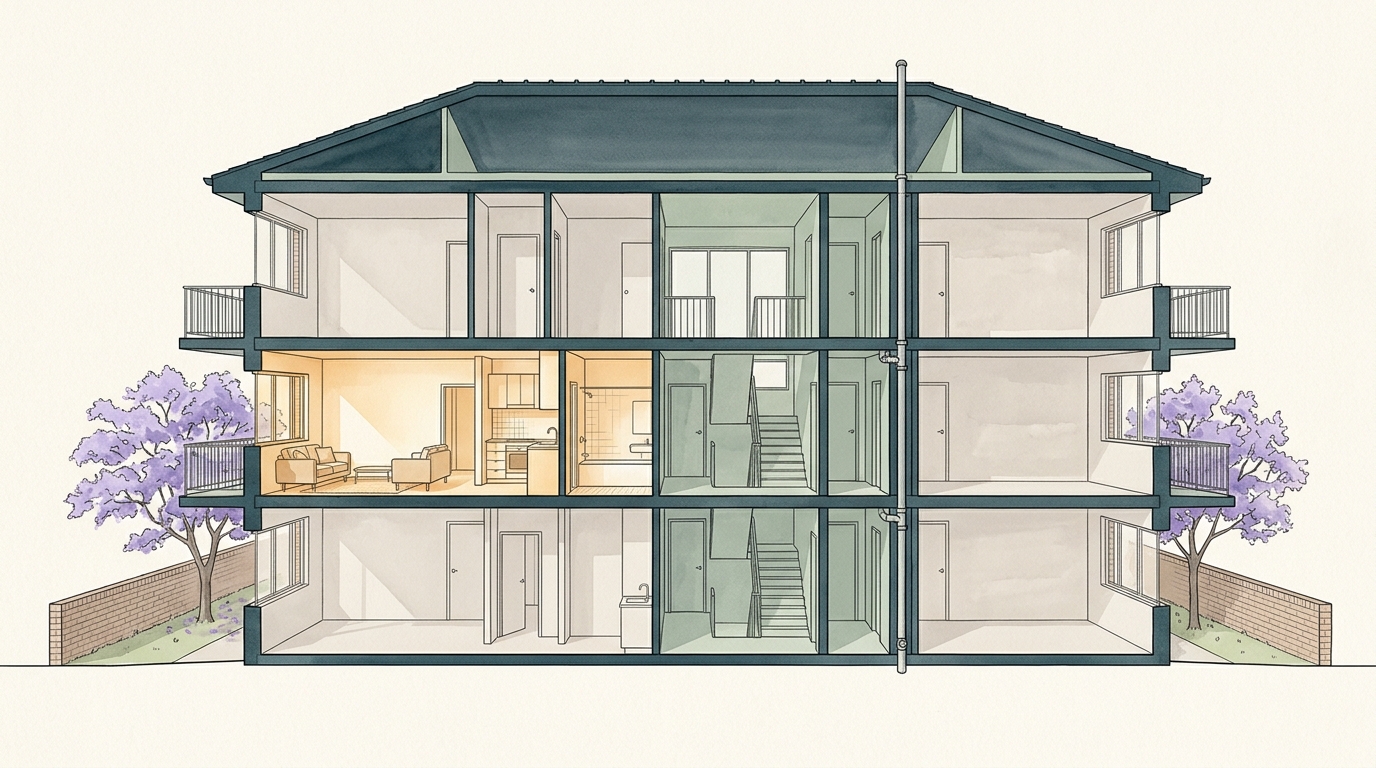
Picture your apartment as a box
Imagine lifting the roof off a typical Sydney brick walk-up or modern apartment tower. Your lot is the cubic space inside your apartment — the air, the paint on the walls, the carpet on the floor, your kitchen cupboards and your internal non-structural walls.
The box holding that space together — the concrete slab under your feet, the ceiling slab above your head, the brick or concrete external walls, the roof, the stairwell and the vertical plumbing stacks running down the building — is common property.
Click the numbered markers on the cross-section below to see how NSW strata law usually divides the building parts that cause the most arguments.
Interactive cross-section
Where your lot ends and common property begins
Bathroom waterproofing membrane
Common propertyWho pays
Usually the owners corporation, unless a past owner's renovation by-law shifted it to the lot.
The usual NSW rule
Your tiles and grout are inside the lot, but the waterproof membrane underneath sits on the boundary slab.
The catch
If an earlier owner renovated the bathroom under a common property rights by-law, that by-law almost always makes the lot owner responsible for the new membrane.
Part-by-part: who usually pays
This table gives the standard starting point for a NSW strata plan registered from 1 July 1974 onwards. It is the baseline, not the final word, because your building's plan or by-laws can override parts of it.
| Building element | Usually common property (owners corporation) | Usually your lot (lot owner) |
|---|---|---|
| Walls and ceilings | External walls, structural load-bearing walls, boundary walls between two lots, ceiling slabs | Paint, wallpaper, plasterboard finishes on internal faces, non-structural partition walls wholly inside your lot |
| Floors and waterproofing | Structural floor slabs, original waterproofing membranes under bathrooms and balconies | Carpet, floorboards you installed, tiles and grout on the surface |
| Windows and doors | External windows, glass, tracks, rollers, seals, balcony sliding doors, front entry door on a boundary wall (unless a by-law says otherwise), window safety devices (s 118) | Internal doors, flyscreens you added, blinds, curtains, extra deadbolts you installed, cleaning glass you can safely reach |
| Plumbing and drains | Main vertical stacks, pipes inside concrete slabs or boundary walls, any pipe serving more than one lot | Branch pipes serving only your lot, taps, mixers, toilets, vanities, flexible braided hoses under sinks |
| Hot water | Central hot water plant serving multiple lots | An individual hot water unit serving only your lot, even if it sits in a cupboard on the balcony or hallway |
| Balconies and courtyards | Structural concrete slab, original membrane, balustrades and external drainage outlets | Surface finishes inside the lot boundary, pot plants and furniture (within slab load limits) |
The bathroom membrane trap
Waterproofing is where almost every new owner gets tripped up — and it is no small issue, accounting for roughly 42% of serious defects in NSW Class 2 apartment buildings according to Building Commission NSW research.
Picture this: your downstairs neighbour knocks on your door with a photo of a brown stain spreading across their bathroom ceiling. Your tiles look spotless. Naturally, they blame your shower, and a rushed strata manager may email you saying "get a plumber in at your cost."
Slow down. Look closely at what sits under your feet:
Click the diagram to enlarge it and read what each numbered layer does. The breached side shows how water can pass through the tile bed, find a membrane defect and appear as a ceiling stain below.
Your tiles and grout are inside your lot, so re-grouting or replacing cracked silicone is normally your job. The waterproof membrane beneath the screed, however, is usually common property on an original bathroom. If that membrane has split or failed, fixing it — and reinstating the tiles ripped up to reach it — is the owners corporation's responsibility under section 106.
The big exception is if you, or a previous owner of your apartment, renovated the bathroom under a common property rights by-law (section 142). Renovation by-laws almost always transfer ongoing maintenance of the new waterproofing membrane to the lot owner. That obligation travels with the lot when it is sold, so a renovation done six years before you bought the place can still make the membrane your bill.
Three documents that can move the boundary line
Never rely solely on a general rule of thumb when thousands of dollars are on the table. Three documents decide the real answer for your specific building:
1. Your registered strata plan
Your building's strata plan, registered with NSW Land Registry Services under the Strata Schemes Development Act 2015, has the final say on boundaries.
Watch out for older NSW plans registered before 1 July 1974. Under earlier legislation, boundaries were sometimes drawn to the centre line of walls or the outer edge of structures rather than the inner face. A pre-1974 strata plan in Randwick or Neutral Bay can allocate balconies, windows or garage doors very differently from a 2015 tower in Parramatta. Check the thick boundary lines and notations on the registered plan itself.
2. The Common Property Memorandum
The NSW Government publishes a common property memorandum prescribed under the Strata Schemes Management Regulation 2016 cl 27. It sets out a clear, item-by-item table covering everything from intercoms and exhaust fans to clotheslines and hot water heaters.
Here is the catch: it only legally binds your building if your owners corporation has formally adopted it as a by-law under section 107. Even if your scheme has not adopted it, committees and tribunals treat it as a practical starting point, so it is worth reading.
3. Common property rights by-laws
Under section 142 and section 143, an owners corporation can pass a special resolution (with the written consent of the benefiting owner) granting exclusive use or special privileges over a piece of common property — such as a courtyard, rooftop terrace, car space, or an owner's bathroom renovation works.
Under section 144, that by-law must state who is responsible for maintaining and repairing that area. If it shifts maintenance onto the lot owner, the owners corporation is off the hook for that part.
The secretary must keep an up-to-date, consolidated copy of your scheme's by-laws (section 141). Ask for it, alongside your strata plan, before you agree to pay for any borderline repair.
The owners corporation's strict repair duty
Once an item sits on the common property side of the line, the legal rule is blunt. Under section 106 of the Strata Schemes Management Act 2015, the owners corporation must properly maintain and keep in a state of good and serviceable repair the common property.
That duty is strict. A committee cannot legally duck a common property repair by saying:
- "We don't have enough money in the capital works fund this year."
- "We're waiting to see if the builder will come back and fix it."
- "The insurance company declined the claim."
- "The committee voted to defer it until next year's AGM."
There are only two narrow legal ways out: passing a special resolution under section 106(3) declaring it inappropriate to repair an item (which is only allowed if leaving it won't affect safety or detract from the building's appearance), or transferring maintenance through a valid section 142 by-law with the owner's written consent.
Your right to claim damages — now a 6-year window
If the owners corporation breaches section 106 and you suffer reasonably foreseeable loss — such as ruined carpet, lost rent while a unit is uninhabitable, or alternative accommodation costs — you can claim damages under section 106(5), confirmed by the NSW Court of Appeal in Vickery v The Owners – Strata Plan No 80412 [2020] NSWCA 284.
From 1 July 2025, NSW tripled the time limit under section 106(6) from two years to six years from when you first became aware of the loss. You still have a duty to mitigate your loss (for instance, reporting leaks promptly rather than letting damage worsen), and you should avoid ripping up common property yourself without written approval.
What to do when something breaks
- Pin down the boundary first. Check the table above, then pull your registered strata plan and consolidated by-laws to see if a pre-1974 boundary, Common Property Memorandum or renovation by-law changes the answer.
- Put it in writing on day one. Email the strata manager and committee secretary with dated photos, explain why it sits on common property, cite section 106, and ask for a concrete response within 14 to 28 days.
- Do not jump in with DIY repairs on common property. Unauthorised repairs to slabs, membranes or external windows can make cost recovery far harder later.
- Escalate cleanly if nothing moves. Since 27 October 2025, NSW Fair Trading can investigate neglected maintenance directly, alongside free mediation and NCAT orders — we cover the full playbook in Repairs and Disputes: mediation, then NCAT.
Check your understanding
1. Your original, unrenovated shower leaks through the floor into the apartment below. Your tiles and grout look intact. Whose job is the failed waterproofing membrane in a post-1974 NSW building?
2. The committee says the building cannot afford to fix the leaking common roof until next financial year. Is a tight budget a valid legal defence in NSW?
3. Your individual electric hot water tank sits in a small cupboard outside your front door on the landing, serving only your apartment. Who usually pays when it rusts out?
Go deeper
General information only, not legal advice.