
Levies and money
The Admin Fund and the Capital Works Fund
Why every NSW strata scheme runs two separate funds, what each one pays for, the 3-month rule for borrowing between funds, the $30,000 two-quote rule, and when your scheme needs an audit.
8 min read · Last checked
Look at any NSW levy notice and you will see your total split into two lines: the Administrative Fund and the Capital Works Fund. New owners often wonder why the building doesn't just chuck everything into one big bank account and pay invoices as they arrive.
There is a good reason the law forbids that. Without a wall between everyday bills and long-term capital savings, committees inevitably raid the roof-replacement kitty to soften this year's insurance jump — leaving everyone staring down a $25,000 special levy five years later when the roof finally fails.
The short version
- Administrative fund (s 73): Pays recurring, day-to-day running costs — insurance, cleaning, gardening, common electricity, management fees, routine servicing and small repairs.
- Capital works fund (s 74): Pays big, discrete, infrequent renewals — repainting the building, replacing the roof, modernising lifts, waterproofing membranes and major plant. (NSW renamed the old "sinking fund" to "capital works fund" on 30 November 2016.)
- Borrowing between funds triggers a 3-month clock (s 76). A scheme can temporarily pay a bill from the other fund, but must hold a general meeting within 3 months to decide whether and how to pay it back.
- Spending controls apply to both funds: Work over $30,000 needs at least 2 independent quotes in every NSW scheme (s 102), and schemes with more than 100 lots or an annual budget over $250,000 must have their accounts audited every year (s 95).
Everyday upkeep vs decade-scale renewals
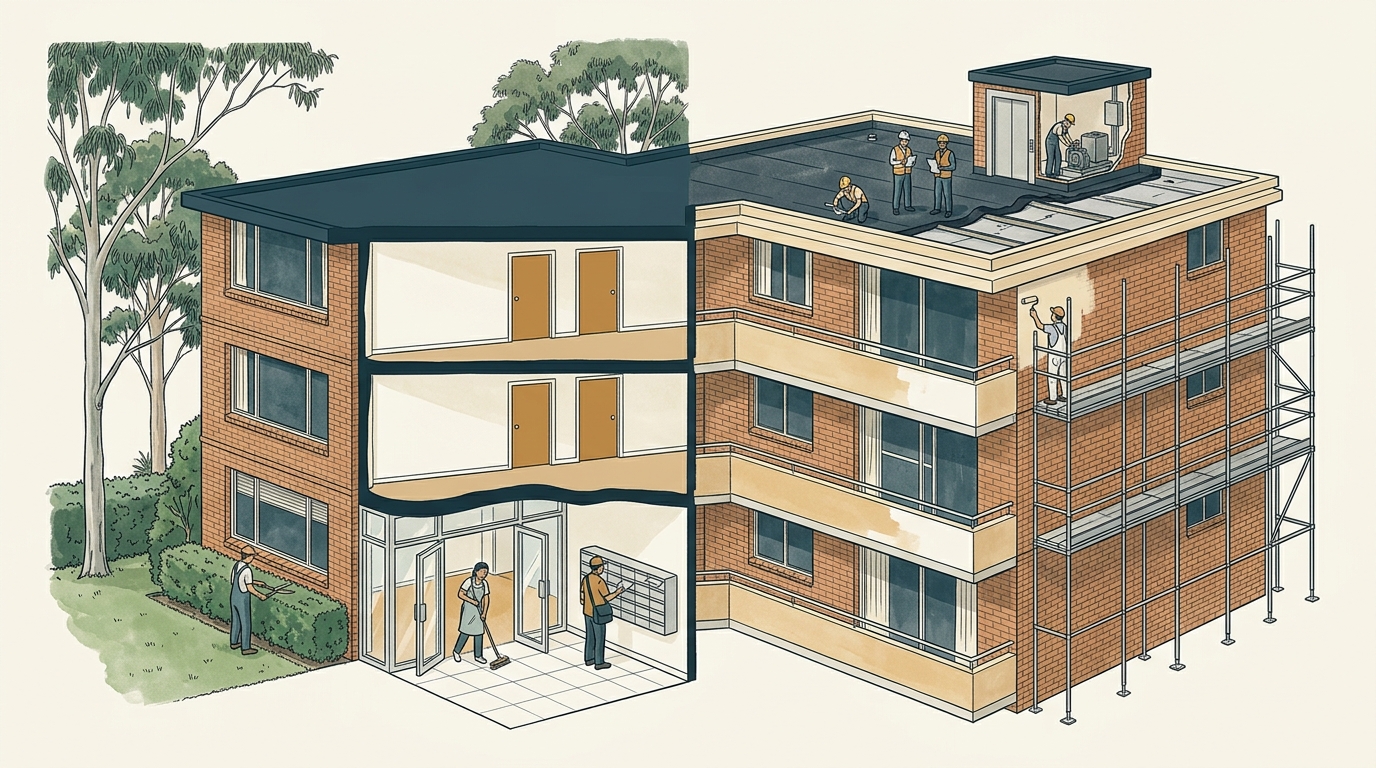
What goes into each fund
A simple two-question test sorts nearly every invoice accurately:
- Does this bill recur every year or two to keep the building operating? Administrative fund.
- Is this a discrete, named project replacing or renewing a major asset with a 10-to-30-year lifespan? Capital works fund.
Test your instincts on six real NSW strata invoices below.
Interactive practice
Which fund pays the bill?
Annual building insurance premium
Scaffolding & full exterior repaint
Weekly foyer cleaning & gardening
Replacing a 25-year-old lift motor
Common hallway & garage electricity
Replacing a failed rooftop waterproofing membrane
Side-by-side breakdown
| Category | Administrative Fund (s 73) | Capital Works Fund (s 74) |
|---|---|---|
| Insurance | Annual building, public liability, office-bearers and fidelity premiums (often 30–50% of the admin budget) | Rarely used for insurance premiums |
| Management & compliance | Strata managing agent fees, building manager contract, annual fire safety statement (AFSS) inspections, Strata Hub fee, audit fees | Commissioning the 10-year capital works plan or major engineering defect reports |
| Utilities & upkeep | Common-area electricity, water, gas, foyer cleaning, lawn mowing, bin room service, pest control, gutter cleaning | Major energy retrofits (e.g. full LED conversion, solar array, EV backbone infrastructure) |
| Building fabric & plant | Monthly lift maintenance contract, patching a small leak, replacing a broken foyer lock, fixing a single garage remote sensor | External repainting (explicitly listed first in s 79(2)(a)), roof replacement, waterproofing remediation, lift modernisation, replacing fire panels, driveways, common carpets |
Why accounting separation matters
Both funds must be accounted for separately in the financial statements presented at the AGM (s 94). Interest earned on your capital works savings stays inside the capital works fund — it does not quietly pad the admin fund. All scheme money must sit in an account in the owners corporation's own name, or in the strata managing agent's regulated trust account (s 78).
The only exemption: Under section 74(5), a two-lot scheme (such as a pair of physically detached townhouses) may opt out of maintaining a capital works fund only if the buildings are physically detached, no building sits outside the lots, and both owners pass a unanimous resolution. Every other NSW scheme must run both funds.
Borrowing between funds (the 3-month transfer rule)
Real life doesn't always wait for the AGM. Suppose an unexpected $12,000 insurance surcharge lands and the admin fund only has $4,000 sitting in cash, while the capital works fund holds $95,000.
Under section 76, a scheme with more than two lots can temporarily pay an expense from the other fund or transfer money between the two funds — with one strict catch. Within 3 months of the transfer, the owners corporation must hold a general meeting to determine whether (and how) to levy contributions to reimburse the borrowed fund.
Spending limits, quotes and audits
Three statutory guardrails stop money slipping quietly out the door:
1. Two independent quotes over $30,000
Across every NSW strata scheme (regardless of size), section 102 and Strata Schemes Management Regulation 2016 clause 25 require at least two independent quotes for any proposed spending over $30,000 (including GST).
Genuine emergencies are excluded, and if two independent quotes are genuinely impossible to obtain (for example, proprietary lift parts from a single manufacturer), the secretary must explain why on the agenda of the next general meeting.
2. The 10% cap for large schemes
If your building is a large strata scheme (more than 100 lots under section 6), section 102 also caps spending on any budget line item to the AGM estimate plus 10% unless owners approve more at a general meeting (again excluding genuine emergencies).
3. When your accounts must be audited
Under section 95, an owners corporation must have its financial statements audited to Australian Auditing Standards before the AGM if either:
- It is a large strata scheme (more than 100 lots), or
- Its annual budget exceeds $250,000.
Two-lot schemes are exempt; smaller schemes can still vote voluntarily at the AGM to commission an audit (often wise before changing managers or after big capital projects).
Watch out for a common line from strata managers: "Our trust account is already audited every year for Fair Trading." That trust account audit checks the agency's compliance as a licensee — it is not an audit of your building's financial statements.
How to read your building's financial statements in 5 minutes
Before every AGM, the notice must include a Statement of Key Financial Information (s 94, Schedule 1 cl 9). You can also request the full financial statements at least 2 days before the meeting (Schedule 1 cl 10). Check four numbers first:
- Closing Admin Fund balance vs annual admin spend: A healthy buffer is usually 2 to 3 months of operating costs so an early insurance invoice doesn't bounce.
- Actual vs Budget variances: Look for any line that ran 20%+ over budget — especially insurance, Schedule B strata management fees, or reactive plumbing.
- Capital Works Fund balance vs 10-year plan: Does the cash on hand match what the plan says you should have saved by this year?
- Levy arrears: If unpaid levies equal more than 5–10% of the annual budget, cash flow is under strain and recovery needs attention.
Check your understanding
1. Your 24-lot block needs to repaint the entire exterior brick and rendered facade for $58,000. Which fund pays, and how many quotes are legally required?
2. Your committee uses $15,000 from the Capital Works Fund to pay an unexpectedly high building insurance invoice. What must happen next under section 76?
3. A 45-lot scheme has an annual budget of $290,000. Is an annual financial audit compulsory under section 95?
Go deeper
General information only, not legal advice.