
Your apartment
Repairs: Getting the Owners Corporation to Act
How to make a NSW owners corporation repair common property under section 106, the 6-year damages window, Fair Trading's direct enforcement powers, right of entry under section 122, and a copyable repair letter.
9 min read · Last checked
A leaking ceiling above your bed, damp creeping across the bedroom plaster, a balcony door that won't lock, or mould flowering behind the wardrobe after every storm — nothing tests an owner's patience faster than reporting a common-property problem and getting silence in return.
The good news in New South Wales is that the law is decisively on your side. Section 106 of the Strata Schemes Management Act 2015 imposes one of the strictest repair duties in Australian property law — and two major 2025 reforms (tripling your damages time limit to 6 years and handing NSW Fair Trading direct enforcement powers) have made stalling far riskier for passive committees.
The short version
- The duty to repair common property is strict (s 106). No money in the bank, waiting on a builder, an insurer declining a claim, or a committee vote to "defer until next year" are not legal defences.
- You have 6 years to claim damages (s 106(5)–(6)). Extended from 2 years on 1 July 2025, covering foreseeable losses such as internal repairs, lost rent or alternative accommodation.
- NSW Fair Trading can now step in for free. Since 27 October 2025, Fair Trading can investigate neglected maintenance, inspect records, issue compliance notices (s 188T) and accept enforceable undertakings (s 188X).
- Don't DIY common-property repairs without written consent. Fixing common property unilaterally can sabotage cost recovery and cut down damages if you obstruct the scheme's own repair method.
- Access into your lot (s 122, s 124): Outside emergencies, the building needs your consent (or an NCAT access order) to enter your apartment.
Common building services vs individual lot plumbing
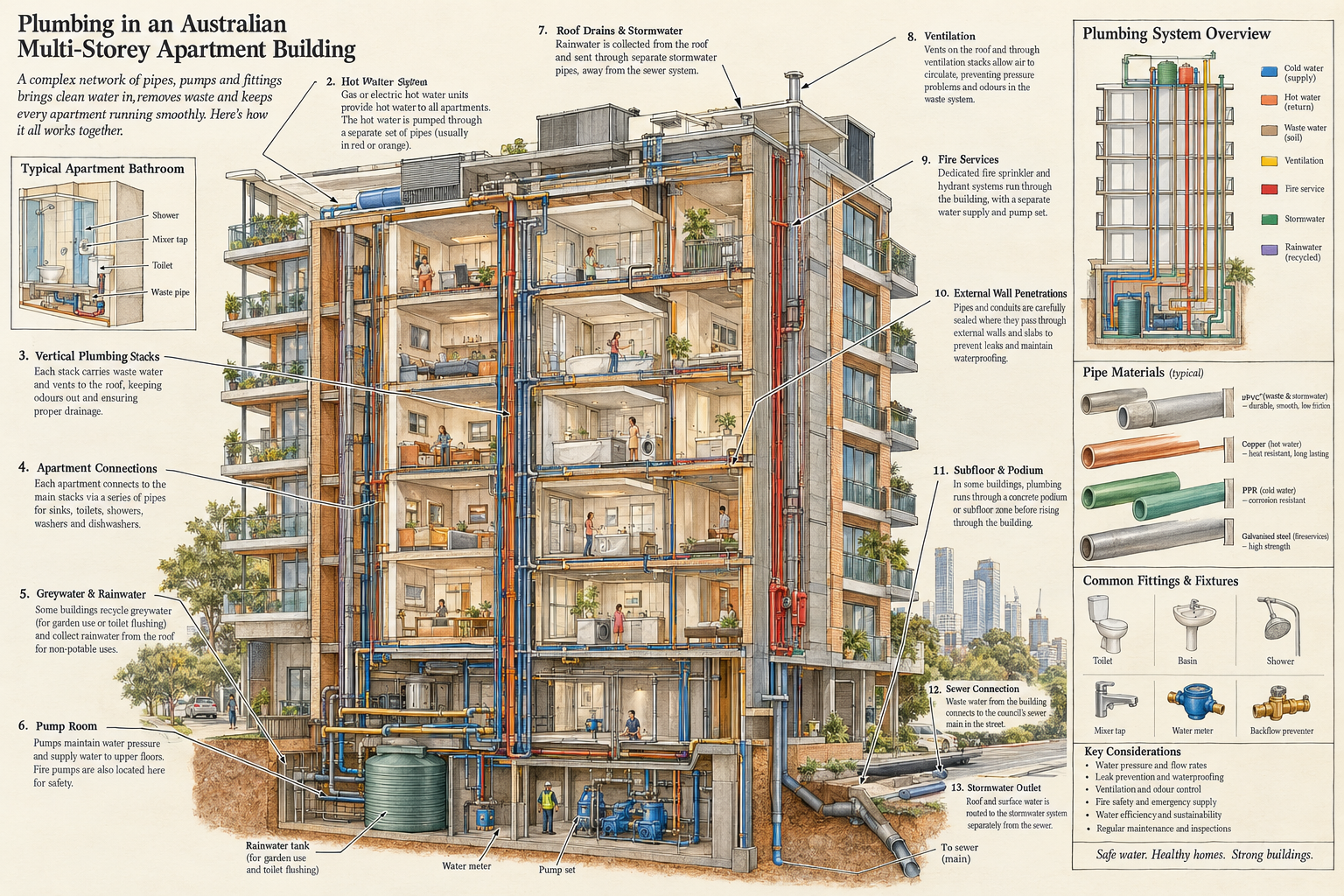
What the strict repair duty means in practice
Under section 106(1)–(2), the owners corporation must properly maintain and keep in a state of good and serviceable repair the common property, and renew or replace fixtures and fittings when needed.
Courts and NCAT have drawn clear boundaries around that duty:
- Owners can recover damages: In Vickery v The Owners – Strata Plan No 80412 [2020] NSWCA 284, the NSW Court of Appeal confirmed that lot owners can claim statutory damages at NCAT under section 106(5) when a breach causes reasonably foreseeable loss — such as lost rent, ruined flooring or specialist reports.
- No need to upgrade unknown, unbroken original items: In Ridis v Strata Plan 10308 [2005] NSWCA 246, the Court of Appeal held an owners corporation didn't have to commission an expert or upgrade older annealed front-door glass when it had no reason to know it was dangerous.
- Once it knows (or should know) something is unsafe, it must act: In SP 36613 v Doherty [2021] NSWCATAP 285, the NCAT Appeal Panel distinguished Ridis and ordered the owners corporation to replace an unsafe rooftop balustrade under section 106 because it knew or ought to have known of the hazard.
That distinction is why putting the problem in writing with dated photos immediately matters so much: it removes every trace of "we didn't know about it."
Two narrow exceptions — and one owner trap
The owners corporation only escapes section 106 if it passes a special resolution under section 106(3) deciding it is inappropriate to repair an item (only allowed where safety and appearance aren't affected), or if a valid section 142 by-law shifted maintenance to a lot owner with their written consent.
The owner trap: DIY repairs on common property. Suppose your bathroom membrane fails, the committee drags its heels, so you hire your own tiler to rip up the tiles and redo the floor — then send the owners corporation a $14,000 invoice. Do not do it. Unapproved work on common property breaches section 108, can let the owners corporation refuse reimbursement, and can see NCAT trim your rental-loss damages if your actions obstructed the scheme's own repair method. Only arrange emergency make-safe work if water is actively flooding and the emergency strata contact cannot be reached — and document every call attempt.
The five-step playbook to get common property fixed
- Day 1: Written s 106 notice to chair & manager with photos + 14–28 day deadline
- If stalled: lodge Sch 1 cl 4 motion (or 25% EGM requisition under s 19)
- Free escalation: report s 106 breach to NSW Fair Trading (ss 188T/188X)
- Free Fair Trading strata mediation (mandatory before NCAT under s 227)
- NCAT application for binding repair order (s 232) + damages (s 106(5))
Copyable repair notice letter
Common property repair notice (section 106)
[Your name]
Owner of Lot [lot number], Unit [unit number], Strata Plan [SP number]
[Your email] · [Your phone]
[Date]
To the Secretary and Strata Managing Agent
The Owners – Strata Plan No [SP number]
Notice of common property defect / repair required under section 106 — Lot [lot number]
Dear Secretary and Strata Manager,
I am writing to report a common property maintenance issue affecting Lot [lot number] and to request repair under section 106 of the Strata Schemes Management Act 2015.
1. Location and problem
[Describe plainly: e.g. "Active water leak coming through the bathroom ceiling above the vanity during rain / when the unit above showers. Paint is bubbling and mould is forming on the plasterboard."]
2. Why this is common property
[e.g. "The water is entering through the concrete ceiling slab / external facade wall / roof above Lot [number], which is common property under the registered strata plan."]
3. Evidence attached\
- Dated photographs taken on [date(s)]
- [Optional: Plumber's / leak detector's inspection note dated [date]]
4. Impact and access
[e.g. "The leak is damaging internal finishes and affecting habitability / my tenant's quiet enjoyment. I can provide access for a licensed inspector or contractor on [days/times] with reasonable notice."]
5. Next steps requested
Please confirm receipt of this notice and advise in writing within [14 / 28] days of the date the owners corporation will inspect and schedule permanent repairs. If I do not receive a clear plan and timetable by [deadline date], I will need to escalate the matter through NSW Fair Trading and, if necessary, NCAT.
Kind regards,
[Your name]
Owner of Lot [lot number]
Right of entry: when can strata enter your apartment?
Repairs frequently require a plumber, waterproofer or fire inspector to step inside your apartment — or inside a reluctant upstairs neighbour's unit to test a leaking shower.
Under section 122 of the Strata Schemes Management Act 2015:
- Emergencies: The owners corporation (and its contractors) can enter at any time without notice if there is an emergency — such as a burst pipe, gas leak or fire hazard.
- Non-emergencies: Unlike some states, NSW sets no fixed 7-day notice formula in the Act — entry requires the occupier's consent at a mutually agreed time. If an owner or tenant unreasonably refuses entry needed to inspect or repair common property, the owners corporation can apply straight to NCAT for an access order under section 124 (no mediation required).
- Obstruction & damage: Obstructing lawful entry is an offence under section 122. Equally, the owners corporation is liable for any damage it causes to your lot while carrying out work (unless you obstructed or hindered it).
If your own tenant is refusing access for a common-property repair or Annual Fire Safety inspection, work with your property manager promptly — the owners corporation can seek a section 124 order directly against the occupier if needed.
Check your understanding
1. A roof leak damaged your tenant's bedroom ceiling in August 2025, forcing you to cut rent by $120 a week while the committee stalled for 9 months. How long do you have under section 106(6) to claim damages from when you first became aware of the loss?
2. Your committee has ignored three written notices about spalling concrete and water ingress on the common corridor for 5 months. What free government enforcement step became available in NSW on 27 October 2025?
3. A plumber needs to enter the apartment above yours to flood-test a suspected leaking shower membrane. The upstairs owner refuses to answer emails or let anyone in. What can the owners corporation do?
Go deeper
General information only, not legal advice.