
How Victorian owners corporations work
What you own: your lot and common property
How Victorian Plans of Subdivision draw the boundary between your lot and common property, what the Damjanovski balcony ruling changed, and how unlimited and limited OCs work.
6 min read · Last checked
On this pageThe three boundary notationsOn this page
When a pipe leaks inside a wall, a balcony tile lifts, or a window frame rots, the first question in Victoria is not "who is being reasonable". It is: where does your Plan of Subdivision draw the boundary?
Every Victorian strata property — whether it is a 1960s St Kilda brick walk-up, a Southbank tower, or a pair of townhouses sharing a driveway — is created when a Plan of Subdivision setting aside common property is registered with Land Use Victoria under the Subdivision Act 1988. Victoria does not have a separate community title Act; the same subdivision framework creates every owners corporation (OC).
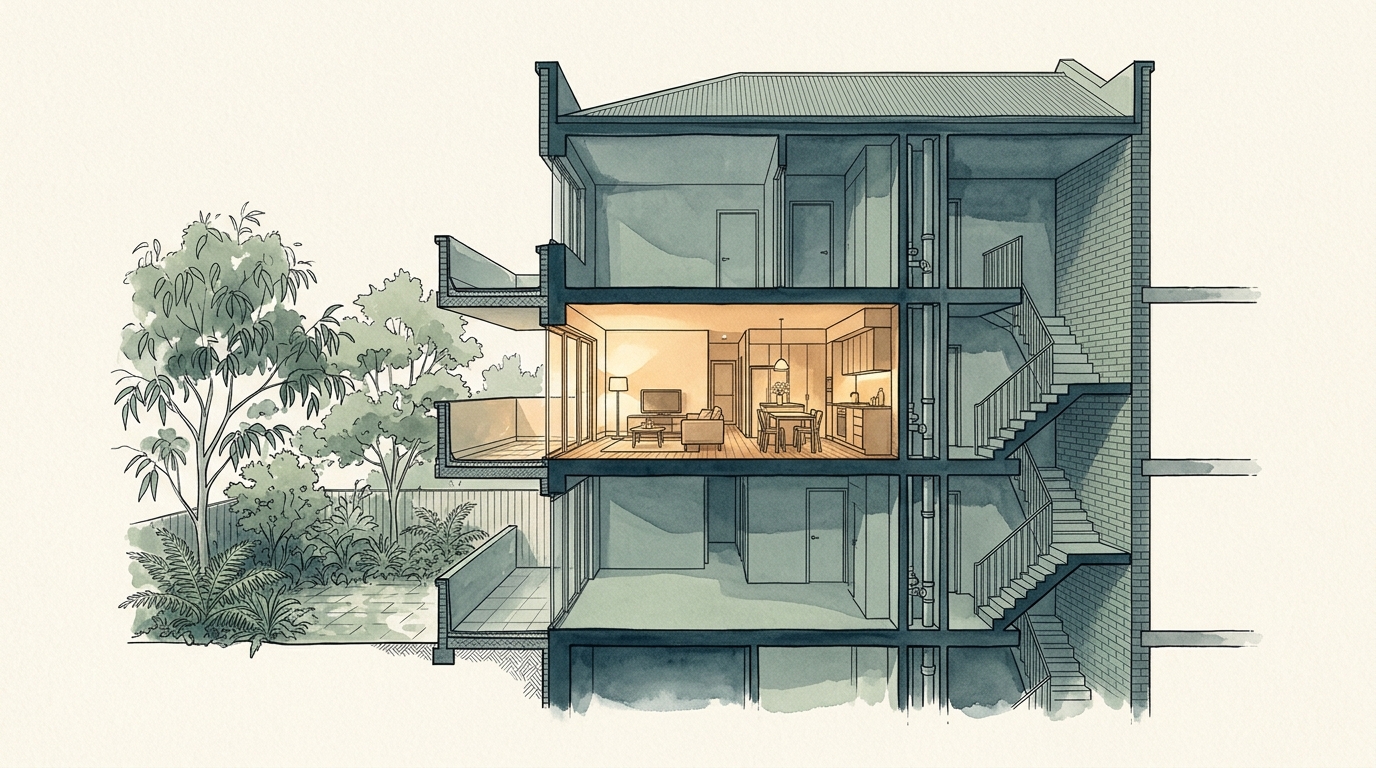
The three boundary notations
Unlike New South Wales, where a single statutory default applies to most strata plans, Victorian Plans of Subdivision explicitly state which boundary rule applies to the buildings on the plan. Look for the notation on your plan (usually in the legend or on the building sheets):
- Interior face: The boundary sits on the inside surface of the walls, floors and ceilings. You own the airspace and internal finishes inside your apartment; the structure, external walls and roof are common property. This is the most common notation in Melbourne apartments.
- Median: The boundary runs down the middle of walls, floors and ceilings. You own the inner half of shared walls and floors; the outer half is common property (or the neighbour's lot). Common in older 1960s–1980s blocks and townhouses.
- Exterior face: The boundary sits on the outside surface of the building. You own the entire structure of your dwelling, including external walls and roof, while the OC typically owns only the shared driveway, gardens and underground services.
Explore how each boundary notation shifts responsibility across common apartment components:
Interactive Plan of Subdivision Explorer
Interior face, median, or exterior? How Victorian boundaries move the bill
Lot ends at the painted/finished inner surface of walls, floors and ceilings.
Owners corporation maintains the structural slab, external walls, roof, and balcony floor layers beneath the surface (confirmed by the Victorian Supreme Court in Damjanovski, Oct 2026).
The Damjanovski ruling and balcony waterproofing
For twelve years, Victorian tribunals followed Owners Corporation PS508732B v Fisher [2014] VCAT 1358, treating an "interior face" boundary as sitting at the top of the concrete slab. Under that reading, balcony tiles, screed and waterproofing membranes sat inside the owner's lot, leaving individual owners to pay for leaking balconies.
On 8 October 2026, the Supreme Court of Victoria overturned that approach in Damjanovski v Owners Corporation 1 Plan No. PS503570D [2026] VSC 656. Justice Harris held that on a 2003 interior-face plan governed by the Subdivision (Procedures) Regulations 2000, where balcony tiles were laid before registration, the tiles, screed and waterproofing membrane are all common property — not lot property.
The practical consequences are significant:
- The OC must do the repair: Because the balcony floor layers are common property, the repair duty falls on the OC under s 46 of the Owners Corporations Act 2006. The OC cannot use a s 48 lot-repair notice to force the owner to fix common property.
- Who pays can still be argued: Justice Harris left open whether the OC can recover some or all of the cost from the balcony owner under the benefit principle (s 24(2A) and s 49), because the balcony benefits that lot more than others.
- Check your plan's registration date: Plans registered after 2011 sit under the Subdivision (Registrar's Requirements) Regulations 2021, which expressly include internal coverings and waterproof membranes within the "relevant parcel" — though Justice Harris noted even that wording can be ambiguous on a balcony slab. Always check the exact plan notation and registration date before accepting a repair bill.
Repair duties on each side of the line
Once you know where the boundary sits, the Act divides responsibility cleanly:
- Common property (s 46): The OC must repair and maintain common property and common services (s 47).
- No DIY on common property (s 47A): A lot owner must not repair, alter or maintain common property unless expressly authorised by the OC as its agent.
- Lot property affecting others (s 129): You must keep any part of your lot that affects the outward appearance of the building, or the use and enjoyment of other lots or common property, in good and serviceable repair.
- Decorating inside (s 132): You have a statutory right to paint, wallpaper and attach fixtures to an interior-face boundary wall, provided you do not damage common property.
Unlimited and limited owners corporations
A single Victorian Plan of Subdivision can create more than one owners corporation under the Subdivision Act 1988:
- Unlimited OC (OC 1): Every plan with multiple OCs has one unlimited OC that covers the entire development — typically the main structure, roof, fire systems and shared driveways.
- Limited OCs (OC 2, OC 3, etc.): Separate OCs that cover only specific lots and their dedicated facilities — for example, a residential tower's lifts and lobby in OC 2, while ground-floor retail shops sit in OC 3 and pay nothing toward the residential pool.
If you buy in a mixed-use or staged Melbourne development, check how many OCs affect your lot. You will receive separate fee notices, separate AGM packs and separate rules from each one.
Check your understanding
1. What did the Supreme Court of Victoria decide in Damjanovski (2026) about balcony tiles and waterproofing on a 2003 interior-face plan?
2. Which boundary notation is most common in Melbourne apartment buildings where the OC owns the external walls, slab and roof?
3. Why might a Melbourne apartment owner receive fee notices from both OC 1 and OC 2?
Go deeper
General information only, not legal advice.