
Self-Management & Software
Two-Lot Strata Schemes and Duplexes: How They Work and What Happens When You Disagree
A duplex on strata title is a two-person owners corporation. This guide covers which rules each state relaxes for two-lot schemes, what both owners still have to do, how insurance and costs are shared, how to break a deadlock when nobody has a casting vote, and how to sell your half or end the scheme.
By Buddy · · 13 min read
On this pageThe owner briefingOn this page
- The owner briefing
- Quick answers
- What is a two-lot strata scheme?
- Do both duplex owners need strata insurance?
- What happens when the two owners disagree?
- Can you terminate a two-lot strata scheme and go to Torrens title?
- What a two-lot scheme is
- What each state relaxes
- What both owners still have to do
- Deadlock: nobody has the casting vote
- How to break it, in order
- Money: who pays what
- Selling your half
- Ending the scheme
- The state-by-state picture
- A checklist for the two owners
- A two-owner agreement outline
- How UnitBuddy fits
- Related reading
- Sources and further reading
The owner briefing
- A two-lot scheme is a full strata scheme with two owners. Most states relax the paperwork, but the duty to insure and repair what you share stays.
- When the two of you disagree, there is usually no casting vote. A 1–1 vote fails, and the next stop is mediation, then a tribunal.
- Write down how you will share insurance, the roof, the driveway and the bills before you need them. That one page does more work than any meeting.
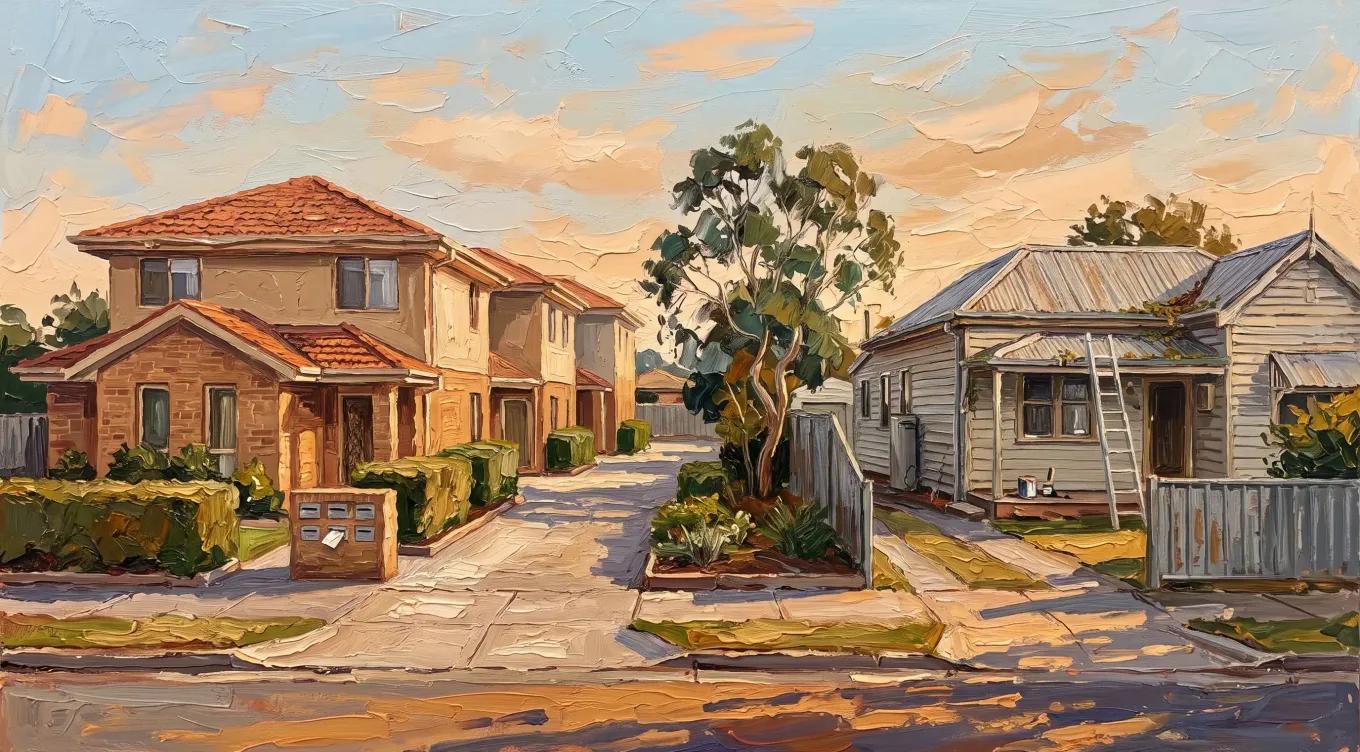
A duplex looks like two houses. On paper it is often one strata scheme with two lots and an owners corporation (or body corporate, or strata company) made up of exactly two people. That works well while you get on. It gets awkward the first time the roof leaks and only one of you thinks it needs replacing.
This guide covers what each state relaxes for two-lot schemes, what it doesn't, and what to do when the two of you can't agree. It is general information, not legal advice. The rules below were checked against the legislation and official guidance as at 19 November 2026.
Quick answers
What is a two-lot strata scheme?
It is a strata or community titles scheme with only two lots, usually a duplex, a pair of townhouses or a house with a granny flat on its own title. The two owners make up the owners corporation. Each state treats them as a full scheme but switches off some duties. NSW gives them an automatic committee of one owner per lot, Victoria exempts them from most of the Owners Corporations Act, and Queensland lets them make decisions by written agreement if their community management statement adopts the two-lot module.
Do both duplex owners need strata insurance?
Usually the building has to be insured as a whole, through the scheme. In NSW, detached two-lot schemes can opt out by unanimous resolution if no building sits outside the lots. Victoria does not require a two-lot owners corporation to insure common property, and Queensland's two-lot module depends on whether the buildings share a wall. Check your state in the state-by-state picture before you cancel anything.
What happens when the two owners disagree?
In most states nothing passes, because nobody has a casting vote and the quorum needs both of you. You talk first, then use the state's mediation or conciliation service, then apply to the tribunal or court. NCAT, VCAT, the Queensland Commissioner's office, SAT and ACAT can all make orders that settle the dispute.
Can you terminate a two-lot strata scheme and go to Torrens title?
Yes, in every state there is a route, but it needs both owners and usually your lenders and the council. Ending the scheme and creating two separate freehold lots are two different steps. The second needs a subdivision approval. See ending the scheme.
What a two-lot scheme is
Strata title splits land into lots and common property. In a duplex, each lot is usually half the building. The common property might be the roof, the party wall, the driveway or just the land underneath. The registered plan says which, so read it before you argue about who owns the thing that broke.
NSW Government figures put two-lot schemes at more than 30 per cent of NSW strata schemes (LookUpStrata, reporting the NSW Government, October 2026). I couldn't find an equivalent figure for the other states.
- One plan, two lots
- Two owners are the owners corporation
- Insure and repair what you share
- 1–1 vote: nothing passes
- Mediation, then tribunal
What each state relaxes
NSW. Two-lot schemes have an automatic strata committee of one owner from each lot (s 30 of the Strata Schemes Management Act 2015; NSW Fair Trading). You still hold an AGM each year, and an owner from each lot must attend, in person or by proxy (Schedule 1). No audit is needed unless the budget is over $250,000 (s 95). Since 1 October 2026, two-lot schemes no longer file the annual Strata Hub report, and their committee members are exempt from the new committee training (NSW Fair Trading). The fourth reform bill goes further and removes the need for a committee and meetings, but NSW Fair Trading lists that part as planned for 2027. Until it starts, keep holding the AGM.
Victoria. A two-lot owners corporation is exempt from a long list of sections of the Owners Corporations Act 2006 (s 7A). Consumer Affairs Victoria says it does not need to use the approved fee notice forms, insure common property, give the chair a casting vote, follow the annual meeting and ballot procedures, keep a maintenance plan or fund, or keep a register (Consumer Affairs Victoria, updated 23 April 2026).
Queensland. A two-lot scheme runs under the Specified Two-lot Schemes Module only if both lots are residential, there's no letting agent, it isn't layered, and the community management statement says the module applies (module s 3). Under that module there is no committee and no general meeting. Decisions are made by written, dated lot owner agreements signed by both owners (s 5). Many older duplexes run under the Small Schemes Module instead, which keeps a secretary, a treasurer and an AGM (Small Schemes Module s 3). Our Queensland self-management guide covers both.
Western Australia. A 2-lot strata company doesn't have to keep an administrative fund, accounts, minutes, a letterbox or a roll, unless its by-laws require them (s 140 of the Strata Titles Act 1985). It doesn't have to hold an AGM (s 127). Both owners are the council (Schedule 1, by-law 4).
ACT. An owners corporation with only 2 or 3 units can exempt itself from keeping a bank account by unopposed resolution (s 68 of the Unit Titles (Management) Act 2011). Most other duties stay.
SA, Tasmania and the NT. I couldn't find a two-lot regime in South Australia's or Tasmania's strata Acts. The NT puts small schemes on their own management module (Unit Title Schemes (Management Modules) Regulations, reg 5(2)), but I couldn't confirm the lot count that defines a small scheme. Read the Act for your scheme before relying on any exemption.
What both owners still have to do
Insure. In NSW the owners corporation must insure the building for full replacement cost (s 160). A two-lot scheme can only opt out if the two buildings are physically detached, no building sits outside the lots, and both owners pass a unanimous resolution (NSW Fair Trading). In Queensland's two-lot module, buildings with a common wall must sit on one policy with one insurer (s 50). Without a common wall, the owners can set up a voluntary insurance scheme by lot owner agreement (s 55). Public risk cover of at least $10 million is still required (s 56). WA requires replacement-value building cover (s 97), and so does the ACT (s 100).
Victoria is the odd one out. A two-lot owners corporation doesn't have to insure common property in its own name. Consumer Affairs Victoria still warns that the owners carry the risk if someone is hurt or the building is damaged, and suggests talking to an insurer. If you share a wall in Victoria, ask your insurer in writing whether your house policy covers your half of a strata building.
Maintain what you share. Every state keeps the repair duty. Queensland's two-lot module says the body corporate must keep common property in good condition (s 31). Victoria still requires a two-lot owners corporation to care for common property and repair shared services (Consumer Affairs Victoria).
Keep records. NSW Fair Trading says each owner must get the AGM minutes within seven days and records must be kept for at least seven years. In Queensland, the owners appoint a record keeper by lot owner agreement (s 70). Even where the law lets you skip minutes, keep them. When one of you sells, the buyer will ask, and so will a tribunal.
Deadlock: nobody has the casting vote
A two-lot scheme is the only kind of strata where every vote can tie. The rules mostly make that worse, on purpose:
- NSW. The quorum needs an owner from each lot. Either of you can block a unanimous resolution, and usually a special one too.
- Victoria. The chair has no casting vote. Consumer Affairs Victoria says an owner with more than 50 per cent of the lot entitlement can carry the resolutions that matter. At 50/50, the owner who wants exterior repairs done has to go to VCAT.
- Queensland. Under the two-lot module, nothing is decided without a lot owner agreement. One owner can send a written request that gives a reasonable time to respond (s 6), but silence isn't consent.
- WA. A meeting has a quorum only if both lots are represented (s 130). A special resolution or a resolution without dissent only counts if it is unanimous (s 123).
- ACT. Both members must be present for a quorum (Schedule 3, s 3.12). An ordinary resolution passes only if no vote is cast against it (s 3.15), and the chair has no casting vote in a two-member owners corporation (s 3.30).
- SA. Each unit has one vote (s 34 of the Strata Titles Act 1988), so a 1–1 ordinary vote fails. Where a unanimous resolution can't be obtained, the Magistrates Court or Supreme Court can declare a special resolution enough (s 46).
How to break it, in order
- Write it down. Say what you want done, what it costs and by when. Attach a quote.
- Get a second quote or a report. If the argument is whether the roof needs work, a licensed roofer's short report settles more than a month of messages.
- Use the free mediation step. In NSW, NCAT will usually only hear a strata dispute after mediation has been tried, normally through NSW Fair Trading (s 227). Queensland's Commissioner's office runs conciliation before adjudication under the Body Corporate and Community Management Act 1997. In Victoria, start with the grievance process in your rules.
- Apply to the tribunal. NCAT can make an order to settle a dispute about how the scheme is run (s 232) and can appoint a compulsory strata managing agent (s 237). WA's SAT hears scheme disputes (s 197) and can order a 2-lot strata company to keep funds, accounts or minutes after all (s 140). In the ACT, either owner can apply to ACAT (s 125). A Queensland adjudicator's order can be appealed to QCAT on a question of law (s 289).
A compulsory manager costs money and takes the decisions out of both your hands. That is usually a good reason to settle before it gets that far.
Money: who pays what
Sharing costs. NSW levies are shared by unit entitlement (s 83). Victorian annual fees are shared by lot liability (s 23). Queensland's two-lot module shares agreed expenses by contribution schedule lot entitlement (s 24). WA levies follow unit entitlement unless the by-laws say otherwise (s 100). Check the entitlements on your plan. They are often not 50/50.
A capital works fund. NSW requires one, with a 10-year plan (s 80). A two-lot scheme can opt out on the same three conditions as insurance: detached buildings, nothing outside the lots, and a unanimous resolution (s 74). Victoria doesn't require a maintenance fund for two lots. Under Queensland's two-lot module there's no levy cycle. Owners pay their share of agreed expenses as they come up, and a bank account is optional (s 29). WA only requires a reserve fund for schemes of 10 or more lots (s 100).
Being allowed to skip the fund doesn't mean you should. A shared roof will need replacing whether or not you saved for it. Without a fund, one owner may not have their half when it does.
When one owner won't pay. In Queensland's two-lot module, an owner who pays a defaulting owner's share can recover it from them (s 27). In NSW, unpaid levies are a debt the owners corporation can recover after written notice. Our NSW self-management guide covers the steps.
Selling your half
The buyer will want the scheme's paperwork, so keep it findable.
- NSW. A buyer can ask for a strata information certificate (s 184). In a duplex with no manager, one of you prepares it.
- Victoria. A two-lot owners corporation must still issue an owners corporation certificate within 10 business days of a request, and it goes into the vendor's Section 32 statement (Consumer Affairs Victoria).
- Queensland. The buyer gets a body corporate certificate before signing (Property Law Act 2023 s 99).
A handshake deal like "I mow, you pay the water" doesn't bind a buyer. If it matters, make it a resolution, a by-law or a lot owner agreement before you list. Our buying and selling guide covers the rest.
Ending the scheme
Ending a two-lot scheme normally takes both owners. If one refuses, the way through is a court or tribunal, not a vote.
- NSW. Any owner, a mortgagee or the owners corporation can apply to the Registrar-General to terminate a scheme (s 142 of the Strata Schemes Development Act 2015). NSW Land Registry Services requires every owner and every mortgagee to sign, and the application needs the planning authority's sign-off. The other route is a Supreme Court order.
- Victoria. Removing an owners corporation is done by a plan under section 32 of the Subdivision Act 1988, which needs a unanimous resolution. If one owner won't agree, the other can apply to VCAT.
- Queensland. A basic scheme can be terminated by a resolution without dissent plus an agreement between all owners, by District Court order, or for economic reasons with 75 per cent support (Queensland Government, updated 21 July 2026). In a two-lot scheme, 75 per cent means both of you.
- WA. A termination proposal with unanimous support doesn't need SAT confirmation. Without it, the proposal goes to SAT for review (Landgate; STA).
- SA, Tasmania, ACT, NT. Each Act has its own cancellation route. I couldn't confirm a two-lot shortcut in any of them, so read the SA Act, the Tasmanian Act, the Unit Titles Act 2001 or the NT Act and get a conveyancer's view.
One trap catches people. Terminating the scheme doesn't automatically give each of you your own house on your own title. In NSW the land can end up on one title, owned by both of you as tenants in common. Two separate Torrens lots need a subdivision the council approves, which may require easements for shared services. Talk to a surveyor and the council before you sign anything. The collective sale guide covers the large-building version of this process.
The state-by-state picture
| State | Two-lot rules | Insurance | Deadlock goes to | Ending the scheme |
|---|---|---|---|---|
| NSW | Automatic committee of both owners; AGM still required; no Strata Hub report since 1 Oct 2026 (s 30) | Required unless detached and unanimous opt-out (s 160) | Fair Trading mediation, then NCAT (s 232) | Registrar-General with all owners, or Supreme Court (SSD Act s 142) |
| Vic | Exempt from much of the OC Act (s 7A) | Not required for common property | Grievance process, then VCAT | Unanimous s 32 plan, or VCAT |
| Qld | Two-lot module if the statement adopts it: lot owner agreements, no meetings (s 5) | Common wall: one policy (s 50) | Commissioner's office, then adjudication | Without dissent, court order or economic reasons (Qld Govt) |
| WA | No admin fund, minutes, roll or AGM needed (s 140) | Required (s 97) | SAT (s 197) | Unanimous without SAT; otherwise SAT review |
| SA | No two-lot regime found (STA) | Required (s 30) | Magistrates Court (s 41A) | Check the Act |
| Tas | No two-lot regime found (Strata Titles Act 1998) | Required (Land Tasmania) | Recorder of Titles or TASCAT | Check the Act |
| ACT | Bank account optional for 2–3 units (s 68); no casting vote | Required (s 100) | ACAT (s 125) | Check the Unit Titles Act 2001 |
| NT | Small schemes use management module 3 (reg 5) | Check the Act | NTCAT | Check the Act |
In South Australia, new strata plans haven't been deposited under the Strata Titles Act since 1 June 2009 (Law Handbook SA). A newer SA duplex is more likely to be community title under the Community Titles Act 1996, which has its own rules.
A checklist for the two owners
A two-owner agreement outline
The outline isn't a contract on its own. To bind a future buyer, the parts that matter need to become a resolution, a by-law or, in Queensland, a lot owner agreement. Ask a strata lawyer which form your state needs.
How UnitBuddy fits
A two-lot scheme doesn't need a strata manager, but it does need one place where both owners can see the same thing. We built UnitBuddy to be that shared record: the plan and insurance documents, the decisions you made, the notices you sent each other, the shared assets like the roof and the driveway, and a view of the scheme's money and capital works planning. UnitBuddy isn't trust accounting and doesn't hold or move money. Your bank account still does that.
The Townhouse plan covers schemes of up to 6 lots for $199 a year plus GST for the whole building, so a duplex pays about $100 each (pricing). When one of you sells, the buyer gets the history instead of a shoebox.
Related reading
- When a Tribunal Appoints a Compulsory Strata Manager: Why It Happens and How to Get Out
- Self-managed strata in Australia: a complete 2026 guide
- Self-managed strata in NSW
- How to self-manage an owners corporation in Victoria
- Strata committee governance in Australia
Sources and further reading
- NSW Fair Trading: simple guide to holding an AGM in a two-lot scheme
- NSW Government: changes to strata laws
- PBL Law Group: general obligations of duplex two-lot strata schemes in NSW
- Consumer Affairs Victoria: two-lot subdivisions
- Queensland Government: Two-lot Schemes Module
- Body Corporate and Community Management (Specified Two-lot Schemes Module) Regulation 2011
- Queensland Government: terminate a basic community titles scheme
- Qld: owning in a duplex or two-lot scheme, via LookUpStrata
- Landgate: guide to termination of WA strata schemes
- Kott Gunning: WA quorums for resolutions without dissent and special resolutions (August 2020)
- ACT Unit Titles (Management) Act 2011, republication 25
What changed in strata this month? Read the strata news for your state, with every figure sourced.
More guides like this

Self-Management & Software
Self-Managed Strata in Australia: A Complete 2026 Guide
Yes, you can self-manage strata in every Australian state. What the committee takes on, when it works, when it doesn't, and how to switch.
30 April 2026 · 18 min read
Self-Management & Software
Opening a Bank Account for a Self-Managed Strata Scheme: What the Bank Needs and How to Set It Up
Your building's money belongs in an account in the scheme's name, never an owner's personal account. What each state's law says about accounts and funds, what a bank asks for, whether you need an ABN, TFN or GST registration, how to set up two signatories, where term deposits fit, and a sample resolution to open the account.
19 November 2026 · 12 min read

Self-Management & Software
Self-Managed Strata in NSW: How to Run Your Building Without a Strata Manager
A NSW owners corporation doesn't need a strata manager. The rules, deadlines and yearly jobs the committee takes on, and a checklist for switching.
4 November 2026 · 10 min read