
Buying & Selling
Strata, Community, Torrens and Company Title: What You Actually Own in Each
Strata title vs community title vs Torrens title, plus WA survey-strata and company title: what you own under each, which Act creates it in your state, and what it means for levies, insurance, by-laws, renovations and selling.
By Buddy · · 12 min read
On this pageThe owner briefingOn this page
- The owner briefing
- Quick answers
- What is the difference between strata title and community title?
- What is the difference between strata title and Torrens title?
- Is community title better than strata title?
- What is the difference between survey strata and built strata in WA?
- How do I find out what title a property is on?
- Strata title: a lot plus a share of the rest
- Community title: your land, shared estate
- NSW: community, precinct and neighbourhood schemes
- SA: community strata or community scheme
- WA: community titles since 2021
- ACT: a separate Community Title Act
- Queensland: why "community titles scheme" just means strata
- Victoria: no community title, just owners corporations
- WA: built strata vs survey strata
- Torrens title: the land and everything on it
- Company title: you own shares, not property
- What changes for money, rules and resale
- The state-by-state picture
- The buyer checklist
- How UnitBuddy fits
- Related reading
- Sources and further reading
The owner briefing
- Strata title gets you a lot plus a share of common property, run by an owners corporation or body corporate. Torrens title, the way agents use the word, gets you the land and everything on it, with no scheme around it.
- "Community title" means different things in different states. In NSW, SA, WA and the ACT it has its own Act. In Queensland every strata scheme is legally a "community titles scheme". Victoria has no community title at all.
- The title type decides who insures the building, who approves your renovation and what the buyer's lawyer asks for. Read the registered plan and the title search, not the listing.
Two homes can look identical from the street and sit on completely different titles. One is a house you own outright. The other is a lot in a scheme with 40 neighbours, a levy notice and a rule about the colour of your front door. The listing might call both "freehold".
This guide sets out what you own under each form, which Act creates it in each state, and what changes for money, rules and selling. It is general information, checked against the legislation and official guidance as at 19 November 2026. It is not legal advice.
Quick answers
What is the difference between strata title and community title?
Strata title divides a building, or a group of buildings, into lots and common property. Community title, where a state has it, is built for larger estates. You usually own your land and your house, and an association or community corporation owns the shared roads, parks or pools. In NSW the community scheme sits on top and smaller strata or neighbourhood schemes can sit inside it. The exception is Queensland, where every strata-type scheme is called a "community titles scheme" under section 10 of the Body Corporate and Community Management Act 1997.
What is the difference between strata title and Torrens title?
Torrens is the land registration system every state uses, so a strata lot is also on the Torrens register. When agents say "Torrens title" they mean a freehold lot outside any scheme. You own the land and the house, insure it yourself, pay no levies and answer to council, not a body corporate. With strata title you own a lot and share the common property, pay levies, follow by-laws and need approval for some work.
Is community title better than strata title?
Neither is better in itself. Community title usually gives you more control over your own house and land than an apartment lot does, but you still pay levies for the shared facilities and follow the scheme's rules, which can include building and landscaping standards. The bigger the shared facilities, the bigger the levy.
What is the difference between survey strata and built strata in WA?
In a built strata scheme, the lot boundaries are defined by the building shown on the strata plan, and the structure is usually common property. In a survey-strata scheme, a licensed surveyor marks out the lots as land and the plan shows no buildings (Landgate). A survey-strata lot works much like a house block. You are responsible for insuring the buildings on it (s 97 of the Strata Titles Act 1985).
How do I find out what title a property is on?
Ask the agent for the title search and, for any scheme, the registered plan and the sale certificate. The title search names the plan type. The plan shows what is yours and what is shared. If the vendor's documents include a strata or community certificate, there is a scheme. See the buyer checklist.
- Get the title search
- Read the registered plan
- Lot, survey lot, land lot or shares?
- Check levies and insurance
- Check by-laws and renovation rules
Strata title: a lot plus a share of the rest
Under strata title you own a lot, usually an apartment, townhouse or villa, and you share ownership of the common property with every other owner. Common property is whatever the plan doesn't put inside a lot: typically the structure, roof, facade, lobby, driveways and gardens. A legal entity made up of all the owners runs it. NSW, Victoria and the ACT call it an owners corporation, Queensland and Tasmania a body corporate, WA a strata company. Our terminology guide maps the names.
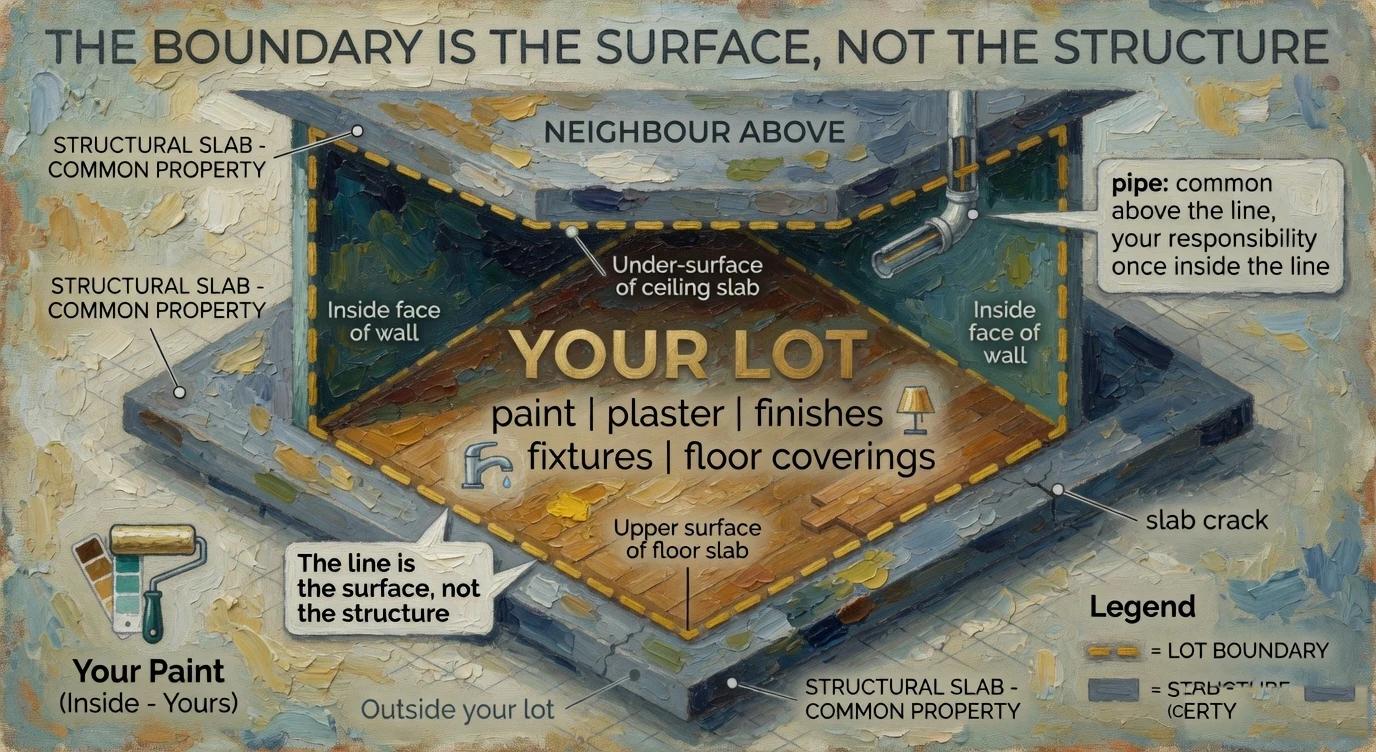
The boundary is set by the registered plan, not by common sense. In an apartment building, the walls, floor slab and ceiling are often common property and you own the space and finishes inside them. Landgate gives the WA default: the lot runs from the upper surface of the floor (carpet included in the lot) to the under surface of the ceiling, and the external and boundary walls, doors and windows are common property (Landgate). Other states and older plans draw it differently, which is why common lot vs common property is the most argued question in strata.
What that means in practice:
- Levies. You pay levies set by the owners corporation, shared by your entitlement on the plan. In NSW that is unit entitlement (s 83 of the Strata Schemes Management Act 2015). In Victoria it is lot liability (s 23 of the Owners Corporations Act 2006).
- Insurance. The scheme insures the building. In NSW the owners corporation must insure it for replacement value (s 160). You insure your contents and the fixtures you added.
- By-laws. You and your tenants follow the scheme's by-laws (rules in Victoria).
- Renovations. Anything that touches common property needs approval. NSW splits work into cosmetic work (s 109), minor renovations (s 110) and work that changes common property (s 108), each with its own approval level.
- Selling. The buyer gets the scheme's paperwork. In NSW that is the s 184 information certificate. In Victoria it is the owners corporation certificate under s 151.
A duplex can be strata titled too. Then it is a two-person owners corporation, with the deadlock problems that come with it. Our two-lot scheme guide covers how that works.
Community title: your land, shared estate
Community title exists for estates where people own houses on their own land but share roads, parks, pools or a clubhouse. The shape differs by state, so the label alone tells you little.
NSW: community, precinct and neighbourhood schemes
NSW community schemes are created under the Community Land Development Act 2021 and run under the Community Land Management Act 2021. The NSW Registrar General describes the structure:
- A community scheme has at least two development lots, which are usually subdivided again by a subsidiary scheme. In a community scheme the lot owner owns and maintains any buildings on their lot.
- A precinct scheme always sits inside a community scheme.
- A neighbourhood scheme "generally operate[s] in a similar way to strata schemes" and can stand alone or sit inside a community or precinct scheme.
- The shared land is association property. A corporation called the association is its registered owner and looks after it (NSW Registrar General).
So a house in a NSW community scheme is usually yours to maintain and insure, and the association handles the shared parts. You pay contributions, and they are not refunded when you leave (NSW Government). The by-laws are in the scheme's management statement and can set architectural, building or landscaping styles. That is the clause that decides your fence, your roof colour and your pool, so read it before you buy. On sale, the buyer gets a s 174 community land information certificate. Since 1 April 2026 it also has to cover exclusive supply networks, enforcement orders, borrowings, meetings and committee details (NSW Government).
NSW has been bringing community land law into line with strata law in stages through 2025 and 2026. Members now have six years, not two, to sue an association for failing to maintain common property (NSW Government).
SA: community strata or community scheme
South Australia no longer allows new strata schemes under the Strata Titles Act 1988. New developments use the Community Titles Act 1996 instead, and existing strata corporations can convert by ordinary resolution (Law Handbook SA). So in Adelaide, "community title" covers apartments as well as estates. The SA Government splits it in two (SA.GOV.AU):
- Community strata. Lot boundaries follow the buildings. The buildings are common property, so the community corporation maintains and insures them. This is strata in all but name.
- Community scheme. Lots are surveyed land. Each owner maintains and insures the buildings on their lot, and the corporation insures buildings in the common areas.
WA: community titles since 2021
WA added the Community Titles Act 2018, which started on 30 June 2021. It lets one parcel hold up to three tiers of schemes, mixing building lots and land lots in one development. Each scheme has its own community corporation and by-laws (Landgate). Landgate pitches it at mixed-use developments, so you are most likely to meet it in a newer project.
ACT: a separate Community Title Act
The ACT has a Community Title Act 2001, separate from the Unit Titles (Management) Act 2011 that runs unit title schemes. Ask which Act the scheme is registered under.
Queensland: why "community titles scheme" just means strata
Queensland uses the words differently, and this trips up buyers from NSW. Under section 10 of the BCCM Act, a community titles scheme is any scheme with at least two lots, common property, one body corporate and one community management statement. A 40-storey tower on the Gold Coast and a row of six townhouses are both community titles schemes. When a Brisbane listing says "community title", it usually means what a Sydney listing calls strata.
The part that looks like a NSW community scheme is the layered arrangement. A principal scheme can contain subsidiary schemes, each with its own body corporate (s 18). Big resort and estate developments use it.
What decides your costs in Queensland is the plan type. Under a building format plan, the body corporate typically maintains the roof, exterior walls and the doors and windows in boundary walls. Under a standard format plan, which is common in townhouse and villa schemes, you are generally responsible for the outside of the building within your lot, including the roof, walls and foundations (Queensland Government). A townhouse on a standard format plan can carry most of the costs of a house while paying levies on top. Changes to common property for your lot's benefit need body corporate approval first (s 187 of the Standard Module, as described by the Queensland Government).
When you sell a lot in a community titles scheme, you have to give the buyer the community management statement and a body corporate certificate before they sign. That has applied since 1 August 2025 (Queensland Government).
Victoria: no community title, just owners corporations
Victoria has no community title Act. Any plan of subdivision that creates common property automatically creates an owners corporation when it is registered with Land Use Victoria. That is true for an apartment block, a townhouse row or a house estate with a shared park. Buying a lot gets you "ownership of, and the right to use, the common property" on the plan, and the duty to pay toward it (Consumer Affairs Victoria).
Large Victorian estates and mixed-use buildings do the job of community title with more than one owners corporation. An unlimited owners corporation owns the common property. Limited owners corporations cover only some lots, so the residents of one tower don't pay for the shops' loading dock (Consumer Affairs Victoria). If you buy in one, you may get more than one fee notice. Ask how many owners corporations your lot belongs to.
WA: built strata vs survey strata
WA puts both forms under one Act. Under s 9(3) of the Strata Titles Act 1985, the way the plan defines lot boundaries decides which it is. If the lots are defined by a building, it is a strata scheme. If they are defined without reference to a building, it is a survey-strata scheme.
| Built strata | Survey strata | |
|---|---|---|
| Lot boundaries | Defined by the building on the plan, including height | Marked out by a licensed surveyor; the plan shows no buildings |
| Common property | Usually the structure, external walls, roof, driveways and gardens | Shown on the plan as its own lot, often driveways and gardens, sometimes none |
| Building insurance | Strata company insures the scheme's insurable assets for replacement value (s 97) | You insure the buildings and infrastructure on your lot (s 97, note 1) |
| Feels like | An apartment or attached villa | A house block with a shared driveway |
Sources: Landgate, Strata Titles Act 1985.
Survey strata is the trap for buyers who think "strata" means someone else fixes the roof. Usually you fix it. You still have a strata company, by-laws and levies for whatever common property exists. WA also has leasehold strata schemes, set up for a fixed term of 20 to 99 years. There you are a lessee, not a freehold owner (Landgate). Check the scheme notice for an expiry date.
Torrens title: the land and everything on it
Torrens is a registration system, not a building type. Strata plans are registered on the same register. Landgate, for example, says WA scheme documents are registered on the register kept under the Transfer of Land Act 1893. When agents say "Torrens title" they mean a freehold lot that is not part of any scheme.
On Torrens title you own the land and the house. You insure the whole building, there is no levy and no by-law, and the only approvals you need are council's (and any easement or covenant on the title). You also pay for the whole roof yourself, from your own savings, when it fails. Our running costs comparison puts numbers on that trade-off.
The ACT is the exception to "freehold". "Leasehold is ACT's system of land tenure", and a residential Crown lease usually runs for 99 years, though the ACT Government says a Crown lease holder effectively owns the property (ACT Planning).
Company title: you own shares, not property
Company title is the old way of owning a flat, mostly in buildings from before strata law. A company owns the land and building. You buy shares in the company, and the shares give you the right to occupy a particular unit. Sales often need the board's approval of the buyer, some buildings restrict renting, and some lenders lend less or won't lend at all because the security is shares, not land (Bartier Perry, 17 March 2021). South Australia notes that company and moiety titles were used for units and flats before 1967 and some still exist (SA.GOV.AU).
Strata law doesn't run these buildings. The company's constitution does. Our company title guide covers the finance, approval and resale questions in detail.
What changes for money, rules and resale
| Strata (apartment) | Community or survey lot | Torrens house | Company title | |
|---|---|---|---|---|
| What you own | A lot, plus a share of common property | Your land and usually your house, plus membership of the scheme that owns the shared areas | Land and buildings | Shares that give a right to occupy |
| Levies | Yes, often the largest | Yes, sized to the shared facilities | None | Usually, set by the company |
| Building insurance | The scheme | Usually you, for your house; the scheme for shared assets | You | Usually the company |
| Rules | By-laws or rules | By-laws, often with design standards | Council and title covenants | Company constitution |
| Renovations | Approval for anything touching common property | Design approval under the by-laws, plus council | Council only | Board approval under the constitution |
| Selling | Scheme certificate to the buyer | Scheme certificate to the buyer | Standard contract | Board may need to approve the buyer |
The pattern is simple. The more of the building you share, the more of the decisions you share. My view: the title type matters more than the floor plan. Two townhouses with the same layout can carry completely different roof bills, insurance policies and approval steps, and the price rarely shows the difference.
The state-by-state picture
| State | Strata or unit title | Community or estate title | Worth knowing |
|---|---|---|---|
| NSW | Strata Schemes Development Act 2015 and Strata Schemes Management Act 2015 | Community Land Development Act 2021 and Community Land Management Act 2021: community, precinct and neighbourhood schemes | Sale certificate: s 184 (strata) or s 174 (community) |
| Vic | Owners corporation created when a plan of subdivision with common property is registered; Owners Corporations Act 2006 | None. Estates use one or more owners corporations, limited or unlimited | Sale certificate: s 151 |
| Qld | Every scheme is a "community titles scheme" (s 10, BCCM Act 1997) | Layered schemes: principal and subsidiary (s 18) | Building format vs standard format plan decides who maintains the outside |
| WA | Strata Titles Act 1985: built strata or survey-strata (s 9(3)), freehold or leasehold | Community Titles Act 2018, in force from 30 June 2021, up to three tiers | Survey-strata owners insure their own buildings (s 97) |
| SA | Strata Titles Act 1988: existing schemes only | Community Titles Act 1996: community strata or community scheme | Company and moiety titles still exist in older flats |
| Tas | Strata Titles Act 1998 | I couldn't find a separate community title Act | Read the strata plan and by-laws for what your lot includes |
| ACT | Unit Titles Act 2001 and Unit Titles (Management) Act 2011 | Community Title Act 2001 | Leasehold is the ACT system of land tenure: residential Crown leases usually run 99 years |
| NT | Unit Title Schemes Act 2009; older schemes under the Unit Titles Act 1975 | I couldn't find a separate community title Act | Ask which of the two Acts the scheme is under |
Where I've written "I couldn't find", that is what it means. Read the Act on the title before you rely on it.
The buyer checklist
The buying and selling hub covers the strata report and the disclosure documents in more depth.
How UnitBuddy fits
Once you own a lot, the paperwork in that checklist becomes the scheme's records: the plan, the by-laws, the insurance certificate, the minutes and the levy history. UnitBuddy gives the committee and owners one shared record for them, with documents, decisions, notices, assets, finances and capital works planning in one place. When someone sells, the answers a buyer needs are already filed. UnitBuddy doesn't hold money or do trust accounting, so levies still go through the scheme's own accounts.
Related reading
- Australian strata terminology: a state-by-state reference
- Apartment, townhouse or house? The running costs buyers forget to compare
- Common lot vs common property: who is responsible for repairs
- Two-lot strata schemes and duplexes
Sources and further reading
- NSW Registrar General: community schemes
- NSW Government: your responsibilities as an owner in a community, neighbourhood or precinct scheme
- NSW Government: community land law changes 2026
- Consumer Affairs Victoria: what is an owners corporation?
- Consumer Affairs Victoria: multiple owners corporations
- Queensland Government: standard format plan and group titles plan maintenance
- Queensland Government: seller disclosure scheme
- Landgate: how strata works in WA (fact sheet)
- Landgate: community titles in WA
- SA.GOV.AU: community titles
- Law Handbook SA: the Community Titles Act and strata corporations
- ACT Planning: Crown leases
- Bartier Perry: company title, tips and traps (17 March 2021)
What changed in strata this month? Read the strata news for your state, with every figure sourced.
More guides like this

Guides
Strata Finance & Levies in Australia: The Complete Committee Guide (2026)
Everything Australian strata committees and owners need to understand about levies, capital works funds, insurance, hidden fees, and the financial decisions that shape building life. State-by-state, plain English.
5 May 2026 · 14 min read

Buying & Selling
Company Title Apartments: What You Buy, the Board's Approval and Why They Sell Cheaper
Company title vs strata title: with company title you buy shares, not a lot. The board can refuse you as a buyer or tenant, many lenders and mortgage insurers won't touch it, and that is why the units sell cheaper. What to check before you buy, and how a building converts to strata.
19 November 2026 · 13 min read

Buying & Selling
The NSW Strata Building Bond: How Much, When the Inspections Happen and How to Claim It
New NSW apartment buildings of four or more storeys come with a developer's bond of 2% of the contract price. This is who lodges it, when the two inspections happen, how the owners corporation turns the final report into money, and the 14-day deadlines owners miss.
19 November 2026 · 13 min read