
Insurance
Who Pays the Strata Insurance Excess? The Rules by State
The owners corporation holds the building policy, so it pays the excess first. Queensland, Victoria and Tasmania have written rules that can move it to one owner. NSW and WA leave it to by-laws. Here is each state's rule, when you can be charged, and the one-page policy that stops the argument.
By Buddy · · 13 min read
On this pageThe owner briefingOn this page
- The owner briefing
- Quick answers
- Who pays the excess on a strata insurance claim?
- Can strata charge me the excess?
- Who pays the excess for water damage from another apartment?
- What if the damage costs less than the excess?
- Does my contents or landlord insurance cover a strata excess?
- What the excess is, and why yours went up
- Queensland: one lot, the owner pays
- Victoria: three cases where an owner can be levied
- Tasmania: the body corporate pays, unless one lot is affected
- The ACT and older NT schemes: recovery for fault
- SA and WA: little in the Acts
- NSW: the Act is silent, so by-laws decide
- When an NSW excess by-law holds up
- When the damage is below the excess
- Tenants and landlords
- Your own policy and the excess
- Stop the fight before it starts
- The state-by-state table
- Owner checklist
- Committee checklist
- How UnitBuddy fits
- Related reading
- Sources and further reading
The owner briefing
- The owners corporation holds the building policy, so it pays the excess to the insurer. Whether it can pass that cost on to you depends on your state, your by-laws and what caused the damage.
- Queensland and Tasmania start with the owner when only one lot is damaged. Victoria lets the owners corporation levy an owner in three set cases. The ACT and older NT schemes let it recover costs caused by an owner's wilful or negligent act.
- The NSW and WA Acts say nothing about the excess. There, a valid by-law does the work, and without one the owners corporation usually pays it from levies.
A hose bursts upstairs. The building's insurer accepts the claim. A week later the strata manager emails you an invoice for the excess. Can they do that?
Sometimes. The excess is the part of a claim the insured pays before the insurer pays the rest. On a strata building policy the insured is the owners corporation (the body corporate in Queensland and Tasmania, the strata company in WA). So the real question is who inside the building ends up carrying that amount, and on what authority.
Quick answers
Who pays the excess on a strata insurance claim?
The owners corporation pays the insurer, because it holds the policy. In Queensland and Tasmania the owner pays when the event affects only their lot, unless the body corporate decides that would be unreasonable. Victoria lets the owners corporation levy an owner in three cases set out in the Act. In NSW and WA the Act is silent, so the owners corporation pays from levies unless a valid by-law says otherwise. The state-by-state table has each rule.
Can strata charge me the excess?
Only with legal authority, such as Queensland's section 203, Victoria's section 23A or a valid by-law. A committee email is not authority. If you get a bill, ask in writing which section or by-law it relies on.
Who pays the excess for water damage from another apartment?
It depends on where the water started, how many lots it hit and your state. In Queensland the body corporate pays for a leak that damages two or more lots unless it decides one owner should. An adjudicator upheld an $11,000 excess charged to the owners of a Brisbane lot whose ensuite flexi hose burst (Insurance News, 30 May 2023).
What if the damage costs less than the excess?
Then nobody claims. The owners corporation repairs common property and you repair your lot. In Victoria the owners corporation can levy an owner whose household caused common property damage below the excess (s 23A(3)(b)).
Does my contents or landlord insurance cover a strata excess?
It depends on your own policy wording, not the strata policy. Wording varies between insurers, so ask yours in writing before you need it. Your own policy and the excess has the question to send.
What the excess is, and why yours went up
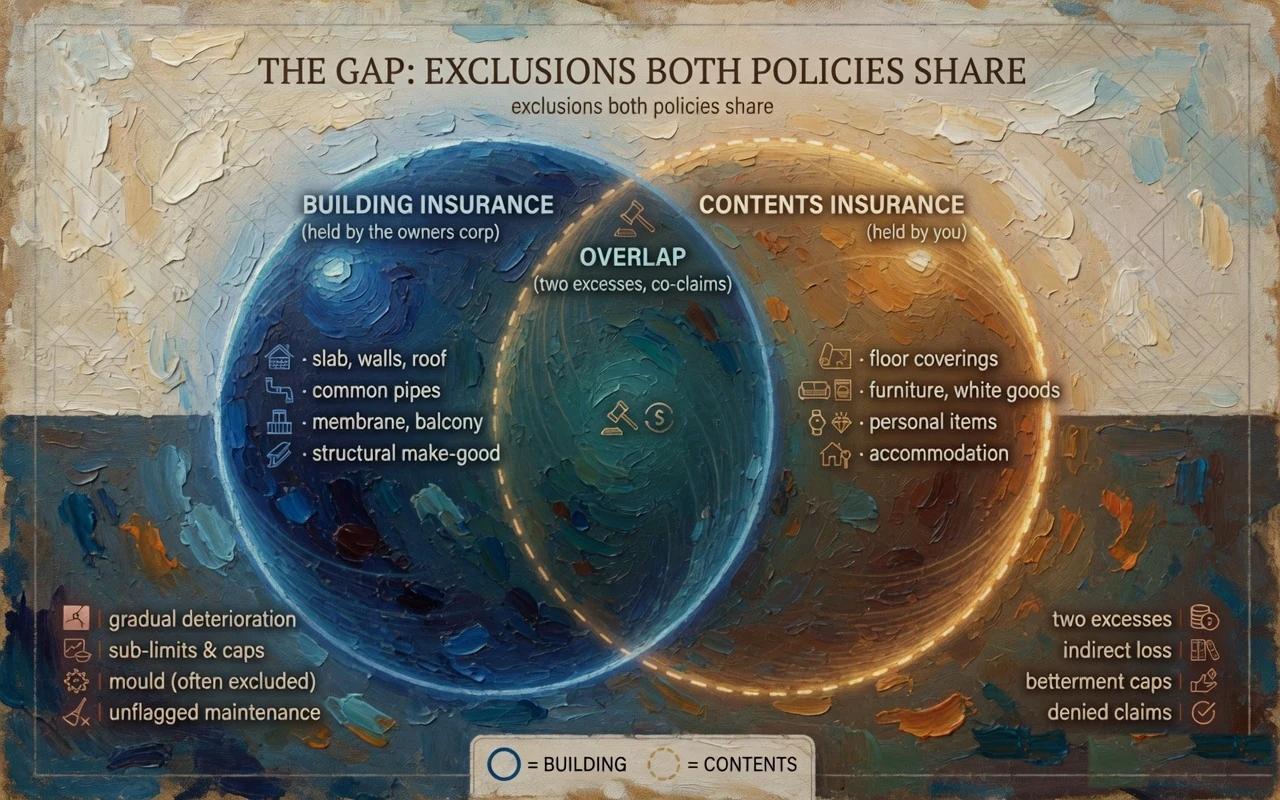
Most strata policies have a general excess plus separate, larger excesses for particular events. Water damage is the one that usually hurts. Your certificate of currency or policy schedule lists them. If you have never seen it, ask the strata manager for it. Our guide to what strata insurance covers explains how to read the schedule.
Claims push excesses up. NSW Fair Trading warns that neglected repairs can mean an "increased excess to be paid, as insurance companies will impose higher excess amounts (such as for water damage claims)", and that the scheme pays through levies (NSW Government). In the Brisbane flexi hose case, the committee told the adjudicator it could not buy a policy with a lower water excess because of the building's claims history (Insurance News).
Insurance professional Scott Driscoll says insurers normally apply one excess per event, not one per defect that contributed to it (LookUpStrata). And a broker told LookUpStrata there are no excess buy-down products in the strata market for these claims; the way down is fewer claims (LookUpStrata). When the building compares quotes, compare the water excess before the premium. Strata Insurers Compared shows how.
Queensland: one lot, the owner pays
Queensland has the most detailed rule. For schemes under the Standard Module, section 203 of the Body Corporate and Community Management (Standard Module) Regulation 2020 says:
- The body corporate may insure on the basis that an excess is payable, but it must make sure the excess would not impose an unreasonable burden on individual owners (s 203(1)–(2)).
- If the event affects only one lot, the owner of that lot is liable for the excess unless the body corporate decides it is unreasonable in all the circumstances for that owner to bear it (s 203(3)).
- If the event affects two or more lots, or one or more lots and common property, the body corporate is liable unless it decides it is reasonable for one or more owners to pay all or part of it (s 203(4)).
The Queensland Government's guidance gives two examples. Water damage from a leak inside a lot would normally see the lot owner pay. Damage caused by poor maintenance of common property would make it reasonable for the body corporate to pay (Queensland Government).
The word that matters is "decides". LookUpStrata's review of adjudicator decisions says the body corporate cannot automatically pass the excess on; it has to look at the circumstances and act reasonably (LookUpStrata). In the Brisbane flexi hose case, the owners argued an $11,000 excess was an unreasonable burden. The adjudicator held the owners responsible for maintaining the hose and upheld the charge (Insurance News). Our flexi hose guide covers how to stop that claim happening.
On another module, such as Accommodation or Commercial, check that module's insurance part.
Victoria: three cases where an owner can be levied
Victoria added an insurance levy power in 2021. Under section 23A(3) of the Owners Corporations Act 2006, the owners corporation may levy a lot owner a fee to cover:
- An excess or increased premium caused by bad conduct. The claim must be caused by a culpable or wilful act or the gross negligence of the owner, their tenant, or a guest of either (s 23A(3)(a)).
- Common property damage that insurance won't pay. The owner or their tenant caused damage to common property and either the policy doesn't cover it or the repair costs less than the excess (s 23A(3)(b)).
- An excess on a claim that is only about your lot. The claim must relate solely to the owner's lot (s 23A(3)(c)).
Read (a) closely. Consumer Affairs Victoria's insurance page says "negligence" (Consumer Affairs Victoria). The Act says "gross negligence", which is a higher bar. A leak from your lot that also damages the unit below is unlikely to be a claim "solely" about your lot, so the owners corporation would need to show (a).
Tasmania: the body corporate pays, unless one lot is affected
Tasmania's rule is close to Queensland's but more direct. Under section 99(4) of the Strata Titles Act 1998, the body corporate, and not the lot owner, pays the excess on the building policy. The exception is section 99(5). If the event affects only one lot, that owner pays unless the body corporate decides, by ordinary resolution, that it would be unreasonable for them alone to pay.
Section 99(6) adds a protection. If the insurer accepts a claim based on an owner's act or omission, it has no right of subrogation against that owner unless the act or omission was wilful.
The ACT and older NT schemes: recovery for fault
In the ACT, the owners corporation must lodge building claims and "pay any excess payable" (section 100A of the Unit Titles (Management) Act 2011). The note to that section points to section 31. That section lets the owners corporation recover, as a debt, an expense made necessary by a wilful or negligent act or omission of an owner or occupier, or by a breach of the rules. If the owner pays for a tenant's conduct, the owner can recover it from the tenant (s 31(3)). The owners corporation has to prove fault. A hose that simply wore out may not be negligence.
The Northern Territory has two regimes. For schemes under the Unit Titles Act 1975, section 46 lets the corporation recover expenditure made necessary by a member's wilful or negligent act or omission, or a breach of the articles, as a debt. The Unit Title Schemes Act 2009 and its management modules regulations do not mention an insurance excess in the versions I read (as in force at 27 November 2023 and 12 May 2023). For a 2009 Act scheme, check your scheme's by-laws.
SA and WA: little in the Acts
South Australia's Community Titles Act 1996 says that on a claim, "any excess or shortfall resulting from under insurance must be met by the corporation" (s 103(3)). Read plainly, that puts the excess on the community corporation, though the clause is written mainly about under-insurance. The Strata Titles Act 1988 does not mention an excess. For an SA strata scheme, look to your articles and get advice before charging anyone.
WA's Strata Titles Act 1985 does not mention an insurance excess either (I searched the consolidation as at 26 June 2025). A WA strata broker told LookUpStrata that where no by-law or agreement covers it, the usual practice is for the strata company to pay (LookUpStrata). That is practice, not law. A WA by-law that moves the excess should be checked by a lawyer before the strata company relies on it.
NSW: the Act is silent, so by-laws decide
The owners corporation must insure the building under section 160 of the Strata Schemes Management Act 2015. I could not find a section of the Act, or a rule in the NSW Government's strata guides, that says who bears the excess. So the owners corporation pays it from levies unless a by-law says otherwise.
Be careful with guides that give NSW owners the Queensland split. PBL Law's December 2025 guide sets out the one-lot and two-lot rule without citing a NSW section (PBL Law). That split is Queensland law. In NSW it binds owners only if your by-laws adopt it.
When an NSW excess by-law holds up
Some NSW schemes have a by-law that makes an owner pay the excess when damage starts in their lot. For it to bind you:
- It must be properly made. The owners corporation passes it by special resolution at a general meeting, then lodges it with NSW Land Registry Services within six months. It has no effect until it is recorded (s 141; NSW Government). Our guide to changing NSW by-laws covers the steps.
- It must be within power. By-laws can deal with the management, administration, control, use or enjoyment of lots and common property (s 136).
- It must not be harsh, unconscionable or oppressive (s 139(1)). NCAT can declare a by-law invalid on that ground (s 150).
I could not find a published NCAT decision squarely about an excess by-law. The closest guidance is from cost-recovery by-laws. In Nicholson v The Owners – Strata Plan No 104042 [2025] NSWCATCD 202, NCAT struck down a by-law that let the owners corporation decide for itself which costs an owner had to pay, with no independent check (Swaab). LookUpStrata's review of cost-recovery cases says by-laws are at risk when they don't limit costs to reasonable amounts or give the owner no way to dispute them (LookUpStrata).
So an excess by-law is safer if it charges only the excess actually paid, only where the damage started in the owner's lot or from their conduct, excludes damage from a common property failure, and lets the owner dispute the cause.
The other direction matters too. If the damage came from common property the owners corporation failed to maintain, it carries the repair duty under section 106. An owner who suffers loss from that breach can claim damages under section 106(5). Our water leak guide covers how that works.
When the damage is below the excess
If the repair costs less than the excess, nobody lodges a claim and the ordinary repair rules apply. The owners corporation fixes common property and you fix your lot.
Who caused it still matters. Victoria lets the owners corporation levy an owner or tenant who caused common property damage below the excess (s 23A(3)(b)). In the ACT and for NT 1975 Act schemes, the fault-recovery sections above can apply to the repair cost. Elsewhere it comes down to your by-laws or a claim for damages.
Small claims also go on the building's claims history, which is what pushes the water excess up.
Tenants and landlords
The owners corporation deals with the owner, not the tenant. If your tenant floods the unit below, expect the bill or levy to come to you. Victoria's levy power expressly covers a lessee's conduct and their guests (s 23A(3)(a)). In the ACT an owner who pays for an occupier's conduct can recover it from the occupier (s 31(3)). In other states your route to the tenant is the lease and your state's tenancy law.
If you rent, report leaks to your landlord or agent in writing and keep a copy. That record protects you if someone later says the leak was ignored.
Your own policy and the excess
There are two personal policies to check:
- Contents or home and contents insurance for owner-occupiers, and landlord insurance for investors. Some include legal liability cover, which may respond if another owner or the owners corporation claims against you for damage you caused. Whether either pays a strata excess you are billed depends on the wording.
- Your own excess. If you claim on your own policy, you pay its excess too.
Send your insurer one question in writing: "If my owners corporation charges me the excess on its building claim for damage that started in my lot, will this policy pay it, and up to what limit?" Keep the answer. Our guide to contents versus strata insurance explains where the two policies meet.
Stop the fight before it starts
An excess bill lands hardest when the owner thinks the committee made the rule up after the leak. The fix is boring. Agree the rules in advance and in writing.
My view: every building should adopt a written excess policy at a general meeting before the next claim, not after it. Deciding who pays once the water is through the ceiling turns a cost question into a fight between neighbours.
What the policy can do depends on your state. In Queensland and Tasmania it guides decisions the law already requires, though the body corporate should still weigh each claim on its facts. In Victoria it explains how the owners corporation will use section 23A. In NSW and WA a policy resolution guides the committee, but making an owner pay needs a valid by-law or another legal basis. Use the policy to draft the by-law.
The state-by-state table
| State | Legislation | Who pays by default | When an owner can be charged |
|---|---|---|---|
| NSW | SSMA 2015, s 160 | Owners corporation. The Act doesn't allocate the excess | A valid by-law (s 136, s 139, s 141) |
| Vic | OC Act 2006, s 23A | Owners corporation | Culpable or wilful act or gross negligence; uninsured or below-excess common property damage; a claim solely about the lot |
| Qld | Standard Module, s 203 | Owner if only their lot is affected; body corporate if two or more lots or common property | One-lot event: owner pays unless the body corporate decides that is unreasonable. Other events: only if the body corporate decides it is reasonable |
| WA | Strata Titles Act 1985 | Act is silent; practice is the strata company | By-law or agreement. Get advice |
| SA | Community Titles Act 1996, s 103(3); Strata Titles Act 1988 silent | Community corporation | Not set out. Check articles or by-laws and get advice |
| Tas | Strata Titles Act 1998, s 99(4)–(5) | Body corporate, except a one-lot event | One-lot event, unless an ordinary resolution finds it unreasonable |
| ACT | UT(M)A 2011, s 100A | Owners corporation | Recovery as a debt for a wilful or negligent act or a rules breach (s 31) |
| NT | Unit Titles Act 1975, s 46; UTSA 2009 silent | Corporation | 1975 Act schemes: wilful or negligent act or articles breach. 2009 Act schemes: check by-laws |
Owner checklist
Committee checklist
How UnitBuddy fits
UnitBuddy gives the building one shared record. The committee can keep the policy schedule and certificate of currency in documents, record the excess policy and each excess decision with its reasons, and send owners the notice. The finances view shows what the building has paid in excesses against the administrative fund budget, and asset records help you see which items keep failing. UnitBuddy doesn't hold or move money and isn't trust accounting software, so payments still go through the scheme's own account.
Related reading
- Strata Insurance Claims: What You Must Tell the Insurer and Who Gets the Payout
- What is strata insurance? What it covers and what it doesn't
- Water leaks from above: who pays and how to force a repair
- Contents vs strata insurance: what apartment owners must have
- Strata Insurers Compared
Sources and further reading
- Body Corporate and Community Management (Standard Module) Regulation 2020 (Qld), s 203
- Queensland Government: insurance premium and excess
- Owners Corporations Act 2006 (Vic), version 024
- Consumer Affairs Victoria: insurance for owners corporations
- Strata Titles Act 1998 (Tas)
- Unit Titles (Management) Act 2011 (ACT)
- NSW Government: strata building repairs health check
- NSW Government: strata by-laws
- Insurance News: apartment owners left with $11,000 excess after burst flexi hose
- QLD: Demystifying insurance excess, via LookUpStrata
- Swaab: Nicholson v The Owners – Strata Plan No 104042
What changed in strata this month? Read the strata news for your state, with every figure sourced.
More guides like this

Guides
Strata Finance & Levies in Australia: The Complete Committee Guide (2026)
Everything Australian strata committees and owners need to understand about levies, capital works funds, insurance, hidden fees, and the financial decisions that shape building life. State-by-state, plain English.
5 May 2026 · 14 min read
Insurance
Strata Insurance Claims: What You Must Tell the Insurer and Who Gets the Payout
The owners corporation holds the building policy, so it is the insured, it carries the duty of disclosure and it usually gets the money. Here is who can lodge a claim, what a building must tell its insurer, where the payout goes, and what to do when a claim stalls or is declined.
19 November 2026 · 13 min read
Insurance
How to Get Your Own Strata Insurance Quotes and Stop Paying Commission
A step-by-step guide for committee members who know nothing about insurance: how commissions work, how to appoint a fee-only broker or go direct, what underwriters ask for, and how to compare quotes.
2 November 2026 · 16 min read