
Repairs & Maintenance
Garbage Chutes in Apartment Buildings: Jams, Fires, Smells and the Notices That Actually Work
A garbage chute is the most-used piece of mechanical infrastructure in a residential building, and the least understood. Here is what causes the jams and fires that take chutes out of service, the cleaning and inspection program that prevents most of it, and copy-ready notices for red and yellow bin chutes that residents will actually read.
· 10 min read
On this pageWhat this guide coversOn this page
- What this guide covers
- The five recurring problems
- Jams
- Smells
- Hopper door damage
- Fires
- Pests
- What can go down a chute
- Cleaning and inspection program
- Annual chute wash
- Quarterly hopper inspection
- Monthly compactor service
- Continuous pest program
- Copy-ready notice for the red-lid (general waste) chute
- Copy-ready notice for the yellow-lid (recycling) chute
- When the chute is out of service
- Lithium-ion batteries: the new chute fire
- Who clears and services the chute
- The chute is common property. The bag is often a by-law problem
- Fire, liners and why a chute is more than a tube
- FOGO, extra streams and the building that has one chute
- A 90-day reset that changes the jam rate
- How UnitBuddy fits
- Further reading
What this guide covers
- The five recurring chute problems every committee will face: jams, smells, hopper damage, fires, and chute-room infestations.
- Why "what can go down the chute" is a smaller list than most residents assume, and the items that quietly cause the most damage.
- The cleaning, inspection and pest program that keeps chutes serviceable.
- Copy-ready notices for red-lid (general waste) and yellow-lid (recycling) chutes, written for the actual hopper door.
- Why a chute breakdown is more expensive than the alternative (resident-carried waste) and how to recover quickly when it happens.
A garbage chute is hidden behind a small steel door on every floor of the building. It is opened by every resident, usually daily, often without thought. It is the building's most-used piece of mechanical infrastructure, and the one residents understand the least.
When a chute works, the building barely notices it. When it stops working, the building notices very quickly: bins fill up at the apartment door, the corridor smells, the bin room overflows, and the committee gets to find out exactly how much it costs to fix a problem that could have been prevented.
The five recurring problems
Jams
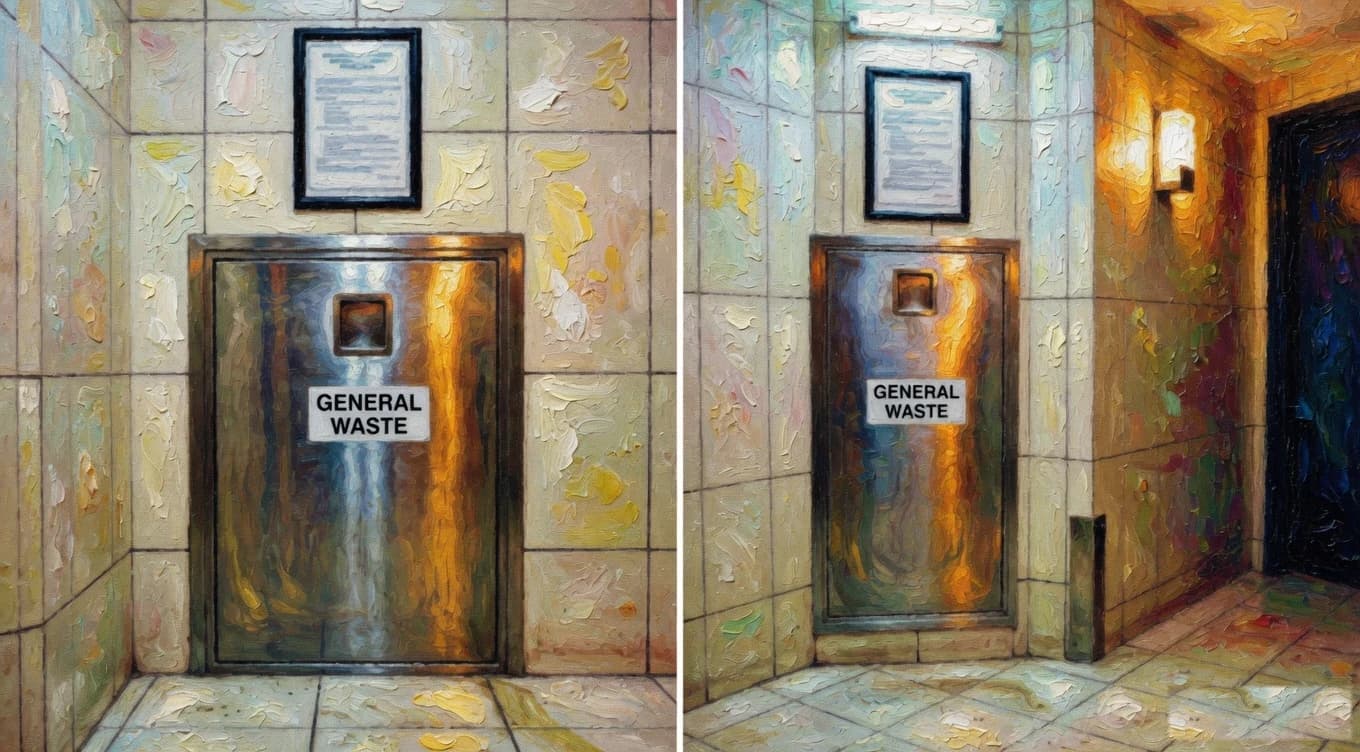
A jam is the most common chute failure. The cause is almost always an oversized or rigid item that lodges at a bend, a hopper door, or the compactor inlet at the base. Common culprits: pizza boxes folded the wrong way, cardboard cartons, mattress pieces, broom handles, branches, broken furniture, a bag tied too loosely that bursts in transit and splays a hard object across the chute.
A jam clear is $400 to $1,500 depending on access and severity. A jam that breaks the compactor head as the operator tries to force the load is $5,000 to $20,000.
Smells
A persistent smell from the chute is usually one of three things: food residue caked on the inside of the chute and never cleaned, a failing compactor seal at the base, or an exhaust fan that has failed without anyone noticing. The diagnostic order matters: the cheapest fix is the fan inspection, the next cheapest is a chute scrub, and the most expensive is the compactor seal replacement.
Hopper door damage
Hopper doors take a beating. They are slammed, kicked, propped open, and bumped by buggies and bags. Common failures: broken hinges (the door is dragged when opened), failed gas struts (the door slams shut), damaged latches (the door does not close fully and leaks smell into the corridor), painted-over hinges (the door binds and gets forced).
Hopper repair costs are modest individually, $200 to $700 per door, but the cumulative number is significant. A 20-storey building has 20 to 40 hopper doors and the maintenance is continuous.
Fires
Chute fires are rare but devastating. The cause is almost always a hot or burning item dropped into the chute: cigarette butts, ashtrays cleared into a bag, batteries (particularly lithium), fireworks, hot ash from a barbecue or fireplace. The chute is effectively a chimney; a fire at the base draws hot gases up the entire vertical column. The fire indicator panel triggers, sprinklers (if installed in the chute) discharge, and the building evacuates.
The most expensive chute fires are not the small ones. A confined fire in the compactor that triggers sprinklers in the chute can produce $50,000 to $200,000 in smoke remediation, sprinkler discharge clean-up and equipment replacement. Lithium-ion battery fires are the fastest-growing category and the hardest to control: a Fire Rescue NSW survey in 2024 attributed a rising share of bin-room fires to discarded e-bike and e-scooter batteries.
Pests
Chutes that are not cleaned regularly attract cockroaches, rodents and, in many buildings, fruit flies and drain flies. The chute itself is a vertical food highway. Pest programs that target the bin room without also addressing the chute are short-lived. Routine chute washes that include a flush of degreaser at each hopper door, and a fogging treatment at the base, are far more effective than perimeter pest control alone.
What can go down a chute
The list is shorter than most residents think, and is much shorter for the recycling (yellow-lid) chute than for the general waste (red-lid) chute.
The principle is that the chute is a smooth vertical tube of around 500 to 600 millimetres diameter, ending in a compactor or a static bin. Anything that catches in the tube, jams in the hopper, or breaks the compactor is the problem.
A working list for the general waste chute:
- Yes: Household waste in a tied bag no larger than around 30 litres. Soft food scraps in a bag. Used tissues. Nappies in a tied bag. Litter from pet trays in a tied bag (in modest quantities).
- No: Cardboard boxes (flatten and take to recycling), broken glass (wrap, label, and take down by hand), batteries of any kind, electronic items, light bulbs and fluorescent tubes, aerosol cans, paint and chemicals, garden waste, large rigid items, mattress fragments, hot or smouldering material, hot ash, cigarette butts not fully extinguished, broken crockery (wrap and take down by hand), liquid waste of any volume.
For the recycling chute, even more is excluded because contamination spoils the whole load:
- Yes (rinsed and empty): Aluminium cans, steel food cans, glass jars and bottles, hard plastic containers (PET, HDPE), paper that is clean and dry, flattened cardboard small enough to fit through the hopper.
- No: Anything in plastic bags (the recycler cannot open them), soft plastics of any kind (return to supermarket collection), food-contaminated containers, takeaway pizza boxes with grease, polystyrene foam, broken glass, ceramics, light bulbs, electronics, batteries, textiles, nappies, food waste, garden waste, liquids.
The most common contamination problem in apartment recycling chutes is bagged recycling: residents bag their cans and bottles in a plastic shopping bag and drop the bag down the chute. The bag is contamination. The recycler treats the load as general waste and the building pays for landfill disposal instead of receiving the recycling discount.
Cleaning and inspection program
A working chute program has four components. Most buildings run one or two of these; the buildings with the fewest problems run all four.
Annual chute wash
A specialist contractor with a chute-wash head sprays the inside of the chute with hot water and degreaser from the top, working down. Cost is typically $1,500 to $4,000 depending on building height and access. Sometimes coupled with a fogging treatment that reaches surfaces the wash does not.
Quarterly hopper inspection
A walk-through of every floor's hopper door checking for latch wear, hinge wear, gas strut function, seal integrity, and signs of forced entry. Issues logged and repaired within 30 days. Annual cost is $1,500 to $3,500 across building size.
Monthly compactor service
The compactor at the base needs its hydraulics serviced, its compaction force calibrated, its seals inspected and its waste discharge checked. A monthly service of $200 to $600 prevents the seal failure and the catastrophic jam at the inlet.
Continuous pest program
Bait stations in the chute room, regular pest visits, and a written log of what was found at each visit. Cost is $1,500 to $4,000 per year for a mid-rise building.
The combined cost is in the $5,000 to $15,000 per year range. The cost of running without one of these components is usually more than the cost of running with all of them, because the event-driven repairs are larger and more frequent.
Copy-ready notice for the red-lid (general waste) chute
The following text fits a vinyl decal or printed plaque of around A5 size, designed to sit at eye level next to or on the hopper door.
Copy-ready notice for the yellow-lid (recycling) chute
The recycling chute notice has to fight harder. The most damaging error (bagged recycling) is intuitively the right thing to do.
When the chute is out of service
A chute fault is one of the few infrastructure failures where the resident response matters as much as the contractor response. A chute jammed at 8 PM on a Friday will not be cleared until Monday for most buildings. In the meantime:
- A clear notice on every hopper door stating the chute is out of service, expected return, and where to take waste.
- An identified bin-room or alternative drop point with clear signage.
- A schedule for the building manager or caretaker to clear that drop point regularly during the outage.
- Email or app notification to all residents within 30 minutes of the fault being confirmed.
A building that handles a 48-hour outage well has minimal corridor smell, no overflow at the apartment doors, and a single resident-facing communication. A building that handles it badly has bags on every floor, complaints to every committee member, and a pest event in the bin room the following week.
Lithium-ion batteries: the new chute fire
Lithium-ion batteries from e-bikes, e-scooters, vapes, power tools and personal electronics are the fastest-growing cause of bin-room and chute fires in Australia. Fire Rescue NSW has documented several apartment-building incidents traced to batteries that had been damaged, overcharged or discarded into general waste.
The committee response is twofold:
- No batteries of any kind in the chute. The notice above states this. The notice in the bin room states this. The annual resident communication states this.
- A drop-off container in the bin room or building lobby for spent batteries, collected by a B-Cycle drop-off site or council pickup. The cost of running the container is in the low hundreds per year; the cost of one battery fire is in the tens or hundreds of thousands.
The e-bike battery post covers the broader picture of building-wide lithium-ion risk.
Who clears and services the chute
Most of the work in this article (jam clears, chute washes, hopper repairs, compactor servicing) is specialist work, and the specialists are a small field.
Elephants Foot Group has been in this field since 1976 and is one of the few fully vertically integrated providers in Australia, meaning they both manufacture the equipment and service it. For a committee dealing with a chute, this covers most issues you will encounter: blocked-chute clearing and unblocking, professional chute cleaning and odour management, chute-door inspection, and chute repair and restoration.
The bin-room machinery is handled by the same provider: compactors, augers, balers, bin lifters, and carousel and linear-track bin systems, all serviced under preventative maintenance programs with 24/7 responsive support for after-hours faults. The practical advantage of a single integrated provider is that the contractor servicing your compactor is the contractor who built it, so calibration, seal replacement and spare parts come from one provider rather than three. This reduces overall cost and complexity when obtaining parts.
The chute is common property. The bag is often a by-law problem
The chute, hoppers, liners, fire dampers, the bin-room plant and the compactors are common property. The owners corporation must keep them working. In New South Wales that is section 106 of the Strata Schemes Management Act 2015. In Victoria it is section 46 of the Owners Corporations Act 2006. Queensland’s Body Corporate and Community Management Act 1997 and Western Australia’s Strata Titles Act 1985 put the same duty on the body corporate or strata company.
A jammed hopper, a torn liner or a failed damper is therefore a building invoice, not a lot invoice — unless the jam was caused by something a resident put in the chute that the by-laws say must not go there. Recovery needs three things: a by-law that is specific enough (no bulky waste, no batteries, no bagged recycling, no wet cardboard that will swell and lodge), evidence that ties the item to a lot (CCTV at the hopper, a labelled bag, a concierge report), and a written process.
In NSW, serve a section 146 notice to comply if the conduct is a by-law breach, then go to NCAT if it continues. Victoria uses the section 155 notice to rectify. Queensland uses section 182 or section 183. A one-off $400 clear after a sofa cushion is a cost of living together. A floor that produces a jam every month is a lot problem, and the scheme is entitled to treat it as one.
Do not invent a “chute fine” that the by-laws do not support. Penalty by-laws have their own state rules. A notice to comply plus cost recovery for the contractor invoice is the path that survives a tribunal. A laminated threat on the hopper door is not.
Fire, liners and why a chute is more than a tube
A refuse chute is a vertical shaft through fire compartments. The hoppers, the liner, the fire damper at the discharge and the bin-room sprinklers or suppression are part of the building’s fire-safety system. A chute that is out of service, propped open, or missing a damper is a fire defect, not only a smell complaint.
The annual fire-safety statement (or the state equivalent) should list the chute dampers and any bin-room suppression. If those items are not on the essential-services schedule, get them added after the next inspection. A lithium-ion battery that ignites in a chute will travel. Fire Rescue NSW and other brigades have published apartment incidents that started as a discarded battery or vape in a hopper. The e-bike battery post covers storage and charging. The chute rule is simpler: no batteries of any kind, a B-Cycle or council drop-off in the bin room, and a notice that is actually on every hopper.
A worn liner that sheds, or a hopper that no longer self-closes, should be a capital item, not a recurring patch. In NSW that replacement sits in the capital works fund under section 79 and should already appear in the section 80 10-year plan. Buildings that spend $8,000 a year on emergency clears of the same liner are funding a replacement they refuse to schedule.
FOGO, extra streams and the building that has one chute
Food-organics and garden-organics (FOGO) reform is arriving suburb by suburb. A building with one general-waste chute and a recycling chute cannot put food waste down either of them. The FOGO stream needs a room, a collection point and a resident habit. The apartment FOGO guide covers the room. The chute implication is that contamination will get worse before it gets better, because residents will try to put caddy bags down the nearest hopper.
Write the FOGO rule into the same notice as the chute rule. Do not run two campaigns. If the building is adding a third hopper or a floor-by-floor caddy, that is an alteration to common property and may need a special resolution under section 108 in NSW or section 52 in Victoria. Budget the joinery, the extra collection contract and the first six months of contamination charges together. A caddy program without a contamination plan is a levy increase with a green lid.
A 90-day reset that changes the jam rate
Week 1. Photograph every hopper, the discharge, the liner and the bin-room plant. Note self-closers that fail, missing notices, and any hopper that has been wedged open.
Week 2. Put the two notices in this article on every hopper and in the lift. Email or app-notify every occupier, including short-stay listings. Give the building manager a single after-hours number for chute faults.
Week 3. Book a professional clean and a damper inspection. Put the report with the fire file.
Week 4. Start a log: date, floor if known, what blocked the chute, cost, who was told. After 90 days the log will show whether the problem is the whole building or two lots.
If two lots own the log, use the by-law process. If the liner owns the log, get three quotes for replacement and put a motion to the next general meeting. If FOGO contamination owns the log, change the room and the collection, not the font on the hopper sticker.
Keep the log, the invoices and the fire certificates in the building’s own records. Chute programs die when the caretaker leaves. The next jam at 8 pm on a Friday should not depend on who still has the contractor’s mobile.
How UnitBuddy fits
UnitBuddy is the building's own software. For the chute program, the practical use is the running log: each clear, each repair, each clean, each pest visit, each fault notification. A committee that can look at twelve months of chute records sees the patterns the strata manager would never surface: the floor that produces most of the jams (often the floor with a frequent renovator or a short-term rental), the hopper door that has been repaired three times in a year (replace, do not repair), the smell complaints clustered around a particular weekend (suggesting a specific event).
The notice templates above can sit alongside the building's other resident communications, ready to print and post. The contractor list, the cleaning schedule and the after-hours fault contact sit in the same place, so a chute event at 11 PM is handled from the same information the committee uses to plan the annual clean.
Further reading
- FOGO and Apartment Bin Rooms: Preparing for Food Waste Reform
- Illegal Dumping and Bulky Waste in Apartment Buildings
- E-Bike and Lithium Battery Rules in Strata
- Wet Wipes Are Costing Your Building Thousands
Keep the scheme file in one place the committee and the manager can both open. Features, pricing, or book a tour.