
Disputes & Living
Illegal Dumping and Bulky Waste in Apartment Buildings
Mattresses, e-waste and renovation debris are a recurring strata cost. The fix is rarely a sign on the bin room door. It is a working bulky-waste system tied to council pickups, EPA rules, move-out timing and a small amount of evidence.
· 12 min read
On this pageWhat this guide coversOn this page
- What this guide covers
- The economics of one mattress
- What counts as bulky waste
- Council pickup rules
- State EPA penalties for illegal dumping
- Move-outs are the pressure point
- Renovation waste: the contractor problem
- Lithium-ion batteries: fire risk and B-Cycle
- E-waste, paint and chemical waste
- CCTV and cost recovery
- Building-level dumping policies that work
- Common objections and extra checks
- Committee checklist
- Dumping on common property is a by-law problem, then a cost-recovery problem
- Moves, renovations and the lot that always “forgets”
- How UnitBuddy fits
- Further reading
What this guide covers
- Why a single dumped mattress costs the building $250–$600 once cleaning, contractor call-out and disposal are added.
- The capital-city bulky-waste systems committees actually need to know: Sydney, Melbourne, Brisbane, Perth, Gold Coast, Inner West.
- EPA penalties for illegal dumping in every state, including the NSW $7,500 on-the-spot fine and the $1,000,000 corporate maximum.
- Why 60–70% of bulky waste appears in the seven days around a move-out, and how to handle that pressure point.
- Lithium-ion batteries, the FRNSW fire data, and where B-Cycle drop-off fits.
- How CCTV evidence and cost recovery actually work in strata, and what a building-level dumping policy should say.
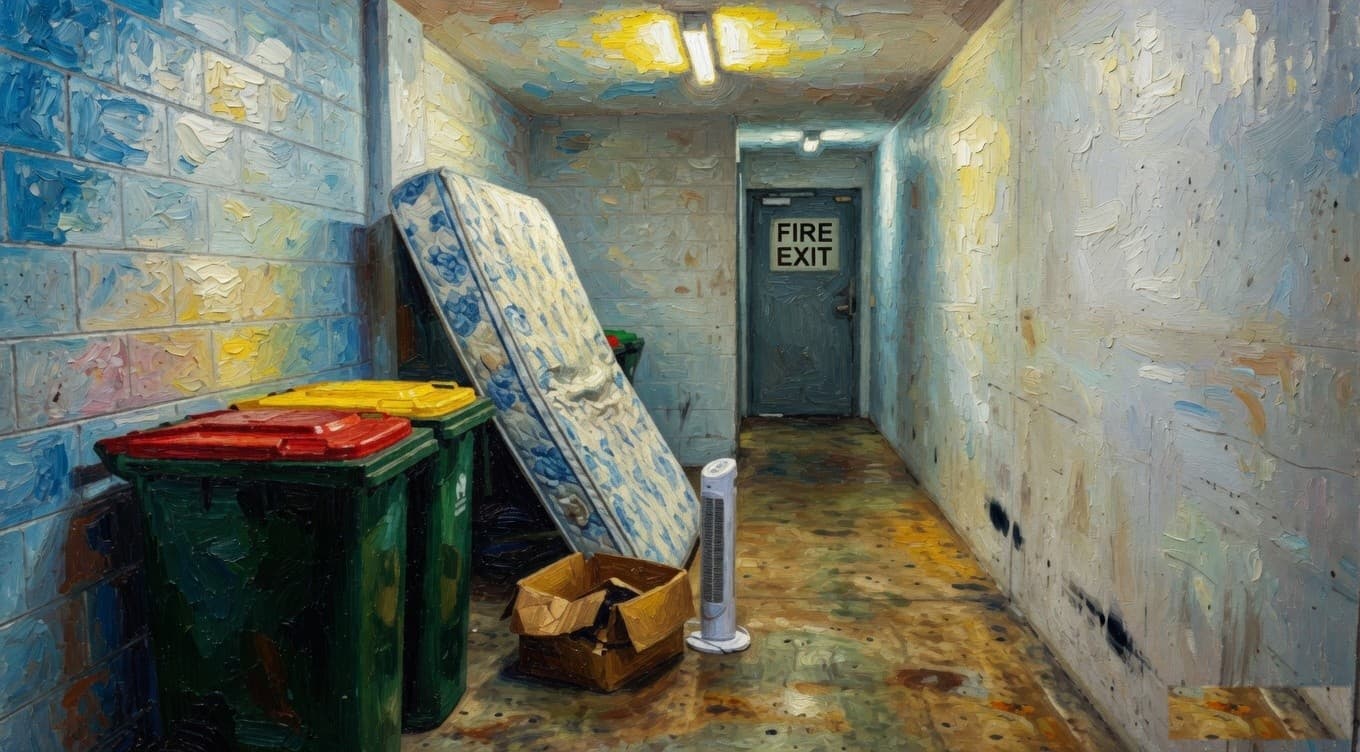
Anyone who's done a Monday morning walk-through of a bin room after move-out weekend knows the routine. The mystery mattress. The broken IKEA wardrobe nobody admits to. A stack of moving boxes, a microwave, a bag of half-finished paint tins and a vape. None of it fits the bins. The cleaner shifts it twice. The bin room smells. By Wednesday the committee is arguing about who pays.
Bulky waste is the area of strata where the smallest individual decision ("I'll just leave it next to the bin") produces the most disproportionate cost. That $40 mattress nobody wanted becomes a $400 contractor call-out. The lithium-ion battery in the kerbside pile becomes a fire risk. A pile of plasterboard from a kitchen renovation becomes a contamination problem the entire scheme pays for at the next collection.
The fix isn't a stern notice on the bin room door. It's a working bulky-waste system that connects council services, move-out timing, contractor approvals and a small amount of evidence.
The economics of one mattress
Worth starting with the most common single item, because committees consistently underestimate the cost.
A mattress dumped in or near the bin room can't go in the general waste bin. It won't fit, the contractor won't collect it, and most councils won't take it as kerbside general waste. Three things have to happen.
First, the cleaner or building manager has to move it out of the fire path or shared corridor. That's labour the building is already paying for, but it's opportunity-cost labour. Every minute on the mattress is a minute not on something else.
Second, the building has to dispose of it. Options are:
- A council booked bulky-waste pickup, where eligible. Free in some councils, capped in others.
- The Soft Landing Mattress Stewardship Scheme, where pickup costs around $30–$50 per mattress and roughly 75% of the mattress is recycled.
- A private waste contractor call-out, which is where the real cost lives. Standard call-out fees run $150–$300 just for the visit, plus disposal at a transfer station. A landfill-tipped mattress now attracts a disposal fee above $100 in most metropolitan transfer stations because of the EPA waste levy.
Add the cleaner's time, the building manager's time, and a CCTV review at $80–$120 an hour to identify who left it. A single mattress that nobody wanted is comfortably a $250–$600 cost to the scheme. That cost is paid out of administrative fund or recovered through levies. Either way, the lot owners pay.
This is the asymmetry that drives every other decision in this guide. The dumped item is small money to the person who dumps it. It's significant money to the building.
What counts as bulky waste
| Category | Typical items | Disposal pathway |
|---|---|---|
| Mattresses | Single, double, queen, king mattresses and bases | Soft Landing scheme, council booked pickup, private contractor |
| Furniture | Sofas, wardrobes, bedheads, dining tables, office chairs | Council booked pickup or charity reuse if undamaged |
| Whitegoods | Fridges, washing machines, dryers, microwaves | Council pickup; refrigerant degassing required for fridges |
| E-waste | TVs, computers, monitors, printers, small appliances | TechCollect, MobileMuster, council e-waste days |
| Lithium-ion batteries | Power tools, e-bike, e-scooter, laptop, phone, vape batteries | B-Cycle drop-off, never to landfill or general waste |
| Paint and chemicals | House paint, solvents, garden chemicals, pool chemicals | Paintback (paint), council chemical drop-off events |
| Renovation debris | Plasterboard, tiles, timber, carpet, cabinetry, fittings | Contractor's responsibility under renovation approval |
| Asbestos-suspect debris | Older fibre cement, vinyl tile, eaves and pipe lagging | Licensed Class A or B asbestos removalist; SafeWork notification thresholds |
| Cardboard and packaging | Move-in and online-shopping cardboard | Recycling bin, flattened |
The list looks long. The point is that almost none of it can go in a building's ordinary general waste or recycling bins. Each category has a specific pathway, and most of those pathways are free or subsidised if residents follow them.
You'd think cost was the problem. It rarely is. Residents who don't know a free council pickup exists default to the bin room. It's an information gap, not a money one.
Council pickup rules
Capital-city bulky-waste systems vary more than people expect. A committee that uses generic advice ("just call the council") will get the answer wrong for an apartment building, because most council pages are written for detached houses.
City of Sydney. On-demand collection booked through 02 9265 9333 or the council's online form. Mattresses, furniture, e-waste, whitegoods and similar bulky items are accepted. Maximum 3 cubic metres per booking. Apartment buildings often book through the strata manager or building manager rather than individual residents, because access, scheduling and presentation rules are easier to manage centrally.
Inner West Council. Two free on-demand pickups per residential property per year. The cap matters in apartments. If individual residents each book under their own address the building can quickly exceed the per-property limits.
City of Melbourne. Hard rubbish collection by booking, with specific restrictions for multi-unit dwellings. The council requires items to be presented at agreed locations, and apartment buildings need to coordinate with the council before placing items kerbside. Random kerbside piles outside an apartment block in the City of Melbourne are treated as illegal dumping under the local law, not as a pickup.
City of Brisbane. Kerbside large item collection by appointment, plus regular chemical and e-waste drop-off events at council depots. Brisbane's free annual kerbside collection has historically rotated by suburb. Check the current schedule rather than relying on memory.
Gold Coast. Two free large-item pickups per year. Same cap-per-property dynamic as Inner West.
City of Perth. Verge pickup is the dominant model. Items are placed on the verge during designated collection windows. Apartment buildings without a usable verge need to coordinate with the council on alternative presentation.
The pattern across most council areas is the same. A free or low-cost service exists, but it requires booking, presentation rules, and someone in the building treating it as part of operations. A scheme that doesn't have a single point of contact for booking pickups will see the volume default to private contractor call-outs at full cost.
State EPA penalties for illegal dumping
Illegal dumping isn't just a council nuisance issue. It's an environmental offence in every state and territory, with significant penalties for individuals and far higher penalties for corporations.
| State | Legislation | Penalty range (illegal dumping) |
|---|---|---|
| NSW | Protection of the Environment Operations Act 1997 | Up to $7,500 on-the-spot fine for individuals; up to $1,000,000 for corporations on serious offences |
| Vic | Environment Protection Act 2017 | Penalties up to approximately $250,000 for serious dumping; on-the-spot infringements available |
| Qld | Waste Reduction and Recycling Act 2011 | Minimum on-the-spot fines around $234.50 (individual) and $1,172 (corporate); far higher for serious or repeat dumping |
| WA | Litter Act 1979 and Environmental Protection Act 1986 | Litter infringements through to environmental offence prosecutions |
| SA | Local Nuisance and Litter Control Act 2016 | Litter infringements and prosecutions for larger dumping |
| Tas | Environmental Management and Pollution Control Act 1994; Litter Act 2007 | Litter and pollution penalties scaling with severity |
| ACT | Litter Act 2004; Environment Protection Act 1997 | Litter infringements and environmental offence penalties |
| NT | Litter Act 1972; Waste Management and Pollution Control Act 1998 | Penalties scaling from litter infringement to environmental offence |
A few practical observations about how these penalties land in apartment buildings.
The penalty is on the dumper, not the building. The body corporate isn't automatically liable when a resident or guest dumps rubbish in or near the building. But the EPA or council can issue a clean-up notice to the occupier of the land where the waste is found, which in apartment contexts can mean the owners corporation. That clean-up notice is a cost the building has to wear immediately, even if the dumper is later identified.
The kicker is that footage and identification are what convert a dumping incident from a building cost into a council prosecution. Without identifiable evidence, the practical outcome in nearly every case is that the scheme pays.
Repeat dumping at the same address attracts attention. NSW EPA's RID Online portal and similar mechanisms in other states allow buildings to report illegal dumping and accumulate a record. A scheme with chronic dumping should be using those channels rather than absorbing the cost silently.
Move-outs are the pressure point
Across most buildings, 60–70% of bulky waste appears in the seven days around a move-out. The pattern is consistent and predictable.
Picture the typical case. The resident is moving on a deadline. The removalist quoted on volume and refuses to take the broken bookcase. The mattress is too stained for the next place but too big for any car. The bond inspection's in three days. Council pickup takes two weeks to book. The bin room is downstairs, unsupervised, and the easiest answer is also the worst one.
Most dumping isn't malicious. It's a logistics failure under time pressure.
The building's response should match the actual decision being made. A move-out information pack, issued before, not after, should cover:
- Which items can go in ordinary bins, and which can't.
- The council booked-pickup window, the booking number and the lead time.
- Where in the building bulky items can wait between booking and pickup.
- Mattress disposal options, including Soft Landing and the typical $30–$50 cost.
- E-waste drop-off points (TechCollect, MobileMuster) within walking distance.
- Battery disposal: the B-Cycle network of 3,500+ Australian collection points.
- Paint disposal through Paintback, free for trade and household quantities.
- The cost-recovery position if the building has to clean up after a dumped item.
Fair enough, a move-out pack isn't enforcement. It's the cheapest preventive intervention available to a committee.
Renovation waste: the contractor problem
Renovation debris is the second-largest source of bulky waste in apartment buildings, and it's structurally different from move-out waste because the person creating it isn't the person who lives there.
Tiles, plasterboard, cabinetry, carpet, underlay, packaging, old fittings. None of this is household waste. None of it should ever appear in the building's bins. The contractor is responsible for removing it and disposing of it through a commercial waste stream. More often than not, apartment renovation contractors who fill the building's bins are pushing their disposal cost onto every other lot owner in the scheme.
The mechanism that prevents this is the renovation approval. Approval conditions should explicitly require the contractor to remove all renovation waste from site daily, prohibit use of the building's bins for construction debris, require a skip booking if waste can't be removed daily, and make the lot owner responsible for any cleaning or disposal costs the scheme incurs.
There's also an asbestos question that rarely gets the attention it deserves. Apartment buildings completed before the late 1980s commonly contain asbestos in eaves, fibre cement sheet, vinyl tile backing, pipe lagging and some textured ceilings. Renovation debris from those buildings can't go in ordinary waste streams. It requires a licensed Class A or B asbestos removalist, and SafeWork notification thresholds apply. A renovation that produces unidentified white fibre cement in the bin room isn't just a dumping problem. It's a potential SafeWork incident.
Lithium-ion batteries: fire risk and B-Cycle
Of every category in this guide, lithium-ion batteries deserve the loudest paragraph.
Fire and Rescue NSW has reported lithium-ion battery fires increasing by approximately 150% recently, with battery-related fires now one of the fastest-growing fire categories in residential settings. The fires originate from damaged, overheated or end-of-life cells. Once a lithium cell enters thermal runaway it's extremely difficult to extinguish. A battery in a general waste bin compacted by a truck is a significant fire risk to the truck, the depot and anyone nearby.
Batteries should never go in a general waste bin, recycling bin or kerbside pile. The Australian B-Cycle scheme operates more than 3,500 drop-off points nationally, including major hardware retailers, supermarkets, council libraries and many shopping centres. Drop-off is free for household batteries.
Buildings with e-bike, e-scooter or power-tool users should make this information visible on the bin room poster, in the building app, in the move-in pack. The cost of a single battery fire in an apartment building is orders of magnitude higher than the cost of any other dumping category in this guide.
E-waste, paint and chemical waste
Three categories with free or low-cost national pathways that residents simply don't know about.
E-waste. TechCollect and MobileMuster operate free e-waste drop-off across Australia for computers, monitors, peripherals, mobile phones and small electronics. Most metropolitan council areas also run periodic e-waste collection events, often co-located with chemical drop-off. A TV in the bin room is a $0 problem with the right information and a $250+ problem without it.
Paint. Paintback Australia accepts unwanted house paint and packaging at a national network of drop-off sites, free for both trade and household quantities. The scheme is industry-funded through a small levy on new paint sales. Paint should never go in general waste, and certainly never down a sink or stormwater drain.
Garden, pool and household chemicals. Most councils run periodic chemical drop-off events. Sydney, Melbourne and Brisbane all run them several times a year. The schedule rotates by region, and committees should circulate the dates as they appear.
In practice, the common pattern is this: a free service exists, residents don't know about it, and the default is the bin room. A one-page resident guide changes that.
- Resident has a bulky item
- Identify category and disposal stream
- Book council pickup or drop-off
- Present item at agreed location
- Building logs disposal and cost
CCTV and cost recovery
CCTV is useful for two specific purposes. Identifying who dumped, and creating enough deterrent that fewer people try.
A few honest constraints.
Most apartment buildings don't have camera coverage of the bin room itself. Privacy considerations, cost, and the fact that bin rooms are dark, dirty environments mean cameras typically cover the corridor outside the bin room rather than the room itself. That produces predictable blind spots, and people who dump regularly know where they are.
Reviewing footage takes time. A committee member or building manager going through 24 hours of corridor footage to identify a dumping incident is doing $80–$120 an hour of labour. The cost of the review can exceed the cost of the disposal unless there's a high-confidence time window.
Footage from cameras in shared common areas can usually be used by the owners corporation for legitimate purposes: identifying a dumper, supporting a cost-recovery claim, providing evidence to the EPA or council. It shouldn't be circulated in resident chat groups, posted on noticeboards or used to publicly shame residents. Buildings should have a written surveillance and footage-handling policy before they need it, not after an incident.
Cost recovery against a dumper requires evidence. A clean recovery file includes:
- Date, time and location of the dumping.
- Photos of the items in place.
- CCTV footage or a witness identification linking the items to a specific lot, occupier or contractor.
- The disposal invoice, with itemised cleaner, contractor and disposal costs.
- Correspondence with the responsible owner or occupier inviting payment.
Without that file, a recovery attempt usually fails. Not because the scheme has no claim, but because the claim can't be substantiated. With it, most owners pay rather than escalate.
Building-level dumping policies that work
The buildings that have the smallest dumping problem share a small number of practical features.
A clearly written, one-page resident waste guide. Plain language, the council booking number, the e-waste and battery drop-off points, the move-out instructions and the cost-recovery position. Available in the building app, the noticeboard and the move-in pack.
A single point of contact for booking council pickups: either the building manager or a nominated committee member. Residents who want to do the right thing should not have to work through the council website themselves.
A renovation approval template that puts contractor waste removal in writing. Lot owner liable if it ends up in the building's bins.
A bin room that isn't dark, unmonitored and unloved. Better lighting and a single visible camera at the door reduces opportunistic dumping more than the same money spent on signs.
A FOGO and recycling regime that actually works, so residents aren't predisposed to give up on the system entirely. Bin rooms that overflow weekly produce more bulky-waste dumping in the same building, because the perceived norm shifts.
A communication channel for waste announcements. The next council e-waste day, the upcoming chemical drop-off, the building's mattress pickup arrangement. Residents who hear about these things in time will use them.
Common objections and extra checks
"We should just install more cameras." Cameras help with evidence, but they don't create pickup capacity, move-out instructions or contractor accountability. If the building has no disposal pathway, cameras mostly record a predictable failure.
"It must be tenants." Sometimes it is. Sometimes it's owners, removalists, renovators, short-stay guests or people from outside the building. Blaming a group before checking move dates, access logs, renovation approvals and CCTV weakens the committee's position.
Check whether the bin room itself is creating the behaviour. Overflowing bins, poor lighting, unclear recycling streams and no visible pickup process teach residents that waste management is already broken. Fixing the baseline bin-room experience often reduces bulky dumping more than another warning notice.
Keep hazardous waste out of ordinary bulky pickups. Batteries, e-waste, paint, chemicals, asbestos and gas bottles need separate handling. A building guide should tell residents where those items go instead of only saying they are prohibited.
Committee checklist
- Confirm the council bulky-waste process for your building, including booking number, lead time, presentation rules and per-property caps.
- Identify the nearest B-Cycle, TechCollect, MobileMuster and Paintback drop-off points and add them to the resident guide.
- Establish a single point of contact for council pickup bookings.
- Update the renovation approval template to require contractor waste removal and prohibit use of building bins for construction debris.
- Add waste instructions to the move-in and move-out packs, including the cost-recovery position.
- Audit the bin room for lighting, camera coverage at the door, and obvious blind spots.
- Adopt or update a written surveillance and footage-handling policy before the next incident.
- Keep a running record of dumping incidents: date, location, photos, disposal invoice, recovery outcome.
- Report repeat or large-scale illegal dumping to the relevant state EPA channel (in NSW, RID Online).
- Review private waste contractor call-out costs annually against booked council pickup volumes. The ratio tells you whether the system is working.
Dumping on common property is a by-law problem, then a cost-recovery problem
The bin room, the loading dock and the basement cage corridor are common property. The scheme must keep them usable and safe. In New South Wales that is section 106 of the Strata Schemes Management Act 2015. In Victoria it is section 46 of the Owners Corporations Act 2006. Queensland’s Body Corporate and Community Management Act 1997 and Western Australia’s Strata Titles Act 1985 put the same duty on the body corporate or strata company. A mattress that blocks a fire egress is a safety defect the same day, not a waste footnote.
The first invoice still belongs to the scheme: the after-hours collection, the cleaner, the skip. Recovery from a lot needs a by-law that says owners are liable for waste they (or their occupiers or contractors) leave on common property, plus evidence that ties the item to the lot. A branded removalist carton, a move-out date, a CCTV still at the bin-room door, and the agent’s email is a file. A mattress with no story is a building cost.
Enforce with a written notice: section 146 in NSW, section 155 in Victoria, section 182 or section 183 in Queensland. Do not invent a “dumping fine” the by-laws do not support. Repeat conduct by the same lot is a tribunal matter. One sofa after a genuine failed council booking is a letter and the invoice.
Illegal dumping that comes from outside the building is a council or EPA problem (in NSW, RID Online). The scheme still has to clear the fire path the same day. Photograph first. Then call the public channel. Then decide whether cameras and a lockable bin-room door are the capital item — that change of common property may need section 108 or section 52 if it alters access.
Moves, renovations and the lot that always “forgets”
Most bulky dumping has a calendar. A tenant vacates. A bathroom is stripped. A short-stay turns over. Put the waste rule in the move pack and in the renovation approval. The approval should say: contractor removes all demolition waste; building bins are not a skip; the lot owner is invoiced if the rule is broken. That condition is easier to enforce than a general cleanliness by-law written in 1982.
Lithium batteries, e-waste, paint and gas bottles are not bulky waste. They are a fire and contamination problem. The e-bike and chute posts cover the fire side. The resident guide should name the B-Cycle, Paintback and council chemical dates. A battery in a mattress pile is how a bin-room fire starts.
Keep the incident log, invoices and notices in the building’s own records. Dumping programs die when the caretaker’s phone is the register.
How UnitBuddy fits
Bulky waste looks small per incident and large in aggregate. It stays large because the records are scattered. A photo on one committee member's phone. An invoice in the strata manager's inbox. A CCTV clip on a basement hard drive. A renovation approval buried in a 90-page PDF. A council booking number scribbled on the noticeboard. UnitBuddy holds those records together so the building can act on the pattern instead of the moment.
Take the classic case: a queen mattress appears in the bin room on a Sunday afternoon, two days after a tenant moved out of Lot 14. With UnitBuddy, the building manager logs the incident with timestamped photos, the cleaner's clean-up time, the private collection invoice that comes back at $380, and the CCTV still that places the item with the outgoing tenant's removalist trolley. That one record links to the move-out date in the lot history, the disposal invoice in the cost register, and the cost-recovery letter that goes to the agent.
For waste and dumping specifically, that includes:
- The dumping incident log: timestamped photos, location, items, suspected source, CCTV review notes, action taken, recovery status.
- The disposal invoice register, broken down by stream. Private collection, mattress recycling under Soft Landing, e-waste under TechCollect, paint under Paintback, with cost per incident and per quarter.
- The council booking history: Sydney's on-demand collection, Melbourne hard rubbish, Brisbane kerbside, Inner West two-per-year. The building uses its allocation strategically rather than ad hoc.
- Move-out timing tied to the incident log, so the committee can see whether 70% of dumping really is clustered around moves in their building.
- Cost-recovery correspondence kept against the lot: notice issued, response received, payment status, by-law step taken.
- The renovation contractor file: insurance, waste-removal acknowledgement, asbestos clearance where applicable, deposit or bond return record.
- Reusable templates for the resident waste guide, move-in and move-out instructions, and renovation approval conditions.
The committee can then see whether the building has a communication problem, a move-out problem, a contractor problem or a single repeat offender. The data is in one record rather than five. When the next committee turns over, they inherit the system rather than starting from scratch. When the strata manager changes, the records stay with the building. When a resident asks why their levies went up, the disposal invoice log gives a real answer in dollars.
UnitBuddy supports owners corporations and committees working alongside their strata manager. The strata manager continues to handle the formal notices, the breach process and the legal questions. UnitBuddy holds the operational record (the incident log, the disposal invoices, the council booking history, the cost recovery) that turns bulky waste from a recurring committee complaint into a small, documented operating cost. The intervention is rarely a new sign on the bin room door. It's a working system, kept in one place, applied consistently.
Further reading
- NSW: Can strata share CCTV images of illegal dumping residents without breaching privacy laws?, via LookUpStrata
- NSW: Can residents go through recycling bins in strata?, via LookUpStrata
Last updated: 8 May 2026. UnitBuddy publishes general information for Australian strata owners and committees. It is not legal, waste-management or fire safety advice.
Keep the scheme file in one place the committee and the manager can both open. Features, pricing, or book a tour.