
Disputes
Surveillance Cameras and Smart Doorbells in Strata: What's Allowed and What's Not
Smart doorbells, indoor cameras, and ring-style devices are now in millions of Australian apartments, and they are generating a growing volume of strata disputes. The overlap between privacy law, surveillance law and strata law now matters in ordinary apartment disputes.
· 9 min read
On this pageStart hereOn this page
Start here
- Cameras create three questions at once: privacy, common property consent, and nuisance.
- Inside your lot is simpler; recording shared corridors and neighbours is where disputes start.
- Committees need a consistent policy before the first smart doorbell fight.
Camera disputes often start with a small device and a basic question: who is allowed to record a shared space, and why?
Residential cameras were unusual a decade ago. They are now common. Apartment buildings can contain smart doorbells, indoor cameras with cloud storage, externally mounted CCTV and dashcams in carparks. Many of those devices record corridors, lift lobbies, carparks or the line between private and common property.
Privacy law, surveillance device law and strata law all apply, but none was written for a smart doorbell that records every person walking through a shared corridor. NCAT, VCAT and other tribunals are still working through these disputes case by case.
Location is the practical starting point. A camera inside a lot is different from one aimed across common property, a balcony, a corridor or a neighbour's doorway.
- Resident proposes camera or doorbell
- Identify what the field of view captures
- Common property or neighbour in frame?
- Written request to the OC with rationale
- OC sets conditions: view, audio, retention
- Consent recorded; complaints handled by policy
The three legal frameworks
Three areas of law overlap.
Privacy law. The Commonwealth Privacy Act 1988 applies to certain businesses that handle personal information, but it has limited application to individual residents. Most residential disputes instead turn on nuisance and the developing protection of privacy in Australian case law.
Surveillance device law. Every state and territory regulates optical, listening, tracking or data surveillance devices. NSW uses the Surveillance Devices Act 2007. Victoria uses the Surveillance Devices Act 1999. The rules differ, but they commonly restrict recording private activities or conversations without consent and include specific exceptions.
Strata law. An OC can regulate equipment installed on common property and deal with nuisances affecting other lots. In NSW, section 153 of the SSMA supports action against surveillance that causes a nuisance. Other jurisdictions have equivalent provisions.
A camera can comply with privacy law and still create a nuisance under strata law. It can comply with strata law and still breach surveillance legislation by recording private conversations. Even a device that complies with both may require OC consent if it is attached to common property.
Cameras inside your own apartment
A camera that records only the inside of a lot is generally lawful, provided it does not capture other people's private conversations or record common property. An owner can install equipment inside an apartment, but cannot use it to create a nuisance.
The risk increases when a camera sees common property through a window or door, or when its microphone can pick up conversations from a neighbouring apartment.
For a camera aimed from a window into a corridor or carpark, the question is whether recording common property interferes with other occupants' use of that space. A camera that captures only what anyone inside the lot could see is less likely to be a nuisance. Persistent recording that makes residents feel watched in a shared space is more likely to cause a problem.
Audio is less forgiving. Most Australian jurisdictions prohibit recording private conversations without consent. A camera microphone may breach surveillance legislation if it captures conversations from neighbouring apartments, even accidentally.
Cameras on balconies
Balconies often contain both lot property and common property. The balcony floor and internal walls are usually part of the lot, while the parapet, underside and external mounting points are usually common property. A camera bolted to an external surface will ordinarily need OC consent.
A portable camera inside the balcony is simpler to install, but its field of view still matters. An outward-facing camera may capture other balconies, common gardens, the street or another area outside the lot. Whether that creates a nuisance depends on what it records, how long the footage is kept and whether it affects how other residents use the space.
Tribunals have treated persistent recording of identifiable people in shared areas, or public distribution of that footage, more seriously than incidental recording.
Cameras on common property
A camera in a corridor, lift lobby, carpark, foyer, garden or external wall sits on common property and faces the strictest controls.
No individual lot owner controls common property. Installing equipment there requires OC consent, and the OC can use its by-law enforcement powers to remove an unauthorised camera.
Consent does not settle every issue. An OC can install cameras for a shared security purpose, set retention rules and control access to recordings. A camera installed by one resident for that resident's benefit is harder to justify.
Tribunals have generally allowed disclosed, OC-managed security cameras with reasonable data controls. They have been more cautious about residents placing their own cameras on common property without specific consent and a clear reason.
Smart doorbells
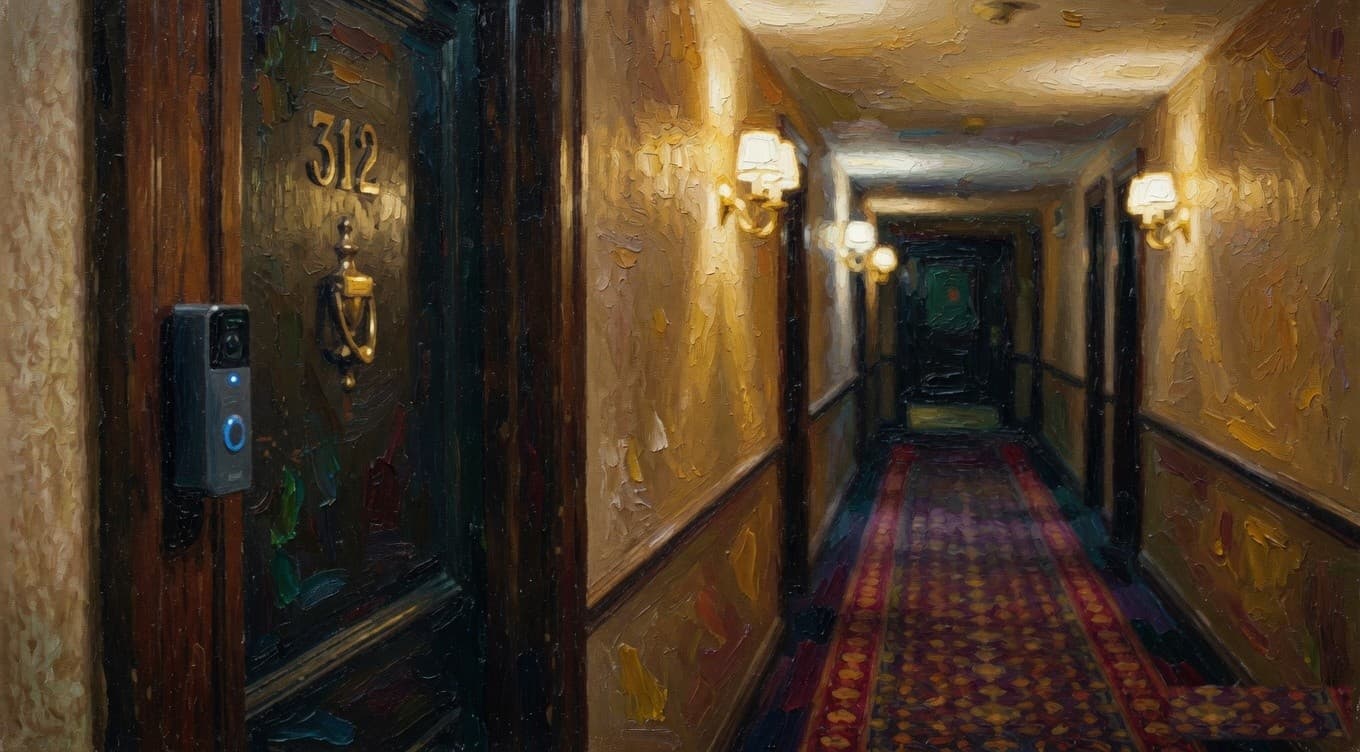
Smart doorbells are a common source of camera disputes. They combine motion-activated recording, cloud storage and remote viewing in a device fitted at the boundary between a lot and common property.
The device may sit on the lot side of the front door, but its camera usually records a shared corridor, hallway or stairwell. A narrow view of the space immediately outside the door is easier to justify as a security measure. Recording a wider corridor and tracking neighbours' movements is harder to defend.
Tribunals have distinguished between identifying someone who approaches the door and monitoring activity in a shared space. A doorbell that records every passer-by and stores footage indefinitely attracts more scrutiny than one that activates briefly when someone approaches.
Larger schemes have started adopting smart-doorbell by-laws. A workable by-law requires consent, limits the field of view, restricts audio recording, sets a reasonable retention period and explains what happens when the resident moves out.
What owners corporations can do
An OC can leave residents to install cameras and deal with complaints as they arise. Many older schemes still operate this way, but the approach becomes difficult once several residents have devices aimed at shared areas.
A more practical policy requires consent for any installation that affects common property, including an external smart doorbell. The OC can then impose conditions on the field of view, audio and data retention.
Buildings with stronger security needs may install OC-managed cameras in lifts, foyers and carparks, then prohibit extra resident-owned cameras that capture common property. This gives the OC more control but also creates more work.
An OC running its own cameras must comply with surveillance legislation, manage the recordings and tell residents about the surveillance.
Practical steps for owners
Before installing a camera, identify everything in its field of view. If it captures common property or another lot, send the strata manager a description of the installation and the reason for it, then obtain written OC consent.
Disable audio unless there is a specific reason to use it and the OC has agreed. Audio creates legal issues that silent video does not.
Keep footage only as long as needed. A short retention period is easier to justify than indefinite storage.
For cloud services, check who can access the footage and what the provider does with it. The Privacy Act 1988 may apply to the provider even when it does not apply to the resident.
Take a neighbour's concern seriously. Many disputes end when the owner narrows the field of view, disables audio or shortens the retention period. Refusing any reasonable adjustment makes escalation more likely.
The state-by-state picture
How UnitBuddy helps owners track cameras
UnitBuddy records camera and doorbell installations by lot, including the OC's decision and any conditions attached to consent. Committees can also record complaints and keep the documents needed to enforce a policy or respond when an installation is challenged.
That gives the committee one record of which devices have approval, what each camera may capture and which conditions apply.
A useful camera policy answers four questions: where cameras may point, whether they may record common property, how long footage can be kept and who may access it. Without those rules, each smart doorbell can restart the same argument about privacy, security and common property.
Further reading
- QLD: Does a body corporate need to display a sign when CCTV cameras are installed on common property?, via LookUpStrata
- ACT: CCTV Cameras and Privacy in Strata, via LookUpStrata
Keep the scheme file in one place the committee and the manager can both open. Features, pricing, or book a tour.