
Repairs & Maintenance
Air Conditioning in Strata: Approval, Where the Unit Can Go and Who Pays for Repairs
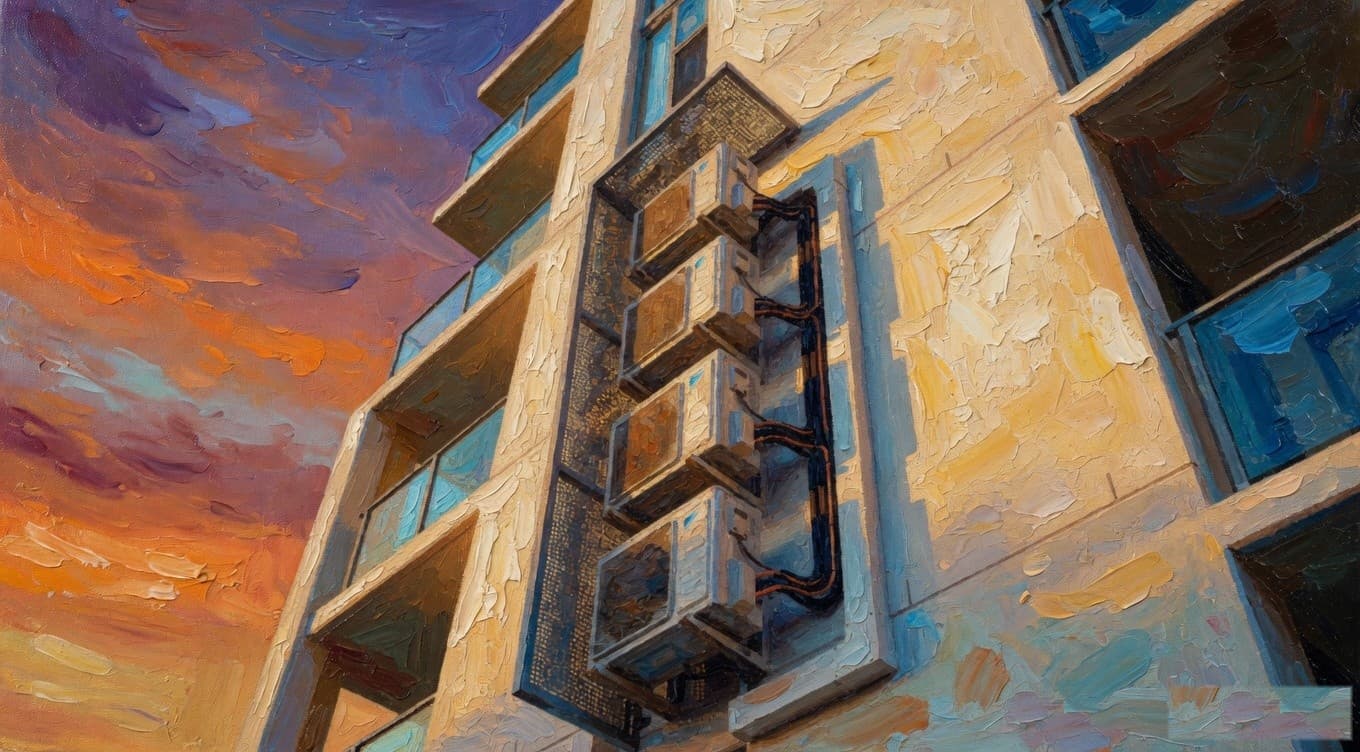
A split system looks like a private appliance, but the condenser, pipes and drain usually land on common property. This is what approval you need in each state, where the outdoor unit can go, the noise rules, and who repairs the system once it is in.
By Buddy · · 12 min read
On this pageThe owner briefingOn this page
- The owner briefing
- Quick answers
- Do I need strata approval to install air conditioning in my apartment?
- Can I put the condenser on my balcony or the outside wall?
- Who pays to repair a split system in strata?
- Can strata refuse my air conditioner?
- How late can my air conditioner run?
- Why a split system is a strata question
- The approval you need in NSW
- Where the outdoor unit can go
- Council approval
- Noise: the rules that actually apply
- Who owns and repairs the system afterwards
- Central systems serving many lots
- The state-by-state picture
- What to put in your application
- A committee checklist for assessing applications
- How UnitBuddy fits
- Related reading
- Sources and further reading
The owner briefing
- You almost always need approval. In NSW a reverse cycle split system is a minor renovation, but a condenser that changes the outside of the building can push it into by-law territory.
- Where the condenser goes decides most of the risk: appearance, noise, fixings into the wall, and where the condensate water ends up.
- Once it is in, a system that serves only your lot is usually yours to repair. Get that written into the approval or a by-law so nobody argues about it in ten years.
You want to cool one bedroom. The committee sees a box on the facade, two holes through an external wall, a pipe that may drip on the balcony below and a fan running at 2 am beside someone else's window. Both views are reasonable. The approval is where they meet.
Quick answers
Do I need strata approval to install air conditioning in my apartment?
Almost always. In NSW, a reverse cycle air conditioner is a minor renovation. It needs approval at a general meeting, or from the committee if a by-law gives it that power (NSW Government). The other states are in the state-by-state picture.
Can I put the condenser on my balcony or the outside wall?
Often, with approval and conditions. A balcony floor is usually the easiest spot, and in NSW it can be exempt from council approval, though by-laws can still limit it (NSW Planning). An external wall or roof is usually common property, so expect a by-law and conditions on fixing and appearance.
Who pays to repair a split system in strata?
Usually you, if it serves only your lot. The NSW common property memorandum puts systems serving only one lot, inside or outside it, on the lot owner, and systems serving more than one lot on the owners corporation (memorandum). It only applies if your scheme adopted it.
Can strata refuse my air conditioner?
For good reasons, yes. For any reason, no. NSW's Appeal Panel upheld a finding that an owners corporation unreasonably refused a by-law for two condensers on a common property wall (The Owners – Strata Plan No 12185 v Brown). Victoria's model rule 5.2 bars an owners corporation from unreasonably withholding approval for a change to a lot's external appearance.
How late can my air conditioner run?
It depends on your state. In NSW the night restriction now starts at 11 pm and does not apply during a severe or extreme heatwave (NSW EPA). Other states are in the noise rules.
Why a split system is a strata question
The indoor head sits inside your lot. The rest usually does not. The condenser sits on a balcony, wall, roof or plant deck, often common property. The pipes go through a wall someone has to drill. The condensate drain has to end somewhere other than the balcony below. And the power supply may need a new circuit. That is why the approval asks about location, fixings, drainage and noise, not the brand.
- Owner picks a unit and a spot
- Check by-laws and the strata plan
- Does it touch common property or the look?
- Approval: committee or general meeting
- By-law records who maintains it
- Install, photos and certificates on file
The approval you need in NSW
NSW sorts owner work into three groups. Cosmetic work under section 109 needs no approval. Minor renovations under section 110 need an ordinary resolution. Work that changes common property, including the outside of the building, falls under section 108 and needs a special resolution.
Air conditioning is named. Clause 28 of the Strata Schemes Management Regulation 2016 adds installing a reverse cycle split system to the minor renovations. NSW Fair Trading lists a reverse cycle air conditioner and a heat pump as examples, and says (NSW Government):
- Approval needs more than 50% of the votes cast at a general meeting, or the committee can decide if a by-law allows it.
- A committee with that power that refuses must give written reasons within three months. If it does not refuse in time, the application is taken to be approved.
- Minor renovations cannot change the outside or structure of the building. Those are major renovations.
That last point is where most NSW arguments start. A condenser on a balcony floor fits the minor renovation box. A condenser bolted to the street facade, with pipes down the outside wall, changes how the building looks. Many schemes handle that with a common property rights by-law under section 142, which needs a special resolution and the benefiting owner's written consent. Section 144 says the by-law must provide for maintenance.
Replacing an old unit is a grey area, because the regulation says "installing". Commentators at LookUpStrata and Strata Choice argue a replacement can reasonably be treated the same way, and call that an interpretation, not settled law. A new unit is rarely identical in size or noise to the old one, so ask anyway. It costs a page.
If the owners corporation unreasonably refuses a by-law, NCAT can make orders (section 149). In Brown, concerns about appearance, noise, the wall, water and setting a precedent did not carry the day. That is a reason to apply with evidence, not a promise that every refusal falls.
My view: even where the minor renovation route is available, ask for a by-law if the condenser or pipes sit on common property. The resolution approves the work. The by-law is what tells the next owner who maintains it.
Where the outdoor unit can go
| Location | What usually helps | What usually goes wrong |
|---|---|---|
| Balcony floor | Easiest approval, short pipe run, out of sight from the street | Noise into the next balcony, condensate on the tiles, blocked balcony drain |
| External wall bracket | Keeps the balcony clear | Changes the facade, drilling into common property, fixings into concrete or cladding, drips onto lots below |
| Roof or plant deck | Keeps units out of sight, good for multi-head systems | Long pipe runs, roof penetrations that can leak, access for servicing |
| Ground-level yard | Common in townhouses | Noise at the boundary, security, the neighbour's bedroom window |
Four things matter wherever it goes.
Appearance. Forty lots with forty different brackets looks it. A committee can reasonably set a location, colour or screen, as long as it applies the rule to every lot.
Noise. Keep the fan away from a neighbour's bedroom window. Moving it 3 metres at the planning stage is free. Moving it after a complaint is a second install.
Fixings. Holes through external walls and brackets in concrete or cladding are work on common property. The installer should say what they are drilling into and how the hole will be sealed.
Condensate. The indoor unit makes water whenever it cools. It belongs in a drain, not on the balcony below. In NSW, section 153 bars an owner from using a lot in a way that causes a nuisance or hazard to another occupier. Queensland's equivalent is section 167 of the Body Corporate and Community Management Act 1997. The water leaks guide covers what happens next.
Council approval
In NSW a home air conditioning unit is exempt development, needing no council approval, if it meets every standard in Subdivision 3, clauses 2.5 and 2.6 of the Codes SEPP. NSW Planning says that allows a unit on a balcony floor. On a heritage item it must be ground-mounted, and on a heritage item or in a conservation area it must sit at or behind the rear building line (NSW Planning). Exempt from council is not exempt from strata, as NSW Planning itself points out. I could not confirm the planning exemptions in other states, so ask your council.
Noise: the rules that actually apply
Two systems apply at once: your by-laws on nuisance, and state environment law on hours or volume.
| State | Rule | Source |
|---|---|---|
| NSW | Restricted hours for household air conditioners now start at 11 pm, up from 10 pm. They do not apply during a severe or extreme heatwave declared by the Bureau of Meteorology. The new regulation started on 28 August 2026 | NSW EPA; Noise Control Regulation 2026 |
| Vic | Must not be heard in a habitable room of another home before 7 am or after 11 pm on weekdays, or before 9 am or after 11 pm on weekends and public holidays. You can run it at any time during a heat health warning | EPA Victoria; Environment Protection Regulations 2021 |
| Qld | No more than 5 dB(A) above background noise from 7 am to 10 pm, and no more than 3 dB(A) above background from 10 pm to 7 am, measured at the affected premises | Queensland Government noise fact sheet; Environmental Protection Act 1994 |
| WA | Air conditioners must meet the assigned noise levels in the noise regulations at all times. They are not treated as "specified equipment" with permitted hours | WA Government fact sheet |
| SA, Tas, ACT, NT | I could not confirm a current rule written for air conditioners. Ask your council or the state environment regulator |
In the NSW consultation draft, the offence needed a warning from an officer and then a repeat. I could not read the final text, so check the regulation before relying on the warning step or the morning hours.
A condenser that obeys the state hours can still breach a by-law if it makes a neighbour's bedroom unusable. Put the unit's sound power level in the application. The noise complaints guide covers what the committee can enforce.
Who owns and repairs the system afterwards
Your paperwork decides which of three answers applies.
1. A by-law or approval says the owner maintains it. The cleanest outcome. In NSW a section 142 by-law must deal with maintenance (section 144), and a good one also covers pipes, brackets, holes and damage. In Queensland an owner who makes an approved improvement to common property must keep it in good condition unless excused (Standard Module s 187). If it raises the insurance premium, you may pay the extra (Queensland Government).
2. The scheme adopted the NSW common property memorandum. Section 107 lets a scheme adopt it by by-law. It puts "air conditioning systems, whether inside or outside of a lot, which serve only that lot" on the owner. Pipes inside a common property wall, floor or ceiling stay with the owners corporation (memorandum), so a leak in a common wall can be the scheme's problem even when the condenser is yours.
3. Nothing in writing. This is where the arguments live. The NSW owners corporation must maintain and repair common property under section 106, and a condenser fixed to common property with no by-law or memorandum can end up the scheme's to fix. That is common where the developer installed the units. Victoria's equivalent duty is section 46 of the Owners Corporations Act 2006.
Under any of these, the head unit inside your lot and its servicing are yours.
Central systems serving many lots
Some buildings have a central chiller, cooling tower or VRF plant serving many apartments.
- It is the scheme's. The NSW memorandum puts systems serving more than one lot on the owners corporation, so repairs come out of everyone's levies.
- It belongs in the capital works plan. A chiller is a large, predictable replacement. If it is missing from the 10-year plan, so is a big number. See capital works plan red flags.
- Your own split may be refused for good reason. Where the building already supplies cooling, appearance and electrical load are fair objections.
- Draw the line inside the lot. Fan coil units, thermostats and ceiling ducting may be yours or the scheme's. Get the committee to write it down once, for every lot.
The state-by-state picture
| State | What needs approval | Who approves | Key law |
|---|---|---|---|
| NSW | A reverse cycle split system is a minor renovation. Changing the outside needs more | Ordinary resolution, or the committee under a by-law (3-month deadline). Special resolution for major work or a by-law | s 110, Regulation cl 28, s 108, s 142 |
| Vic | Altering common property, or changing the external appearance of your lot | The owners corporation, in writing. It cannot unreasonably withhold approval for an appearance change, and can set reasonable conditions | Model rules 4.3 and 5.2 |
| Qld | Improvements to common property. Under the default by-laws, changing a lot's external appearance unless the change is minor and keeps the amenity | The committee for minor improvements ($3,000 or less, no effect on appearance), otherwise an ordinary resolution. An exclusive use by-law needs a resolution without dissent | Standard Module s 187, Schedule 4 by-law 8, s 171 |
| WA | A structural alteration of a lot, which a WA strata manager writing for LookUpStrata argues an install likely is | Resolution without dissent or every owner's written approval. Refusal only on listed grounds. No valid objection within 77 days counts as approval | Strata Titles Act 1985 s 87, Landgate fact sheet |
| SA | Erecting, altering or removing a structure, or changing the external appearance | Special resolution | Strata Titles Act 1988 / Community Titles Act 1996 |
| ACT | Erecting or altering any structure in the unit or on common property | Special resolution, unless the scheme has adopted its own rules | Unit Titles (Management) Act 2011 |
| Tas | Changes to the exterior, and structural improvements | The body corporate's written permission | Strata Titles Act 1998 |
| NT | Disturbing common property or changing the unit's external appearance | Majority resolution | Unit Title Schemes Act 2009 |
For SA, the ACT, Tasmania and the NT I found no rule written for air conditioners, so those rows are the general alteration rules. Many schemes also have their own air conditioning by-law. Read it first.
What to put in your application
A committee checklist for assessing applications
How UnitBuddy fits
UnitBuddy keeps the building's shared record. A committee can store each air conditioning application, the resolution or by-law that approved it, the conditions, and the installer's photos and certificates against the lot. When a buyer asks whether the condenser was approved, or a leak turns up years later, the paperwork is in the building's own documents rather than a former treasurer's inbox.
For central plant, UnitBuddy's asset register and 10-year capital works planning help the committee put the chiller or cooling tower replacement in the forecast before it fails.
Related reading
- Apartment renovations in strata: what needs approval, state by state
- Heat, ventilation and summer readiness in strata buildings
- Balcony rules in strata: BBQs, plants and laundry
- Noise complaints in apartments: what strata can and can't enforce
Sources and further reading
- NSW Government: renovations in strata
- NSW Government: common property memorandum
- NSW Planning: air conditioning units as exempt development
- NSW EPA: changes to the noise control regulation
- EPA Victoria: residential noise
- Queensland Government: improvements in a body corporate
- Queensland Government: noise regulation fact sheet
- WA Government: noise regulations fact sheet, residential equipment
- Is it unreasonable to refuse a by-law to install air conditioning?, via LookUpStrata
- Can strata pass air conditioning maintenance to owners?, via LookUpStrata
- WA: air conditioner installation refused, timeframes and your rights, via LookUpStrata
- Is replacing an air conditioning unit a minor renovation?, via Strata Choice
What changed in strata this month? Read the strata news for your state, with every figure sourced.
More guides like this

Guides
Strata Repairs and Defects in Australia: Who Fixes What and Who Pays (2026)
Leaks, waterproofing, mould, roofs, drains, glass, gates, fire safety and new-building defects: who has to fix each one, who pays, what to do first and how to make a slow owners corporation act. State-by-state, written for owners and committees.
19 November 2026 · 18 min read
Repairs & Maintenance
Asbestos in Strata Buildings: Registers, Renovations and Who Pays to Remove It
Any apartment building finished before the 2003 national ban can contain asbestos. This is when an owners corporation needs an asbestos register, what you must do before renovating, who pays to remove it from common property or a lot, and how loose-fill asbestos works in NSW and the ACT.
19 November 2026 · 12 min read
Repairs & Maintenance
Broken Windows in Strata: Who Pays for Glass, Leaks and Locks
A cracked pane, a leaking frame or a lock that won't turn: in most apartment buildings the window is common property, but the plan, the boundary rules and your by-laws can move the line. This is who fixes what, who pays when someone breaks the glass, how insurance and upgrades work, and NSW's window safety device duty.
19 November 2026 · 12 min read