
Your apartment
Repairs, maintenance and right of entry
The body corporate's s 152 and SM s 180 maintenance duty, lot owner duties under SM s 211, The Dalgety and Jefferson Villas waterproofing rules, and 7-day entry notices under s 163.
4 min read · Last checked
On this pageBody corporate vs lot owner maintenance dutiesOn this page
Maintenance is the single largest source of disputes before the Queensland BCCM Commissioner — 342 applications in 2025–26 alone. Knowing where the body corporate's statutory repair duty starts, where your lot duty ends, and how right of entry works stops leaks from turning into six-month stalemates.
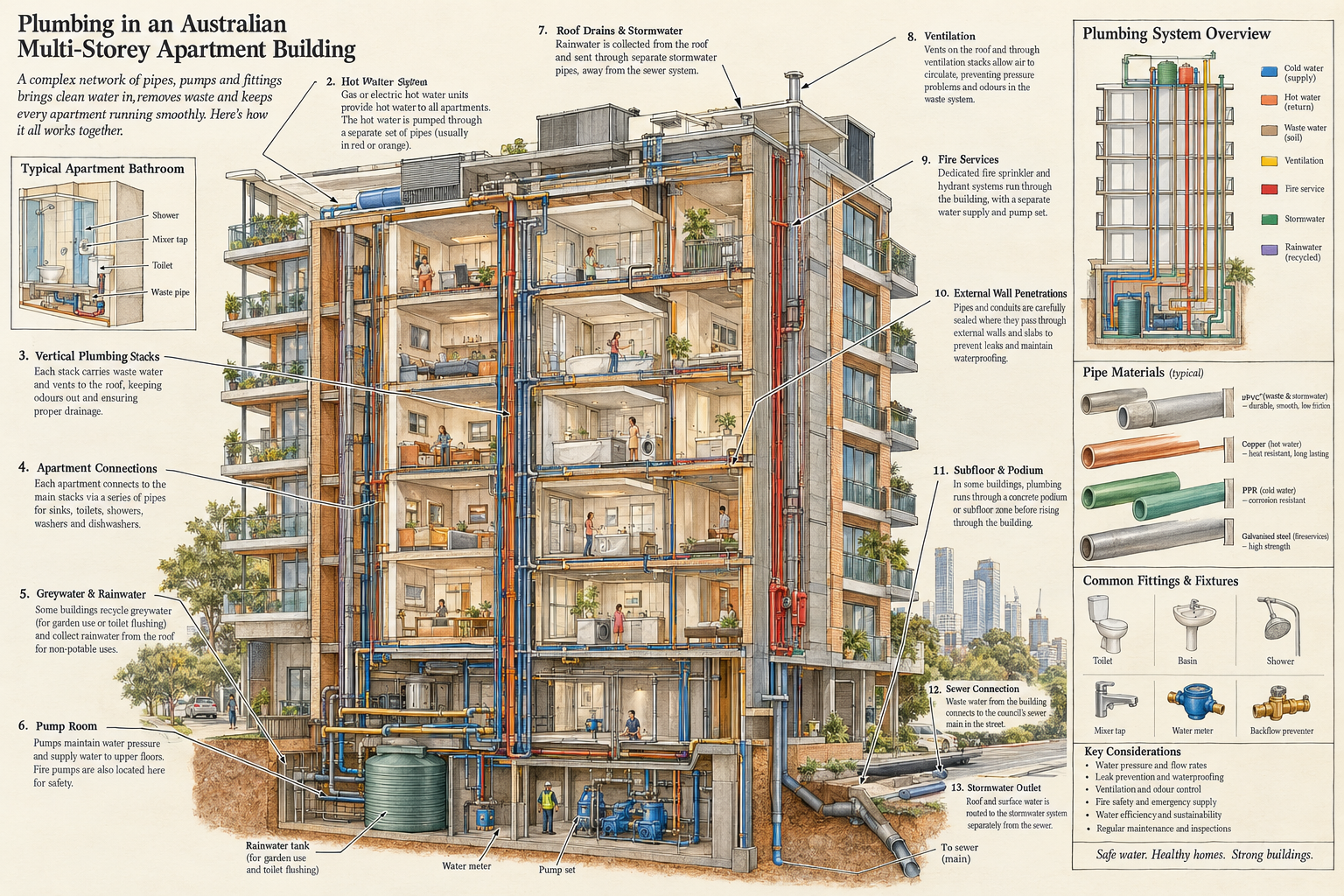
Body corporate vs lot owner maintenance duties
- Body corporate (s 152 & SM s 180): Must maintain common property in good condition and structurally sound condition. On a Building Format Plan, this includes foundations, roofs, load-bearing walls, railings, balustrades and doors/windows in boundary walls — plus external balcony terrace waterproofing (confirmed in Jefferson Villas [2024] QBCCMCmr 473).
- Sole-use utility infrastructure (SM s 180(4)): The lot owner maintains utility infrastructure serving only their lot (such as an individual hot-water unit or split-system air conditioner), even where it sits on common property.
- Internal bathroom waterproofing: Under The Dalgety (Apartments) [2020] QBCCMCmr 118, bathroom waterproofing wholly inside a Building Format Plan lot is generally the lot owner's responsibility.
- Lot owner's duty & step-in power (SM ss 211–212): Owners must keep their lot in good condition and visible areas clean and tidy; if they fail to do required work, the body corporate can step in, do the work and recover the cost.
Right of entry: 7 days' notice vs emergencies
Under s 163 of the Body Corporate and Community Management Act 1997:
- Non-emergency entry: At least 7 days' written notice to the occupier, at a reasonable time.
- Emergency entry: At any time, with or without notice.
- Obstruction: Obstructing an authorised person carrying out entry under s 163 is an offence carrying up to 20 penalty units. However, forcing entry with a locksmith requires a specific adjudicator's order, not unilateral committee action.
Notice to body corporate requesting common property repair (SM s 180)
Dear [Committee Secretary / Body Corporate Manager],
I am the owner of Lot [number] in the Body Corporate for [Scheme Name], CTS [number].
Under section 152 of the Body Corporate and Community Management Act 1997 (Qld) and section 180 of the Standard Module Regulation 2020, I am reporting the following common property maintenance issue:
Location: [e.g. Balcony membrane / Roof cavity above Lot 11 / External window frame] Description: [Describe the leak, spalling or damage factually, with dates when first noticed.] Attachments: [Dated photos / licensed plumber or builder report attached.]
Please confirm in writing within [7 / 14] days when a licensed contractor will inspect and provide a schedule for repair. This letter also forms part of my reasonable self-resolution steps under the Act.
Kind regards, [Your name] Lot [number] · [Email] · [Phone]
Check your understanding
1. How much written notice must a Queensland body corporate give an occupier before entering a lot for non-emergency common property repairs under s 163?
2. What is the key difference between The Dalgety [2020] and Jefferson Villas [2024] on Queensland waterproofing?
3. If a tenant refuses entry after receiving a valid 7-day notice under s 163, can the committee simply call a locksmith to break in?
Go deeper
General information only, not legal advice.