
Disputes & Living
Abandoned Cars and Junk on Common Property: How Strata Can Remove Them Legally
A dead car in visitor parking, a fridge in the corridor, a bike chained up since 2023. Abandoned goods still belong to someone, so the building has to follow a process before it throws them out. This is the notice, the waiting period, the police and PPSR checks for vehicles, who pays, and the rule in every state and territory.
By Buddy · · 11 min read
On this pageThe owner briefingOn this page
- The owner briefing
- Quick answers
- What can strata do about an abandoned car in the car park?
- How long do you have to wait before removing abandoned goods in strata?
- Can the owners corporation just throw out junk left on common property?
- Who pays to remove an abandoned car from strata?
- Abandoned goods or dumped rubbish?
- The NSW process
- Step 1: find the owner
- Step 2: give a disposal notice
- Step 3: wait the full period
- Step 4: for a car, prove it isn't stolen
- Step 5: dispose, account and keep the file
- Goods on a lot, not common property
- A car abandoned on the street
- Victoria: the Owners Corporations Act process
- Safety comes before the waiting period
- When the owner is a resident
- Who pays
- State by state
- Committee checklist
- A disposal notice template
- How UnitBuddy fits
- Related reading
- Sources and further reading
The owner briefing
- Abandoned goods still belong to their owner. The building can remove them, but only after notice and a waiting period, and a car also needs proof it isn't stolen.
- NSW and Victoria set out a clear process: the uncollected goods rules in NSW, the Owners Corporations Act in Victoria. WA and SA have general uncollected goods laws. Elsewhere I couldn't confirm a strata-specific process, so get advice before you dispose of anything valuable.
- The owners corporation pays the first invoice. In NSW it can take its actual costs out of any sale, and chase a shortfall as a debt.
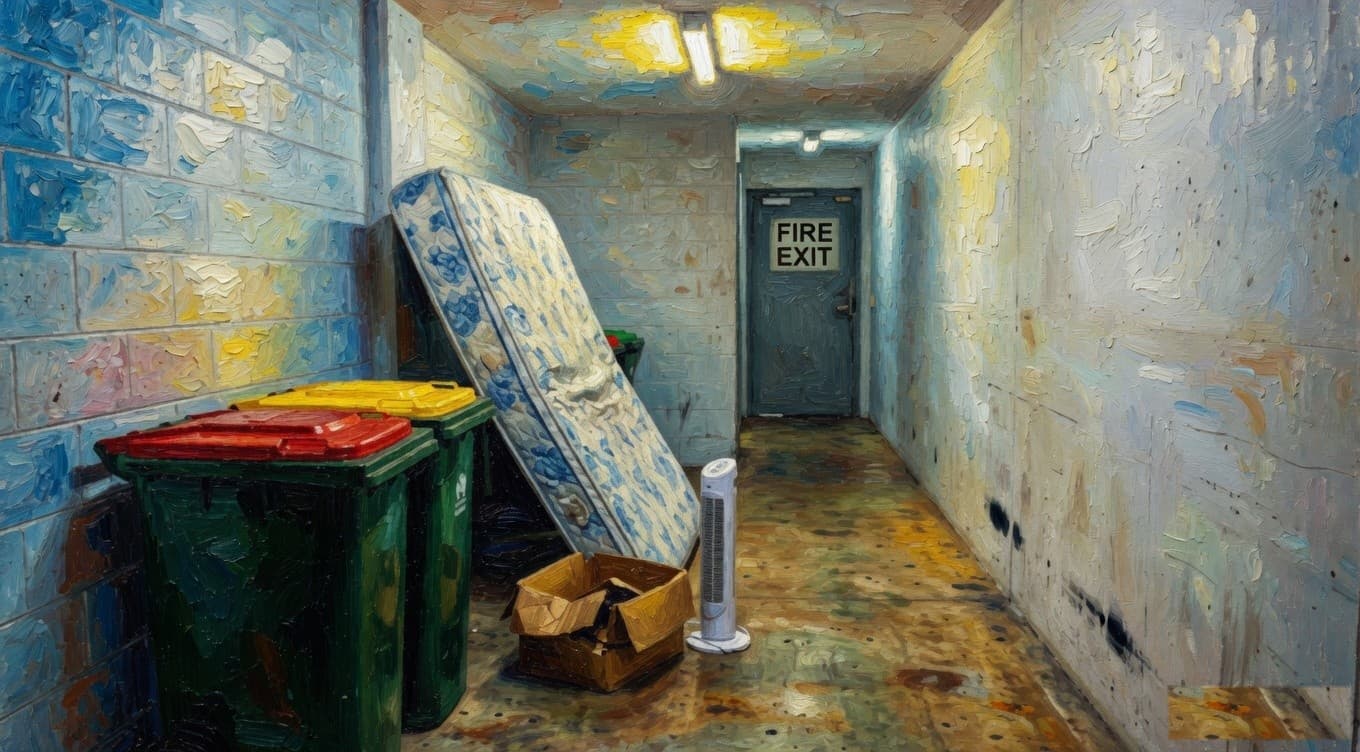
A car with flat tyres and lapsed rego has been in the visitor bay since winter. Nobody admits to owning it. Down the corridor, a fridge has sat outside the bin room for three weeks, and the bike room holds a dozen bikes that haven't moved in a year.
The committee wants it gone. The trap is that "abandoned" is a description, not a transfer of ownership. The person who left the car still owns it. Throw it out without following the process and the building can end up paying for it.
Quick answers
What can strata do about an abandoned car in the car park?
Follow your state's process for abandoned or uncollected goods. In NSW that means notice to the owner, a waiting period based on the car's value, a police certificate that the car isn't stolen and a search of the Personal Property Securities Register (PPSR) before you sell or scrap it. In Victoria the Owners Corporations Act sets out the notice and disposal steps. Don't call a tow truck on day one. See the state-by-state table.
How long do you have to wait before removing abandoned goods in strata?
In NSW, at least 14 days after notice for goods worth under $1,000 and at least 28 days for goods worth $1,000 to $20,000. Above $20,000 you need an NCAT order. Victoria's consumer regulator doesn't publish a minimum period; the notice has to say when the goods will be disposed of. WA's general law needs a month's notice and a court order. Other states: check the Act and get advice.
Can the owners corporation just throw out junk left on common property?
Rubbish, yes. Goods, no. In NSW, rubbish and perishables need no notice. Anything with value (a fridge, a bike, a couch someone might want back) needs notice and a wait first. If it's a mattress dumped by the bins, it's a dumping problem, not an abandoned goods problem.
Who pays to remove an abandoned car from strata?
The owners corporation pays upfront from the administrative fund. In NSW it can keep its actual costs of removal, storage and disposal out of the sale price, then refund the balance to the owner or send it to Revenue NSW as unclaimed money. If the sale doesn't cover the costs, NSW lets it recover the shortfall from the owner as a debt in court.
Abandoned goods or dumped rubbish?
Rubbish is something nobody wants back: a broken mattress, food, a bag of packaging, dead plants. In NSW, rubbish and perishables can go without notice (NSW Government). The real questions are who dumped it and whether the building can recover the clean-up cost. The illegal dumping guide covers that.
Abandoned goods have value, or might matter to someone: a car, a working fridge, a bike, a pram, a box of papers. They still belong to someone, so the building needs notice and a waiting period before disposal.
Personal documents get their own rule in NSW. Licences, passports, wills, bank books and photos need written notice and at least 28 days, and then they are returned or securely destroyed, not thrown in the bin.
My rule of thumb: if you hesitated before calling it rubbish, treat it as goods. A month's wait costs the building nothing. A thrown-out bike that turns out to belong to the owner on level 6 who was overseas costs an apology at best and a claim at worst.
The NSW process
NSW is the most detailed. The Uncollected Goods Act 1995 applies to goods left in strata schemes, and the NSW Government's guidance names strata schemes and common property expressly (NSW Government: uncollected goods). I couldn't find a separate abandoned goods section in the Strata Schemes Management Act 2015. The NSW Government's strata page points owners corporations to the uncollected goods rules instead.
Step 1: find the owner
The owners corporation must make a reasonable effort to find the owner. Ask the committee, the building manager and the cleaners. Put a dated notice in the lift lobby. Check the visitor and fob logs.
The owners corporation usually delegates this work to the strata manager or building manager. Minute the decision so it's clear who is acting.
Step 2: give a disposal notice
The NSW Government says a disposal notice can be given in person, by letter or by email. It must include:
- the name of a person acting for the owners corporation
- a description of the goods
- an address where the owner can collect them
- the removal, storage or maintenance charges, and whether they will come out of any sale
- a statement that from a stated date the goods will be sold, kept or destroyed unless they are collected and the charges paid
If you can't find the owner, the NSW strata guidance says to move the goods into storage and prominently display the disposal notice on common property. There's a template below.
Step 3: wait the full period
The waiting period depends on a reasonable estimate of the item's market value:
| Value of the goods | Notice | Minimum wait | How to dispose |
|---|---|---|---|
| Rubbish and perishables | None | None | Any appropriate way |
| Personal documents | Written | 28 days | Return or securely destroy |
| Under $1,000 | Verbal or written | 14 days | Any appropriate way |
| $1,000 to $20,000 | Written | 28 days | Public auction or private sale at fair value |
| Over $20,000 | As NCAT orders | As NCAT orders | Only with an NCAT order |
Source: NSW Government, which says items are valued one by one unless they clearly form a set.
Removing goods early is the mistake that turns a tidy-up into a tribunal file. Count the days.
Step 4: for a car, prove it isn't stolen
A vehicle can only be disposed of with proof it isn't stolen. The NSW Government lists two documents:
- an uncollected goods certificate (vehicles) from NSW Police, issued under section 31 of the Uncollected Goods Act 1995. You apply at a local police station and pay the fee on the NSW Police website, and an officer has to inspect the car. Bring the make, model, colour, year, location and any VIN, chassis, engine or registration number.
- a written search result from the Personal Property Securities Register. This shows whether a lender holds security over the car.
Legal Aid NSW says the police certificate application has to be served at least 28 days before the sale (Legal Aid NSW). So even a wreck worth $300 takes a month or more. Then the normal value bands apply, and a car worth over $20,000 needs an NCAT order.
While you wait, the car can be moved or stored appropriately. If a lender turns up on the PPSR search, write to them too. A lender with security over the car may want it back.
Step 5: dispose, account and keep the file
When goods are sold, the buyer gets clear title. The owners corporation can keep its actual costs of removal, storage, maintenance, insurance and disposal, but no profit. The balance goes back to the owner, or to Revenue NSW as unclaimed money so the owner can claim it later. If the sale doesn't cover the costs, the owners corporation can recover the shortfall as a debt in court (NSW Government).
Record the disposal within 7 days: what it was, when and how it went, and for a sale, the buyer, the price and what you kept. Keep the records for 12 months for low-value goods and 6 years for everything else. If the owner later complains, the owners corporation has to prove it followed the process. The file is the defence.
Goods on a lot, not common property
If the goods are on a lot, such as a car space that forms part of a lot, the NSW Government says the owners corporation must get the lot owner's consent before acting. If the car space is yours and someone else's car has died in it, start with the car space guide.
A car abandoned on the street
If the car is on a public road outside the building, it isn't the building's problem to solve. Legal Aid NSW says not to take possession of a vehicle abandoned on public property and to report it to the local council, which may impound it.
Victoria: the Owners Corporations Act process
Victoria has its own abandoned goods provisions in sections 53A to 53E of the Owners Corporations Act 2006. Consumer Affairs Victoria summarises them like this (Consumer Affairs Victoria):
- The owners corporation may dispose of goods abandoned on common property, and may tell the owner, if known, that it intends to.
- The notice must be in writing and can be given in person, left at the premises or posted to the person's last known address.
- It must include the plan number and address of the owners corporation, a description of the goods, where they can be collected, when they will be disposed of unless collected, and a statement that the owners corporation will keep funds from any sale to cover its costs.
- If the goods block reasonable access to a lot or the common property, the owners corporation may move them to a safe place first, as long as it has made a reasonable attempt to alert the person who left them.
- It must not dispose of the goods if the owner disputes it and an application has been made to VCAT.
- An owners corporation that disposes of abandoned goods correctly is not liable for them.
The CAV guidance doesn't set a minimum notice period or deal with vehicles specifically. For a car, I would still check with police that it isn't stolen and run a PPSR search before disposal. That's caution, not a step I could confirm in the Victorian Act, but it's cheap.
Safety comes before the waiting period
The waiting period stops the building disposing of goods. It doesn't make the building leave a hazard where it is.
A fridge across a fire exit, a car leaking fuel in the basement or a pile of boxes against a hydrant is a safety problem the same day. In NSW the owners corporation must keep common property in good and serviceable repair under section 106 of the SSMA, and the NSW guidance lets goods be moved and stored before disposal, as long as the owner is notified before anything is disposed of. Victoria's Act expressly allows moving goods that block access to a safe place.
Photograph it, move it somewhere safe, put the notice up, then start counting. Damage the goods while moving them and the owners corporation may wear the cost, a point PICA Group also makes. Use a contractor for anything heavy or mechanical.
When the owner is a resident
Sometimes the "abandoned" car belongs to a resident. It's unregistered, it hasn't moved since the owner bought a new one, and it's sitting in a visitor bay.
That's often a by-law breach before it's an abandoned goods case. Parking an unregistered car in a visitor bay usually breaks the parking by-law, and the by-law process is faster than proving abandonment. Use a notice to comply under section 146 in NSW, a breach notice under section 155 in Victoria, or a contravention notice under section 182 in Queensland. The visitor parking guide has the by-law wording.
The abandoned goods process is for owners who can't be found or won't answer. If you can name the neighbour, use the by-law process. For clutter like a storage cage spilling into the corridor, see the common property storage guide.
Who pays
The building pays first. The removalist, the storage, the tow to a wrecker and the auctioneer are all invoiced to the owners corporation, which pays from the administrative fund.
Recovery depends on the state:
- NSW: take actual costs out of the sale, refund or lodge the balance, and recover any shortfall as a debt in court.
- Victoria: the notice tells the owner the owners corporation will keep sale funds to cover its costs.
- WA and SA: costs come out of the sale, and money nobody claims ends up with the state Treasurer.
- Elsewhere: I couldn't confirm a cost recovery rule. Get advice before promising owners the money will come back.
A dead car with no owner in sight may sell for scrap or not at all, so plan on the building carrying most of the cost. That is still far cheaper than paying a stranger for a car you crushed without notice.
State by state
Check which Act governs your scheme before relying on a row. "Not confirmed" means I couldn't confirm from the legislation or official guidance that a process applies to goods on common property. It does not mean you can skip notice.
| Jurisdiction | Process for goods on common property | Vehicles | Disputes |
|---|---|---|---|
| NSW | Uncollected Goods Act 1995: notice, 14 days (under $1,000), 28 days ($1,000–$20,000), NCAT order above $20,000 | Police certificate under s 31 plus a written PPSR search before disposal | NCAT |
| VIC | ss 53A–53E OC Act: written notice, safe place if blocking access, no disposal while a VCAT dispute is on foot | No vehicle-specific step in CAV guidance; police and PPSR checks are prudent | VCAT |
| QLD | No statutory procedure for abandoned goods that I could find (PICA Group says the same). If you know the owner, a contravention notice under s 182 BCCM Act | Towing from common property under s 163A where other law allows; disposal process not confirmed | Commissioner's Office, then QCAT |
| WA | Part VII Disposal of Uncollected Goods Act 1970: written notice to the owner, anyone claiming an interest and the Commissioner at least a month before applying (s 21), then a court order to sell or dispose (s 20) | No vehicle-specific rule in that Act; towing from private parking areas under Part 6A Road Traffic Act 1974 | Court order for disposal; SAT for strata disputes |
| SA | Unclaimed Goods Act 1987, reformed from 1 August 2026: notice, then 14, 28 or 60 days by value. Whether it covers goods left on common property is not confirmed | PPSR search and notice to anyone with a registered interest (s 5A); a court order at $20,000 or more | Magistrates Court |
| TAS | The Disposal of Uncollected Goods Act 2020 replaced the 1968 Act. Coverage of common property not confirmed; check it with the Strata Titles Act 1998 | Not confirmed | TASCAT |
| ACT | The Uncollected Goods Act 1996 covers goods left with businesses and landlords and on public land. Coverage of unit titles common property not confirmed; check the Unit Titles (Management) Act 2011 | Not confirmed | ACAT |
| NT | Not confirmed; the NT has a general uncollected goods law, but check the Unit Title Schemes Act 2009 and get advice | Not confirmed | NTCAT |
Wherever you are, use the NSW steps as a floor: find the owner, give written notice with a clear date, wait at least 28 days for anything of value, check a car with police and the PPSR, and keep the file. Then get advice before you sell or destroy anything worth real money.
Committee checklist
A disposal notice template
Adjust it to your state's rule. In NSW, notice for goods over $20,000 is set by NCAT, not by this template.
How UnitBuddy fits
Abandoned goods cases are won or lost on the file: photos, notices, dates, decisions and receipts. UnitBuddy gives the building one shared record for all of it. The committee decision sits with the notice it authorised. Photos and the PPSR search sit in the documents. Storage and disposal invoices sit in the finances, so the cost is visible when it's time to recover it. When the strata manager or committee changes, the file stays with the building. UnitBuddy doesn't hold or move money, so sale proceeds still go through the owners corporation's own accounts.
Related reading
- Illegal dumping and bulky waste in apartment buildings
- Someone is parking in my car space: what strata owners can do, state by state
- Common property storage: bikes, prams, scooters and fire egress
- Visitor parking in Australian strata: a state-by-state guide
Sources and further reading
- NSW Government: strata abandoned goods
- NSW Government: uncollected goods
- Legal Aid NSW: uncollected goods FAQs
- NSW: Uncollected Goods Act 1995
- NCAT: uncollected goods
- Consumer Affairs Victoria: maintaining and improving common property
- Victoria: Owners Corporations Act 2006
- Personal Property Securities Register
- WA: Disposal of Uncollected Goods Act 1970
- LookUpStrata: how to dispose of abandoned goods in a WA strata scheme
- SA Attorney-General's Department: unclaimed goods in South Australia (fact sheet, 2026)
- Tasmania: Disposal of Uncollected Goods Act 2020
- Access Canberra: a guide to uncollected goods in the ACT (2007)
- PICA Group: what to do with abandoned goods on strata common property
- PICA Group: removing an abandoned vehicle from common property
What changed in strata this month? Read the strata news for your state, with every figure sourced.
More guides like this

Guides
Strata Disputes & Enforcement in Australia: A Complete Guide for Owners and Committees (2026)
How strata disputes actually get resolved in Australia: water leaks, defects, noise, mould, smoking, by-law breaches, and tribunal applications. State-by-state, written for the people whose problem it is, not the people paid to manage it.
5 May 2026 · 14 min read
Disputes & Living
Defamation in Strata: Emails, Group Chats and Notices That Go Too Far
An all-owners email that calls the treasurer a thief, minutes that say an owner lied, a Facebook group nobody moderates. How defamation law applies in a strata building after the 2021 and 2024 reforms, the defences committees rely on, who answers for group chat posts, and what to do if you are defamed or receive a concerns notice.
19 November 2026 · 12 min read

Disputes & Living
Harassment and Bullying in Strata: What You Can Do About a Neighbour or Committee Member
Abuse in the lift, threats at the door, a committee member who targets you, or defamatory posts in the building group chat. This is what the strata Acts can and can't do about it, when the police or a protection order fits better, what the committee owes owners and workers, and the rule in every state and territory.
19 November 2026 · 12 min read