
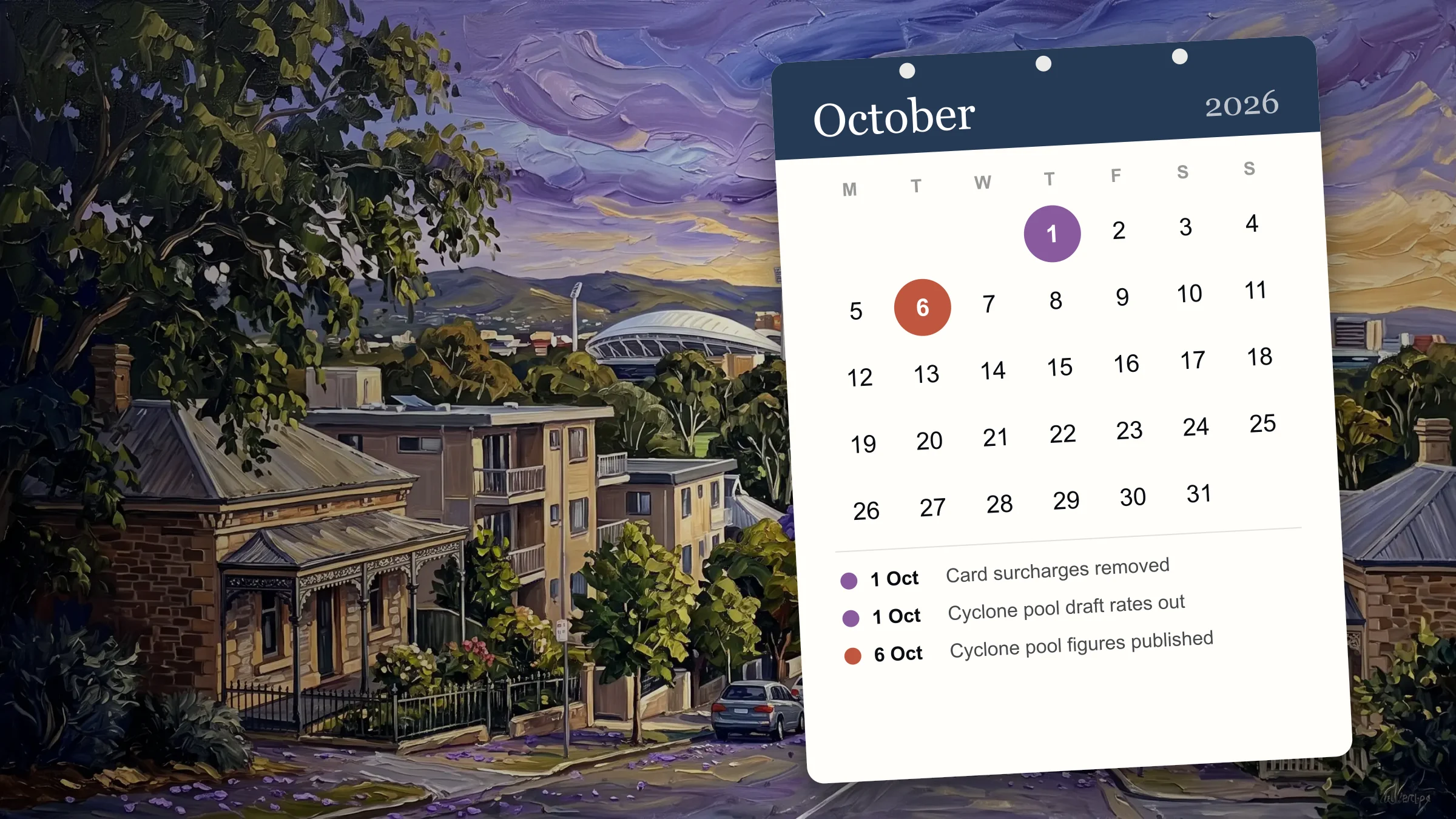
SA, ACT & NT strata news · October 2026
SA, ACT and NT strata news, October 2026: a lower ACT quorum, new SA regulations and the cyclone pool's draft rates
A bill would cut the ACT's standard quorum for owners corporation meetings from half the units to a quarter, South Australia's new Community Titles Regulations are in force, and the cyclone reinsurance pool has put draft rates out for comment. NT strata buildings pay far more than the national average for that cover.
· 8 min read
$1,950
average annual cyclone pool premium per NT strata building, against $820 nationally
On this pageNewsOn this page
- News
- ACT: a quarter of the units would be enough for a quorum
- ACT: the government's answer to the strata inquiry
- ACT tribunal: a balcony screen rule struck out, and a hedge that cost $1,054
- ACT: help for apartment solar and home upgrades
- SA: new Community Titles Regulations are in force
- NT: what Territory strata buildings pay for cyclone cover
- All three: no more card surcharges on levy payments
- The numbers
- Offers
- Reach strata owners in SA, the ACT and the NT
- From the blog
The ACT had the busiest few months of the three. The government answered the Assembly's strata inquiry on 27 August, agreeing to a Strata Commissioner and, in principle, to licensing strata managers. On 17 September the Attorney-General presented a bill that cuts the standard quorum for owners corporation meetings from half the units to a quarter. In the NT, the cyclone reinsurance pool published new figures showing what Territory strata buildings pay for cyclone cover, then put draft rates for 2027 out for comment. In South Australia, new Community Titles Regulations started on 1 September. And from 1 October, card surcharges on eftpos, Mastercard and Visa are gone everywhere, levy payments included.
- Today27 Aug 2026ACT Government responds to the strata inquiry10 recommendations agreed and 13 agreed in principle.
- 1 Sept 2026SA Community Titles Regulations 2026 startThey replace the 2011 regulations. Matching changes to the Strata Titles Regulations 2018 start the same day.
- 17 Sept 2026ACT quorum bill presented to the AssemblyThe unit titles changes start 3 months after the Act is notified.
- 1 Oct 2026Card surcharges removed nationallyDebit, prepaid and credit cards on eftpos, Mastercard and Visa.
- 1 Oct 2026Cyclone pool draft rates for 2027 released
- 6 Nov 2026Submissions on the cyclone pool draft rates close
- 1 July 2027New cyclone pool rates proposed to start
News
ACT: a quarter of the units would be enough for a quorum
The Housing and Consumer Affairs Legislation Amendment Bill 2026, presented by Attorney-General Tara Cheyne on 17 September, makes three changes to how owners corporation general meetings work under the Unit Titles (Management) Act 2011:
- Lower quorum. A standard quorum under schedule 3, section 3.9 would need people entitled to vote for at least a quarter of the units, down from half. Retirement villages under a units plan drop from a third to a quarter.
- Reduced quorum decisions take effect the next day. At the moment a decision made with a reduced quorum (two or more voters, once a standard quorum fails to turn up within half an hour) waits 28 days, and a majority petition can overturn it (schedule 3, section 3.11). The bill drops both the wait and the petition. Owners still get notice of the decision and can challenge it at ACAT.
- Proxies and absentee votes count. A proxy can be given general authority or limited to stated motions. An owner who appoints a proxy, or casts an absentee vote on a motion in the meeting notice, counts as present for the quorum.
The government's explanatory statement says the change answers recommendation 13 of the Assembly's strata inquiry, and that the 28-day delay was stalling urgent repairs and decisions to take legal action. The unit titles changes start three months after the Act is notified. The bill has been presented but has not yet passed.
- Voters for 1/4 of the units arrive: standard quorum
- No standard quorum in 30 minutes: 2 or more voters form a reduced quorum
- Owners are told of the reduced quorum decision
- Decision takes effect the next day, not after 28 days
ACT: the government's answer to the strata inquiry
The ACT Government responded on 27 August to the Standing Committee on Legal Affairs' report on the management of strata properties. Of the 33 recommendations, it agreed to 10 and agreed in principle to 13. The full response sets out what comes next:
- A Strata Commissioner, in two stages. First an education and information role publishing guidance, templates and model documents. Wider functions, which could include dispute resolution, would follow after consultation.
- Licensing for everyone doing strata management work, staged and subject to funding. Commission disclosure, and whether to restrict or ban commissions, will be looked at in light of NSW.
- Levies in real estate advertising, through changes to sale advertising rules similar to those for energy ratings.
- Better guidance for owners corporations on honorariums for executive committee members, Class B units plans and using sinking funds for environmental upgrades.
- Not agreed: a standard strata management contract, five-year term limits for executive committee members, renters on executive committees, and a central document hub like NSW's Strata Hub. The government will instead consider letting owners corporations set their own term limits.
Most of this needs further policy work and money, so expect consultation before any law changes. The quorum bill above is the first recommendation to reach the Assembly.
- Agreed in principle1338%
- Agreed1029%
- Noted721%
- Not agreed412%
| Agreed in principle | 13 |
|---|---|
| Agreed | 10 |
| Noted | 7 |
| Not agreed | 4 |
ACT tribunal: a balcony screen rule struck out, and a hedge that cost $1,054
- Balcony screens. In The Owners - Unit Plan No 4654 v Hurst [2026] ACAT 52 (published 18 August), an owners corporation in City Walk asked ACAT to order owners to remove freestanding shelves and screens holding plants on their enclosed balcony. ACAT refused and declared the building's whole balcony rule invalid. The rule let the executive committee give or withdraw permission without any criteria or reasons, which the tribunal found uncertain and potentially oppressive. The tribunal also reminded owners corporations that rules must be enforced in line with the executive committee code of conduct in schedule 1, and that a rule restricting sustainability infrastructure is invalid under section 108(3)(f).
- Trimmed hedge. In The Owners - Unit Plan 4487 v Adams [2026] ACAT 53 (published 16 September), a townhouse complex won $875 in damages plus its $179 filing fee from a neighbour who cut back a hedge growing on its common property. It had claimed $1,750. The neighbour's $12,250 counterclaim was dismissed.
ACT: help for apartment solar and home upgrades
The Sustainable Household Scheme now lends up to $20,000 at 3% over as long as 10 years, and loans for e-cargo bikes were added in September. More than $290 million in loans has been settled since 2021. For whole buildings, owners corporations can still register for Solar for Apartments, which offers up to $100,000, half as a grant and half as a zero-interest loan the owners corporation repays. It is limited to Class A units plans without rooftop solar where the average unimproved value of a unit is $300,000 or less in any year from 2022.
SA: new Community Titles Regulations are in force
The Community Titles Regulations 2026 started on 1 September 2026, replacing the Community Titles Regulations 2011 under the Community Titles Act 1996. The Strata Titles (Miscellaneous) Amendment Regulations 2026 started the same day and make matching changes under the Strata Titles Act 1988, according to the Surveyor-General's notice of 20 August.
The change the notice spells out is a fuller licensed surveyor's certificate. Any community plan certified or re-certified from 1 September must give the date field work was completed, say who carried out the survey, and confirm the boundary monuments and service infrastructure. If your community corporation is planning to amend its plan, divide a lot or add land, ask your surveyor to use the new certificate. Community corporation forms, by-laws or minutes that quote the 2011 regulations now point to a replaced instrument, so check them at your next review.
NT: what Territory strata buildings pay for cyclone cover
The Cyclone Reinsurance Pool's figures as at 30 June 2026, published on 6 October, put the average annual pool premium for an NT strata building at $1,950, across 2,453 strata buildings. The average for all strata buildings in the pool is $820. These are reinsurance premiums insurers pay to the pool per building, not per lot, and only one part of what a body corporate pays.
| Northern WA | $5,622 |
|---|---|
| Far North QLD | $2,720 |
| NT | $1,950 |
| SE and Mid Coast QLD | $903 |
| Southern WA | $421 |
| Northern NSW | $255 |
| Inland QLD | $94 |
Every NT strata building in the pool has wind cover and 83% have flood cover, but only 60% have storm surge cover.
On 1 October the Australian Reinsurance Pool Corporation released draft premium rates for comment, proposed to start on 1 July 2027. Total pool premiums would rise 2.9% to $770 million a year, but the average premium for high-risk properties would fall from $981 to $897. ARPC's consultation paper says the cuts are concentrated in higher-risk areas, including the NT. Insurers set their own premiums, so a lower pool premium does not guarantee a lower bill. Submissions close on 6 November 2026.
| Current rates | $981 |
|---|---|
| Draft rates | $897 |
All three: no more card surcharges on levy payments
From 1 October 2026, businesses can no longer add a surcharge to debit, prepaid or credit card payments on the eftpos, Mastercard and Visa networks. The Reserve Bank's Payments System Board made the decision in March and also lowered the caps on interchange fees. If your levy notice or payment portal still adds a fee for paying by one of those cards, ask your strata or body corporate manager why.
The numbers
South Australia approved 754 apartments, townhouses and other non-house dwellings in August, the highest monthly figure since May 2018. Monthly approvals in SA swing a lot, so read one strong month with care.
| Sep 25 | 315 |
|---|---|
| Oct | 435 |
| Nov | 424 |
| Dec | 420 |
| Jan 26 | 326 |
| Feb | 393 |
| Mar | 479 |
| Apr | 378 |
| May | 527 |
| Jun | 392 |
| Jul | 517 |
| Aug | 754 |
The ACT has the largest share of residents living in strata in Australia, at least 22%. The NT is at 16% and South Australia at 8%.
| NSW | 17% |
|---|---|
| VIC | 18% |
| QLD | 13% |
| WA | 10% |
| SA | 8% |
| ACT | 22% |
| TAS | 8% |
| NT | 16% |
South Australia has more strata and community title lots than the ACT and NT combined, and far more schemes: 23,854, against 4,840 in the ACT and 2,960 in the NT.
- South Australia130,47556%
- ACT77,93233%
- Northern Territory25,42711%
| South Australia | 130,475 |
|---|---|
| ACT | 77,932 |
| Northern Territory | 25,427 |
| VIC | 128,896 |
|---|---|
| NSW | 91,078 |
| QLD | 52,927 |
| WA | 52,878 |
| SA | 23,854 |
| TAS | 10,537 |
| ACT | 4,840 |
| NT | 2,960 |
Offers
There are no sponsor offers for SA, the ACT or the NT this month. If your executive committee, strata corporation or body corporate is getting ready for an AGM, the free UnitBuddy demo shows how a building can keep its committee register, levies, capital works plan and records in one place.
Reach strata owners in SA, the ACT and the NT
Are you a plumber, waterproofer, electrician, cleaner or another trade that works on apartment buildings? You can put your offer here and beside our state-by-state guides. Our readers are apartment owners and the volunteer committee members who hire trades for their buildings, and they usually find us by searching for the exact problem they need fixed.
| 4 May | 21 |
|---|---|
| 11 May | 41 |
| 18 May | 35 |
| 25 May | 46 |
| 1 Jun | 70 |
| 8 Jun | 58 |
| 15 Jun | 48 |
| 22 Jun | 75 |
| 29 Jun | 110 |
| 6 Jul | 142 |
| 13 Jul | 141 |
| 20 Jul | 132 |
| 27 Jul | 175 |
| 3 Aug | 185 |
| 10 Aug | 201 |
| 17 Aug | 215 |
| 24 Aug | 245 |
| 31 Aug | 271 |
| 7 Sep | 220 |
| 14 Sep | 234 |
| 21 Sep | 208 |
| 28 Sep | 181 |
| 5 Oct | 212 |
A sponsorship for SA, the ACT or the NT puts your business on our 13 state-by-state guides, and on this monthly report. Prices are set per trade category, from $60 to $250 a month plus GST for one state or territory. Every click goes straight to your site: no commission and no lead fees. Each month you also get a labelled sponsored article on the UnitBuddy blog.
See audience numbers, categories and prices on the advertise page, or email sales@unitbuddy.com.au.
From the blog
Strata news by state