Queensland strata news · November 2026
Queensland strata news, November 2026: one month to smoke alarms and cyclone pool hits $1b
One month remains before interconnected photoelectric smoke alarms become mandatory in every Queensland unit on 1 January 2027. The cyclone pool passed $1 billion in claims paid, ARPC warned on policy excesses before a parliamentary inquiry, and QCAT clarified its jurisdiction after BCCM dismissals.
By the UnitBuddy team · · 7 min read
1 Jan
deadline for interconnected photoelectric smoke alarms in every Queensland unit and townhouse
On this pageNewsOn this page
- News
- One month left for the 1 January 2027 smoke alarm deadline
- Cyclone pool passes $1 billion in claims as ARPC warns on excesses
- In the tribunal: QCAT jurisdiction and BCCM appeal limits
- QBCC licensing and contract updates, plus UOAQ guidance on extensions and roofs
- The numbers
- Offers
- Reach Queensland strata owners and committees
- From the blog
Queensland unit owners have one month left before the final stage of the state's smoke alarm laws takes effect on 1 January 2027. With electrician diaries tightening ahead of Christmas shutdowns, long-term owner-occupiers who have not sold or leased since 2022 face the hardest rush. Meanwhile, cyclone season opened with fresh figures from the Australian Reinsurance Pool Corporation (ARPC): the Cyclone Reinsurance Pool has passed $1 billion in claims paid since 2022, nearly three in ten paid residential cyclone claims had an excess at or above the payout, and ARPC executives gave evidence to a parliamentary inquiry on 25 November. In the tribunals, two recent QCAT decisions drew sharper lines around BCCM appeals and where maintenance damages claims belong.
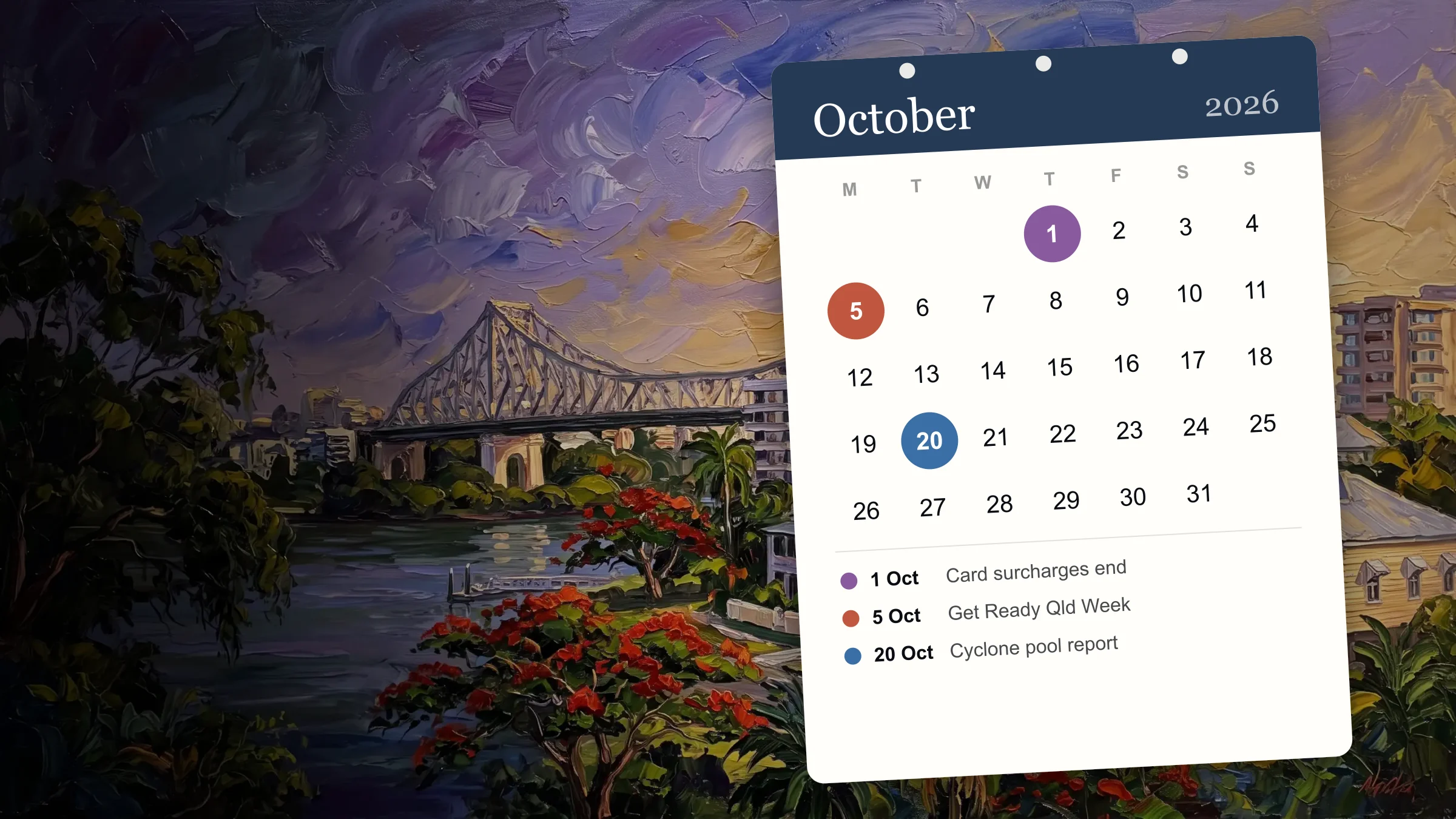
- Today21 Oct 2026ARPC releases 2026 Financial Outlook ReportCyclone pool records a $701m positive operating result for 2025-26.
- 22 Oct 2026QCATA decides Southport Residential CTS 35751 v TranAppeals under s 289(2) stay confined to questions of law; divestment order stands.
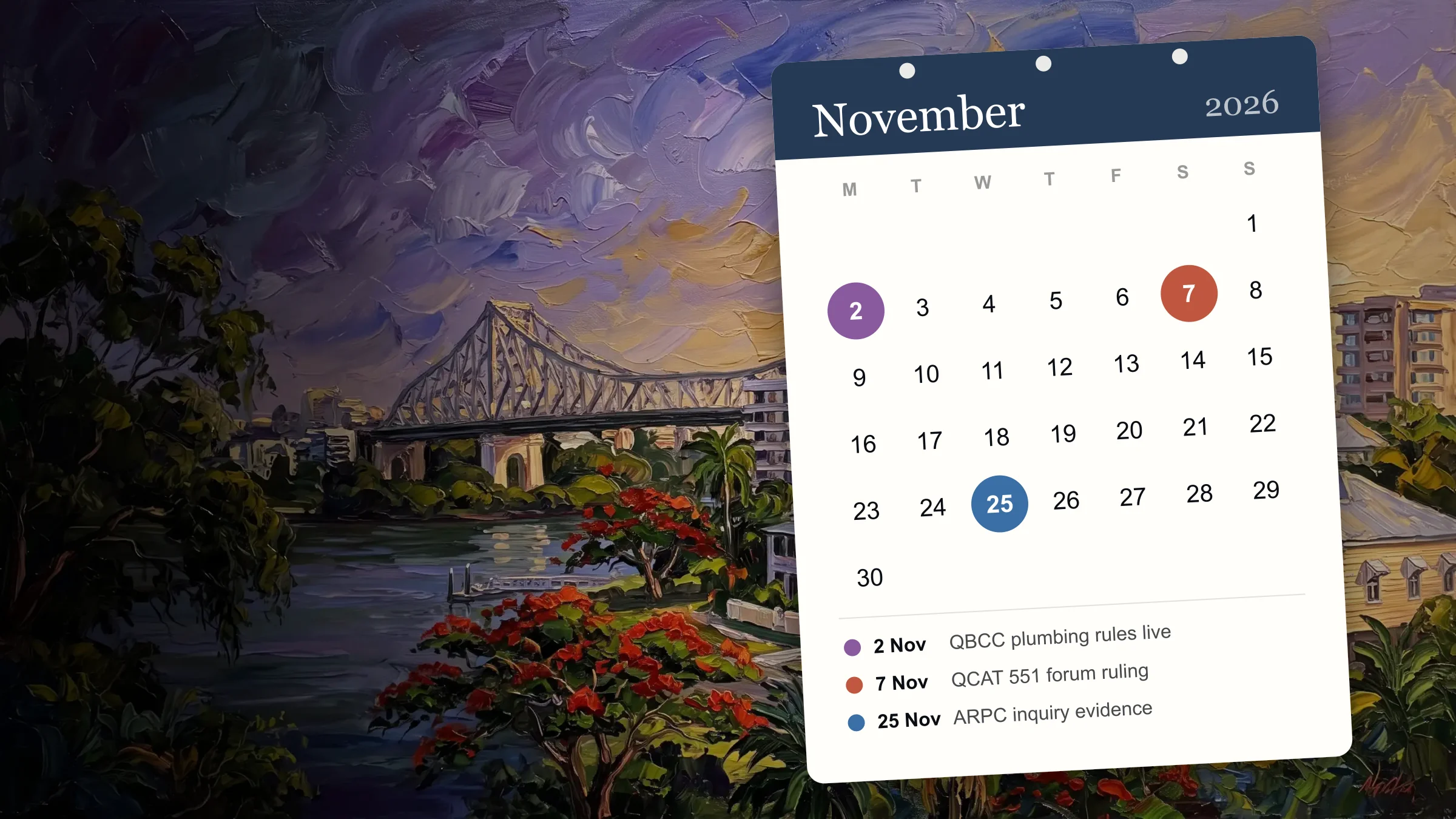
- 2 Nov 2026QBCC plumbing licensing changes startStreamlined occupational licences for Australian apprenticeship completers and returning plumbers.
- 6 Nov 2026Submissions close on draft cyclone pool ratesARPC consultation on 1 July 2027 premium rates closes.
- 7 Nov 2026QCAT decides Darborello Property 1 v Princeton CourtBCCM s 270 dismissal does not grant QCAT original jurisdiction; claim moves to Magistrates Court.
- 12 Nov 2026ARPC warns on cyclone claim excessesNearly three in ten paid residential cyclone claims had an excess at or above the payout.
- 25 Nov 2026ARPC appears at Northern Australia parliamentary inquiryEvidence covers 3.2 million insured buildings and ongoing affordability pressures.
- 1 Jan 2027Interconnected photoelectric smoke alarms required in every homeFinal stage under s 104RBA of the Fire Services Act 1990 covers all remaining units and townhouses.
News
One month left for the 1 January 2027 smoke alarm deadline
The transitional domestic smoke alarm rules in section 104RB of the Fire Services Act 1990 expire on 31 December 2026. From 1 January 2027, section 104RBA applies to every remaining domestic dwelling in Queensland, including owner-occupied apartments, units and townhouses that have not been sold or leased since 2022.
Under Queensland Fire Department and Queensland Government requirements, every dwelling must have photoelectric smoke alarms compliant with AS 3786:2014 in every bedroom, in hallways connecting bedrooms to the rest of the home, and on every storey. All alarms must be interconnected so every alarm sounds together, and each must be hardwired or powered by a non-removable 10-year lithium battery. Under section 104RC, any alarm more than 10 years old must be replaced, and an existing hardwired alarm must be replaced with a hardwired alarm.
In a body corporate, the responsibility split trips up many owners. Standalone alarms inside a lot belong to the lot owner, while alarms on common property or wired back to a central Fire Indicator Panel (FIP) sit with the body corporate.
- Required in every bedroom, connecting hallway and storey by 1 January 2027.
- Must be photoelectric (AS 3786:2014), interconnected and hardwired or 10-year lithium.
- Replacements for hardwired alarms must stay hardwired (licensed electrician required).
- Owner pays and keeps the compliance certificate.
- Common corridors, stairwells, lobbies and plant rooms.
- In-lot detectors wired directly to a building Fire Indicator Panel (governed by AS 1670).
- Lot owners must not tamper with or replace FIP-connected detectors.
- Can offer voluntary bulk installation for opted-in lots under s 158 of the BCCM Act.
Cyclone pool passes $1 billion in claims as ARPC warns on excesses
Storm and cyclone season is underway across Queensland, and the Australian Reinsurance Pool Corporation (ARPC) put four sets of numbers on the table between late October and late November.
First, ARPC's 2025-26 Annual Report confirmed that the Cyclone Reinsurance Pool has passed $1 billion in claims paid since it began in July 2022, following nine declared cyclone events in 2025-26, without drawing on the $10 billion Commonwealth guarantee. Its 2026 Financial Outlook Report (21 October) recorded a $701 million positive operating result for 2025-26, rebounding from a $1.2 billion negative result in 2024-25 as claims costs fell to $203 million (well below the $638 million modelled Average Annual Loss) and provisions for Tropical Cyclone Alfred eased. Net liabilities narrowed from $734 million to $33 million as at 30 June 2026.
Second, on 12 November, ARPC warned that minor cyclone damage still leaves many policyholders out of pocket. In ARPC's claims analysis, for nearly three in ten (almost 30%) paid residential cyclone claims, the insurance excess was equal to or greater than the payout from the insurer. The average residential building claim sat around $8,000.
Third, on 25 November, ARPC Chief Executive Dr Christopher Wallace gave evidence to the Parliamentary Joint Standing Committee on Northern Australia. He reported that the pool now covers 22 participating insurers and roughly 3.2 million buildings nationwide, and that average quoted home premiums in medium- to high-cyclone-risk areas are 14% to 37% lower than before insurers joined the pool. He also acknowledged that overall affordability remains under pressure from rebuilding costs and non-cyclone perils. Submissions on ARPC's draft 1 July 2027 pool premium rates closed on 6 November.
| Medium-risk floor | 14% |
|---|---|
| Highest-risk average | 37% |
In the tribunal: QCAT jurisdiction and BCCM appeal limits
Two recent decisions from Queensland's civil and administrative tribunal clarify where body corporate disputes go when an adjudicator's process ends.
- A BCCM dismissal does not give QCAT jurisdiction over maintenance damages. In Darborello Property 1 Pty Ltd v Body Corporate for Princeton Court CTS 16000
[2026] QCAT 551(7 November 2026), Member King-Scott held that an adjudicator's dismissal under section 270(1)(b) of the Body Corporate and Community Management Act 1997 releases a dispute from Chapter 6 exclusivity, but does not automatically confer original jurisdiction on QCAT. QCAT's original body corporate jurisdiction is restricted to complex disputes, and an unliquidated maintenance compensation claim does not qualify as a minor civil dispute. Rather than dismissing the self-represented owner's claim, QCAT transferred it to the Magistrates Court under section 52(2)(a) of the Queensland Civil and Administrative Tribunal Act 2009. - Appeals from adjudicators stay strictly on questions of law. In Body Corporate for Southport Residential CTS 35751 v Tran
[2026] QCATA 162(22 October 2026), Senior Member Brown reaffirmed that an appeal under section 289(2) of the BCCM Act cannot be used to re-litigate factual findings. Although the Appeal Tribunal found the adjudicator erred on section 44 (holding shares in a company that owns lots is not a proprietary "interest in a lot"), the adjudicator's divestment order under section 276 remained within power and the appeals were dismissed.
- Self-resolution & BCCM conciliation
- Adjudicator order or s 270 dismissal
- Law appeal to QCAT within 6 weeks (s 289)
- Unliquidated damages go to Magistrates Court
QBCC licensing and contract updates, plus UOAQ guidance on extensions and roofs
On 2 November 2026, QBCC's plumbing licensing changes commenced, removing provisional licence steps for eligible Australian apprenticeship completers and easing re-entry for former occupational plumbing and drainage licensees who held a licence within the past 10 years. Earlier, on 29 October, QBCC published fixed-price contract guidance for Queensland home owners, setting out what owners should check before signing a fixed-price building or renovation contract. Always confirm a contractor's QBCC licence before approving works over $3,300.
On the owners' advocacy front, the Unit Owners Association of Queensland (UOAQ) followed its October procurement comparison with two November notes. On 5 November, UOAQ argued that a management-rights extension is not reasonable under section 94 of the BCCM Act merely because an ordinary resolution passes, and committees need objective evidence on duties, performance and alternatives. On 16 November, it urged committees to commission independent roof specifications before seeking quotes so contractors price the same scope of work.
The numbers
Queensland apartment and townhouse approvals eased slightly in September 2026 after peaking in July. In the ABS September 2026 release (published 2 November), trend approvals for dwellings excluding houses came in at 1,820, down 2.0% from 1,857 in August and below the July high of 1,900, though still well above February's low of 1,613.
| Oct 25 | 1,769 |
|---|---|
| Nov | 1,749 |
| Dec | 1,691 |
| Jan 26 | 1,637 |
| Feb | 1,613 |
| Mar | 1,647 |
| Apr | 1,731 |
| May | 1,839 |
| Jun | 1,899 |
| Jul | 1,900 |
| Aug | 1,857 |
| Sep | 1,820 |
Unlike NSW, where apartments make up more than half of new approvals, detached houses still lead Queensland's pipeline. In September 2026, apartments, townhouses and other non-house dwellings made up 43% of all Queensland dwelling approvals in trend terms (1,820 compared with 2,444 houses).
| Apartments & townhouses | 1,820 |
|---|---|
| Houses | 2,444 |
Offers
There are no sponsor offers for Queensland this month. If your committee is chasing smoke alarm certificates before 1 January, reviewing insurance excesses for cyclone season or preparing for an AGM, the free UnitBuddy demo shows how a building can keep its committee records, levies, sinking fund forecast and documents in one place.
Reach Queensland strata owners and committees
Are you a plumber, roofer, electrician, cleaner or another trade that works on apartment buildings? You can put your offer here and beside our Queensland guides. Our readers are apartment owners and the volunteer committee members who hire trades for their buildings, and they usually find us by searching for the exact problem they need fixed.
| 4 May | 21 |
|---|---|
| 11 May | 41 |
| 18 May | 35 |
| 25 May | 46 |
| 1 Jun | 70 |
| 8 Jun | 58 |
| 15 Jun | 48 |
| 22 Jun | 75 |
| 29 Jun | 110 |
| 6 Jul | 142 |
| 13 Jul | 141 |
| 20 Jul | 132 |
| 27 Jul | 175 |
| 3 Aug | 185 |
| 10 Aug | 201 |
| 17 Aug | 215 |
| 24 Aug | 245 |
| 31 Aug | 271 |
| 7 Sep | 220 |
| 14 Sep | 234 |
| 21 Sep | 208 |
| 28 Sep | 181 |
| 5 Oct | 212 |
| 12 Oct | 221 |
| 19 Oct | 233 |
| 26 Oct | 260 |
| 2 Nov | 256 |
| 9 Nov | 230 |
A Queensland sponsorship puts your business on our 10 Queensland guides and 13 state-by-state guides, and on this monthly report. Prices are set per trade category, from $60 to $250 a month plus GST for one state. Every click goes straight to your site: no commission and no lead fees. Each month you also get a labelled sponsored article on the UnitBuddy blog.
See audience numbers, categories and prices on the advertise page, or email sales@unitbuddy.com.au.
From the blog
Get Queensland strata law updates once a month
New reforms, tribunal decisions and deadlines in one short email. Unsubscribe anytime, or follow via RSS.
General information only, not legal, financial or professional advice. Figures and dates come from the linked primary sources; confirm the current legislation before acting.
Strata news by state