
How NT unit titles work
Which Act applies: 2009 Unit Title Schemes vs 1975 Unit Titles
How to tell whether your Northern Territory apartment or townhouse is governed by the Unit Title Schemes Act 2009 (and its Management Modules) or the legacy Unit Titles Act 1975.
3 min read · Last checked
On this pageThe two Northern Territory ActsOn this page
The Northern Territory has 2,960 registered strata schemes covering 25,427 lots — housing about 16% of Territory residents. Before checking a rule on renovations, insurance excesses, manager handovers or NTCAT fees, you need to confirm which of the NT's two parallel Acts governs your building.
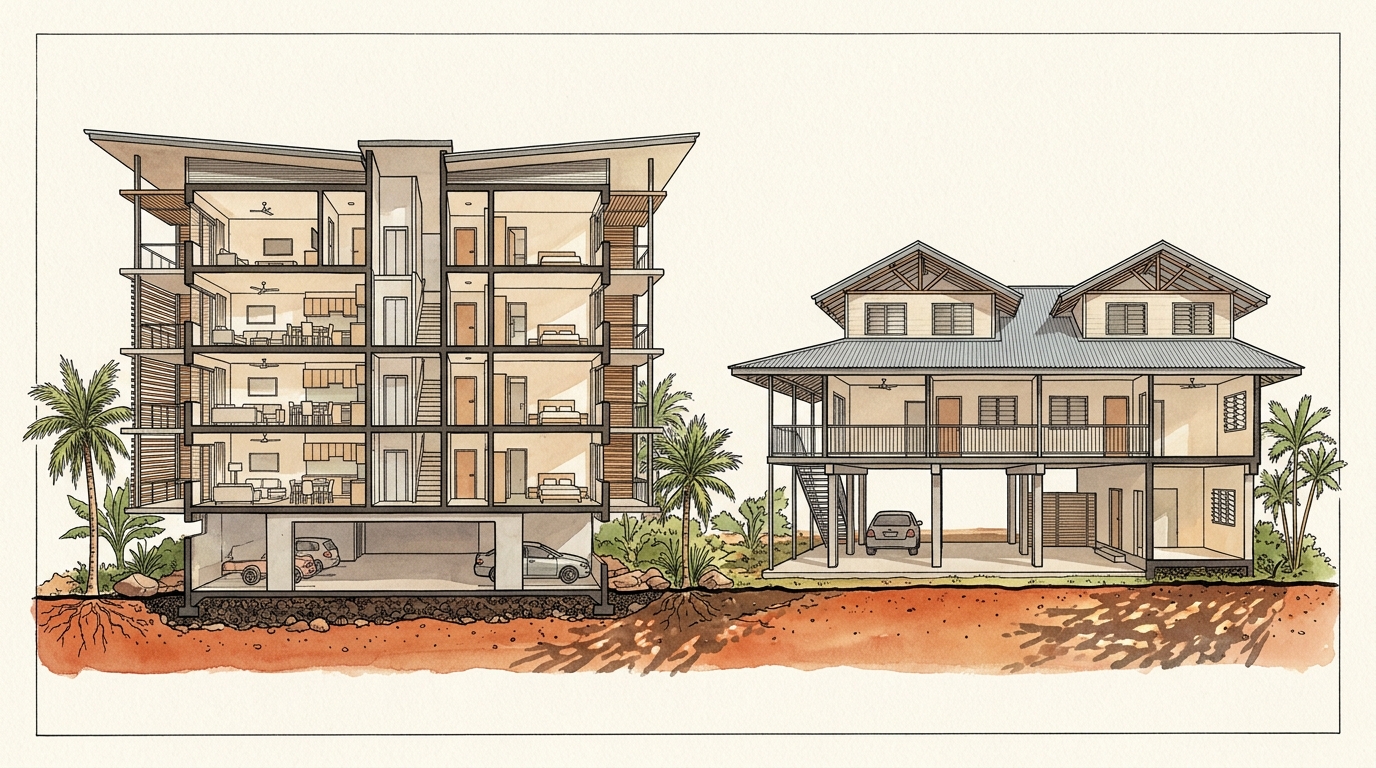
The two Northern Territory Acts
- Unit Title Schemes Act 2009 (NT): Commenced on 1 July 2009. Covers all newer developments formed since then plus older schemes that voted to convert (ss 110–111). It uses a scheme statement, a body corporate, unit owners and by-laws (Schedule 2 defaults or custom by-laws in the scheme statement), paired with the Unit Title Schemes (Management Modules) Regulations 2009 (Modules 1 and 2 for general schemes, and Module 3 for small schemes).
- Unit Titles Act 1975 (NT): Still governs older pre-July 2009 developments registered as a units plan or building development plan that have not converted (s 113), alongside the Unit Titles (Management Modules) Regulations 2009. In these legacy schemes, the entity is called the corporation, owners are proprietors, and rules are articles (Schedule 1 defaults) and by-laws.
The Territory does not have a separate Community Title Act. Ending or terminating a scheme under either Act is governed by a third statute: the Termination of Units Plans and Unit Title Schemes Act 2014 (unanimous, or 80% to 95% of interest entitlement depending on building age).
Interactive · Northern Territory
Which NT unit title Act applies to your building?
Governing law & documents
- Act: Unit Title Schemes Act 2009 (NT)
- Regulations: Unit Title Schemes (Management Modules) Regulations 2009 (Standard Management Module)
- Core document: Scheme Statement + Schedule 2 Default By-laws
- Body & owners: Body corporate & unit owners
Key rules that change
- Renovations: Majority resolution (>50% of all units) under default by-laws 2 & 4
- Breach notices: s 96 Contravention Notice (strict liability offence up to 20 penalty units)
- Exclusive use: Exclusive use by-law certified by Schemes Supervisor (ss 95A–95C, 97)
- NTCAT filing fee (from 1 July 2026): $454 (ss 84–86)
Why checking your Act first changes everything
- Breach notices: The strict-liability contravention notice under s 96 of the 2009 Act does not apply to a 1975 units plan.
- Manager handover: The 1975 Act gives a 7-day statutory handover deadline (s 51(8), max 1,000 penalty units), while the 2009 Act has no fixed statutory deadline (you rely on a written requirement under Schedule 1 cl 12).
- Insurance excess: The 1975 Act expressly allows fault-based expense recovery (s 46), while the 2009 Act is silent on insurance excesses.
- NTCAT filing fees (from 1 July 2026): $454 under the 2009 Act vs $518 under the 1975 Act.
Check your understanding
1. A Darwin townhouse complex was registered as a Units Plan in 1994 and has never converted. Which Act governs it today?
General information only, not legal advice.