
On this pageKey takeawaysOn this page
- Key takeaways
- Does a kitchen renovation in strata need approval?
- What changed with benchtops in 2024?
- What about the old benchtop coming out?
- What can a committee reasonably ask for?
- Before approval
- During the work
- After the work
- Final thoughts
- Frequently asked questions
- Is replacing a kitchen benchtop cosmetic work in NSW strata?
- Do I have to remove my existing engineered stone benchtop?
- Is granite banned in Australia?
- Can the owners corporation refuse a kitchen renovation?
- Sources
- About the author
Submitted by Jose Chavez, Blog Growth Expert at Ready To Rank.
An owner on level four emails the committee on a Friday afternoon. New kitchen, trades booked for Monday, can someone confirm the lift is free? Nobody has seen any plans. Nobody knows what benchtop is going in. The committee member who usually handles this is overseas.
A strata kitchen renovation affects more than one lot. It uses the lift, the corridors and the loading dock. It tests the neighbours' patience. And since July 2024, it raises a question most buildings never had to ask: what happens to the dust when a benchtop is cut?
This guide covers the approval rules, what the engineered stone ban means for benchtop choices, and what a committee can reasonably ask for before work starts.
Key takeaways
- In NSW, renovating a kitchen is listed as a minor renovation under section 110 of the Strata Schemes Management Act 2015. It usually needs approval by ordinary resolution, or by the committee if your by-laws delegate it.
- Engineered stone containing 1% or more crystalline silica can't be supplied, processed or installed anywhere in Australia from 1 July 2024.
- Removing an old engineered stone benchtop is still allowed, but if it has to be cut, ground or broken, the business doing it must control the dust and notify the WHS regulator first.
- Committees can set reasonable conditions on work hours, lift protection, dust, insurance and waste.
Does a kitchen renovation in strata need approval?
In NSW, usually yes. Section 110 names renovating a kitchen as a minor renovation, so the owner needs owners corporation approval by ordinary resolution at a general meeting, unless the by-laws let the strata committee approve it. The owners corporation can attach conditions but can't unreasonably refuse.
If the by-laws let the committee decide, it has three months to refuse in writing with reasons, or the request is treated as approved. The owners corporation must also keep a record of approved minor renovations for 10 years. NSW has passed further reforms that will rename minor renovations "minor work" and redefine the category, with start dates still to be announced, so check the current rules before lodging.
Where it gets grey is the size of the job. A straight swap of cupboard doors or a benchtop, entirely inside the lot, may not touch common property at all. Kitchens rarely stay that tidy, though. Moving the sink means plumbing. A new cooktop can mean new wiring or a gas line. A rangehood ducted through an external wall changes the facade.
Once the work involves structural changes, waterproofing or the building's external appearance, it's no longer minor. It becomes a major renovation that needs a special resolution. The NSW Government's strata renovation rules set out all three categories with examples.
Other states run their own systems. Victoria has owners corporation rules and Queensland relies heavily on body corporate by-laws, so check your scheme's by-laws before assuming any of the above applies. For a state-by-state breakdown, see our apartment renovation approvals guide.
What changed with benchtops in 2024?
From 1 July 2024, engineered stone benchtops, panels and slabs with 1% or more crystalline silica were banned from manufacture, supply, processing and installation across Australia, with imports added from 1 January 2025. The reason is silicosis, an incurable lung disease that fabricators were developing after years of cutting high-silica stone.
For owners, the practical change is simple. The engineered quartz that went into many apartment kitchens over the past 15 years isn't an option for new work. What's left falls into a few groups.
| Benchtop type | Where it sits with the ban | Strata things to check |
|---|---|---|
| Natural stone (granite, marble, quartzite) | Not banned, but natural stone can still contain crystalline silica, so cutting needs dust controls | Slab weight and size against the lift; marble marks and etches easily in a busy kitchen |
| Silica-free mineral or engineered surfaces | Made to sit outside the ban; the supplier should be able to show test results | Ask for the lab report and Safety Data Sheet before approval |
| Porcelain and sintered stone | Not classed as engineered stone if they contain no resin, though many still contain some silica, so cutting must be controlled | Thin, large panels need careful handling through corridors and lifts |
| Laminate, timber, stainless steel | No silica concern when cut | Lighter and easier to get up the building; usually the cheapest option |
Owners who want the stone look without the dust question often end up looking at silica-free benchtops, and a reputable supplier will hand over test results and a Safety Data Sheet without being chased. That paperwork is also what makes a committee's approval straightforward.
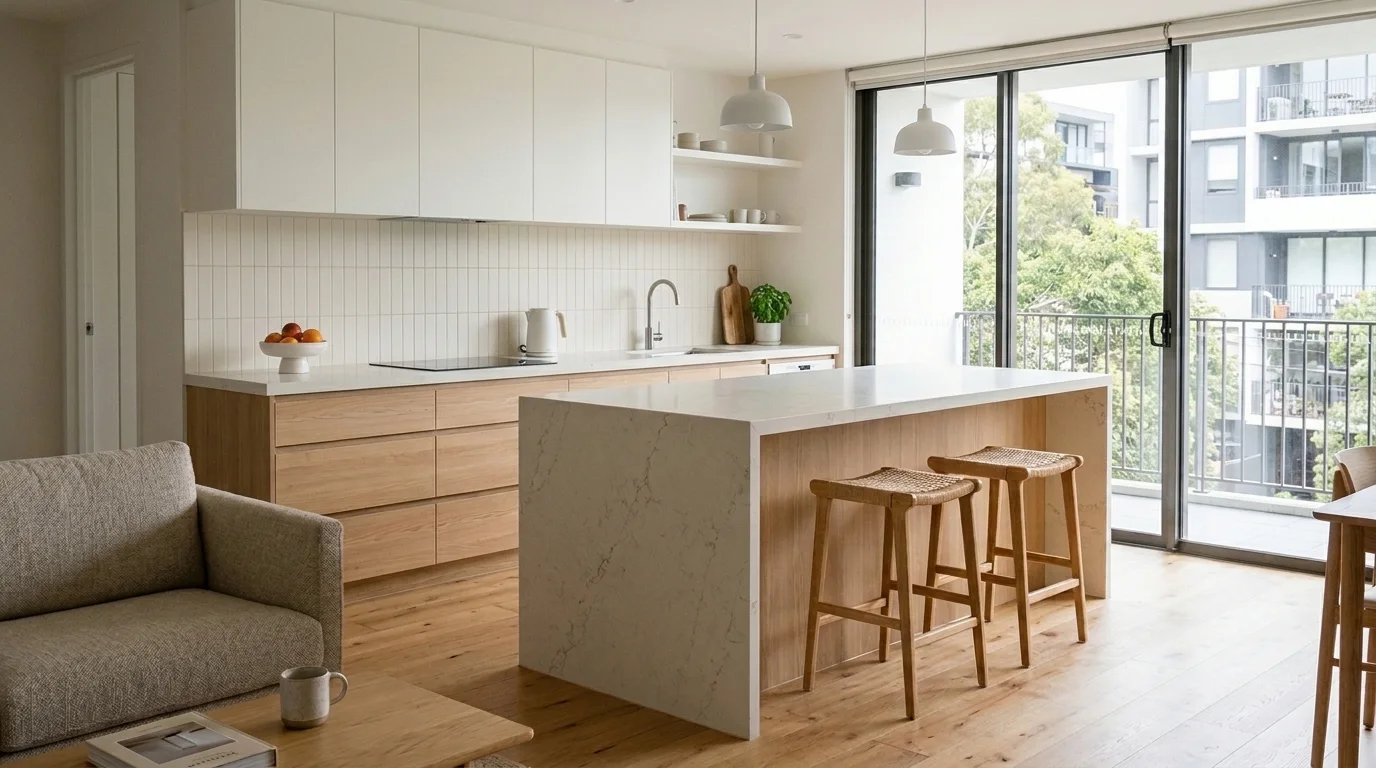
A pale stone-look mineral benchtop photographed from the living area — the kind of finish owners still want, now achieved with compliant silica-free surfaces.
What about the old benchtop coming out?
Removing a legacy engineered stone benchtop is legal, but any cutting, grinding or breaking counts as processing. The business doing it has to use controlled methods, such as water suppression, on-tool dust extraction and proper respirators, and notify SafeWork NSW (or the regulator in your state) before the work starts.
This is the part most owners miss, and it matters more in strata than in a house. Dust doesn't stay in the kitchen. It drifts into the corridor when the front door is propped open, travels in the lift and settles on common property the owners corporation has to keep safe. A benchtop lifted out whole and wrapped is a very different job from one broken into pieces on the balcony.
What can a committee reasonably ask for?
A committee can set conditions as long as they're reasonable and tied to protecting common property and residents. For a kitchen job, a short written checklist sent to the owner with the approval covers most of it.
Before approval
- A scope of works listing what's being removed and installed, including the benchtop material
- Licensed trades for plumbing, electrical and gas work, with licence numbers
- A certificate of currency for each contractor's public liability insurance
- For a silica-free benchtop, the Safety Data Sheet and test report
- For removing engineered stone, confirmation the contractor holds a current notification with the regulator and how dust will be controlled
During the work
After the work
Keep the approval, conditions, insurance certificates and Safety Data Sheet in the building's records. If a neighbour reports a cracked corridor tile six months later, or a future buyer asks what's in the kitchen, the committee isn't searching through a former member's inbox.
Final thoughts
Kitchen jobs in strata go smoothly when the paperwork comes before the trades. The ban has added one question to every approval: what is the benchtop, and how will it be cut? Owners who answer that up front usually get a quick yes.
Frequently asked questions
Is replacing a kitchen benchtop cosmetic work in NSW strata?
Not quite. In NSW, cosmetic work means small jobs on common property, such as painting or fitting hooks. A benchtop swap may not need owners corporation approval at all if it stays entirely within the lot and doesn't touch plumbing, wiring or common property. Most kitchen work goes further than that, which makes it a minor renovation under section 110. Check your by-laws and ask the strata manager or committee before booking trades.
Do I have to remove my existing engineered stone benchtop?
No. The ban covers new supply, processing and installation, not benchtops already in place. An intact benchtop that isn't being cut doesn't release dust. If you later remove or modify it and that involves cutting, grinding or breaking, the contractor must use controlled methods and notify the WHS regulator first.
Is granite banned in Australia?
No. Natural stone such as granite and marble isn't covered by the engineered stone ban. It can still contain crystalline silica, though, so anyone cutting or polishing it must follow WHS rules on dust control. That applies on site in an apartment as much as in a workshop.
Can the owners corporation refuse a kitchen renovation?
In NSW, the owners corporation can't unreasonably withhold approval for a minor renovation, but it can attach reasonable conditions. Conditions around work hours, lift protection, insurance and dust control are normal. If an owner thinks a refusal is unreasonable, NSW Fair Trading mediation and NCAT are the usual next steps.
Sources
- Strata Schemes Management Act 2015 (NSW), s 110 — Minor renovations by owners
- Strata Schemes Management Act 2015 (NSW), s 109 — Cosmetic work by owners
- NSW Government: strata renovation rules
- SafeWork NSW: crystalline silica and engineered stone
- Moving in and out of strata: lift bookings, protection and damage bonds
- Strata record-keeping requirements: what buildings must keep and for how long
About the author
This article was submitted by Jose Chavez, Blog Growth Expert at Ready To Rank.
We encourage business owners to get in touch with us about producing high-quality, informative articles for apartment owners in Australia.
What changed in strata this month? Read the strata news for your state, with every figure sourced.
General information only, not legal, financial, tax or professional advice. Strata laws and by-laws vary by state and scheme; check the current legislation and get independent advice about your own situation.
More guides like this

Guides
Strata Living: A Plain-English Guide to Apartment Life in Australia for 2026
How Australian apartment buildings actually run day to day: fobs, parcels, parking, balconies, bins, neighbours, lifts, lithium batteries and the legal lines sitting behind everyday life, written for residents and committees.
10 May 2026 · 16 min read
Laws & By-Laws
Can Strata Enter My Apartment? Right of Entry, State by State
Yes, your scheme can enter your apartment, but only for specific work, after proper notice, or in a genuine emergency. Here is when the owners corporation, body corporate or strata company can come through your door, how much notice you are owed, what happens if you refuse, who pays for a broken lock, and the rules across every Australian state and territory.
19 November 2026 · 12 min read

Laws & By-Laws
TV Antennas, Satellite Dishes and Starlink in Strata: What Needs Approval
The rooftop master antenna is usually the owners corporation's job, while a private dish or Starlink terminal on your balcony is yours to manage and usually needs approval if it alters the building's appearance or touches common property. Here is who decides, who pays and how to apply, state by state.
19 November 2026 · 11 min read