
Disputes
By-Law Breaches in Strata: The Process, Who Pays, Who Decides, and What Evidence You Need (State by State)
A practical walkthrough of the by-law breach process in every Australian jurisdiction. Who issues the notice, what evidence you need, who pays for enforcement, and how far the process can go before it reaches a tribunal.
· 20 min read
On this pageStart hereOn this page
- Start here
- Who decides to enforce
- The three-step process
- Step one: formal notice
- Step two: escalation if non-compliance
- Step three: tribunal orders and penalties
- The evidence question
- Who pays
- State-specific features worth knowing
- NSW — penalty escalation
- Victoria — mandatory internal process
- Queensland — the Form 1 mechanism
- WA — the three-strike rule
- SA — the corporation imposes its own penalty
- ACT — the strict section 109 process
- Tasmania — the Recorder of Titles option
- Northern Territory — strict liability for non-compliance
- Common mistakes committees make
- What actually gets enforced
- Before you issue: a 30-minute file
- A realistic timeline
- What a valid notice must contain
- If you receive a notice
- When not to enforce
- Who pays, in practice
- How UnitBuddy supports the work
- Further reading
Start here
- Every state has a formal by-law enforcement process that starts with a written notice and escalates to a tribunal. The notice is a legal step, not a polite request.
- The evidence standard for issuing a notice is lower than for winning at tribunal. Confusing the two is the most common committee mistake.
- Who pays depends on who is at fault, but in practice each side bears its own costs at tribunal unless special circumstances apply.
- The committee decides whether to enforce, not the strata manager. Delegation is possible but the accountability stays with the committee.
A by-law breach sounds formal. It is. But most by-law breaches in Australian apartment buildings are resolved before any notice is issued. A conversation, a reminder, a note under the door. The formal process exists for the cases where that does not work.
This guide covers the formal process only. If your building is dealing with a breach, start with the direct conversation. If that fails, the process below applies.
The process differs by state in the name of the notice, the timeline, the tribunal and the penalties. The underlying structure is the same everywhere: investigate, notify, escalate, adjudicate.
Who decides to enforce
The owners corporation (body corporate in WA and NT, strata company in WA) holds the power to enforce by-laws. That power sits with the corporation itself, exercised through the committee or, in some states, delegated to the strata manager.
In NSW, the committee can resolve to issue a notice to comply, and can delegate this function to the strata manager. The delegation must be explicit. A strata manager who issues notices without delegated authority may find those notices challenged.
In Victoria, the owners corporation must follow its internal dispute resolution procedure before issuing a notice to rectify breach. The committee can authorise the step by ordinary resolution.
In Queensland, the committee can decide to issue a contravention notice if it "reasonably believes" a breach is occurring. The decision must be made by the committee, not individual members or the body corporate manager.
In WA, the strata company has a statutory duty to enforce by-laws (section 112 of the Strata Titles Act). The council of owners exercises this duty, but owners, occupiers and mortgagees can also enforce by-laws independently.
In SA, penalties are imposed by the corporation itself (under the old Strata Titles Act) or by the community corporation (under the Community Titles Act). The management committee or corporation must vote to issue the notice.
In ACT, the executive committee must pass an ordinary resolution authorising a rule infringement notice. ACAT has held that the committee must satisfy each step of section 109 of the Unit Titles (Management) Act in order.
In Tasmania and the NT, the body corporate issues a compliance notice (TAS) or contravention notice (NT). The committee or manager acts on behalf of the body corporate.
The common thread: enforcement is a committee decision, not an individual one. A strata manager or building manager cannot unilaterally issue breach notices unless the committee has formally delegated that authority.
The three-step process
Every state follows a three-step sequence. The labels differ. The logic is the same.
Step one: formal notice
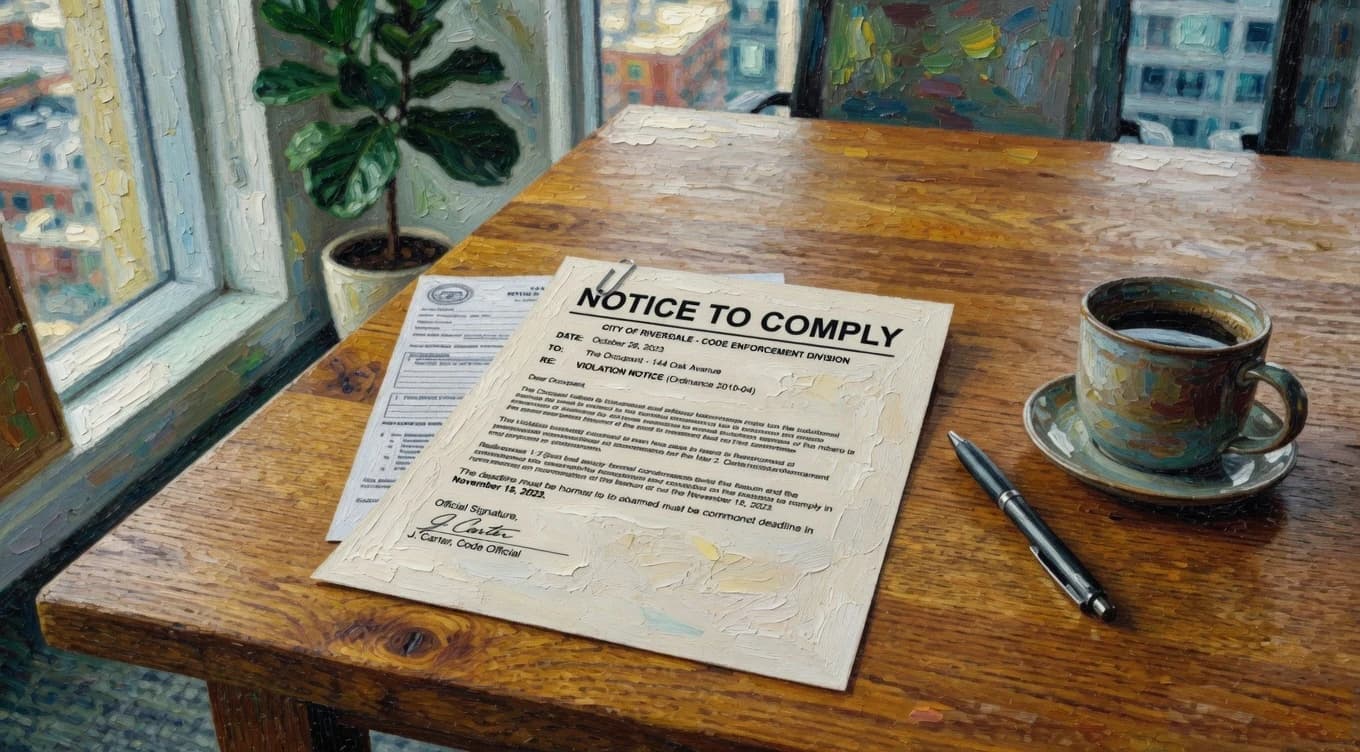
The owners corporation gives a written notice to the person alleged to have breached the by-law. The notice must identify the specific by-law, describe the conduct, and require the person to stop or remedy it.
| State | Notice type | Time to comply | Prescribed form? |
|---|---|---|---|
| NSW | Notice to comply (s146 SSMA) | Reasonable period stated in notice | Yes — prescribed form issued by Fair Trading |
| VIC | Notice to rectify breach (s155 OC Act) | 28 days | Yes — approved form required |
| QLD | Continuing or future contravention notice (s182–183 BCCM Act) | Reasonable period stated in notice | BCCM Forms 10 and 11 are available but not mandatory |
| WA | Breach notice (s47 STA) | Reasonable period stated in notice | Template available from SCA WA; must include schedule 2 of STGR |
| SA (old) | Penalty notice (s19 Strata Titles Act) | At least 60 days | Yes — Form 4 in Schedule 1 of Strata Titles Regulations |
| SA (new) | Notice to remedy (s101 Community Titles Act) | Time stated in notice | Not prescribed but must be in writing |
| ACT | Rule infringement notice (s109 UT(M)A) | Reasonable period stated in notice | Not prescribed but must contain all s109(3) information |
| TAS | Compliance notice (s95 STA) | At least 30 days | No prescribed form |
| NT (new) | Contravention notice (s96 UTSA) | Reasonable period stated in notice | No prescribed form |
Step two: escalation if non-compliance
If the person does not comply within the required period, the owners corporation can escalate. In most states, this means applying to the relevant tribunal.
| State | Intermediate step | Tribunal |
|---|---|---|
| NSW | Mediation through Fair Trading (optional but recommended) | NCAT |
| VIC | Final notice (s157 OC Act) — 28 days; internal dispute resolution must be exhausted | VCAT |
| QLD | BCCM conciliation (optional, but most cases go through conciliation first) | BCCM adjudication or Magistrates Court |
| WA | None required (can apply direct after breach notice) | SAT |
| SA (old) | Penalty notice with 60 days to pay; person can apply to Magistrates Court for revocation | Magistrates Court |
| SA (new) | None required | Magistrates Court |
| ACT | None required (non-compliance is an offence) | ACAT |
| TAS | Alternative: application for relief to Recorder of Titles under Part 9 | TASCAT |
| NT (new) | None required | NTCAT |
Step three: tribunal orders and penalties
If the matter reaches a tribunal, the range of orders is broad and depends on what the applicant asks for and what the tribunal considers appropriate.
| State | Maximum penalty (individual) | Other orders available |
|---|---|---|
| NSW | $1,100 per breach; up to $2,200 for second breach within 12 months | Stop conduct, remedy breach, pay compensation |
| VIC | $250 for breach of rules (s166) | Stop conduct, do specified work, pay damages, vary contracts |
| QLD | 20 penalty units (approx. $2,875 in 2026) | Compliance orders, damages, declaratory orders |
| WA | $2,000 (s47 STA) | Stop conduct, remedy breach, pay damages |
| SA (old) | $500 (set by by-laws under s19) | Work orders, compliance orders, vary by-laws |
| ACT | 5 penalty units (approx. $750) for non-compliance with notice (s110) | Compliance orders, injunctions, damages |
| TAS | 50 penalty units (approx. $8,250) (s96 STA) | Compliance orders, injunctions, application for relief under Part 9 |
| NT (new) | 20 penalty units (approx. $3,400) (s96 UTSA) | Stop conduct, remedy breach, compensation |
Penalty unit values change annually. Check the current value in your jurisdiction before relying on the dollar figures above.
The evidence question
This is where most committees make mistakes. There are two different evidence standards at play, and confusing them can cost the scheme time and money.
Evidence to issue a notice. To issue a notice, the committee needs a reasonable belief that a breach has occurred or is occurring. This is not a high bar. A photo, a resident's written complaint, the cleaner's observation, a date-stamped CCTV still. Enough to form a reasonable view. The notice does not require proof beyond reasonable doubt.
Evidence to win at tribunal. To obtain a tribunal order, the applicant must prove the breach on the balance of probabilities (the civil standard). This is higher. It requires clear evidence of the conduct, the date, the by-law, and the failure to comply with the notice. Hearsay and general complaints are not enough.
In NSW, the NCAT case The Owners SP 78475 v Hamad confirmed that the committee must be able to point to the evidence it relied on when forming its belief. A bare assertion that a breach occurred, without supporting material, may not support a valid notice.
In ACT, ACAT has found rule infringement notices invalid where the executive committee did not properly form the reasonable belief required by section 109. The committee must minute its decision, identify the evidence, and link it to the specific rule.
In Queensland, the BCCM Office has stressed that issuing a contravention notice without reasonable belief prevents the owner or occupier from pursuing the dispute directly. The body corporate takes on enforcement responsibility once it issues the notice. If it then fails to follow through, the person who made the complaint is worse off than if the notice had never been issued.
The practical takeaway: gather the evidence before you issue the notice, not after. A well-documented notice is the foundation of a winnable tribunal case.
Who pays
The short answer is that each side usually pays its own costs in strata tribunal proceedings.
In NSW, NCAT generally does not award costs unless special circumstances apply: the case was frivolous or vexatious, or a party's conduct caused unnecessary expense. This means the owners corporation pays its own legal fees even if it wins, and the respondent pays theirs even if they lose.
In Victoria, VCAT follows the same principle. Costs are not routinely awarded. The owners corporation bears the cost of the enforcement process (manager's time, legal advice, tribunal application fee) unless it obtains an order for the respondent to pay compensation or costs.
In Queensland, the BCCM adjudication process is relatively low-cost because it is administrative rather than a court hearing. The application fee is modest. Legal representation is discouraged.
In WA, SAT may award costs in some circumstances, but the general position is that parties bear their own costs.
In ACT, ACAT has held in UP 666 v Quaid that an owners corporation cannot recover its legal costs of by-law enforcement as "expenses" under section 31 of the UT(M)A unless it took reasonable steps to resolve the dispute before commencing proceedings.
The exception is where the by-law itself provides for a penalty for breach. In those cases, the penalty (capped by state legislation) flows to the owners corporation, not to cover its costs.
The practical position for committees: budget for enforcement costs and do not expect to recover them from the person in breach.
State-specific features worth knowing
NSW — penalty escalation
NCAT can impose a penalty of up to $1,100 for a breach that occurs after a notice to comply has been issued (within 12 months of the breach). A second breach within 12 months carries a maximum of $2,200. The penalty is payable to the owners corporation.
Victoria — mandatory internal process
VCAT will strike out an application if the owners corporation has not exhausted its internal dispute resolution process first. This includes issuing the initial notice to rectify (28 days) and a final notice (another 28 days). The double 28-day requirement is strict.
Queensland — the Form 1 mechanism
An owner or occupier who believes a by-law is being breached can use BCCM Form 1 to request the body corporate to issue a contravention notice. If the body corporate does not respond within 14 days, or decides not to act, the owner or occupier can apply directly for dispute resolution. This gives individual lot owners a pathway when the committee is unwilling to enforce.
WA — the three-strike rule
WA is the only state that imposes a minimum threshold for enforcement. Under section 47 of the Strata Titles Act, an application to SAT for a by-law enforcement order can only be made if the person has breached the by-law on at least three separate occasions, or has had one breach with serious adverse consequences for someone else. A single minor breach cannot be taken to SAT on its own.
SA — the corporation imposes its own penalty
Under the Strata Titles Act 1988 (SA), the corporation itself imposes the penalty via a Form 4 notice. The penalty can be up to $500 as set in the by-laws. The person can apply to the Magistrates Court to revoke the penalty. Under the Community Titles Act 1996, the process goes through the Magistrates Court directly.
ACT — the strict section 109 process
ACAT has held that the executive committee must satisfy each element of section 109 in sequence before issuing a rule infringement notice. This means: (1) form a reasonable belief that a breach occurred, (2) decide it is likely to continue or be repeated, (3) pass an ordinary resolution authorising the notice, (4) issue the notice with all required content. Skipping any step can invalidate the notice.
Tasmania — the Recorder of Titles option
Tasmania offers an alternative enforcement pathway through the Recorder of Titles under Part 9 of the Strata Titles Act. This is an administrative remedy that operates alongside the TASCAT tribunal process. The Recorder can make orders for compliance but cannot impose fines.
Northern Territory — strict liability for non-compliance
Under the Unit Title Schemes Act 2009 (NT), failing to comply with a contravention notice is a strict liability offence with a maximum penalty of 20 penalty units. The defence of "reasonable excuse" is available. The body corporate can also remedy the breach itself and claim compensation from the person responsible.
Common mistakes committees make
Issuing a notice without a formal resolution. A notice issued by the chair or the strata manager without a committee resolution can be challenged as invalid. The resolution does not need to be complicated, but it must be recorded in the minutes.
Using the wrong notice or no prescribed form. In NSW, Victoria and SA, the notice must be in a prescribed form. A letter that does not use the form is not a valid notice and cannot support a tribunal application.
Re-issuing the same notice repeatedly. A notice to comply is a legal step, not a reminder system. If the behaviour continues after a valid notice, the next step is escalation to the tribunal, not another notice.
Expecting cost recovery. As noted above, strata tribunals rarely award costs. The committee should budget for enforcement as an operational expense of running the building.
Waiting too long. Evidence degrades over time. CCTV footage is overwritten. Witness memories fade. A building that waits six months to act on a by-law breach may find its evidence has evaporated.
What actually gets enforced
Most formal notices are not about obscure drafting. They cluster around a short list:
- Noise after hours, or a pattern of noise that a by-law or nuisance rule already covers
- Parking in visitor spaces, on common driveways, or in someone else's lot
- Pets kept without approval, or kept in breach of a valid condition
- Smoking that enters another lot or common property
- Rubbish, bulky waste and dumping in basements and chutes
- Unapproved renovations, especially wet-area and balcony work
- Short-term letting where the by-law or local law restricts it
- Storage of goods on common property
If the complaint is really a maintenance dispute, a personal feud, or an attempt to ban something the legislation now protects (assistance animals, many ordinary pets in NSW and Victoria), a notice will fail. Check that the by-law is still valid before you enforce it. A repealed or inconsistent by-law cannot be rescued by a well-written form.
Before you issue: a 30-minute file
A notice is cheap to print and expensive to defend. Spend half an hour first.
- Identify the exact by-law or rule, including the clause number. "They are being unreasonable" is not a by-law
- Confirm the person you will serve: lot owner, occupier, or both. Tenants can be served. Visitors usually cannot; the lot that invited them can
- Collect one piece of contemporaneous evidence per incident: photo, video still, noise log, contractor report
- Check whether this is a continuing breach (the bike is still in the fire stair) or a past breach that may be repeated (a Saturday party). Queensland uses different notices for those two facts
- Minute a committee resolution that states the belief, the evidence relied on, and the authority to serve
- Use the prescribed form where one exists. Attach the evidence or at least list it
Serve the way your Act requires: in person, by post to the address for service on the roll, or electronically if the owner has consented. A WhatsApp to the tenant is not service on the owner.
A realistic timeline
Take a visitor-parking complaint in a NSW building.
Week 1: two dated photos and a written complaint. Secretary writes a short, non-legal letter asking the owner to stop using the visitor bay.
Week 3: same car, same bay. Committee resolves to issue a notice to comply on the prescribed form, giving 14 days (a reasonable period for this conduct).
Week 5: the car is still there, or it returns on a pattern. The corporation books Fair Trading mediation or goes to NCAT. It does not send a third "final final" letter and call that enforcement.
Victoria adds a hard extra month: notice to rectify (28 days), then a final notice (28 days), and the internal dispute process must be finished before VCAT. WA will not take a minor one-off to SAT; you need three occasions or serious harm. Queensland owners who cannot get the committee to act can serve BCCM Form 1 and, after 14 days of inaction, go themselves.
If you cannot describe this timeline for your state in one paragraph, you are not ready to issue the notice.
What a valid notice must contain
Whatever the local title, the document has to do four jobs:
- Name the person and the lot
- Quote or clearly identify the by-law
- Describe the conduct with dates and enough detail that the person knows what to stop
- State what they must do, and by when
A notice that says "cease causing a nuisance" without dates or a description is a sermon. Tribunals have set those aside. A notice that demands something the by-law does not require (a $5,000 "fine" invented by the committee, or a ban on a child using the common lawn) is also defective.
Do not attach a penalty unless your state lets the corporation impose one itself (South Australia's older strata schemes are the main example). In NSW the penalty is an NCAT order after a breach of a notice, not a line the secretary adds to a levy notice.
If you receive a notice
Read the by-law. Check the dates. Check whether the form is the prescribed one. If the conduct is yours, stop it and write back confirming that you have. If the notice is wrong, say so in writing, attach your evidence, and ask the committee to withdraw it. Do not ignore it. Silence is treated as non-compliance.
If the corporation then applies to a tribunal, you can argue that there was no breach, that the by-law is invalid, that the notice was defective, or that the corporation skipped a mandatory step (Victoria's internal process is the classic example). Keep the correspondence. The file you build in the first fortnight is the file the member will read.
When not to enforce
Committees waste the most money on notices that should never have been issued.
- The by-law is inconsistent with the Act (absolute pet bans in jurisdictions that now require reasonableness, smoking rules that try to ban legal activity inside a lot without evidence of drift)
- The evidence is one anonymous complaint
- The same conduct is being ignored for a committee member's lot
- The real issue is a defect the corporation will not repair, reframed as the occupant's "misuse"
- Someone wants a penalty more than they want the conduct to stop
Selective enforcement is both a legal risk and a political one. If you enforce visitor parking, enforce it for every lot, including the chair's.
Who pays, in practice
Budget enforcement as an admin-fund cost: manager time, form preparation, application fees, sometimes a solicitor's letter. NSW NCAT application fees are modest compared with the legal invoices that follow if the parties lawyer up. Because costs are rarely awarded, a $400 dispute can become a $8,000 lesson if both sides instruct counsel.
That is why the informal letter in week 1 is not weakness. It is the cheapest way to get the result the by-law exists for: the conduct stops. The formal process is for the cases where it does not.
How UnitBuddy supports the work
UnitBuddy's by-law and complaints module tracks every step of the enforcement process. The incident log records date, location, photos, suspected source and the by-law provision alleged to have been breached. Each incident links to the relevant lot and to any correspondence, including the notice to comply, warning letters, mediation outcomes and tribunal orders.
The resolution register records the committee's decision to issue a notice, the date the notice was served, the response (if any), and the outcome. If the matter escalates, the same record tracks the tribunal application, hearing date and final orders.
For committees, the practical difference is that the enforcement history survives committee turnover, strata manager changes, and memory. When the next breach involves the same lot or the same by-law, the committee has a complete record of what was done, when, and what the result was.
UnitBuddy also stores building-specific by-laws, prescribed notice forms for each state, and the state legislation references, so the committee can check the process without searching for it elsewhere.
A by-law breach is rarely the emergency it feels like when the complaint first arrives. The process exists, it works, and it is designed for volunteer committees to follow without legal training. The steps are: check the evidence, resolve to act, serve the correct notice, and escalate if the behaviour continues. Skip the first step and the rest of the process is built on sand.
Further reading
- Pets in Strata: The Legal Landscape After Recent Tribunal Rulings Across Australia — UnitBuddy guide to by-law enforcement in the pet context
- Smoking on Balconies in Strata: How NCAT and Tribunals Are Banning It Across Australia — UnitBuddy guide to nuisance-based by-law enforcement
- Illegal Dumping and Bulky Waste in Apartment Buildings — UnitBuddy guide to enforcing waste and rubbish by-laws
- NSW: Can a Strata Committee Re-Issue Breach Notices Without Proof? — via LookUpStrata
- Tips & Traps in Enforcing By-laws — via Allison Benson, strata lawyer
- When Building By-laws Are Breaches and the Steps to Remedy — via Velocity Strata
Keep the scheme file in one place the committee and the manager can both open. Features, pricing, or book a tour.