
Finance & Levies
Making Money From Your Building: Roof Leases, Signage, EV Charging and the Other Revenue Levers Strata Buildings Miss
Roof space, roadside walls, basement power, parking bays, parcel lockers, function rooms — most strata buildings own income-producing assets that aren't earning. What each is worth in Australian capital cities, how the contracts work, and the traps that turn a good deal into a 15-year headache.
· 12 min read
On this page1. Roof leases for telco infrastructureOn this page
- 1. Roof leases for telco infrastructure
- Typical income and lease term
- What committees need to watch
- 2. Roof leases for solar generation
- Building-owned solar
- Third-party solar PPA
- What to check in the contract
- 3. Wall and rooftop signage
- Typical income
- Planning and structural constraints
- 4. EV charging margins
- Revenue models
- Check the electrical capacity first
- 5. Parcel-locker commissions
- Common contract models
- 6. Parking and storage cage transactions
- Typical values
- Approvals and costs
- 7. Short-stay function-room and amenity hire
- Ways to structure bookings
- 8. Common-property licence fees
- Examples
- 9. Battery storage and grid services
- Where the economics stand
- Putting it together: the realistic picture
- Example income mix
- The legal and governance frame
- Resolutions and legal review
- Contract protections
- The traps that recur
- The legal question is almost always exclusive use, not "can we make money"
- New South Wales and Victoria
- Queensland and Western Australia
- Short licences are different
- What the motion and the contract must say
- Minimum terms to put before owners
- Income, GST, levies and the duty not to chase rent at the expense of the building
- Accounting and GST
- Maintenance still comes first
- A realistic sequence for testing the idea
- How UnitBuddy fits
- Further reading
Levies keep going up. Sooner or later, someone asks whether the building can earn money instead of collecting all of it from owners. Often it can. The first job is to work out what the scheme owns and whether anyone will pay to use it.
This guide covers the income streams a residential strata building can realistically pursue: roof leases for telecommunications equipment or solar, wall and rooftop signage, EV charging margins, parcel-locker commissions, parking and storage cage sales, short-stay function-room hire, common-property licence fees and battery-storage revenue. It also covers realistic dollar ranges in Australian capital cities, contract structures, resolution thresholds and the traps that can turn a promising deal into a long-term liability.
Many schemes own assets that could produce income but do not. Usually, nobody has listed what the building has, tested what it is worth or worked out how to contract it properly. The figures below are indicative. Location, building configuration and market conditions will move them.
1. Roof leases for telco infrastructure
This is the oldest and best-understood option. Mobile carriers (Telstra, Optus, TPG/Vodafone) and tower companies (Axicom, Indara, Amplitel) lease rooftop space for cellular base stations and microwave equipment.
Typical income and lease term
Typical Australian capital city rooftop lease for a single carrier: $15,000 to $50,000 per year, CPI-linked, reviewed every five years. Tower companies often head-lease and sub-let to multiple carriers; the building's rent comes from the tower company.
The term is usually 5 + 5 + 5 years: an initial five years with two five-year options. Once the equipment is installed, it is hard for the building to end the arrangement early.
What committees need to watch
Residents often raise EME (electromagnetic energy) objections during approval. ARPANSA RPS S-1 compliance is well documented and the regulatory position is settled, but committees still need to handle residents' concerns properly.
Roof access for maintenance. Carriers need access for installation and routine maintenance, sometimes involving helicopter-hoisted equipment. The lease should spell out access protocols and notice periods.
Roof penetrations and waterproofing. Every penetration through the membrane creates a future leak risk. The carrier should be responsible for waterproofing around its equipment and indemnify the building for any resulting damage.
Removal at the end of the lease. The make-good clause should require the carrier to remove all equipment and restore the roof. Without it, the building can inherit both the equipment and the removal bill.
A special resolution is usually required because the deal grants exclusive use of common property. Legal review is essential. Standard tower-company contracts are long and heavily favour the carrier.
2. Roof leases for solar generation
Two structures, very different economics.
Building-owned solar
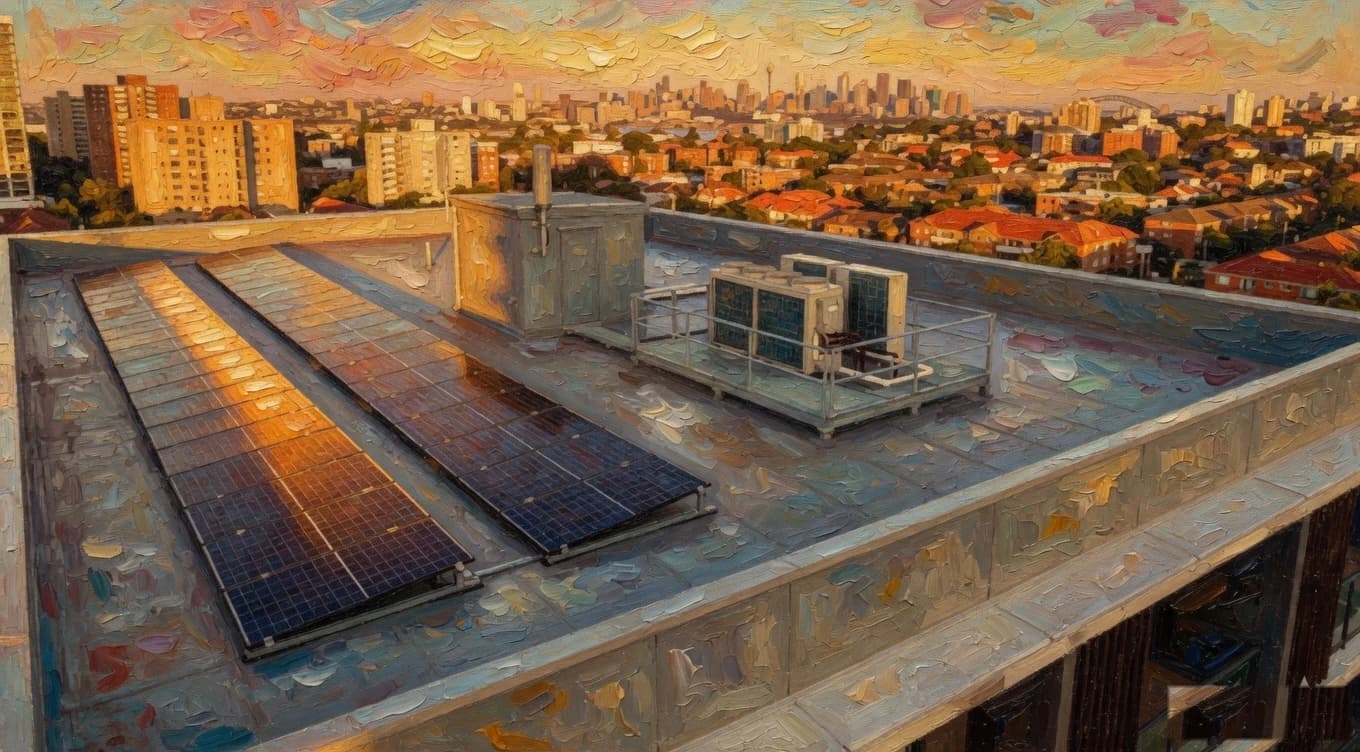
Behind-the-meter solar (building owns the system). Owners corporation installs panels, generation offsets common-area electricity (lifts, lights, pumps, ventilation), excess exports at the feed-in tariff. Typical mid-rise residential roof: 30 to 80 kW. Capital cost $40,000 to $120,000. Annual saving on common-area power $5,000 to $20,000. Payback usually 6 to 10 years. Most common path; usually funded from the capital works fund. The solar panels in strata buildings post covers structure in detail.
Third-party solar PPA
Solar PPA (third party owns the system). A developer installs the system at no upfront cost and owns the equipment. It either sells the generated electricity to the building below the grid rate or pays rent for the roof space. This structure is less common in residential strata than in commercial buildings. There is no capital outlay or maintenance burden, but the building will often be tied to a 15 to 20 year contract and receive less total economic benefit than it would from owning the system.
What to check in the contract
Watch the roof penetration and waterproofing terms, battery clauses in some PPAs, end-of-term ownership and removal obligations, and the cost of future roof maintenance. Replacing the membrane may require every panel to be lifted first. Batteries also raise fire-safety questions in residential buildings.
3. Wall and rooftop signage
A building on a main road, busy intersection or high-visibility corner may have signage value that nobody has tested.
Typical income
Wall-mounted illuminated signage (corporate logo on the roadside face): $20,000 to $150,000 per year depending on traffic, visibility, exclusivity.
Rooftop signage (steel frame on roof, visible from distance): $10,000 to $80,000 per year. Rare in residential, common in commercial; possible on tall residential beside highways.
Billboard easement (external structure attached to or near building): $30,000 to $200,000 per year in premium spots.
Planning and structural constraints
The constraints add up quickly. Most councils regulate signage closely, so the scheme may need a development application or an exempt-development assessment before the income is real. Heritage listings and view corridors prevent external signage on many older buildings. Owners corporation consent will usually require a special resolution. Residents have to live with the sign, so lighting hours, brightness and advertising content matter. Structural attachments change the building's wind loading and may require an engineer's certificate.
The biggest trap is signing a long-term lease before the council rejects the sign on planning grounds. The lease should be conditional on planning approval, with the advertiser carrying the planning risk.
4. EV charging margins
EV charging in strata is no longer only a cost of providing infrastructure for residents. It can also produce revenue when non-residents charge in visitor or commercial bays.
Revenue models
Charge-by-the-hour for non-residents. A few basement bays have chargers that non-residents access through an app such as Chargefox, EVie or Tesla. The charging company takes a share of the revenue and pays the building a host fee. Typical building income is $500 to $3,000 per bay per year. It is modest, but it adds up.
Resident charging with a margin. The building installs chargers in resident bays and uses metered billing to recover the electricity cost plus a small margin. The margin covers maintenance. This is not usually a profit centre, but it stops the rest of the owners subsidising the program through levies.
Fleet partnerships. Delivery, taxi and ride-share fleets pay to charge overnight in a basement they could not otherwise access. This is less common but is starting to appear in some buildings.
Check the electrical capacity first
The main problems are technical. The building's electrical capacity may not support enough charging to produce useful income without an upgrade that costs far more than the chargers earn. The EV charging strata approval post covers technical decisions and load management.
5. Parcel-locker commissions
Many residential buildings now have a locker bank from Australia Post or a private operator such as Hubbed or Parcel Locker by NB.IO. The usual contract offers free installation in exchange for a long-term concession.
Common contract models
Some buildings negotiate revenue share:
Concession only. Installation and resident use are free, but the building receives no revenue. This is the most common deal.
Per-parcel commission. The building receives a small payment for each parcel handled. Typical income is $1,500 to $8,000 per year in a busy building and less in a quiet one.
Common-property licence fee. The operator pays a flat annual fee of $1,000 to $4,000 for the bay space.
The parcel lockers post covers the operational side. The income is not large, but the scheme is granting the operator valuable common property. It is reasonable to negotiate a return for it.
6. Parking and storage cage transactions
In many older buildings, the largest one-off income opportunity is the sale of unused common-property parking bays or storage cages to lot owners.
Typical values
The process depends on the jurisdiction and the original strata plan. A building may hold surplus visitor parking, unused service bays or storage cages as common property. The owners corporation can sell that space to a lot owner who wants it incorporated into their lot.
Typical capital city values:
Standard car bay, inner Sydney or Melbourne basement: $40,000 to $120,000.
Standard car bay, suburban building: $15,000 to $50,000.
Storage cage, 4 to 6 square metres: $3,000 to $15,000.
Approvals and costs
This requires an amendment to the strata plan and, depending on the state and the change, a special or unanimous resolution. Legal and surveyor costs range from $3,000 to $10,000. The proceeds usually go into the capital works fund or towards a planned capital expense. They are not generally distributed to owners as cash.
The income is not recurring, but it is often the largest non-levy capital injection available to an existing building.
7. Short-stay function-room and amenity hire
Some buildings hire their function room, BBQ area, rooftop terrace or media room to non-residents. The income is modest and the administration can be considerable.
Ways to structure bookings
Resident-only with a bond. The bond covers cleaning and damage, so the room should cost the scheme nothing but produces no revenue. This is the most common approach.
Resident-paid hire. A small fee covers cleaning and maintenance, typically $50 to $200 per booking.
Non-resident hire through a resident sponsor. The resident books the space for a non-resident event and remains named and liable. Income ranges from $200 to $1,500 per booking, depending on the space. Someone still has to enforce the hours, noise limits and access rules, so the overhead is significant.
In a small building, the income rarely justifies the work. It can be worthwhile in a larger building with a desirable rooftop. The shared amenities post covers the operational model.
8. Common-property licence fees
This category covers assets licensed for exclusive or near-exclusive use:
Examples
Vending machine in lobby or pool area.
Coffee cart on ground-floor forecourt.
Vehicle wash bay licensed to a mobile detailer for weekend resident access.
Laundry licence in older buildings with shared laundry rooms.
Stormwater easements to neighbouring properties.
Telecommunications conduits leased to NBN, telcos or building services companies.
Each arrangement is small, typically bringing in $500 to $5,000 per year, and requires an owners corporation licence over common property. Several small licences can still add up to a useful income line.
9. Battery storage and grid services
This is an emerging category. A building with rooftop solar installs battery storage and participates in grid-services markets such as virtual power plants, demand response and frequency control. Grid-services income exists in 2026, but it is not yet substantial for a typical mid-rise residential building.
Where the economics stand
The economic case still rests mainly on self-consumption: the battery shifts midday solar generation to evening common-area use. Grid-service revenue is a useful extra, but rarely the main reason to install the system.
The smart building ROI post covers broader building-services automation.
Putting it together: the realistic picture
A typical 60-lot residential building in a capital city might realistically pursue:
Example income mix
Telco rooftop lease: $20,000 per year if positioned for it (many buildings aren't).
Common-area solar (cost offset, not direct income): $8,000 per year in saved electricity.
One-off parking bay sales: $80,000 to $200,000 if it has unused common property to sell.
Parcel-locker commission: $2,000 per year.
Vending and small licences: $1,500 per year.
Annual recurring income or saving: roughly $30,000 to $50,000. One-off capital injection: variable, often $50,000 to $200,000.
That recurring amount could cover a meaningful share of the common-area electricity bill, provide a buffer for an insurance excess or contribute to a capital project. It will not transform the building's finances, and few buildings will be able to pursue every option.
The legal and governance frame
Whatever the opportunity, the same governance rules apply:
Resolutions and legal review
Most leases and licences over common property require a special resolution. Check the state strata or owners corporation legislation for the threshold (typically 75% in NSW, 75% in Victoria, and a two-thirds or special resolution in Queensland, depending on the matter).
Have a lawyer review every contract. The standard terms used by carriers, signage companies, charging operators and locker companies are written in their favour. Two or three hours with a solicitor is likely to be the cheapest part of the project.
Contract protections
End-of-term make-good and removal. Every contract should require the equipment to be removed and the common property restored, without leaving the scheme with an inherited liability.
Indemnity and insurance. The counterparty should carry public liability insurance that names the owners corporation as an interested party and indemnifies the building for damage caused by the installation.
Resident disclosure. Give residents enough detail for an informed vote, including the term, income, risks and removal process. Special resolutions often fail because residents feel uninformed, not because they think the deal itself is bad.
The traps that recur
The same problems recur in buildings that sign income contracts:
Terms that are too long. A committee signs a 25-year lease without understanding the implications, leaving the next committee to deal with it.
No CPI escalation. Income that looked reasonable in 2010 is below market by 2026 when the contract has no reset mechanism.
Inadequate make-good terms. Equipment is left on the roof at the end of the term, and the building inherits the removal cost.
No connection to building operations. The signage contract has no lighting hours, the telco lease has no noise limits, or the charging arrangement has no billing controls.
Counterparty insolvency. The contractor fails, the equipment remains on the roof, the payments stop and the building has to clean it up.
Competent legal review at the start can address each of these problems. Getting the contract wrong can cost several times the legal fees the scheme tried to save.
The legal question is almost always exclusive use, not "can we make money"
Common property belongs to all owners as tenants in common. A rooftop telco lease, a courtyard sign, a parcel locker in the lobby, an EV charger on a common bay, or a licence over a storage cage is a grant of exclusive use or a special privilege over that part of the common property. It is not a committee handshake and an invoice.
New South Wales and Victoria
In New South Wales the instrument is a common property rights by-law under section 142 of the Strata Schemes Management Act 2015. It needs a special resolution and the written consent of each owner who benefits. Changing the appearance of the common property, such as adding an antenna farm, fascia sign or locker bank, also engages section 108.
In Victoria, section 52 of the Owners Corporations Act 2006 blocks a significant alteration to the use or appearance of common property without a special resolution. A lease or licence that hands a roof or a wall to a third party is that alteration. Repair of the existing roof under section 46 is not.
Queensland and Western Australia
Queensland’s Body Corporate and Community Management Act 1997 uses exclusive-use by-laws and, depending on the regulation module, a resolution without dissent or a special resolution for grants of exclusive use. Western Australia’s Strata Titles Act 1985 uses exclusive-use by-laws and scheme resolutions in the same family. Do not copy a NSW motion into a Queensland building. The threshold is the first thing the solicitor should confirm.
Short licences are different
A short licence for a temporary skip or a one-weekend film shoot can often be done under a committee delegation, if the by-laws allow it and the occupation is brief. A five-year locker contract, a ten-year rooftop lease or a sign that changes the street elevation cannot. If the deal will outlast the current committee, it needs the owners in general meeting and a registered or recorded instrument, not a signed proposal in the manager’s drawer.
What the motion and the contract must say
Owners vote against revenue deals when the paperwork is thin, not simply when the rent is small. A motion that says "that the owners corporation enter into a rooftop licence on terms the committee considers appropriate" gives the committee too much room to sign a 25-year lease that owners may later regret. The motion, or the papers attached to it, should state:
Minimum terms to put before owners
- The part of the common property, identified on a plan, rather than simply "the roof."
- The term, any options, and how either party ends it.
- The starting rent or fee, the review method (CPI, market, or fixed steps), and who pays outgoings.
- Who maintains the equipment and the common property it sits on. A section 142 by-law can transfer maintenance of that part to the user. If it does not, the scheme still owns every leak around the penetration.
- Make-good: removal, making-good the membrane, and a bond or bank guarantee that actually covers a crane lift off a roof.
- Insurance: public liability naming the owners corporation, and an indemnity for damage caused by the installation.
- Access hours, noise, RF emissions, lighting hours for signage, and a complaints process.
- What happens if the counterparty becomes insolvent. Equipment left on a roof is the scheme’s problem the day the rent stops.
Two or three hours with a strata solicitor, reviewing the carrier’s or operator’s standard form, is the cheapest line in the project. Those forms are written for the carrier. The special resolution is the owners’ only real leverage. Use it.
Income, GST, levies and the duty not to chase rent at the expense of the building
Accounting and GST
Non-levy income is still scheme money. It belongs in the administrative fund or the capital works fund according to what it is offsetting, and it should appear in the financial statements owners see. If locker commissions disappear into a manager's "sundry income" line, the AGM never considers whether the deal is still worth the lobby space.
GST applies to many commercial licences. Get accounting advice before the first invoice. A building that is not registered, or that treats a rooftop lease as a mere reimbursement, can create a BAS problem larger than a year of rent.
Maintenance still comes first
The statutory duty to maintain common property is not displaced by a good rent. A membrane that is due for replacement in three years should not have a ten-year antenna farm bolted through it unless the licence funds the re-membrane, or the term is aligned with the capital plan. Section 106 in NSW, and the equivalent duties in the other states, still apply to the roof under the antenna. A committee that signs a deal that makes a necessary repair harder has not "found revenue." It has passed a maintenance problem to a later committee.
The same is true of parking-bay sales and exclusive-use grants over unused common property. Selling a common bay can fund a capital project. It also permanently reduces visitor parking and can change fire-egress and swept-path assumptions. Get a surveyor and, if the plan of subdivision needs amendment, budget that cost and timeline before telling the AGM the sale is "simple."
A realistic sequence for testing the idea
- One-page brief: the asset, the likely income, the likely term, the likely objections.
- Solicitor confirmation of the resolution type and whether a by-law, lease or both is required.
- Capital-plan check: does this installation collide with a roof, façade or basement project already in the 10-year plan?
- Resident paper with the term, the money, the risks and the make-good, circulated with the meeting notice.
- Special resolution (or the state equivalent), then signing, then registration or recording of the by-law.
- A contract register entry: start, rent, review date, insurance certificate expiry, make-good trigger.
Most buildings skip steps 2 and 3 and then lose the vote at step 4. That is cheaper than signing first. The buildings that make useful money do the legal work once, put the income on the levy paper every year, and refuse any term that outlives the next two capital cycles without a break clause.
How UnitBuddy fits
For revenue opportunities, UnitBuddy can act as the building's asset and contract register. It records which assets exist, which are under contract, what those contracts say, when they expire, what income they produce and which renewal options apply.
Solar generation, parking bay inventory, the locker contract, signage history, the telco lease and small licences can all sit in one place. A committee considering a new opportunity can see what has been done, what was tried and rejected, and what is producing income in the current budget.
Owners can see non-levy income alongside the costs it offsets, so the AGM levy discussion starts with the full picture. Buildings often miss these opportunities because nobody owns the process. A written register of the building's assets, existing contracts and ideas already tested is a practical place to start.
Further reading
- Solar Panels in Strata Buildings
- EV Charging Strata Approval
- Parcel Lockers and Package Theft in Strata
- Shared Amenities in Strata: Gyms, Pools, Rooftops
- Smart Technology in Strata Buildings
Keep the scheme file in one place the committee and the manager can both open. Features, pricing, or book a tour.