
Disputes & Living
Parcel Lockers, Food Deliveries and Package Theft in Apartment Buildings
Australian apartment buildings now move tens of millions of parcels a year through lobbies built for letters. Courier access, lockers, refrigerated bays, CCTV, theft claims, and the fixes committees can actually afford.
· 13 min read
On this pageWhat this guide coversOn this page
- What this guide covers
- The new lobby problem
- Parcel volume has outgrown the mailroom
- More carriers mean more handoff points
- How delivery works and where it fails
- The four handoff points
- Fix the weakest handoff first
- Where parcels go missing
- Parcel locker systems: options and costs
- Common systems
- Amazon Key for building access
- Ballpark costs
- Two questions before signing
- Food, fridge lockers and power costs
- Mailroom retrofits can be cheaper and better
- Food delivery needs its own policy
- Access control, tailgating and building traffic
- Audit the access system
- Short stays add more access problems
- What CCTV can and cannot do
- Insurance and responsibility for a missing parcel
- Approval and legal framework by state
- Approval by jurisdiction
- Security and privacy standards
- Building design for new schemes
- What lockers and cameras will not fix
- Lockers do not solve every handoff
- CCTV needs usable footage
- Responsibility belongs in the rules
- Delivery instructions must be visible
- Committee checklist
- A locker bank is common property, not a gadget
- Approval for a new installation
- Repair is different from a new bank
- Put the contract terms in the motion
- Theft, liability and the scheme's limits
- When the scheme may be responsible
- Treat footage and access logs as controlled records
- Record repeated access problems
- How to pay for the work
- Capital and running costs
- Count parcels before the AGM
- How UnitBuddy fits
- A parcel register shows the pattern
- What to keep in the record
- Further reading
What this guide covers
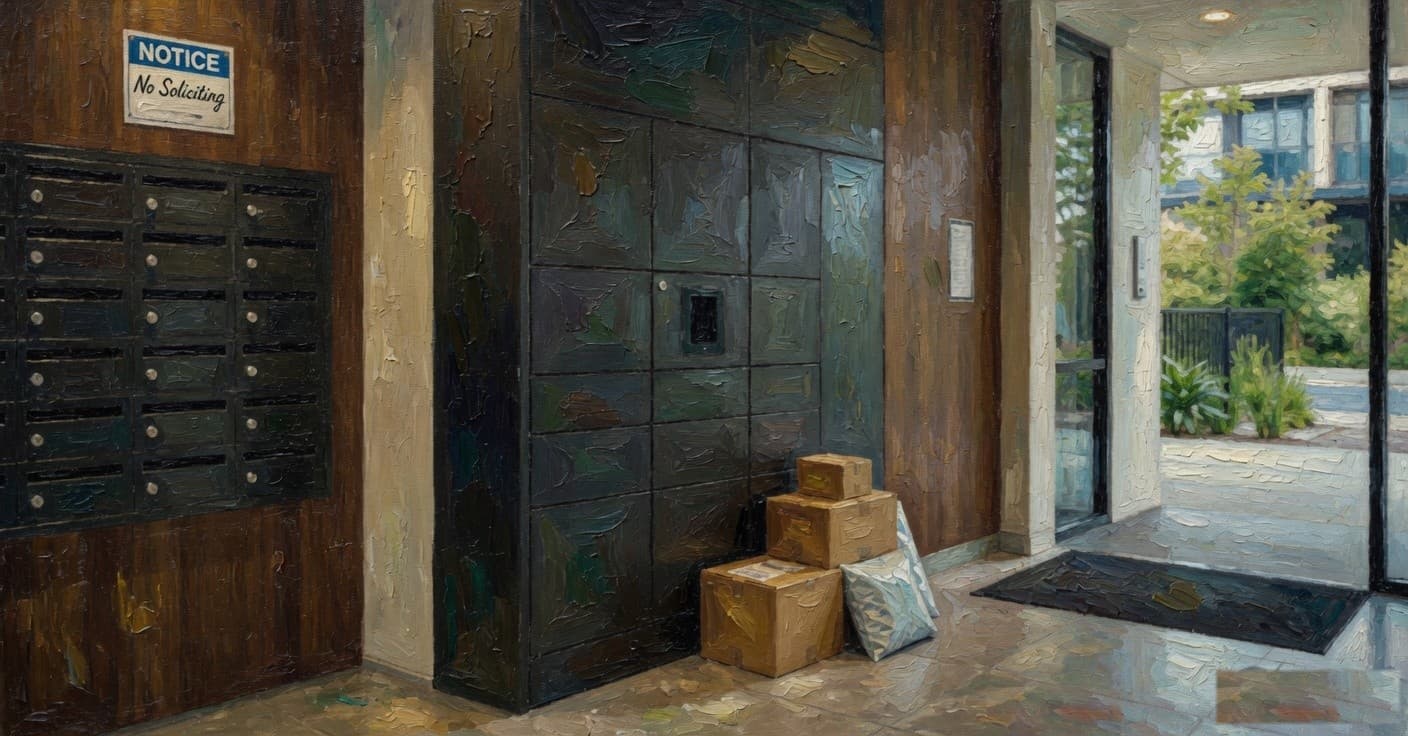
Boxes piled against the mailboxes are now a normal Monday morning sight in many apartment buildings. Those lobbies were built for letters, not the volume and variety of deliveries passing through them today. Strata committees are left trying to manage the mess without taking responsibility for every parcel.
This guide looks at the scale of the problem. Australia Post alone moved about 528 million parcels in FY24. Insurance estimates put the average cost of a missing package at around $140, while 12 to 18 per cent of apartment residents in cities say they have lost at least one parcel in the past year. It also covers the less obvious complications of parcel lockers and food deliveries, along with the four things committees can control: access, cameras, mailroom design and short-stay guest rules.
Letterboxes now receive online shopping, groceries, meal kits, pharmacy scripts, UberEats, DoorDash, contract courier deliveries and returns. Flat-packed boxes that fit nowhere may sit in the lobby for days.
That creates a familiar dispute. A resident reports a stolen parcel. The courier says it was left in the lobby and produces a photo. Another resident complains about delivery riders tailgating through the front door. The committee says it cannot insure residents' parcels. Each point may be reasonable, but the delivery system has still failed.
The new lobby problem
Parcel volume has outgrown the mailroom
Online shopping now accounts for about 16 per cent of retail spending. A typical apartment building may receive five to fifteen parcels per lot each month. Volumes can double or triple during November sales and December gifting. For a mid-size 60-lot building, that means 300 to 900 parcels a month. During Black Friday week, 250 to 400 boxes may arrive in seven days.
Letter mail declined while parcel deliveries grew. Mailrooms designed for a handful of envelopes became makeshift warehouses.
More carriers mean more handoff points
Australia Post, Amazon, Couriers Please, Aramex, Toll, Star Track, DHL, FedEx and Sendle all use their own scanning, notification and drop-off processes. Food delivery riders and drivers add another set of handoffs. These systems do not work together.
The parcels have also become more valuable since 2015. Lobbies now hold meal kits, medication, tablets, wine and other goods that should not be left within easy reach of anyone passing through.
How delivery works and where it fails
The four handoff points
A parcel passes through four stages. A failure at any one of them can produce a complaint.
- Access. How does the courier enter? Common problems include tailgating, propped doors and old codes still in circulation.
- Drop-off. Where may the courier leave the parcel? A lobby, mailroom floor, fire exit or random apartment door should not all be treated as acceptable.
- Notification. How does the resident know the parcel has arrived? The scan may be missing, the app may stay silent or the photo may show little more than a dark floor.
- Collection. How long does the parcel remain there? A lobby can quickly turn into an unattended warehouse.
Fix the weakest handoff first
Committees can improve each stage without becoming the courier's insurer. A common mistake is to spend weeks debating how long parcels may remain in the lobby while the front door barely closes and couriers have no clear drop-off point.
A courier arrives, receives access, leaves the parcel, sends a notification and the resident collects it. The dispute starts where that sequence breaks.
- Courier arrives at front entrance
- Access granted via intercom or fob
- Parcel dropped in lobby or locker
- Resident notified by scan or app
- Collected within retention window
Where parcels go missing
Review enough CCTV footage and the same scenarios recur:
- A courier leaves the parcel in the lobby. A stranger tailgates into the building and takes it within half an hour.
- The parcel is left at the wrong apartment. Nobody notices before it disappears, and it may never be clear whether anyone stole it.
- A person with legitimate access takes it, such as a resident, tradesperson or short-stay guest. A camera may capture the person without proving intent.
- The courier did not deliver it to the building at all. The scan is incomplete, the address is wrong or the delivery photo shows only a dark rectangle.
Each problem needs a different response. Cameras and lockers can reduce opportunistic theft, but they do not prevent misdeliveries or false delivery records. Those errors account for a surprising share of complaints.
Parcel locker systems: options and costs
Lockers are often the first proposal. They can work, particularly in buildings with more than 40 apartments, but the installation is rarely as simple as the brochure suggests.
Common systems
- Parcel Sorter by My Smart Locker, a modular system managed through a mobile app.
- Stowe Group parcel lockers in varied sizes, including refrigerated options.
- Velocity, iLocker and TZ Smart Lockers, which are hardware-heavy systems commonly used in larger buildings.
- Smiota's MailRoom, which focuses on software and integration.
- AusPost 24/7 Parcel Lockers, usually located off-site but useful for residents who prefer collection.
Amazon Key for building access
Amazon Key works alongside the building's existing access control system. When an Amazon driver has a delivery for the building, Amazon verifies the driver and provides time-limited entry through the driver's delivery app. The building does not need to share a permanent access code or fob.
Amazon says the device, installation and maintenance are available at no cost to eligible properties. It is primarily used for Amazon deliveries, so a committee should treat it as one part of the building's delivery setup, not a replacement for a parcel room or a system that other couriers will use.
Ben Khodeir from Deploy Control Systems is a local contact for Amazon Key in NSW. You can reach Ben on 0405 257 952.
Ballpark costs
- A 24-bay system costs about $8k to $18k installed, before power, data or work on the room.
- A refrigerated locker bank costs $15k to $35k, plus any electrical upgrade.
- A software subscription adds $30 to $120 per month for each bank. Some vendors charge per locker or resident.
- Integration with the building's fob or access system may add $1k to $5k.
- A basic room retrofit with shelves, signage and simple cabinetry costs $3k to $15k.
- A full mailroom security upgrade with better doors, cameras and access control usually starts above $25k.
Two questions before signing
First, will the couriers residents actually use place parcels in this locker bank? Not every system integrates with every carrier. Ask the vendor for a written list of integrations used during the past year, not a general marketing claim.
Second, what happens when every bay is full? Size the system for Black Friday rather than the quietest week. The contract and delivery policy should also state where couriers leave parcels when the lockers are full.
Food, fridge lockers and power costs
Meal kits, online pharmacy orders and wine deliveries raise the question of cold storage. A building that wants to accept those deliveries when residents are away needs refrigerated lockers. They cost more and may require an electrical upgrade. They also run from common-area power, not an apartment owner's meter, so the committee must decide who pays the ongoing bill.
Some buildings skip the refrigerated hardware and require residents to be home for meal-kit deliveries. That policy is workable where many residents work from home. It is less useful in a building that is empty during the day.
Mailroom retrofits can be cheaper and better
An older mailroom designed for envelopes may need shelves, signage and access control more than it needs a locker bank. A practical retrofit can cost $3k to $15k and may work better than a $30k locker system that some couriers ignore.
A committee can fix the room, door and signage first, then decide whether lockers still solve a problem worth their cost.
Food delivery needs its own policy
Food deliveries create different problems. The order is time-sensitive, may leak and is often handled by a rider who cannot spend ten minutes searching for a resident. A rider may prop the front door open, leave the food in the wrong place or follow someone into the building.
Rules are more likely to work when they are simple:
- Residents meet riders at the front entrance.
- Riders do not enter residential floors.
- Nobody props open a security door.
- Hosts give delivery rules to their guests in writing.
Put the instructions where riders and residents will see them, such as the intercom splash screen. A rule hidden in a by-law binder will do little at the front door.
Access control, tailgating and building traffic
If delivery workers can enter without proper access, other people can too. In buildings with many short-stay rentals, up to 40 per cent of access events may involve guests, riders, couriers and contractors rather than residents. Most have a legitimate reason to be there. The volume still makes access harder to control.
Audit the access system
- Can couriers call apartments one after another until someone lets them in?
- Do vendors and tradespeople receive revocable codes?
- Does someone revoke those codes when the work ends?
- Can delivery drivers reach residential floors?
- Does the mailroom have its own camera and access control?
- Does the front door close properly, or has a piece of cardboard held it open for weeks?
Old codes are not security. They are unmanaged access with an app attached.
Short stays add more access problems
Short-stay guests may miss the house rules, prop doors open, send building codes to delivery riders or collect mail that is not theirs. Buildings with frequent short-term turnover see more missing parcels, propped doors and complaints.
A locker does not fix that access problem. Parcel rules need to work with the building's short-stay policy and by-laws. If the scheme has no short-stay policy, the committee still needs to address that gap.
What CCTV can and cannot do
Cameras record what happened after the event. A typical review shows the courier entering, the parcel being left and another person taking it later. Police are unlikely to investigate one missing $200 parcel unless the same person is involved repeatedly.
Control access to the footage. A building manager or designated committee member should review it, not an angry resident from a WhatsApp group. Do not circulate clips or screenshots. The scheme should document who may access footage, how long it is retained and what may be shared.
Insurance and responsibility for a missing parcel
A courier marks the parcel as delivered in the lobby, and then it disappears. Who is responsible?
As a practical rule, the parcel becomes the recipient's problem once the courier leaves it. The building is not the resident's parcel insurer. Contents policies often exclude theft from a lobby, while strata insurance does not cover personal parcels. The result can fall into a grey area that neither the courier, retailer nor insurer readily accepts. The committee's role is to reduce the risk, not mediate every insurance dispute.
Approval and legal framework by state
Installing lockers or upgrading a mailroom requires formal committee or owner approval in every jurisdiction. The exact resolution depends on the location and scale of the work.
Approval by jurisdiction
- NSW. The Strata Schemes Management Act 2015 applies. The work may need a committee or general meeting resolution depending on its scale, and by-laws can regulate delivery use of common areas.
- Victoria. The Owners Corporation Act 2006 and its rules apply. Major works thresholds matter, and owners corporations can regulate the use of common property.
- Queensland, WA, SA, Tasmania, ACT and NT. Equivalent strata or unit titles provisions apply. A scheme should obtain proper approval when lockers occupy common property, draw common power or connect to access systems.
Security and privacy standards
The AS/NZS 4040 series is relevant to security installations. The Privacy Act and Australian Privacy Principles also matter when the scheme stores access logs or images.
This is a jurisdictional summary only. Check the proposal with the strata manager or a lawyer before approving a major installation.
Building design for new schemes
Developers now have enough delivery data to design parcel handling into a building instead of retrofitting it five years later.
New residential designs should consider:
- A dedicated parcel room with controlled access, separate from letter mail.
- Locker capacity for about fifteen parcels per lot each month, with seventy-fifth percentile peak headroom.
- Refrigerated bays for 10 to 20 per cent of lots if the project is aimed at residents who use meal-kit deliveries.
- Power and data for a managed locker system included at the drawings stage.
- A food handover zone near the entrance, visible from the street, so riders do not need internal access.
- CCTV covering the parcel area, with a separate retention policy.
- Locker credentials connected to the building access system instead of a second app that residents may not install.
These items are cheaper to include during design than to retrofit in 2032.
What lockers and cameras will not fix
Lockers do not solve every handoff
Lockers can reduce theft, but they do not stop tailgating, couriers who ignore the locker bank, food riders, oversized IKEA boxes, short-stay turnover or residents who leave parcels uncollected. The building still needs a delivery policy and an access audit.
CCTV needs usable footage
A camera may capture an incident, but the angle may be wrong, the file may have been overwritten or the person may be impossible to identify. Tell residents what the cameras can and cannot do before an incident occurs.
Responsibility belongs in the rules
The parcel usually does not become the building's property when it enters the lobby. Notices and house rules should state that residents remain responsible for delivery instructions, retailer or courier claims and collection.
Delivery instructions must be visible
Couriers and riders need to find the handover point within seconds. If the instructions are unclear, they may prop the door, follow a resident inside, call random apartments or leave the parcel in the first available corner.
Committee checklist
- Map the delivery path from the front door to the parcel location and record where parcels actually end up.
- Count parcels for two representative weeks, including a sale-event week, before sizing a locker investment.
- Get a written list of courier integrations from every locker vendor under serious consideration.
- Decide where parcels may and may not be left, then place the rule on the intercom screen.
- Set a separate food delivery rule and include it in resident onboarding and short-stay instructions.
- Audit every active access code. Cancel old codes and require revocable, time-limited codes for contractors.
- Document who authorises a CCTV review, who reviews the footage and what may be shared.
- Set a written rule for lobby clutter and abandoned parcels, then apply it consistently.
- Cost a mailroom retrofit alongside any locker proposal. The cheaper option may be the better one.
- For a new building, raise parcel infrastructure with the developer or design team before the lobby design is final.
A locker bank is common property, not a gadget
Approval for a new installation
A parcel locker, mailroom fit-out, refrigerated bay or courier cupboard occupies common property. Installing one is an alteration. In New South Wales, changing the appearance or use of common property generally requires a special resolution under section 108 of the Strata Schemes Management Act 2015. If a vendor receives exclusive control of the floor space, the scheme should also add a common property rights by-law under section 142.
Victoria uses section 52 of the Owners Corporations Act 2006 for a significant change of use or appearance. Queensland's Body Corporate and Community Management Act 1997 and Western Australia's Strata Titles Act 1985 have their own exclusive-use and improvement rules. A committee handshake and vendor invoice can leave a building tied to a seven-year locker contract it cannot exit.
Repair is different from a new bank
Like-for-like repair of an existing locker is maintenance under section 106 in NSW or section 46 in Victoria. Installing a new bank in the lobby is not.
Put the contract terms in the motion
The motion should identify the location on a plan, the contract term, who pays for power and data, who removes stale parcels, the make-good requirements, public-liability cover naming the owners corporation, and what happens if the vendor fails. The revenue opportunities post explains the same legal structure when the locker pays a commission. A commission does not replace the resolution.
Theft, liability and the scheme's limits
When the scheme may be responsible
A parcel left in a lobby or locker is usually still the recipient's property. The owners corporation does not become a bailee simply because the box passed through the front door. House rules and the welcome pack should say so. Residents make claims through the retailer or their contents policy.
The building's public-liability cover relates to the scheme's negligence, such as a propped fire door, a known broken lock or a credential that should have been cancelled. It does not insure every missing meal kit.
If theft follows a broken common-property door, the scheme's maintenance duty applies. A scheme that leaves a street door on the latch for couriers owns that security failure. It is a section 106 problem presented as a delivery issue.
Treat footage and access logs as controlled records
CCTV aimed at the parcel area needs a written purpose, a retention period and a rule stating who may review footage. Access logs that identify residents require the same privacy controls as the intercom. The CCTV and digital keys guides explain the record-keeping requirements. Do not email a clip to a resident group chat.
Record repeated access problems
Couriers who tailgate create a by-law and access-control problem. Repeated guest codes from a short-stay lot belong in that lot's file, with a section 146 or section 155 notice where the by-laws support it. One missing box is not a tribunal case. A lot that creates a weekly access exception needs a documented response.
How to pay for the work
Capital and running costs
A locker purchase or lobby joinery is capital work. In NSW it belongs in the capital works fund under section 79 and in the 10-year plan under section 80. A vendor-funded locker that the building never owns can be treated as a licence once the legal work described above is complete. Power, data and a cleaning contract are administrative-fund costs.
Count parcels before the AGM
Count deliveries for two weeks before the AGM. A $20,000 locker bank for a building receiving twelve boxes a day is a different motion from one receiving twelve a week. The count is evidence. The vendor brochure is not.
How UnitBuddy fits
An apartment building with regular parcel traffic is running a small delivery operation. A usable record shows repeat problems and helps the committee fix the inexpensive failure before signing a $20,000 locker contract.
A parcel register shows the pattern
Consider one lot with five missing-parcel reports in three months. Three happened on the same weekday and two involved short-stay guests. Without a register, the building has five separate WhatsApp threads and an angry owner. A register shows the courier, the Tuesday period when the door was propped open and the host who did not send the meeting-point rule. That gives the committee evidence for a conversation with the host.
What to keep in the record
UnitBuddy keeps the parcel record in one place:
- Locker procurement, including the system chosen (Parcel Sorter, Smiota, TZ, Velocity, Stowe or Parcel Hive), confirmed courier integrations, SaaS cost, warranty and data-portability clause.
- Mailroom retrofit records, including the shelving plan, security upgrade, CCTV coverage, lighting and capital works line.
- A parcel incident register for each lot, including missing reports, courier timestamps, delivery photos, CCTV notes, refund outcomes and building-level totals.
- Access details shared with the digital-keys record, including courier codes, rider rules, tailgating and propped-door reports.
- The CCTV review procedure, including who requests, authorises and reviews footage, the retention period, redaction and the ban on screenshots in the group chat.
- A short-stay host template for parcel and delivery rules, linked to any short-term-letting by-law.
- The food-delivery policy, including meeting points, entry rules, the complaint path and breach records.
A missing parcel reported at 11pm becomes a structured record rather than a direct message to whichever committee member happens to be available. Two years later, the building can compare incidents, complaints and the cleaner's time spent clearing the lobby before and after the locker installation.
UnitBuddy is built for owners corporations and the strata managers who support them. The strata manager still handles formal notices and the by-law process. UnitBuddy holds the operational records, including the incident register, CCTV log, host template and locker contract, so the committee can measure the problem and respond consistently.
Related on UnitBuddy: Smart Technology in Strata Buildings: What Is Worth Paying For on which building tech pays back; Surveillance Cameras and Smart Doorbells in Strata on camera rules; Digital Keys, Fobs and Intercom Access on who controls the front door.
Further reading
- NSW: Letterboxes, parcels and deliveries to my apartment, via LookUpStrata
- WA: Strata letterbox break-ins: who is responsible for improving security?, via LookUpStrata
Last updated: 9 May 2026. UnitBuddy publishes general information for Australian strata owners and committees. It is not legal, security or insurance advice.
Keep the scheme file in one place the committee and the manager can both open. Features, pricing, or book a tour.