
Finance & Levies
Inside NSW's $45 Million Strata Defect Bill
Only 54% of the serious-defect costs recorded in NSW's 2025 survey went to rectification. Reports, lawyers, insurance pressure and delayed capital works explain why the repair quote is rarely the full budget.
· 13 min read

On this pageWhere the $45 million wentOn this page
- Where the $45 million went
- Why the average tells you very little
- Even the repair category needs unpacking
- A defect starts costing money before it has a scope
- Paying an expert can be the cheaper decision
- Legal work needs its own stages
- The building that raised $500,000 and still had leaks
- Build a budget that follows the job
- Separate money spent from money guessed
- Name the work that has been postponed
- How buildings found the money
- The cash can run out before the approved budget does
- Healthy reserves buy time to make a decent decision
- Recovery is valuable and unreliable
- Insurance keeps the bill running
- What owners should see before the vote
- Keep the money and the decisions in the same file
- Sources and scope
The committee has a repair quote. It is painful, but at least it is a number. Owners can divide it by unit entitlement, argue about instalments and vote.
Then the other invoices arrive.
There is the consultant who worked out why the building leaks, the lawyer dealing with the builder, temporary work to protect apartments, design and certification costs, and the extra meetings needed to keep the job moving. The insurance renewal arrives with a higher premium as well. Meanwhile, painting or lift work that was supposed to happen this year is pushed back.
That mess is visible in Building Commission NSW's 2025 Strata Defects Research Report. Strata managers provided confirmed cost information for 211 apartment buildings with serious common property defects. Together, those buildings had incurred about $45 million after recovered amounts were deducted.
Only 54% went to temporary or permanent rectification. Professional fees took 25%, legal costs took 19%, and other costs, including strata management charges, made up the balance.
Using the dollar totals in the report, every $1 spent on rectification came with about 85 cents in professional, legal and other costs. Do not use that ratio to price the next project. Use it as a warning that the repair quote will rarely be the whole budget.
Where the $45 million went
Across the 211 buildings, rectification cost $24.6 million. Professional work cost $11.1 million, legal work cost $8.5 million, and other costs came to $1.2 million.
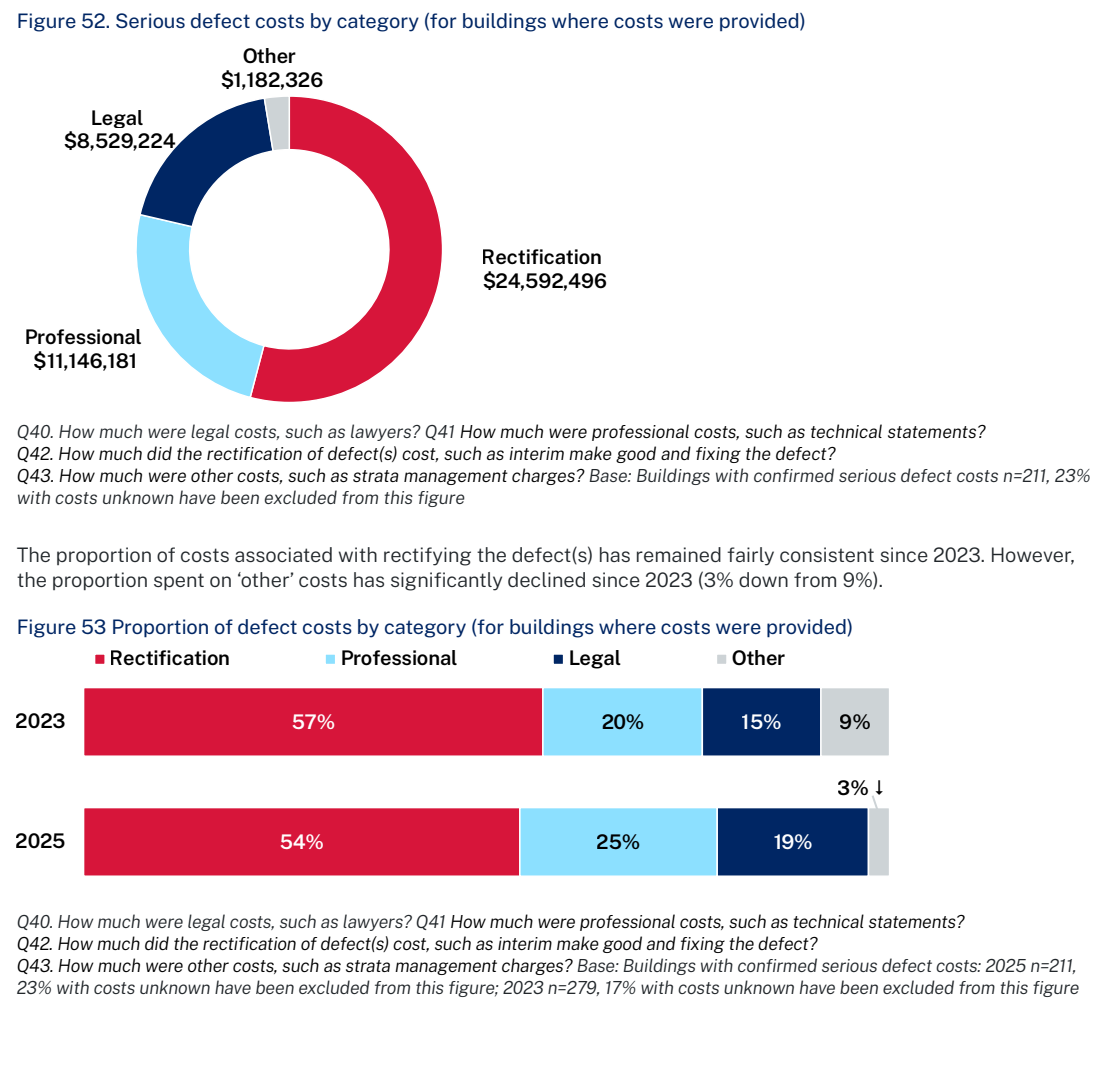
Figures 52 and 53 from the 2025 Strata Defects Research Report. The figures cover 211 buildings where costs were confirmed.
The categories are fairly broad. Rectification includes interim make-good work as well as the work intended to fix the defect. Professional costs include technical statements. Legal costs include lawyers. "Other" includes strata management charges.
Why the average tells you very little
The reported average was $215,400 per building. It is useful as a picture of the money already absorbed across the sample. It is useless as a quote for your own building.
The schemes had different defects, lot counts and legal positions. Some had finished their repairs. Others were still paying to investigate, negotiate or litigate. The average is a snapshot of projects at different stages, not the final cost of a typical defect.
There is another gap. Cost details were unavailable for 23% of buildings with serious defects, so those buildings were left out of the cost analysis. The report does not estimate what they had spent.
Even the repair category needs unpacking
The $24.6 million rectification figure combines temporary work and long-term repairs.
That can hide an unpleasant part of defect spending. A committee may have to make an apartment safe, seal an area before another storm or protect cars from water running through a basement slab. The work is necessary and the invoice is real, but the underlying defect can remain untouched.
If the same area has been patched three times, owners should be able to see three temporary repairs in the cost history. Folding them into one line called "rectification" makes it look as though the building has paid for a permanent result.
A defect starts costing money before it has a scope
Most committees do not begin with a tender-ready document. They begin with a stain, a crack, a failed fire inspection or a report from a resident.
Someone has to work out what happened. Access may need to be arranged across several lots. A specialist may need to open up a wall or test a system. The consultant then has to turn the findings into a scope that contractors can price. If the builder disputes the cause, each side may appoint experts and try to settle the disagreement.
The building can spend a substantial amount before receiving its first firm repair price.
Paying an expert can be the cheaper decision
Professional costs made up one quarter of the survey total. That is a lot of money to spend before owners see a leak stop or a fire door replaced. It can also prevent the owners corporation from fixing the wrong thing.
One interview in the report covered a 2022 development of about 110 apartments. Independent structural and fire engineering reports found facade, waterproofing, fire and enclosure defects that the building bond inspection had missed. The owners corporation spent about $260,000 across the defect process. It had budgeted well from the start, so the extra levies were mainly used for expert reports. The scheme also used a line of credit.
A recognisable consultant's name says little about whether the fee is well spent. The proposal should say what will be inspected, which question the report will answer, whether opening-up work is included and what the owners corporation will receive at the end. A vague engagement for a "defect report" can produce an expensive document that still leaves the committee wondering what to do.
Legal work needs its own stages
The 211 buildings reported $8.5 million in legal costs. The survey included schemes negotiating with builders, pursuing regulatory options and litigating. It does not tell us which legal work paid off in each building.
Owners still deserve to know what they are funding. Early advice might identify the responsible parties, evidence gaps, available pathways and deadlines. The next stage could cover notices or negotiations. Later spending may involve a deed, expert conference, tribunal or court.
Ask what decision the next piece of legal work will enable. Ask when the lawyer will return with a recommendation and a revised estimate. A defect dispute may be unpredictable, but the approvals do not have to be open-ended.
The building that raised $500,000 and still had leaks
The report includes an interview about a 35-unit building registered in 2019. It had fire safety, waterproofing, structural and enclosure defects. The report calls the strata manager Sarah and notes that identifying details were changed.
Owners raised $500,000 through special levies. About $250,000 had been spent at the time of the interview, mostly on legal and project management costs rather than physical repairs. The building already had a rectification order and a deed with the developer, yet communication and certification problems kept the work from reaching a clear end point.
Residents were paying the levy while still living with leaks and faulty services. Some could not sell for the price they expected. Committee members resigned because the workload became too much.
It is one interview, not an average outcome. Still, it explains why the words "defect rectification" are inadequate in a levy motion. Owners need to know whether they are funding investigation, legal work, project management, actual repairs or close-out. They also need to know what remains unfunded.
Build a budget that follows the job
One total at the bottom of a spreadsheet is not enough for a project that may run for years. Separate the costs according to what they are buying.
| Budget line | What belongs here | The question it should answer |
|---|---|---|
| Immediate protection | Emergency attendance, temporary sealing, make-safe work and damage control | What harm are we containing, and for how long? |
| Investigation | Inspections, testing, opening-up work and specialist reports | What cause or disputed issue are we trying to establish? |
| Scope and design | Repair specifications, regulated designs, tender documents and approvals | What will contractors price and build? |
| Legal and recovery | Initial advice, notices, negotiations, deeds and proceedings | Which decision or recovery path does this stage support? |
| Rectification | Contract work, access, preliminaries and approved variations | Which defects and locations does the price cover? |
| Verification and close-out | Testing, independent inspection, certification, warranties and final records | What evidence will let the owners corporation close the item? |
These lines do not have to replace the building's chart of accounts. They give owners a way to see whether money approved for one stage has been swallowed by another.
Separate money spent from money guessed
For each line, show the amount already paid, the amount contractually committed and the current estimate for work that has not been contracted. Put contingency on its own line and say who can approve its use.
Expected recovery belongs in a separate column. Do not subtract it from the levy before the amount and timing are firm.
This makes changes easier to explain. If opening up reveals another failure, the committee can point to the report, the revised scope and the approval. Owners see why the forecast moved instead of receiving another unexplained total.
Name the work that has been postponed
In 62% of affected buildings, dealing with serious defects got in the way of other work. The survey did not record each postponed project. Money and volunteer time move to the defect, while painting, lift work, roof maintenance or another planned job waits.
Put the delayed work in the defect report. Record its new target date and update the capital works plan. Otherwise, it reappears a year later as another surprise.
How buildings found the money
Among the 211 buildings with confirmed costs, 65% used standard levies, 46% used special levies and 29% increased the annual capital works budget. Respondents could choose more than one source.
Many schemes combined them. Of the buildings using standard levies, 39% also used a special levy. Of those using a special levy, 55% also used standard levies.
This makes sense once a defect file stretches beyond one budget year. Existing cash might pay for the first reports. A special levy funds a major work package or legal stage. Ordinary contributions rise because the building still has to pay its usual bills and rebuild the capital works fund.
The cash can run out before the approved budget does
Expert retainers, legal invoices, contractor deposits and progress claims rarely line up neatly with quarterly levy dates. A scheme can approve enough money overall and still have an immediate cash gap.
Map the invoice schedule against cash on hand and levy due dates. If instalments, a strata loan or a line of credit are being considered, show the financing cost and explain whether the borrowing pays for the project itself or bridges timing between receipts and invoices.
Healthy reserves buy time to make a decent decision
The manager of the 2022 building said the scheme had budgeted appropriately from the beginning and held a strong cash position. The defect process still cost about $260,000 and delayed other capital work, but the owners corporation could commission independent reports without first losing months to a funding crisis.
Reserves will not stop a construction defect. They can stop the investigation from being dictated by whichever option requires the least cash today.
Recovery is valuable and unreliable
Only 17 of the 211 buildings with confirmed costs had recovered any money. That is 8%.
Those 17 buildings did well. They recovered $6.5 million from combined costs of $10.3 million, or 63%. The average recovery was $383,427 per building.
That uneven result is hard to budget around. Recovery can transform the final cost, but most buildings had received nothing by the survey date. Consultants, lawyers and contractors still expect to be paid while the builder, insurer, regulator, tribunal or court process continues.
Show claimed, offered, agreed and received amounts separately. A settlement offer is not cash. Neither is a judgment that still has to be enforced. If the budget depends on money that has not arrived, owners need to see the gap.
Insurance keeps the bill running
Serious defects affected insurance in 74% of the buildings concerned. Strata managers reported higher premiums for 60%, fewer willing insurers for 49%, and reduced cover or additional exclusions for 31%. More than one impact could apply to the same building.
These costs land in the annual budget, sometimes while owners are already paying a special levy.
One interviewee said insurers could misread a long defect report and assume the worst. The building had a better discussion when it supplied a current summary of the risks and the work underway. The full report still had to be disclosed. The summary explained what had changed since it was written, which controls were in place and what the rectification plan said.
Ask the broker what will be needed at renewal and keep that pack current. Doing it in the final week leaves the committee explaining a complicated building from scratch while the policy deadline approaches.
What owners should see before the vote
A proper cost report should tell owners:
- which defects and locations are included
- what stage the project has reached
- what has been paid and contractually committed
- which estimates come from quotes and which are allowances
- what temporary work has already been done
- what professional, legal, design and certification work remains
- what recovery is being pursued and whether any money has arrived
- which planned building work will be delayed
- when invoices fall due compared with available cash and levy dates
- when the committee will publish the next forecast
Owners may disagree with the strategy. That is a legitimate meeting. Asking them to vote on one repair quote while the rest of the project sits off-page is not.
Keep the money and the decisions in the same file
UnitBuddy keeps the motion, approved budget, consultant engagement, invoices, variations and recovery receipts beside the defect history. The finances, decisions, documents, projects and contractor records stay with the owners corporation rather than one committee member or one manager's inbox.
Liability estimates and legal strategy stay with the scheme's professional advisers. UnitBuddy shows the next committee what was approved, what was paid, what came back and what remains open.
Sources and scope
- Building Commission NSW: 2025 Strata Defects Research Report, especially report pages 4, 31 to 33, 41 to 47 and 59 to 60.
The figures come from eligible NSW Class 2 buildings registered between July 2018 and June 2024. Cost data was available for 211 of the 275 buildings with serious defects, and projects were at different stages. The figures describe reported accumulated costs, not a completed-project average or a quote for another building. This article is general information, not financial or legal advice.
Keep the scheme file in one place the committee and the manager can both open. Features, pricing, or book a tour.