
Repairs & Maintenance
Why a Clean First Year Proves Very Little About a New Apartment Building
NSW's 2025 defects research found that reported problems rise sharply as apartment buildings age. A quiet first year is the time to build evidence, not assume the building is clear.
· 12 min read
On this pageThe numbers change as buildings ageOn this page
- The numbers change as buildings age
- The fairer comparison is building age
- Waterproofing makes the lag obvious
- The first report usually comes from a resident
- Ask for facts, not a diagnosis
- Keep the untidy history
- A standard inspection may miss the problem
- The first six years need a plan
- At handover, chase the missing records
- Use the first wet season properly
- Do not arrive at two years with a shopping list
- Keep watching repairs through year six
- Four questions before closing an item
- Has this happened anywhere else?
- What evidence would settle the next decision?
- Which date are we working to?
- What will count as finished?
- Give the next committee the actual file
- Sources and scope
Most serious defect files begin with something that looks minor.
A resident emails a photograph of damp carpet after heavy rain. Someone else reports paint bubbling below a balcony. A contractor reseals an edge, the weather clears and the maintenance request is closed. Six months later, another apartment on the same side of the building reports the same thing.
That is how a building can spend its first few years looking mostly fine while the evidence slowly accumulates in separate inboxes.
Building Commission NSW's 2025 Strata Defects Research Report looked at 520 eligible Class 2 buildings registered between July 2018 and June 2024. Serious defects had been reported in 53% of them.
Newer buildings looked much cleaner than older ones. The report found serious defects in 69% of buildings registered in 2018 and 21% of those registered in 2024. It would be comforting to call that a 48 percentage point improvement in construction. The report does not.
The 2018 buildings had about six years for leaks, fire defects, structural problems and failing services to reveal themselves. The 2024 buildings had no more than about a year. Some newer buildings may be better built. Some have simply had less time to fail.
The numbers change as buildings age
The difference between registration years is clear in the survey data. So is the uncertainty around it.
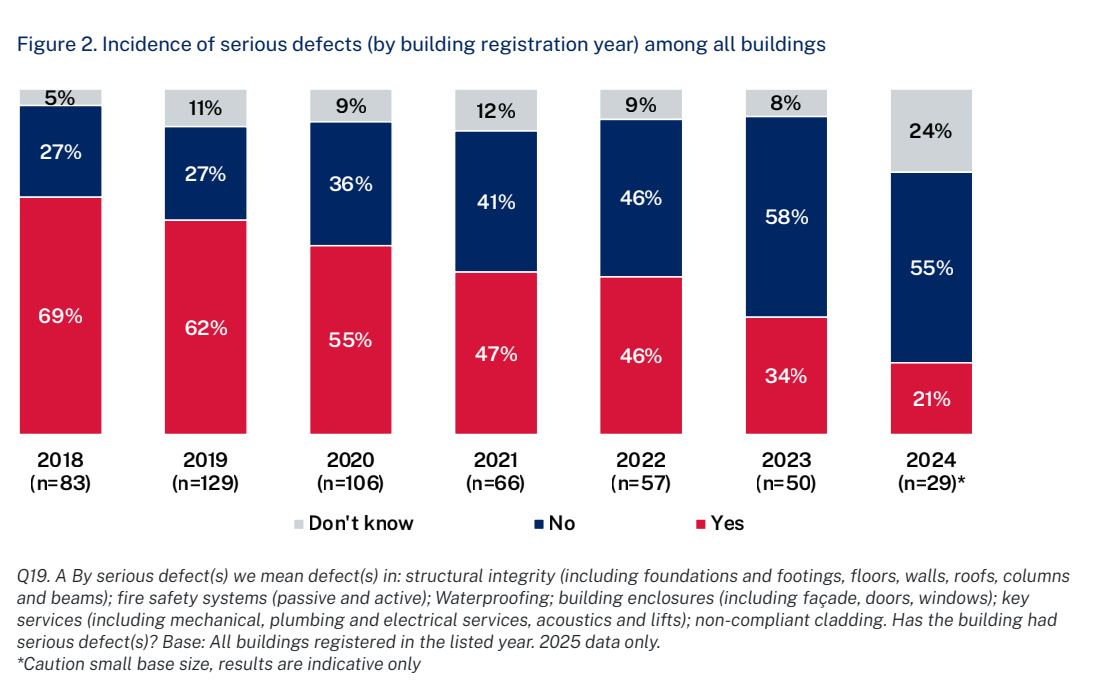
Figure 2 from the 2025 Strata Defects Research Report. The 2024 group has a small sample and should be treated as indicative.
The 2024 result came from 29 buildings, a small enough group that the report marks it as indicative. Nearly one quarter of respondents for that year answered "don't know" when asked whether the building had experienced a serious defect. Across the full sample, the "don't know" response was 10%.
That uncertainty is not a footnote for committees. A newly appointed strata manager may have inherited incomplete records. The first committee may never have created a defect register. A problem may still be hidden. If nobody can say what was inspected, reported or repaired, a clean first year is mostly a lack of evidence.
The fairer comparison is building age
The report compared buildings of similar ages in the 2023 and 2025 surveys. On that basis, it found no statistically significant change in the proportion reporting serious defects.
Among buildings up to one year old, the figures were 17% in the 2023 survey and 21% in 2025. At six years old, they were 55% and 69%. Those differences were not large enough for the researchers to conclude that the underlying defect rate had changed.
There may be an improvement from new regulation or better industry practice. The survey cannot separate that effect from the extra time older buildings have had to expose their faults. Anyone claiming the 2024 buildings prove the problem has been solved is reading more into the data than is there.
Waterproofing makes the lag obvious
Waterproofing was the most common serious defect category, found in 44% of all 520 buildings. Only 7% of the 2024 group had a reported waterproofing defect. For the 2018 group, the figure was 66%.
The same 2018 registration year appeared in the previous survey. In 2023, 46% of that group had reported waterproofing defects. Two years later, it was 66%. Structural defects and problems with building services also rose significantly for that group.
The construction work was already done. What changed was the amount of time available for problems to appear, be investigated and make it into the building's records.
The first report usually comes from a resident
Occupants were involved in the initial discovery of serious defects in 63% of affected buildings. Independent advice followed closely at 58%. Building owners were a source in 32%, routine inspections in 24%, and building bond inspections in 12%. Respondents could select more than one answer.
This is easy to recognise in a real building. Residents see the ceiling after a storm. They hear the pump cycling at night. They know the fire door has stopped closing properly because they walk through it every morning.
The committee's job is to make those observations comparable. A photograph with no date or exact location is hard to use later. An email forwarded to one committee member can disappear at the next AGM. A job marked complete after a contractor attendance tells the next person nothing about the cause or whether the problem returned.
Ask for facts, not a diagnosis
Residents do not need to decide whether a stain is common property, a major defect or a warranty claim. Ask them for what they can actually provide:
- the exact location, including lot, room, level and common property area
- when the problem appeared and whether it has happened before
- original photographs or video
- recent weather or operating conditions where relevant
- visible damage and any immediate safety concern
- details of previous visits or repairs
Classification comes later. The first task is to preserve what happened.
Keep the untidy history
Defect files become confusing because the events themselves are confusing. A leak appears, disappears, moves, returns after different weather and gets two different explanations from two trades.
Do not replace that history with one polished paragraph. Keep the first report, the original photographs, the contractor's note and the later recurrence. Add a current summary so people can follow the file, but leave the underlying evidence intact.
When a new committee sees "leak reported last week", it should also be able to see that the same location was patched eighteen months earlier.
A standard inspection may miss the problem
One of the report's interviews covered a 2022 development of about 110 apartments. The owners corporation commissioned independent structural and fire engineering reports. They found facade, waterproofing, fire safety and enclosure defects that the building bond inspection had missed.
The strata manager said the bond inspection relied on non-invasive visual work. Some waterproofing concerns only came to light after engineers noticed corrosion around shower doors and investigated further.
Read the scope. A visual inspection, a structural assessment, a fire inspection and an invasive waterproofing investigation look for different things. Ask what the inspector saw, what they tested, what they could not access and what qualifications they brought to the job.
"The building was inspected" is too vague to support a decision.
The first six years need a plan
The report focused on buildings around the NSW statutory warranty window. Section 18E of the Home Building Act 1989 provides a six-year period for a breach resulting in a major defect and two years for other breaches.
Do not count forward from the occupation certificate and assume you have the legal deadline. The start date, type of work, responsible party and classification of the defect can affect the position. Get advice from a strata or construction lawyer on the building's facts.
The committee still needs a practical timetable. Waiting for an obvious failure is a poor use of the warranty years.
At handover, chase the missing records
Start with the occupation certificate, approved designs, construction certificates, as-built drawings, warranties, fire documents, building manual and consultant reports. Make a list of anything missing and give the follow-up to a named person.
The report found that 65% of surveyed buildings had access to as-built drawings. Warranties were available for 62%, the initial maintenance certificate for 59%, and a building manual for 45%.
Those gaps become expensive later. A consultant trying to understand a waterproofing detail or a fire system should not have to begin by recreating documents that ought to have stayed with the building.
Record the baseline condition of common areas and major systems. State what was inspected and what was outside scope. A limited visual review cannot support a sweeping statement that the building is defect-free.
Use the first wet season properly
After meaningful rain, compare reports by location and symptom. Look across lots rather than closing each job on its own. A failed window seal in one apartment may be a small repair. Similar failures down one elevation call for a wider view.
Keep temporary repairs open until the cause has been investigated or the committee has deliberately accepted an ongoing maintenance response. Dry plaster after one week proves the patch stopped water on that occasion. It says little about the concealed detail or the next storm.
Do not arrive at two years with a shopping list
Well before the two-year point, review every recurring or unexplained item with the strata manager and the relevant specialists. Allow time to define the inspection, obtain quotations, approve the cost, arrange access and receive the report.
The interviews in the report describe technical reviews commissioned before the two-year period that found problems residents could not see. That work cannot be organised properly in the final few weeks.
Keep watching repairs through year six
A closed repair still belongs in the building history. If it fails again, reopen the same record. Compare annual fire safety work, facade observations, plant failures and new water reports with what happened before.
Six years is longer than many committee members remain in office. The file has to survive without the person who remembers why the builder attended, what they promised and which photograph mattered.
Four questions before closing an item
When a maintenance request might be part of a defect, four questions usually expose what is missing.
Has this happened anywhere else?
Search the same location, elevation, stack, trade and building element. Similar reports change the scope of the problem.
What evidence would settle the next decision?
It may be a photograph after rain, access to the adjoining lot, a moisture reading, a specialist report or the approved design. Commission the work to answer a question. A vague request for a "full defect report" can produce an expensive document that still leaves the committee unsure what to do.
Which date are we working to?
The next builder visit, committee review and legal deadline are separate dates. Record all of them. A friendly promise to attend should never obscure a deadline supplied by the scheme's lawyer.
What will count as finished?
Decide before the work begins. Completion may require photographs, test results, warranties, regulated designs, certification or independent inspection. "Contractor attended" belongs in the timeline. It is not a reason to close the defect.
Give the next committee the actual file
UnitBuddy keeps the resident report, photographs, consultant documents, committee decision, repair history and later recurrence in the building's shared record. Maintenance, finances and contractor activity stay visible through committee and manager handovers.
The technical and legal judgments still belong with engineers and lawyers. They can give better advice when the building can produce a dated history instead of asking someone to search old inboxes.
Sources and scope
- Building Commission NSW: 2025 Strata Defects Research Report, especially report pages 2 to 4, 6 to 13, 27, 34 and 41 to 45.
- Home Building Act 1989, section 18E.
The survey covers eligible NSW Class 2 buildings registered between July 2018 and June 2024. Its results do not measure low-rise buildings, older schemes or buildings outside NSW. The eight follow-up interviews add detail to the survey findings but are not statistically representative. This article is general information, not engineering or legal advice.
Keep the scheme file in one place the committee and the manager can both open. Features, pricing, or book a tour.