
Repairs & Maintenance
Common-Area Lighting Retrofits: The LED and Sensor Payback Most Strata Buildings Underestimate
Common-area lights in a mid-rise apartment building burn through 80,000 to 150,000 kWh a year, and most of that load is a basement carpark lit at full output around the clock. A scoped LED and sensor retrofit typically pays back in 18 months to 3 years, halves the electricity line on the budget, and cuts the recurring lamp-replacement labour bill. This is what gets retrofitted, the worked payback math, the rebate landscape, and the specification traps that decide whether the job lasts five years or fifteen.
· 10 min read
On this pageWhat this guide coversOn this page
- What this guide covers
- Why common-area lighting is bigger than it looks
- What gets retrofitted
- The sensor layer: where it pays and where it does not
- A worked payback example: 60-lot mid-rise
- Rebates: VEU, ESS, and the accredited-provider trap
- Specification traps the buyer needs to understand
- Tendering and procurement
- What does not belong in this project
- Where to start
- Which fund pays, and what resolution you need
- Emergency lighting is a legal system, not a nicer globe
- Sensors, darkness and the safety case
- Rebates, warranties and the record the next committee will need
- How UnitBuddy fits
- Further reading
What this guide covers
- Why common-area lighting is a larger and more controllable cost line than most buildings realise, with basement carparks doing most of the damage.
- What actually gets retrofitted in a typical 40 to 80 lot residential building, with realistic Australian per-fitting and per-project cost bands.
- Where occupancy and daylight sensors pay back quickly, where they fail in apartments, and the regulated boundary with emergency lighting.
- A worked payback example for a mid-rise 60-lot building at 2026 east-coast tariff rates, including the maintenance-labour saving on top of the kWh saving.
- The VEU and ESS rebate programs, the accredited-provider pricing trap, and the six specification details that decide whether the new fittings last five years or fifteen.
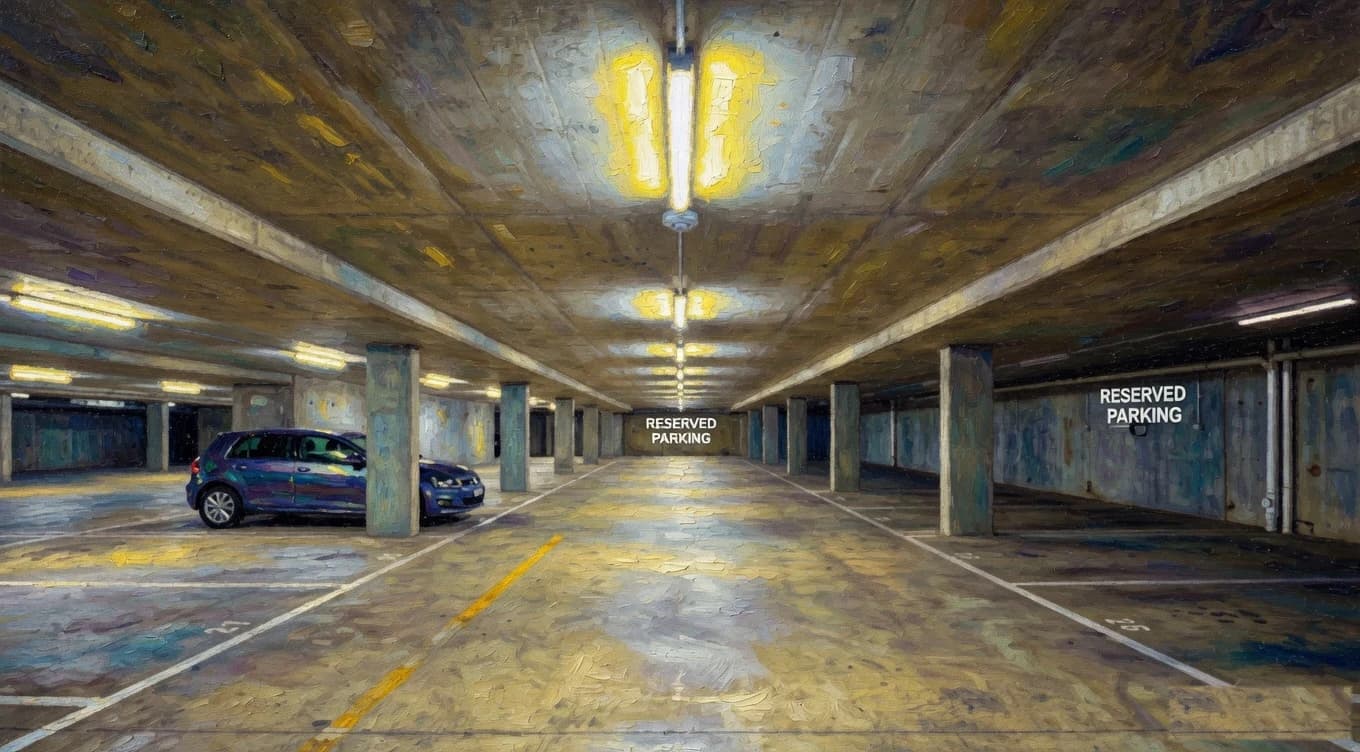
A typical Australian mid-rise apartment building runs between 80,000 and 150,000 kWh of common-area electricity a year. The bulk of it is lighting. Corridors, lift lobbies, fire stairs, ground-floor entries, the bin room, the plant rooms, the bollards along the driveway, and the single largest line by a wide margin: the basement carpark, lit at full output for every hour of every day because nobody ever installed a sensor or a timer.
At 2026 commercial tariffs of roughly 30 to 38 cents per kWh on the eastern seaboard, that load sits somewhere between $24,000 and $57,000 a year on the operating budget. It is one of the three largest controllable lines in a residential strata budget alongside insurance and waste, and unlike those two, the building can directly reduce it with capital work. A properly scoped LED and sensor retrofit pays back inside three years on almost every basement-heavy building, and on many it pays back inside eighteen months.
The reason this is underestimated is that lighting reads as a small recurring expense until someone meters the actual kWh and multiplies it out. The hardware looks the same year after year, the bill arrives quarterly, and the line item is rarely broken out from base building consumption on the financial statements. Unlike insurance, the cost is one the building can act on directly with capital work.
Why common-area lighting is bigger than it looks
Common-area lighting in a typical mid-rise breaks down something like this:
- Basement carpark, 40 to 60 per cent of the total kWh. Carpark lighting is usually fluorescent battens or older metal halide high-bays running 24 hours a day at full output. A 60-lot building with two basement levels often runs 60 to 100 fittings of 36W to 80W each. Multiply by 8,760 hours a year and the carpark alone will clear 30,000 to 60,000 kWh.
- Corridors and lift lobbies, 20 to 30 per cent. Almost always 24/7 because residents move at all hours and the fire-safety expectation is that egress paths are lit. Fittings vary: older buildings have compact fluorescent or halogen downlights every two to three metres; newer buildings already have LEDs but often the first-generation cheap ones with failing drivers.
- Fire stairs, 5 to 10 per cent. Lit continuously because they form part of the emergency egress route. Often the worst fittings in the building, because nobody walks the stairs and nobody complains.
- External: entry, bollards, garden uplighters, driveway, 5 to 15 per cent. Usually on a photocell or astronomical timer, so they run dusk-to-dawn. Halogen MR16 downlights at entries are still common and are the highest-wattage-per-lumen fittings in the building.
- Plant rooms, switch rooms, bin rooms, 2 to 5 per cent. Often left on permanently because the switch is inside the room and the cleaner or contractor forgets on the way out.
The 24/7 numbers are what makes this line large. A single 36W fluorescent batten running continuously consumes 315 kWh a year. A 70W metal halide high-bay clears 613 kWh. A bank of 30 such high-bays in a basement is around 18,000 kWh a year by itself, or roughly $6,000 in electricity. Replacing them with 35W LED equivalents on motion sensors that hold a 30 per cent baseline and ramp to full on detection typically cuts that line by 70 to 80 per cent.
What gets retrofitted
The retrofit scope on a typical building includes some or all of the following.
Corridor and lobby downlights. Compact fluorescent or halogen downlights replaced with LED downlights at equivalent or higher lumen output. Per-fitting hardware: $25 to $80 for a quality residential-grade fitting, $80 to $180 for a commercial-grade fitting with a five-year warranty. Install labour: $40 to $90 per fitting depending on access, ceiling type, and whether the existing transformer can be reused or needs to be bypassed.
Fluorescent tube replacements. T8 or T5 tubes replaced with LED tubes. The simplest job is a ballast bypass, where the electrician rewires the fitting to take direct mains and the new LED tube has its own driver. Per tube: $12 to $35 for the tube, $25 to $60 for the bypass labour. A full fitting replacement (new LED batten) costs $80 to $200 per fitting installed, and is often the right call once the old fitting body is past 15 years old because the diffusers yellow and the reflectors corrode.
Basement high-bay or batten fittings. Metal halide high-bays at 70W to 250W replaced with LED high-bays at 30W to 100W. Per fitting hardware: $90 to $250 for the LED high-bay, $50 to $120 install. Old fluorescent battens replaced with sealed LED battens (IP65 for damp basements) at $70 to $160 installed.
Emergency and exit lighting. This is a separate compliance program, not a retrofit category. Emergency and exit lights are regulated by AS/NZS 2293, must be tested every six months, and must come from accredited fittings. Bundling them into a general LED retrofit is appropriate only if the contractor is qualified to do AS 2293 work. More on this below.
External fittings. Bollards, garden uplighters, building uplighters, driveway lights. LED replacement bollards run $150 to $400 per unit installed; uplighters $80 to $250 each. The lumen output and beam pattern matter here more than the wattage: a cheap LED uplighter with poor optics can wash out a feature wall or floodlight a neighbour's bedroom window.
Whole-building project cost. For a 40 to 80 lot building doing a thorough retrofit (basement, corridors, lobbies, stairs, external) the all-in figure typically lands between $15,000 and $40,000 before any rebates. A basement-only project at the same building runs $5,000 to $14,000. A full retrofit on a larger building of 100 to 150 lots can clear $50,000 to $80,000.
The sensor layer: where it pays and where it does not
LEDs alone cut energy by 50 to 65 per cent on a typical mixed retrofit, because LED efficacy is roughly 100 to 150 lumens per watt against 40 to 80 for fluorescent and 15 to 25 for halogen. Adding sensors layers another 20 to 50 per cent of energy reduction on top, but only in the right locations.
Basement carparks. This is where sensors earn their keep. A basement lit at 100 per cent for 8,760 hours a year, with actual human or vehicle presence perhaps two to four hours a day, is the textbook case for occupancy detection. The standard configuration is microwave or PIR sensors at each fitting (or at fitting groups linked by a bus or wireless mesh), holding a 10 to 30 per cent baseline output for safety and ramping to 100 per cent on detection with a 60 to 180 second hold. The baseline matters: residents need to see the carpark is safe before they walk into it, and AS 1680 requires minimum illuminance for parking areas. Pure on-off switching feels unsafe and produces complaints. Dimming to a baseline does not.
A reasonable estimate for a sensor-controlled basement is 35 to 50 per cent of the baseline LED consumption (which is itself already 40 to 50 per cent of the original metal halide consumption). The combined effect against the pre-retrofit baseline is often a 70 to 85 per cent reduction in basement kWh.
Daylight harvesting in lobbies with glazing. Ground-floor lobbies and lift lobbies with windows or atrium glazing can use daylight sensors to dim or extinguish artificial lighting during daylight hours. The saving is modest in southern cities (Melbourne, Hobart) and meaningful in northern cities (Brisbane, Perth) where useful daylight runs longer. Payback is slower than basement sensors because the absolute kWh in lobbies is smaller.
Stairwells. This is where it gets regulated. Emergency egress lighting under AS/NZS 2293 cannot be switched off by an occupancy sensor; the building code requires the egress path to be continuously illuminated to a minimum level whenever the building is occupied. The compliant pattern is a dual circuit: the regulated emergency/maintained luminaires stay on at their certified output, and any additional ordinary lighting can be sensor-controlled. In practice, many buildings replace the stair lighting with combined fittings that hold the AS 2293 minimum continuously and ramp brighter on motion. This requires the right product and a competent electrician.
Where sensors fail in apartments. Three failure modes show up repeatedly. First, badly-placed PIRs miss residents walking quietly through long corridors, producing dark stretches that residents complain about within a week. Microwave sensors detect through walls and around corners better, but cost more per fitting. Second, traffic noise and HVAC airflow can trigger nuisance switching in poorly-tuned microwave installations, with fittings cycling on and off as the system mis-reads the environment. Third, cheap sensor drivers cause visible flicker on dimmed output, particularly on the baseline level. Spending an extra $10 to $20 per fitting on a quality sensor module is almost always justified at the building scale.
A worked payback example: 60-lot mid-rise
Take a 60-lot building, two basement levels, six storeys above ground, single lift core, a glazed ground-floor lobby, a driveway with bollards, two fire stairs.
Pre-retrofit consumption.
- Basement: 70 fittings at 70W metal halide, 24/7, ~43,000 kWh/yr
- Corridors and lobbies: 90 fittings at 18W CFL, 24/7, ~14,200 kWh/yr
- Fire stairs: 24 fittings at 36W fluorescent, 24/7, ~7,600 kWh/yr
- External (bollards, entry, uplighters): 22 fittings averaging 35W, 12 hours/day, ~3,400 kWh/yr
- Plant rooms, bin room, switch room: ~2,500 kWh/yr
Total common-area lighting: approximately 70,700 kWh/yr. At 32c/kWh blended commercial tariff (energy + network + retail margin, before demand charges), that is $22,600 a year on lighting alone.
Retrofit scope.
- Basement: 70 LED high-bays at 35W with microwave sensors, $200 each installed = $14,000
- Corridors and lobbies: 90 LED downlights at 9W (equivalent lumen output) = $90 each installed = $8,100
- Fire stairs: 24 dual-circuit LED battens (AS 2293 compliant maintained + sensor-controlled boost) at $180 each installed = $4,320
- External: 22 LED replacements averaging 12W at $180 each installed = $3,960
- Plant rooms and bin rooms: occupancy switches added, $1,500
- Project management, electrical compliance certification, scope variation buffer: $3,000
Gross project cost: approximately $34,900.
Post-retrofit consumption.
- Basement: 35W LED, sensor-controlled, effective average ~12W per fitting = ~7,400 kWh/yr (an 83 per cent reduction)
- Corridors and lobbies: 9W LED, no sensor = ~7,100 kWh/yr (a 50 per cent reduction)
- Fire stairs: dual-circuit, ~3,800 kWh/yr (a 50 per cent reduction)
- External: 12W LED = ~1,150 kWh/yr (a 66 per cent reduction)
- Plant rooms: ~600 kWh/yr (a 76 per cent reduction)
Total post-retrofit: approximately 20,050 kWh/yr. At the same 32c/kWh tariff, that is $6,400 a year.
Annual energy saving: $16,200.
Maintenance saving on top. The old fluorescent and metal halide fittings have rated lifetimes of 8,000 to 15,000 hours. At 24/7 operation, that is roughly 12 to 22 months. The building was paying for lamp replacements continuously: tubes at $8 to $15 each plus $40 to $80 labour, plus metal halide lamps at $50 to $120 each plus access labour (ladders or scaffolding in the basement, often charged at minimum call-out rates of $200 to $350 per visit). A realistic figure for a 60-lot building's recurring lamp-replacement bill is $3,000 to $6,000 a year. After the retrofit, with LED L70 ratings of 30,000 to 50,000 hours, the equivalent labour drops to occasional driver replacements: typically under $500 a year for the first five years.
Combined annual saving: $18,500 to $21,500.
Simple payback: 1.6 to 1.9 years on the gross cost. With a VEU or ESS rebate (see below) effectively halving the capital, the payback drops below 12 months on the basement-heavy portion.
This is a deliberately middle-of-the-road example. A building with older metal halide fittings and no existing sensors will see better numbers; a building that already has first-generation LED fittings and only needs sensors added will see a smaller absolute saving but a similarly fast payback on the smaller capital outlay.
Rebates: VEU, ESS, and the accredited-provider trap
Two state schemes dominate rebates for common-area lighting in residential buildings.
Victorian Energy Upgrades (VEU) issues VEECs (Victorian Energy Efficiency Certificates) to accredited providers who install qualifying LED products in eligible buildings. The certificates have a market value that, at the time of writing, effectively covers 30 to 60 per cent of the installed cost of a compliant lighting retrofit. Residential common areas are eligible.
NSW Energy Savings Scheme (ESS) issues ESCs (Energy Savings Certificates) on the same principle. Residential common areas qualify under the Commercial Lighting Energy Savings Formula. Coverage is similar in magnitude, typically 30 to 50 per cent of installed cost.
Other states have reduced or wound back their equivalent schemes. South Australia's REPS is now narrower; the ACT scheme has ended for most lighting categories; WA and the NT have no equivalent. Queensland buildings sometimes access ESS or VEU through cross-border accredited providers but the picture there is more limited.
The accredited-provider pricing trap. The rebate is paid to the accredited provider, not to the building. The provider then offers the retrofit at a discounted price reflecting the rebate, or, in some cases, free of charge for the lighting portion. The discount is real but not always transparent. Two patterns to watch for:
- The provider quotes a single project price without breaking out the rebate value. The building never sees what the unsubsidised price was, which makes it hard to compare against a non-rebate quote from a regular electrical contractor.
- The provider specifies their preferred product range, which may be the cheapest available LED that qualifies for the rebate rather than the best-value product for a 20-year asset. Driver quality and warranty length are often worse on rebate-driven products than on commercial-grade equivalents.
The defensible approach is to ask the accredited provider to quote both ways: the gross project cost itemised by fitting, and the net cost after rebate. Then get one non-rebate quote from a commercial electrical contractor against the same written specification. The comparison reveals whether the rebate is reducing the building's cost or whether the provider is capturing most of the value.
Specification traps the buyer needs to understand
LED product quality varies more than any other category in a strata retrofit. The cheap end of the market and the durable end use the same form factor and look identical on a quote, but the cheap end will be failing within three to five years while the durable end will still be running at year fifteen. Six specifications decide which one a building gets.
Colour temperature. Measured in Kelvin. 2700K to 3000K is warm white, appropriate for residential corridors, lobbies, and entries. 4000K is neutral white, appropriate for basements, plant rooms, and any task-oriented area. 5000K to 6500K is cool white, institutional, and almost always wrong in a residential building. The most common specification mistake is fitting a single colour temperature across the whole building because it simplifies procurement. Corridors at 4000K feel like a hospital; basements at 3000K feel dingy. Specify zone by zone.
Colour Rendering Index (CRI). A measure of how accurately the light reproduces colour. CRI 80 is the minimum for any habitable area. CRI 90 or higher is appropriate for lobbies, entries, and anywhere residents and visitors form a first impression of the building. The premium for CRI 90 over CRI 80 is small at the fitting level and disproportionately visible in the result.
L70 lifetime. The number of operating hours at which the fitting's lumen output has dropped to 70 per cent of its initial value. This is the meaningful lifetime number, not the "rated hours" headline figure (which is often the LED chip's theoretical life under lab conditions rather than the assembled fitting's real performance). Specify L70 of 30,000 hours minimum, preferably 50,000 hours.
Flicker. Most LED failures that residents notice are not the LED dying but the driver causing visible flicker, particularly on dimmed output or in combination with sensors. Specify a flicker percentage under 10 per cent at full output and under 30 per cent at minimum dim level. The product datasheet will state the figure; if it does not, the product is not a credible commercial specification.
Driver quality. Roughly 80 per cent of LED fitting failures in the field are driver failures, not LED failures. The driver is the small power-electronics module that converts mains AC to the regulated DC the LED needs. Cheap drivers are the single largest determinant of whether the fitting lasts five years or fifteen. Specify a named driver brand (Tridonic, Philips, Osram, MeanWell) with a minimum five-year warranty.
IP rating. External fittings, basement fittings in damp areas, and any fitting exposed to wash-down or condensation need an Ingress Protection rating of IP65 or higher. Indoor dry-area fittings can be IP20 or IP40. Specifying IP65 across the whole job adds cost without value; under-specifying it on a wet area causes early failure.
Warranty. A credible commercial LED product carries a five-year fitting warranty and a minimum three-year driver warranty. Anything shorter is not a serious specification. Hold the contractor to the warranty in writing and keep the documentation.
Tendering and procurement
A typical residential building putting a lighting retrofit out to quote will receive offers that vary by a factor of two to three for the same scope. The variation is almost entirely a function of how loose the scope is. A request for "LED retrofit of common areas" gets quotes ranging from the cheapest qualifying products with a 12-month warranty to commercial-grade products with a five-year warranty, and there is no way to compare them.
The fix is a written specification covering the seven points above, plus a per-zone schedule of fittings (basement 70 fittings, corridors 90 fittings, etc.), the expected service life, and the warranty. With that specification in hand, three quotes will fall within a much narrower band, and the differences between them will be commercial (the contractor's labour rate, the provider's rebate handling, the project management overhead) rather than product variance.
Three quotes is the practical minimum. One from a VEU or ESS accredited provider (with the rebate broken out), one from a non-rebate commercial electrical contractor, and one from a lighting designer who will specify product independently and tender to multiple installers on the building's behalf. The last option costs more upfront in fees but typically produces the best outcome on a building over $40,000 in project value.
What does not belong in this project
Two categories of work need to be kept out of a general LED retrofit unless the contractor is specifically qualified.
Emergency and exit lighting (AS/NZS 2293). These are regulated separately, require six-monthly testing, must come from listed fittings, and the installation and certification must be performed by an electrician with the relevant qualifications. They can be bundled into a single project, but only if the contractor is qualified to do both. The cost of getting this wrong is severe: a non-compliant emergency lighting installation discovered at the next fire safety inspection can require a complete redo, and the original installation contractor is rarely willing to wear that cost.
Switchboard work. Any retrofit that changes the load profile of a circuit, replaces switchgear, or modifies the switchboard requires a Certificate of Electrical Compliance and may trigger upgrade obligations under current standards. A pure fitting-for-fitting LED retrofit using existing circuits does not, but adding sensor controls that introduce new wiring sometimes does. The contractor should confirm in writing before quoting whether any switchboard or circuit-level work is required, and price it separately.
Where to start
A short practical sequence.
Meter the common-area circuit for a month. Most buildings have a dedicated common-area meter; the bill from the retailer will show the kWh. If the meter is shared with something else, the strata manager or the building's electrician can install a temporary clamp meter on the lighting sub-circuit for a few hundred dollars. A month of data is enough to establish the baseline.
Walk the building and count. Count fittings by zone (basement, corridor, stair, lobby, external) and note the wattage and lamp type. This produces the schedule that the eventual tender will be priced against.
Identify the highest-usage zone. It will almost always be the basement. If the basement is metal halide running 24/7, that zone alone is usually large enough to justify a project on its own, and starting with the basement (a contained, single-area retrofit) is a lower-risk first step than committing to a whole-building project.
Get a scoping audit. A lighting designer's audit on a 60 to 80 lot building costs $1,500 to $4,000 and produces a written specification, a fitting schedule, an energy model, and a rebate eligibility assessment. For projects over $25,000 this is almost always money well spent.
Tender against the written specification. Three quotes, one from an accredited rebate provider with the rebate broken out, one from a commercial electrical contractor without rebate, and one through the lighting designer if the audit included tender management.
Commit the funds correctly. A lighting retrofit is capital works, not maintenance. It is funded from the capital works fund (NSW), sinking fund (other states), or by special levy if the fund is short. The sinking vs capital works guide covers the categorisation question in more detail.
Which fund pays, and what resolution you need
A like-for-like lamp change is maintenance. A building-wide LED retrofit with new fittings, new sensors and a different colour temperature is an improvement to common property. In New South Wales, section 106 of the Strata Schemes Management Act 2015 covers keeping the existing system working. Section 108 covers changes to the appearance of common property. A corridor that moves from warm 2700K opal globes to 4000K batons is a change residents will notice, and a special resolution is the safe approval path.
Victoria draws a similar line. Section 46 of the Owners Corporations Act 2006 is the repair-and-maintain duty. Section 52 blocks a significant alteration to the use or appearance of common property without a special resolution, with narrow exceptions. Queensland’s Body Corporate and Community Management Act 1997 and Western Australia’s Strata Titles Act 1985 also treat a material change of appearance as more than day-to-day maintenance.
Money follows the same split. Failed lamps, sensor batteries and the electrician’s six-monthly emergency-light test sit in the administrative fund. The retrofit itself — fittings, drivers, sensors, labour, design, rebate administration — sits in the capital works fund in NSW under section 79, or the sinking fund elsewhere. Paying a $60,000 retrofit from the admin fund because “it will save electricity” is how buildings then cannot pay the insurance premium. Put the project in the 10-year plan required by section 80 in NSW, with a year and a dollar figure, even if the work is two budgets away.
Emergency lighting is a legal system, not a nicer globe
AS/NZS 2293 is the Australian standard for emergency escape lighting and exit signs. It is not a product brochure. Fittings must be of a listed type, installed and certified by a qualified electrician, and tested on a six-monthly cycle. The test is a compliance obligation under the building’s fire-safety regime, not a nice-to-have extra the retrofit contractor can “include if budget allows.”
Bundling emergency lights into a general LED retrofit is only safe if the contractor is qualified for both, quotes the emergency circuit as a separate line, and issues the certificates the annual fire-safety statement needs. A cheap LED battens job that also swapped the exit lights, without certification, is a defect that will be found at the next fire inspection. The redo cost is usually larger than the saving on the original quote.
Keep the emergency-light log where the rest of the fire records live. A missing six-month test is a fire-safety failure, not a lighting-project footnote. The fire inspections guide covers how that log is used at statement time.
Sensors, darkness and the safety case
Occupancy sensors are the largest operating-cost lever after the lamp change itself. They are also the fastest way to create a safety complaint. A basement that goes to darkness between cars feels cheaper on the meter and hostile at 11 pm. A stair that drops to a dim standby is fine; a stair that goes black is not.
Specify a minimum stand-by level, not an on/off sensor, in every circulation space and every basement aisle. Typical stand-by is 10 to 20 per cent of full output, with a fast ramp to full when a person or car is detected. External paths and entries should not be sensor-dark at night. Crime-prevention and trip-and-fall risk sit with the owners corporation as occupier of the common property. Saving $800 a year on basement electricity is not a defence to a fall on an unlit ramp.
Write the sensor behaviour into the specification before tender, zone by zone. Do not leave it to the installer on the day. After commissioning, walk the building at night and record any dark spots. Fix them under the contract, not as a later variation.
Rebates, warranties and the record the next committee will need
A Victorian Energy Upgrades or NSW Energy Savings Scheme rebate changes the net capital cost. It does not change the duty to specify a commercial product or to keep the warranty documents. Hold, in the building’s own records:
- The written specification and the three quotes, including the rebate broken out.
- The product schedule: fitting type, driver brand, colour temperature, IP rating, L70 hours.
- The fitting warranty and the driver warranty, with start dates.
- The electrical compliance certificate and, if any switchboard work was done, that certificate too.
- Pre- and post-install metering, so the levy debate next year has a number rather than a feeling.
- The emergency-lighting certificates, kept with the fire file.
When a driver fails in year four, the building should be able to claim on the warranty in an afternoon. Buildings that cannot find the schedule buy a new fitting at retail and tell themselves LED “doesn’t last.” It lasts when the paper lasts.
- Meter common-area circuit for a month
- Count fittings by zone, record wattage
- Identify highest-usage zone (usually basement)
- Scoping audit and written specification
- Three quotes against the same spec
- Install, commission, post-install metering
How UnitBuddy fits
UnitBuddy is the building's own software. For a lighting program, the practical use is the asset and circuit register that holds the fitting schedule, the warranty register that records the driver and fitting warranties so failed components can be returned rather than re-purchased, and the document store that holds the rebate provider's quote alongside the competing tenders so the committee can see the value comparison years later when the next renewal comes around.
The pre-retrofit and post-retrofit metering data also sits in the building's own records, which matters at the next budget cycle when the operating-cost reduction needs to be reflected in the levy projection. None of this is dramatic; it is the kind of record-keeping that turns a one-off project into a documented improvement to the building's operating cost base.
Further reading
- Apartment Building Maintenance Costs: The Full Picture covers the operating-cost lines that a lighting retrofit fits into and how to think about the largest ones.
- Solar Panels on Strata Buildings covers the next obvious capital project once common-area load has been reduced.
- Smart Technology in Strata Buildings covers the broader picture of building automation and where sensors fit in.
- Sinking Fund vs Capital Works Fund covers the funding question for a project of this size and how to categorise it correctly in the budget.
Keep the scheme file in one place the committee and the manager can both open. Features, pricing, or book a tour.