
Repairs & Maintenance
How to Keep an Agreed Defect Repair From Stalling
Builder agreement is the beginning of a defect project. NSW's 2025 data shows how often work remains unstarted, unfinished or uncertified, and what committees need to control next.
· 13 min read
On this pageWhat "agreed" still leaves openOn this page
- What "agreed" still leaves open
- Negotiation is often how buildings get there
- The clock keeps moving
- Turn the promise into a defect schedule
- Turn the finding into a repair scope
- Give every party a named job
- Work backwards from the finish date
- Access can derail an otherwise sound job
- Agree on when updates will arrive
- Work on site can still be the wrong work
- One building had repairs that could not be certified
- Variations need more than a phone call
- A temporary repair stays open
- Decide what "complete" means before the work begins
- Get the completion evidence while the work is visible
- Close defects one by one
- Decide how long the committee will wait
- Put review points in the decision
- Keep legal dates away from the site program
- Tell owners what changed
- What a successful negotiation looked like
- Keep the whole job in one building record
- Sources and scope
The email finally arrives. The builder agrees to fix the defects.
After months of reports, unanswered messages and committee meetings, those words bring genuine relief. They also leave most of the job unresolved.
Which defects are covered? What repair has been accepted? Who prepares the design? When does work start? Who decides whether it passed? What happens if the builder turns up, does half the work and leaves?
Building Commission NSW's 2025 Strata Defects Research Report found serious common property defects in 275 of the buildings surveyed. Only 14% had completed all rectification. Another 33% had completed some work.
For the remaining 53%, no defect had been completed. Work had started but nothing was finished, an agreement existed but work had not started, or the parties still had no agreement.
Getting the builder to say yes is a real step. Turning that yes into a finished, documented repair is a separate piece of work.
What "agreed" still leaves open
The report divided the 275 affected buildings into five positions. Fourteen per cent had completed all defect work and 33% had completed some. Nine per cent had started but completed nothing. Eleven per cent had an agreement but had not started. The remaining 33% still had no agreement.
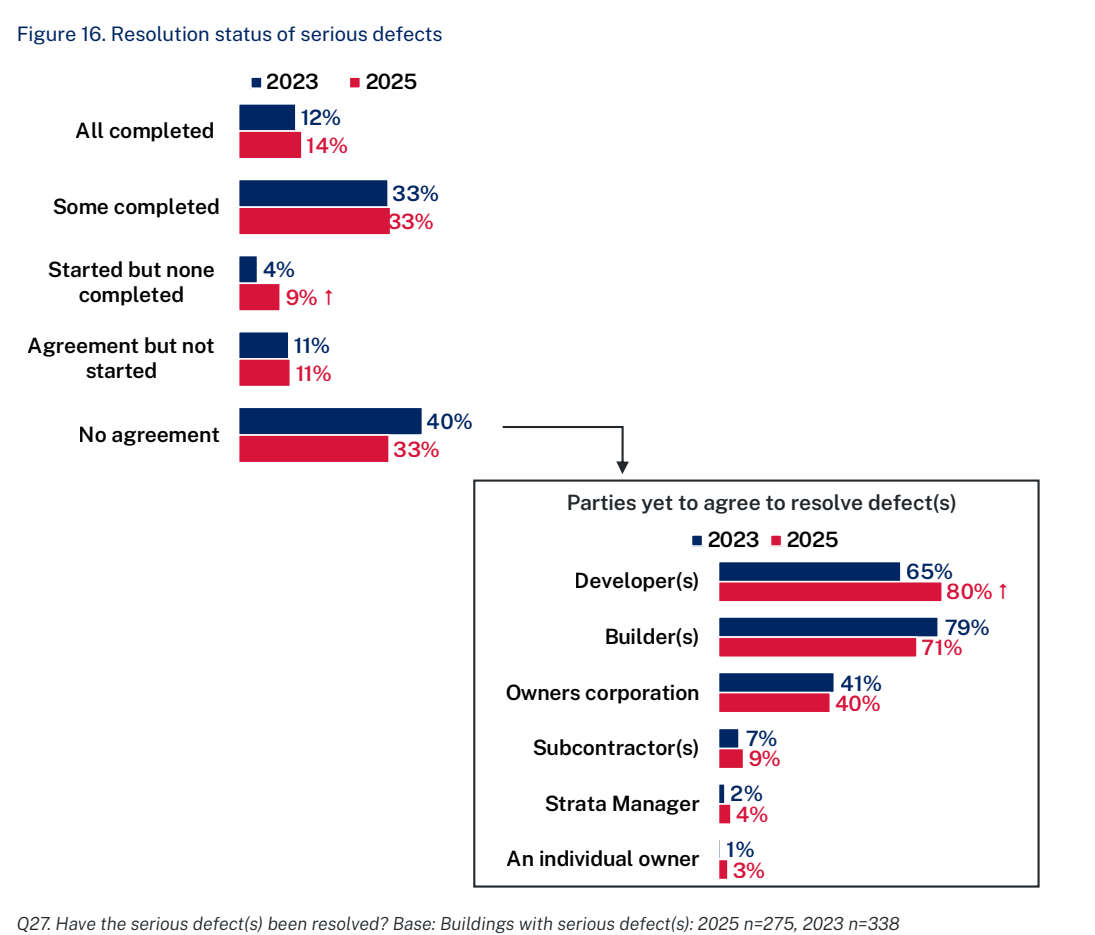
Figure 16 from the 2025 Strata Defects Research Report. The 2025 resolution results cover 275 buildings with serious defects.
Those categories are worth keeping in mind at committee meetings. "The builder is dealing with it" could mean a scope has been signed and work starts next Monday. It could also mean the builder sent a polite email six months ago and has not supplied a program.
Negotiation is often how buildings get there
Among the 38 buildings where every serious defect had been resolved, 53% used independent negotiation or negotiation led by a facilitator with the builder or developer. Litigation was used by 13% of that group.
Negotiation was also the most common route for the 147 buildings that had an agreement but had not finished all the work. Fifty-nine per cent of that group reached agreement through negotiation with the builder or developer.
Negotiation produces very different outcomes depending on what comes out of it. "We agree to rectify the waterproofing defects" leaves plenty of room for another argument. A schedule naming the locations, repairs, documents, dates and completion tests gives both sides something concrete to work through.
The clock keeps moving
Of the buildings that had completed all serious defect work, 29% did it within a year. Among buildings still unfinished, 58% had been trying for more than 18 months. Thirty per cent had been at it for more than three years.
Three years is enough time to lose a chairperson, a building manager, a consultant and the builder's original project contact. The fifth person to inherit the file should not have to work out the agreement by reading several thousand emails from the bottom up.
Turn the promise into a defect schedule
Start with one controlled list of every defect covered by the agreement. Give each item an identifier and record the exact building, level, lot or common area. Link it to the report that identified the problem and the repair the parties have accepted.
It can feel like paperwork while nothing is happening on site. Once work begins, item-level tracking stops partial progress from being flattened into one vague update.
One balcony may be open while the builder disputes another. Five fire doors may pass inspection while two still fail. Facade sealing may be finished, but internal water damage may sit with another trade. A single status of "works underway" hides all of that.
Turn the finding into a repair scope
An engineer's report may explain why water is entering the building. It may not tell a contractor exactly what to remove, which system to install, what testing is required or what has to be handed over.
Before work starts, the agreement or attached scope should identify:
- the document that defines the repair for each item
- any drawings, specifications or regulated designs required
- the products or systems proposed
- areas included and excluded
- the person who can approve a change
- the consultant, certifier or other person who will assess the finished work
Keep disputed defects on the schedule and label them as disputed. Omitting them from the repair list makes them much easier to forget once everyone is busy with the accepted work.
Give every party a named job
Where buildings still had no overall agreement, developers were named as a party yet to agree in 80% of cases. Builders were named in 71%, and the owners corporation in 40%.
Those parties can have very different roles once work begins. The developer may fund or coordinate. The builder may appoint trades. A consultant may review designs. The owners corporation arranges access and communicates with residents.
Write down who prepares the documents, who books access, who gives site instructions, who pays for opening up and reinstatement, and who receives the completion pack. Nominate one contact for each party. Six committee members giving directions to a site supervisor is an efficient way to lose control of the agreed scope.
Work backwards from the finish date
"Complete by 30 June" sounds definite until May arrives and the designs are still missing.
Put dates against the work that has to happen before completion: access inspection, design submission, consultant review, resident notices, site start, opening-up inspection, repairs by area, testing and final documents.
Each step needs a person responsible and a date. The wording should be plain enough to check. "Builder to progress works" tells the committee nothing. "Builder to submit the balcony repair detail for consultant review by 14 October" can be marked done or late.
Access can derail an otherwise sound job
Apartment repairs often require entry to private lots, cars moved from basement bays, furniture protected and residents given enough notice to rearrange work or care.
Map the affected lots before mobilisation. Keep the access notices, responses and confirmed appointments with the relevant defect. If one owner cannot provide entry, record which work moved and the new date. Do not let a failed appointment become a blanket explanation for months of inactivity across the whole project.
Agree on when updates will arrive
Poor communication runs through the interviews in the report. Owners were left chasing builders, developers and government programs. Strata managers had residents asking for answers they did not have.
Set an update interval before work starts. The update can be brief. It needs to say what finished, what is late, why it is late, what decision is needed and what happens next.
Even "no work this fortnight" can be a useful update if it records the missed promise and the follow-up. Silence leaves every owner to invent their own version of events.
Work on site can still be the wrong work
Residents see trades arrive and assume the project is moving. The owners corporation may later discover that the work fell outside the agreed scope, skipped required designs or cannot be certified.
One building had repairs that could not be certified
The report describes a 35-unit building with fire safety, waterproofing, structural and enclosure defects. The developer sometimes came to site and carried out work without coordinating with the undertaking manager. The strata manager said the work could not be certified because the required documents had not been supplied.
Owners had raised $500,000 in special levies and spent about half, mainly on legal and project management costs. They were still living with leaks and faulty services. Activity on site gave them no reliable way to close the defects.
Before allowing work to proceed, check which designs, approvals, hold-point inspections, tests and close-out documents apply. If the builder wants to change that process, get the change reviewed and recorded. Otherwise the committee may inherit a finished surface and an open compliance problem.
Variations need more than a phone call
Opening a wall, facade or balcony can reveal something nobody could see when the scope was written. Changes are normal. Unrecorded changes are where arguments begin.
Keep the finding, revised work, consultant advice, cost responsibility, effect on time and approval together. Retain the old scope as well. Months later, it may be the only clear explanation for why the installed repair differs from the settlement document.
When the builder says a newly exposed condition falls outside the agreement, record the dispute against that defect. The other agreed items can continue without the contested work disappearing from view.
A temporary repair stays open
Another interview in the report describes leaking planter boxes and garages. The builder returned several times and carried out temporary repairs, but the leaks came back. Lawyers became involved as the warranty period neared its end. The builder later failed, and the owners corporation had to pursue another recovery path.
Label a temporary repair for what it is. Record when it was done, what it was meant to achieve and when it will be reviewed. Closing the underlying defect because the area survived one dry week makes the next leak look like a separate event.
Decide what "complete" means before the work begins
Contractors, builders, consultants and owners can all use the word "complete" differently. The contractor may mean the crew has left. The builder may mean the scope is done. The consultant may still be waiting to inspect. The owners corporation may still be missing warranties and certificates.
Use statuses that describe the actual position.
| Status | What it should mean |
|---|---|
| Agreed | The parties have accepted the repair approach for this item |
| Scheduled | Access, required documents and a start date are confirmed |
| In progress | Physical work has started and the next milestone is recorded |
| Awaiting evidence | Work has stopped, but testing, documents or inspection remain outstanding |
| Verified | The nominated reviewer has accepted the completion evidence |
| Closed | The owners corporation has recorded the outcome, warranties and any monitoring requirement |
Get the completion evidence while the work is visible
Depending on the defect, the owners corporation may need photographs before work is covered, waterproofing tests, fire system results, regulated designs, compliance declarations, product warranties, consultant inspection or an updated as-built record.
The appointed professional should set the technical acceptance requirements. Get them into the scope before the relevant detail is hidden or the contractor leaves site.
Close defects one by one
If five fire doors pass and two fail, record five verified items and two open ones. If one elevation is complete and another is waiting for access, show both positions.
The survey found that 33% of affected buildings had completed some defect work. Partial completion is common. Reporting the entire project as "almost done" without listing what remains is where owners lose sight of the job.
Decide how long the committee will wait
Slow action by the developer or builder was the most common barrier in the survey, reported for 40% of affected buildings. Upfront expert costs affected 33%, lack of builder or developer engagement affected 32%, and upfront litigation costs affected 27%.
Committees can send another friendly follow-up for months because nobody agreed what a missed date would trigger.
Put review points in the decision
When the owners corporation approves the agreement or project plan, record when it will reconsider the path. A missed design date, failed temporary repair, delayed mobilisation or outstanding completion pack can each trigger a review.
The response may be a revised date, another expert opinion, formal notice or legal advice. A defined review date stops the file drifting until the next meeting.
Keep legal dates away from the site program
A negotiation, deed, site visit or attempted repair may not preserve every legal right. Statutory warranties, duties of care, contractual rights and limitation periods can operate differently. The owners corporation's lawyer should confirm the dates and steps that apply.
Keep those dates on their own register. A builder's promised completion date should never overwrite one supplied by the lawyer.
Tell owners what changed
Owners rarely need every email between lawyers. They do need the number of defects closed since the last update, the items still open, milestones missed, money spent and the next decision.
A short update backed by the controlled defect schedule is more useful than a long account of meetings that reaches no current position.
What a successful negotiation looked like
The report also includes a 2022 development of about 110 apartments where the owners corporation commissioned independent experts and negotiated most items with the developer. For disputed issues, the parties used joint expert reports. They reached a settlement outside court for the remaining defects.
The process cost about $260,000 and delayed other capital work, so it was hardly painless. Early expert evidence, money available for the reports and a developer willing to engage gave the building a path to completion.
That sits beside the stalled cases in the same report. An agreement can work. It needs enough detail and follow-up to survive the first missed date, disputed variation and committee handover.
Keep the whole job in one building record
UnitBuddy keeps the original reports, agreed scope, due dates, resident notices, variations, invoices and completion evidence together. Maintenance, projects, decisions, documents, contractor activity and finances remain with the owners corporation when committee members or managers change.
Engineers, lawyers and contractors still do the technical work. The shared record lets the committee see what the builder promised, what has been verified and which defect is still open.
Sources and scope
- Building Commission NSW: 2025 Strata Defects Research Report, especially report pages 3 to 4, 24 to 33 and 41 to 50.
The report covers eligible NSW Class 2 buildings registered between July 2018 and June 2024. The resolution figures describe the position when the survey was completed. The eight interview cases add detail but are not statistically representative, and the names were changed in the report. This article is general information, not construction or legal advice.
Keep the scheme file in one place the committee and the manager can both open. Features, pricing, or book a tour.