
How ACT unit titles work
What you own: Crown leases, Class A and Class B
How ACT unit titles split 99-year Crown leases, Class A apartments and Class B townhouses, balcony structures and special privileges over common property.
3 min read · Last checked
On this pageClass A vs Class B unitsOn this page
In the ACT, nobody owns freehold land. Every residential block sits on a 99-year Crown lease. When a block is subdivided into units under the Unit Titles Act 2001, that Crown lease is divided into individual unit leases plus a shared Crown lease over the common property (s 33).
Canberra has the highest share of strata residents in Australia: 77,932 units across 4,840 unit plans, housing about 22% of Territory residents. Understanding what sits inside your unit and what belongs to the owners corporation starts with knowing whether your unit is Class A or Class B.
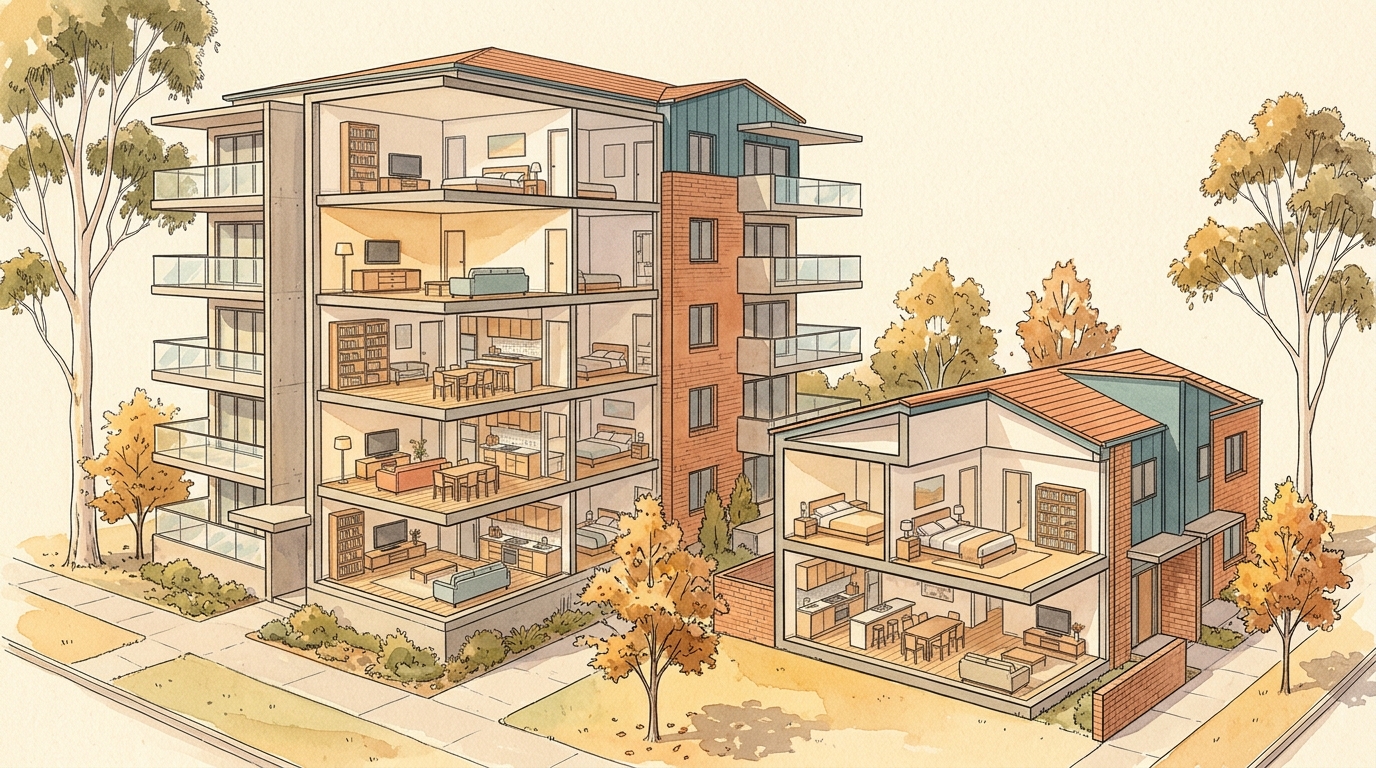
Class A vs Class B units
Every ACT unit plan classifies its units as either Class A or Class B under the Unit Titles Act 2001:
- Class A units are apartments or stacked buildings defined by floors, walls and ceilings. Under sections 14 and 15 of the Unit Titles Act 2001, the default boundary runs through the centre of the floor, wall or ceiling dividing your unit from another unit or common property, unless the registered units plan specifies another line.
- Class B units are land-based townhouses or villas where the boundary is defined by surveyed land lines rather than building surfaces. You generally own and maintain the entire building sitting on your parcel, while the owners corporation maintains shared driveways, visitor parking, common gardens and shared utility infrastructure (see s 24(1)(g) of the Unit Titles (Management) Act 2011).
Interactive · ACT unit classes
Class A vs Class B units in the ACT
Switch between Class A (apartments) and Class B (townhouses) to see how boundaries and s 24 maintenance duties shift.
The Class A structural and balcony rule
Even where a boundary runs through the middle of a wall or slab, the Unit Titles (Management) Act 2011 shifts structural responsibility onto the owners corporation in a Class A building. Under section 24, the owners corporation must maintain all load-bearing walls, columns, footings, floor slabs, roof beams and any part of a balcony — whether or not those elements are formally common property.
That rule saves Class A owners from endless boundary arguments when a balcony waterproof membrane fails or a structural wall cracks. It does not cover purely internal finishes like paint, carpets or kitchen joinery.
Special privileges over common property
If you want exclusive use of a strip of common property — such as a courtyard, storage cage or extra car space — the ACT separates short-term arrangements from long-term ones:
- Under 3 months: The owners corporation can grant a special privilege by special resolution with the written consent of the benefitting owner under section 22 of the Unit Titles (Management) Act 2011.
- 3 months or longer: The grant must be made as a special privilege rule under section 112A, with the unit owner's written consent, and registered on the units plan so future buyers can see it.
Check your understanding
1. In an ACT Class A apartment building, who must maintain a leaking balcony slab and membrane?
General information only, not legal advice.