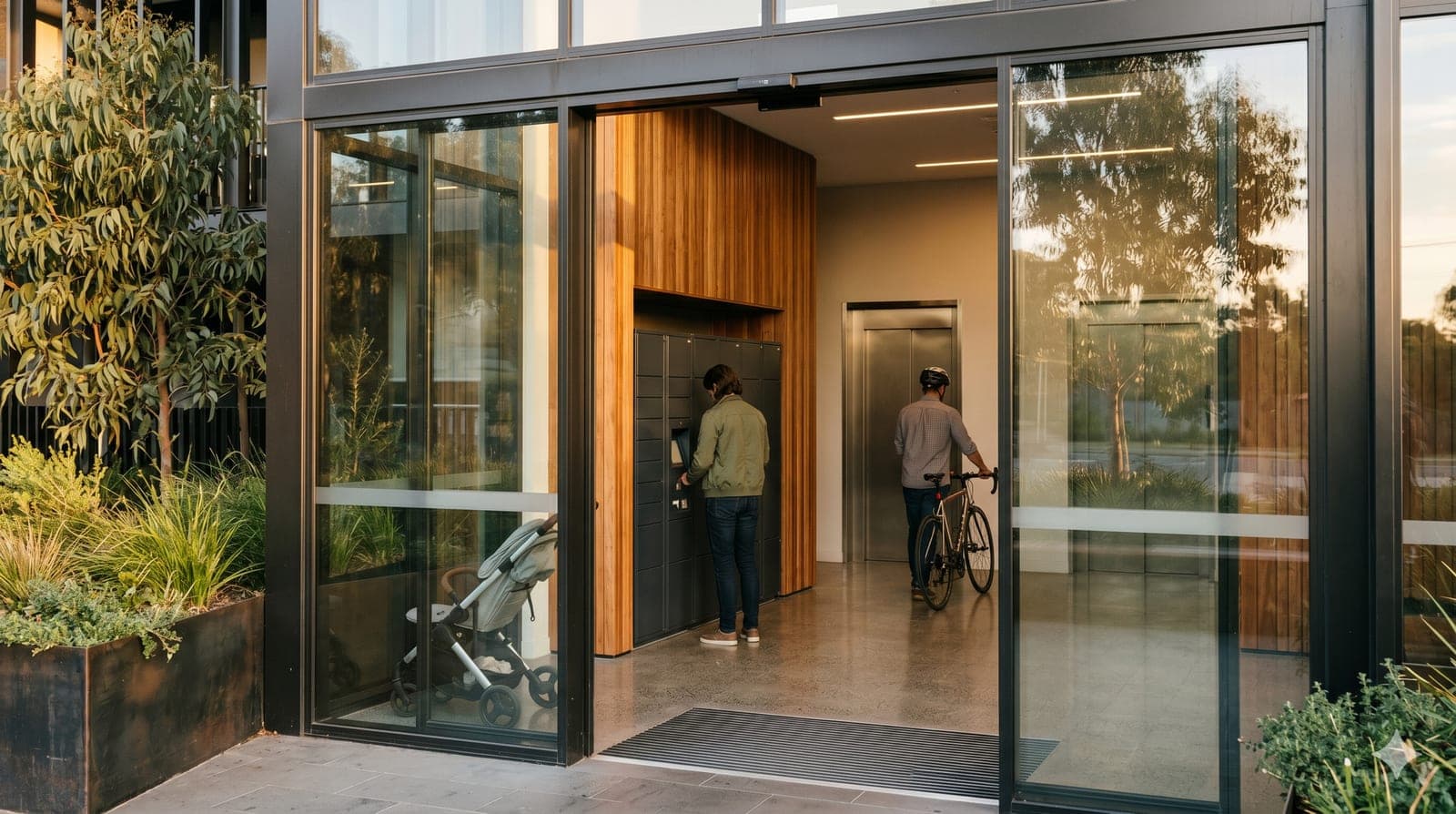
Strata Living: A Plain-English Guide to Apartment Life in Australia for 2026
Ask any committee chair what actually eats their evenings, and it's not the special levy or the tribunal hearing. It's the small stuff. Who used the visitor bay last Saturday. Whether the courier really did leave the parcel at door 7B. The fob that should have been cancelled six months ago and wasn't. A mattress beside the bins. Again.
Most of those questions have answers. Where you find them depends on the strata plan, the by-laws, the relevant state Act and the operating decisions a building has quietly made over its life. This guide pulls those answers together for the people whose home is an apartment: owners, tenants, and the committee members who keep the lights on.
It's written for residents and committees, not strata managers. The strata manager works for the owners corporation, not the other way round. In practice, the day-to-day operating decisions in this guide are the committee's to make. UnitBuddy is built to support that work.
How to use this guide
Read it top to bottom if you've just moved in, joined a committee, or bought your first lot. The order roughly mirrors the year of building life. Moving in. Settling in. Sharing the space. Dealing with the safety items. And the legal lines sitting behind all of it.
Looking for one specific topic? Skim the table of contents and jump straight to the section you need. Each section is written to stand on its own.
If your building runs reasonably well most of the time but loses institutional memory at every committee turnover, the same parcel-theft conversation every January, the same balcony-screen approval relitigated every two years, that's exactly the problem UnitBuddy was built to solve.
Table of contents
- The everyday building
- Getting in and out of the building
- Visitor parking and your second car
- Moving in and moving out
- Your balcony, your apartment, your boundaries
- Shared spaces: storage, common property and amenities
- Living with neighbours
- Safety, fire risk and ageing residents
- Modern strata living: EVs, solar, smart tech
- Waste, dumping and the bin room
- State-by-state quick reference
- Tools and templates for residents and committees
- Frequently asked questions
The everyday building
Apartment buildings rarely fail dramatically. They fail slowly, through a thousand small decisions nobody wrote down. A fob that stayed active after a tenant left. A planter approved by a chair in an email no one can find. A bond returned without photos. A bike that's lived in the corridor so long no one remembers whose it is.
Each one, on its own, is small. Add them up across a decade and they're the difference between a building people want to live in and one they want to leave.
Committees who keep their building working tend to do the same things in the same order:
- Write down the rule, attach the by-law reference, apply it the same way to every lot.
- Keep the photo, the receipt, the certificate, the contractor record, the date.
- Make boring decisions slowly and safety decisions quickly.
- Treat the operating record as the building's memory, not as paperwork.
Most of this guide is the practical version of those four habits, applied to specific everyday topics.
Getting in and out of the building
The first thing that goes wrong in an apartment is access. Someone props a door for a courier. A delivery driver gets handed a master code. An ex-tenant keeps their fob. The building manager from three years ago still has admin rights to the cloud intercom. None of it is dramatic. All of it is the building gradually losing control of its own front door.
Modern apartment access has four layers that all need rules: front door, garage, lift floor permissions and the parcel/mailroom. They interact in messy ways. A resident loses their lobby fob on Friday night, a delivery rider tailgates in behind a neighbour, a parcel disappears from the mailroom by Saturday afternoon, and the committee blames couriers when the underlying problem is governance.
The fixes are unglamorous: a credential register, a contractor offboarding step, a food-delivery rule that stops the lobby door being propped open at 8pm, and a vendor contract that doesn't lock the building in for a decade.
If a surveillance upgrade is bundled in, the camera rules and the access policy almost always share a vendor and a policy gap. Treat them as one decision, not two.
Visitor parking and your second car
Visitor parking is one of the fastest ways for a quiet building to turn hostile. Bays look empty during the day, residents start treating them as overnight overflow, short-stay guests rotate through every weekend, and the committee discovers that "we'll just fine them" isn't actually how strata enforcement works.
Two things are worth being clear on. Owners corporations cannot issue their own parking fines. Penalties flow through the by-law process and the state tribunal, and in some buildings through council parking-management agreements. And in many newer buildings the development consent counts visitor bays toward the building's planning approval, which is why "let's just convert them to EV charging" hits a wall.
The closely related issue is residents treating common property of any kind as private. Visitor bays are one example. Furniture in courtyards, cabinets in hallways, planters fixed to common walls and informal storage cages are others. The pattern's the same: the longer it's tolerated, the harder it becomes to unwind.
Moving in and moving out
Most residents meet their building's rules properly on move-in day. Either the lift is booked or it isn't. The bond is taken or it isn't. Lobby protection is installed or it isn't. The removalist has insurance or doesn't. The bond gets refunded promptly. Or doesn't.
Post-2025 NSW reforms tightened the reasonableness test for move-in bonds. Committees now have to explain why an amount was chosen and refund promptly when no damage was caused. Other states are heading the same way.
If the resident is moving in to renovate, that's its own conversation, and the approval thresholds for cosmetic, minor and major works vary by state. Floor coverings deserve a callout: they're the single most common renovation trigger for inter-lot disputes. New owner pulls the carpet, lays hard floors, the lot below loses its peace.
Your balcony, your apartment, your boundaries
The balcony feels private. In strata, more often than not it isn't. The slab, the membrane, the balustrade glass, the external wall and the drainage are typically common property even when the floor space sits inside the lot. That distinction is why a BBQ, a planter box, a privacy screen or a piece of decking can become a building-wide issue.
A working set of balcony rules covers BBQs and gas-bottle storage, planter weight, decking that doesn't break the waterproofing, NSW window restrictors, and the smoking position. Tribunals have upheld smoking restrictions where documented smoke drift caused real nuisance to a neighbouring lot, but blanket bans without evidence don't tend to survive review.
Inside the lot itself, the dispute that costs the most is rarely the renovation. It's the flexi hose under the bathroom vanity that nobody's looked at in fifteen years. And the dispute that takes longest to resolve is rarely water damage from above; it's moisture left to become mould.
Shared spaces: storage, common property and amenities
Common property storage looks like a tidiness issue. In practice it's a fire egress, accessibility and fairness issue dressed up as one. Bike rooms, pram corners and storage cages need active management. Mobility aids need a respectful, documented process, never a sign that just says "no scooters."
Pools, gyms, rooftops, BBQ areas, cinema rooms, guest suites. These are the most regulated, most insured and most expensive parts of an apartment building. The brochure sells them. The operating layer is what makes them work or fail.
Accessibility isn't a niche topic anymore. As resident populations age, the building that handles ramps, lift reliability, mobility-aid charging and ageing-in-place modifications well is the building people stay in.
Living with neighbours
Most ongoing strata disputes are about other people, not infrastructure. Noise, smoke, pets, short-stay guests, cameras pointing in the wrong direction. The legal frameworks are reasonably well-developed; the practical question is usually how to apply them without making the building unliveable for everyone.
Short-term letting is the issue most likely to change in the next 12 months. NSW has introduced a stricter regulatory framework, Victoria's reforms continue to roll through, other states are watching closely. Anyone who's chaired a building's first short-stay dispute knows the practical levers come down to four things: by-law, planning, access control, noise enforcement. The short-term rentals article is the one to read if your building is wrestling with this now.
Surveillance is its own world, governed by each state's Surveillance Devices Act and the Privacy Act 1988. The default position in most states is that recording common property is permitted with a posted privacy notice, but recording into another lot generally is not.
Safety, fire risk and ageing residents
A small set of safety issues now dominates strata insurance loss data and tribunal applications. Water damage from inside lots. Lithium-ion battery fires. Heat-stress deaths in older residents. The long tail of accessibility-related events. Each one has the same operating answer: a documented program, applied consistently, recorded permanently.
Lithium-ion fires from e-bikes, e-scooters and consumer batteries are the fastest-growing fire risk in Australian apartments. FRNSW data shows a multi-year increase in lithium-related callouts and insurers are pricing it in. The lithium battery article covers the practical rules.
Heat is no longer a comfort issue. Heatwaves move faster than committee response times. Lifts fail when motor rooms overheat. Vulnerable residents become medical emergencies before the strata manager has read their email. The fix is mundane: an AC approval workflow, plant compliance, and a heatwave welfare protocol that doesn't wait for a committee meeting to activate.
Water damage from above remains the single most common multi-lot incident. The flexi hose mentioned earlier is the $8 component driving roughly one in five claims. When the leak comes from a neighbour's lot, the source lot owner usually wears their own plumbing, the owners corporation wears the common-property pipework, and strata insurance covers the resulting damage subject to excess and cause.
Accessibility ties the safety thread together. A building that isn't navigable by an older or disabled resident is also a building that's harder to evacuate, harder to reach in an emergency and harder to insure.
Modern strata living: EVs, solar, smart tech
The building you bought five years ago isn't the building you live in now. EV charging, rooftop solar, embedded networks, smart locks, app-based intercoms, IoT sensors. They've all moved from "novelty" to "expected" in newer buildings, and they all carry governance implications.
The dedicated Sustainable Strata pillar covers most of these in depth. The everyday-living perspective is narrower: which of these matter for the person living in the building right now, and what should they ask before signing anything?
The biggest crossover with everyday living is the embedded-network question. If your building has one (most newer buildings do), your power, hot water and sometimes internet are sold to you by the building, not by a retailer of your choice. Worth checking the rate against the equivalent retail offer in your state.
Waste, dumping and the bin room
The bin room is where building culture is most visible. A working bin room is quiet, signed, contractor-managed and clean. A failing bin room is the visual case for whatever the next levy increase is funding. Most councils offer scheduled bulky-waste pickups; the building's job is to publish the schedule clearly so residents stop dumping next to the bins instead.
The FOGO rollout (Food Organics, Garden Organics) is changing how bin rooms get designed and operated, especially in Victoria and parts of NSW.
If lithium-ion batteries are ending up in the bin stream, the bin room becomes a fire risk as well as a waste issue. B-Cycle's collection-point network now covers most metropolitan areas. The building's job is to make the right disposal path easier than the wrong one.
State-by-state quick reference
Strata living principles are similar across Australia. The terminology, statutory detail and dispute pathway are not. Below is a compressed reference for the rules that vary the most.
New South Wales
Strata Schemes Management Act 2015. Tribunal: NCAT. Standard By-Laws schedule covers laundry, balcony objects, smoking and cleanliness. Window-restrictor obligation under SSMA s118. 2025 reforms tightened bond reasonableness for move-in fees, moved short-stay enforcement forward, expanded committee duties.
Victoria
Owners Corporations Act 2006, currently under review. Tribunal: VCAT. Model rules apply where the OC has not made its own. Pool-fence registration under the Building Act. Strong precedent on second-hand smoke and floor-covering noise.
Queensland
Body Corporate and Community Management Act 1997. Tribunal: QCAT, with Commissioner first-instance. Standard Module / Accommodation Module / Small Schemes Module determine which rules apply. Pool safety certificates (Form 23 / Form 26). Mandatory committee code of conduct.
Western Australia
Strata Titles Act 1985 (as amended 2018). Tribunal: SAT. Schedule by-laws cover most living issues by default. Modernised governance and dispute pathway under the 2018 reforms.
South Australia
Strata Titles Act 1988 / Community Titles Act 1996. Tribunal: SACAT. The two regimes treat amenities and exclusive use differently, so strata schemes and community schemes need separate treatment.
Tasmania
Strata Titles Act 1998. Tribunal: Magistrates Court (Recorder of Titles for some matters). Smaller schemes; many buildings operate without a formal committee, with the body corporate acting as a whole.
Australian Capital Territory
Unit Titles (Management) Act 2011. Tribunal: ACAT. Stronger statutory duties on executive committees than several eastern states. Living rules close to NSW in practice.
Northern Territory
Unit Titles Schemes Act 2009 / Unit Title Act 1975. Tribunal: NTCAT. Smallest jurisdiction; most newer schemes managed under the modern Schemes Act framework. Less public guidance than the larger states, so the scheme statement and by-laws carry more weight.
For terminology mapping across all eight jurisdictions, the strata terminology reference is the place to look.
Tools and templates for residents and committees
Most committees we work with don't realise this until their second turnover, but the bit that breaks isn't the AGM or the levy notice. It's the operating layer underneath: the records, decisions, approvals and incidents that decide whether the building actually works for the people living in it. UnitBuddy holds that layer in one place so it survives the next handover.
A few of the things residents and committees use it for:
- Per-lot approval register. Balcony screens, BBQs, decking, planters, AC condensers, accessibility modifications, pet approvals. Every approval recorded against the unit it relates to.
- Move file per move. Lift booking, removalist insurance, condition photos, bond ledger, refund correspondence. Kept together, not scattered across three inboxes.
- Access governance. Credential register, intercom contract, contractor offboarding, lost-fob ledger, privacy notice.
- Common property log. Exclusive-use grants, tolerated-use precedent, the by-law file, signage register.
- Storage and fire egress records. Bike room register, abandoned-item notices, mobility-aid approvals, AS 1851 inspections.
- Amenity asset register. Pool plant, gym equipment, BBQ infrastructure, cinema AV, with replacement years and dollar values feeding the sinking-fund forecast.
- Incident log. Noise, smoke, parcel theft, dumping, lithium events, water damage. Captured per lot and aggregated to the building.
- Resident comms templates. Heatwave welfare notice, lift-outage update, by-law reminder, move-in pack, bond refund letter.
The strata manager keeps doing what they do well: meeting calendar, levies, statutory filings, legal advice. UnitBuddy holds the operational record that gives the committee institutional memory and the resident a clear answer when they ask why something was decided.
Explore the tools · See how it looks for an owner
Frequently asked questions
Who is responsible for the flexi hose under my kitchen sink?
You are. In nearly every Australian jurisdiction the plumbing inside your lot, including flexi hoses on taps, dishwashers and washing machines, is the lot owner's responsibility. The body corporate maintains the supply pipe up to the lot's isolation valve. A five-yearly replacement schedule is cheap insurance.
Can the committee fine me for parking in a visitor bay?
Generally no. Owners corporations cannot issue their own parking fines. Penalties flow through the by-law process and the state tribunal (NCAT, VCAT, QCAT), and in some cases through council parking-management agreements where the building has signed one.
Do I need approval to put a planter on my balcony?
Probably yes if the planter is heavy, fixed to common property, drains onto another lot, or could fall in high wind. The balcony floor is usually inside the lot but the slab, balustrade and waterproofing membrane are usually common property, which is why a planter that looks personal can become a building-wide issue.
A neighbour's BBQ smoke is coming into my apartment: what can I do?
Document the dates, times and direction. Raise it with the committee in writing. Cite the cleanliness or nuisance by-law most schemes have. Tribunals have upheld restrictions where smoke drift caused real nuisance. Avoid blanket bans without evidence and avoid informal confrontations.
Can I charge my e-bike in my apartment?
Generally yes for a quality, in-warranty battery, charged with the supplied charger, away from egress paths and not overnight unattended. Some buildings now have by-laws restricting charging to ventilated bike rooms.
My building wants to charge me a $1,000 move-in bond. Is that legal?
Probably yes, but it has to be reasonable and the refund process has to be defensible. Post-2025 NSW reforms tightened the reasonableness test. Bonds without written terms, without condition photos, and without prompt refunds when no damage was caused are challengeable at NCAT.
Can the strata manager cancel my fob without telling me?
The strata manager (or the building manager, depending on the building) usually administers the access system, but the policy belongs to the owners corporation. Cancelling a credential without notice could itself be a breach of by-law or contract. The right document to read is your scheme's access policy.
My downstairs neighbour says they can hear me walking: am I in breach?
Possibly, depending on whether your floor coverings comply with the scheme's acoustic by-laws. Many schemes require an underlay rated to AAAC4 or AAAC5 for hard floors.
Where do I dispose of an old mattress?
Through the council bulky-waste program, the building's coordinated waste service, or a private collection. Don't leave it beside the bins.
How do I find the by-laws for my building?
They're usually on title and obtainable from the strata manager, the owners corporation, or via a strata report from the relevant land registry. Section 184 / equivalent certificates issued at the point of sale also include the current by-law set.
Keep reading
This is one of seven pillar guides on UnitBuddy:
- Strata Finance & Levies
- Committee Governance
- Strata Disputes & Enforcement
- Strata Living ← you are here
- NSW Strata Reform Timeline
- Buying & Selling in Strata
- Sustainable Strata Buildings
Or browse the full blog for everything we have published.
Last updated: 10 May 2026. UnitBuddy publishes general information for Australian strata owners, tenants and committees. It is not legal advice. For advice specific to your scheme, consult a strata lawyer or your owners corporation's professional advisers.