
Repairs & Maintenance
Repainting a strata building: what the scaffold finds, who approves it, and who pays
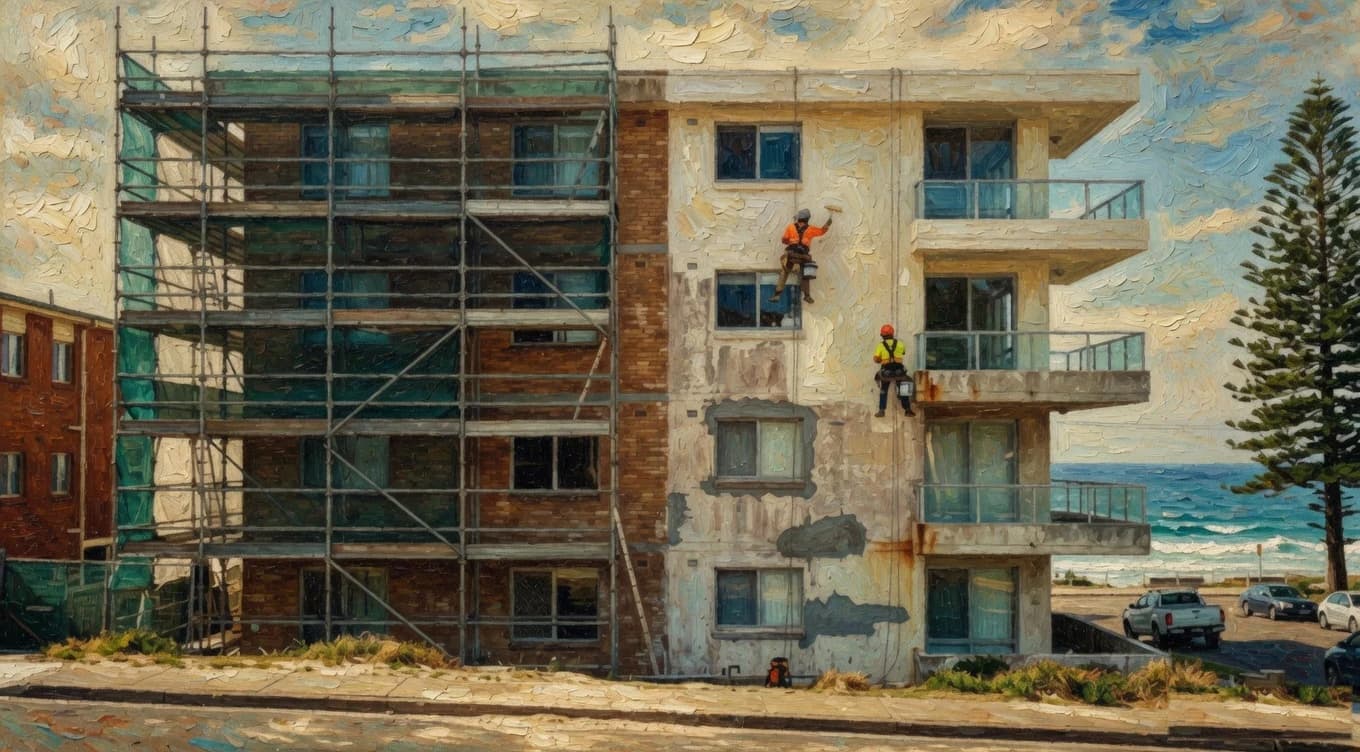
A repaint is when someone gets close enough to every square metre of the facade to price what they find. This article uses verified tribunal cases, quoted project figures, and the rules in New South Wales, Victoria and Queensland on who approves the work, who pays, and why a building within a kilometre of surf sits on a shorter coating cycle.
· 19 min read
On this pagePaint is the building’s sacrificial skinOn this page
- Paint is the building’s sacrificial skin
- The coastal clock: why “near the beach” is a technical category
- What a strata repaint involves
- What the scaffold reveals
- Maintenance or improvement? The colour question is a legal question
- New South Wales
- Victoria
- Queensland
- Heritage buildings — one more gate
- Who pays, and what it costs
- The funding machinery
- The numbers
- The deferral arithmetic
- So how often should a strata building be repainted?
- A committee checklist
- Frequently asked questions
- How often does a strata building need repainting?
- Who pays for repainting a strata building?
- Do we need a special resolution to change the building’s colour?
- How much does repainting a strata building cost?
- Does being near the coast change anything?
- What if the owners corporation just refuses to repaint?
- What waiting costs
In 2018, a Queensland apartment scheme called The Presidents Lodge put a package of works to its owners: surface preparation and repainting of the building in the existing colour. The price was $639,361.66. When objecting owners pulled the package apart at adjudication, it turned out the “painting project” contained four contracts — one for painting, one for remedial repairs to spalled podium faces and corroded bulkheads, one for the balcony decks, and one to pressure-clean, repair and coat the roof. The adjudicator upheld the lot as lawful maintenance (The Presidents Lodge [2018] QBCCMCmr 226).
Owners tend to file repainting under colour choice. On the record, a repaint is the one scheduled event in a building’s life when someone gets close enough to every square metre of the facade to see what is happening to it, and prices what they find.
The rest of this article is the construction sequence, the defects that turn up once access is up, the approval and payment rules in New South Wales, Victoria and Queensland, and the AS 4312 corrosivity bands that set a coastal building's wash-down and topcoat cycle. Every case below links to the primary tribunal or court record.
Paint is the building’s sacrificial skin
Concrete fails from the inside out. When the steel reinforcement rusts, the rust occupies more volume than the steel it came from, so the corroding rebar cracks the concrete around it and eventually pops the cover off. That is concrete spalling — “concrete cancer” in the trade.
Two things get the corrosion started, and both come through the surface. Carbonation is carbon dioxide slowly soaking into the concrete and lowering its pH until the steel’s natural protective layer fails. Chloride attack is salt doing the same job faster. Dulux’s protective coatings division lists the defences in its technical bulletin on spalling: adequate concrete cover, good curing, and “a certified and effective anti-carbonation and chloride ion resistant coating system” (Dulux Protective Coatings, “What is spalling?”).
In that list, the coating system sits alongside concrete cover and curing as an engineering control against structural deterioration. The paint on your building is a sacrificial, renewable membrane between the atmosphere and the reinforcement, and it protects only for as long as it keeps getting renewed.
The coastal clock: why “near the beach” is a technical category
Distance from the surf is a classified variable in Australian standards.
AS 4312 (Atmospheric corrosivity zones in Australia) grades every location from C1 (very low) to C5/CX (very high to extreme). The zones lean on decades of CSIRO salt-deposition and corrosion mapping across Australia (Galvanizers Association of Australia summary; CSIRO-authored corrosivity mapping paper). As tabulated in the Australian Steel Institute’s corrosivity guide, the bands run roughly like this:
| Location | Corrosivity category |
|---|---|
| Within ~100 m of breaking surf | C5M (very high, marine) — sometimes to 300–500 m |
| ~100 m to ~1 km from breaking surf | C4 (high) |
| Coast with calm water (bays, harbours), first ~100 m | C4 (high) |
| Calm-water coast to ~1 km | C3 (medium) |
| 1 km to 20–50 km inland from surf coast | C3 (medium) |
The standard’s commentary notes that salt influence does not normally extend beyond about a kilometre from the coastline — except across flat terrain with strong prevailing onshore winds, where it carries further.
What does a category change do to a coating? The companion standard for steel coatings, AS/NZS 2312.1, assigns every coating system a durability to first maintenance that collapses as corrosivity climbs — the same system that lasts 15+ years in a quiet suburb can be down to a few years at C5M (NATSPEC TECHnote DES 010).
Paint manufacturers write the same physics into their warranty terms. Dulux’s AcraTex texture-coating systems come with written 10- and 15-year warranties — conditional on maintenance that includes washing the building down every 12–18 months, “more often in seaside locations”, and re-applying the protective topcoat at 7–10 years (Dulux AcraTex TechNotes & FAQs; Exteriors Care & Maintenance Guide). Skip the wash-downs and you may have voided the warranty on a six-figure paint job.
And when a coastal building doesn’t keep up, the courts see the result. In Glenquarry Park Investments Pty Ltd v Hegyesi [2019] NSWSC 425, a 1960s waterfront block at Point Piper ended up in the Supreme Court over a refurbishment estimated at $2.2 million. The engineering evidence found bricks deteriorated by salt attack and brick ties corroding “(especially in a salty environment)”.
What a strata repaint involves
A multi-storey strata repaint is a construction project. It is not a larger version of painting a bedroom. The sequence:
1. Condition inspection and specification. The governing document is AS/NZS 2311:2017, the Guide to the painting of buildings — the standard the industry uses to write painting specifications, including criteria for judging when a surface needs repainting and how to treat surfaces in poor condition. A building-specific specification is what stops you comparing three quotes for three different jobs.
2. Access. Scaffold, elevated work platforms, or industrial rope access. Erecting scaffold where a person or object could fall more than 4 metres requires a licensed high-risk-work scaffolder (Safe Work Australia), and any work with a fall risk over 2 metres is “high risk construction work” requiring a Safe Work Method Statement (Safe Work Australia falls Code of Practice). Rope access (abseiling painters) is governed by AS/NZS ISO 22846 and typically prices 20–40% above standard rates per square metre — but can still win overall by removing weeks of scaffold hire (The Quote Yard strata painting cost guide, a trade marketplace figure).
3. Wash-down and surface preparation. High-pressure washing to strip salt, chalk and mould before anything goes on. Paint applied over a salt-laden surface fails early, warranty or not.
4. Repairs before coating. Spalling repair, crack injection, render patching, sealant replacement. Coating over unrepaired concrete cancer doesn’t fix it. It hides it for a short time. The Presidents Lodge package is the template that survived adjudication: painting was one contract of four.
5. Hazardous materials screening. Two gates that catch old buildings:
- Lead. Australian paint made before 1970 can contain up to 50% lead; the legal limit dropped to 1% in 1965, 0.25% in 1992 and 0.1% in 1997 (Australian Government Lead Alert guide). Dry-sanding a 1960s walk-up is a contamination event; AS/NZS 4361.2:2017 exists specifically to manage lead paint work in residential buildings.
- Asbestos. Textured coatings and some renders in pre-1990 stock can contain asbestos, and buildings built before 31 December 2003 need an asbestos register before contractors disturb coatings (Comcare).
6. A licensed contractor. In NSW, painting work over $5,000 including materials requires a licence (NSW Government); in Queensland, painting as part of building work over $3,300 requires a QBCC licence (QBCC).
7. Coating system selection matched to the AS 4312 corrosivity zone and the substrate, with the warranty’s wash-down interval and topcoat year written into the building’s maintenance calendar so the dates get booked.
What the scaffold reveals
The same pattern repeats through the verified record: the paint job gets priced, access goes up, and the scope grows. What turns up:
- Concrete spalling. Only visible and testable up close. Remedial contractors treat “found once access is up” as the norm. The rate tables below put a number on that discovery: the same square metre moves from a paint rate to a cut-out rate.
- Salt-attacked embedded steel. Glenquarry Park’s corroded brick ties sat invisible inside the walls of a waterfront building for decades until engineers went looking.
- Waterproofing and membrane failures. The Presidents Lodge roof needed sealer and membrane, not a colour change. And in Mastellone v The Owners – Strata Plan No 87110 [2021] NSWCATAP 188, the painting problem — stained ceilings — was the symptom; the cause was defective common-property roofing, and the Appeal Panel ordered the owners corporation to repaint the lot owner’s ceiling after fixing it. If your building needs paint to cover water stains, the paint is not the project. Our guide to who pays when water gets in covers that side.
- Lead and asbestos, per the screening gates above — budget lines committees never see coming on pre-1970 and pre-1990 buildings.
- The last cheap repaint. Coatings applied over unwashed, unrepaired surfaces fail well inside their expected life. Master Painters Australia’s own guidance is that exterior repainting “should be in the order of 5–7 years” as a safeguard (Master Painters Australia FAQ) — noticeably shorter than the ten-year figure most sinking-fund forecasts quietly assume.
Do not budget a repaint off a ground-level quote alone. Get the condition inspection first, and carry a contingency for the spalling, sealant and membrane work that access usually finds.
Maintenance or improvement? The colour question is a legal question
Every repaint reaches the meeting where someone says “while we’re at it, let’s modernise the colour.” That sentence moves the project into different legal territory in every state.
New South Wales
The owners corporation “must properly maintain and keep in a state of good and serviceable repair the common property” — s 106(1) of the Strata Schemes Management Act 2015. It is a strict duty. A like-for-like repaint sits inside it. But changing the building’s appearance — a new colour scheme, or painting surfaces that were never painted — is an improvement under s 108 and needs a special resolution first.
That line was drawn by the Supreme Court in Glenquarry Park: repairing the salt-damaged bricks, ties and mortar was within the repair duty, but cement-rendering and painting the previously unpainted brick facade “involves going beyond the restoration of the walls to their previous functional state” — an enhancement requiring a special resolution. The judgment even quotes the consultant’s report: full render and paint is what you choose “if a totally new look of the property is desired.”
The duty runs both ways. In Vickery v The Owners – Strata Plan No 80412 [2020] NSWCA 284, the Court of Appeal confirmed owners can recover damages for a breach of s 106. Mastellone established that neither a common property memorandum nor a special by-law lets the owners corporation contract out of it.
Victoria
The owners corporation “must repair and maintain the common property” — s 46 of the Owners Corporations Act 2006. But s 52 blocks any “significant alteration to the use or appearance of the common property” without a special resolution (with narrow exceptions for maintenance-plan items and urgent safety works). A Melbourne block that swaps cream for charcoal without one is in voidable-decision territory.
Tribunals will not enforce perfectionism. In Langevad v Victoria Body Corporate Services [2018] VCAT 784, an owner in a 1930s St Kilda block sued over under-maintained paintwork and lost — his own expert conceded the building was fair for its age. But note what that expert said under oath about the windows: they needed “prompt preparation and painting, in order to avoid costly timber repairs.” The duty is condition-based, and so is the economics.
Queensland
Queensland adds a distinction that has already voided hundreds of thousands of dollars in painting levies: what kind of survey plan is the scheme on?
- Building format plans (typical apartment blocks): the body corporate maintains the outside of the building, including painting (qld.gov.au).
- Standard format plans (most townhouse and villa schemes): exterior painting of the buildings is each owner’s own responsibility — and the body corporate is not allowed to accumulate sinking-fund money to do it for them (qld.gov.au).
In Somerset Park [2017] QBCCMCmr 412, a townhouse scheme had spent years levying owners to build a painting kitty. An owner challenged it; the adjudicator voided the motion and ordered the body corporate to refund $437,580 to owners. The detail that stings: the body corporate manager had told successive committees the practice was outside the Act, and they “chose to continue to operate as if the body corporate was registered under a building format plan.” Months later, Bayshore Central [2017] QBCCMCmr 550 voided a 142-lot scheme’s entire ~$500,000 painting project — including its $67,914 painting levy and a $340,000 loan.
On the colour question, Queensland runs a like-for-like rule: repainting in the same or similar colour is maintenance; a new colour scheme is an improvement, with spending bands — committee authority up to $300 × lots for basic improvements, ordinary resolution to $2,000 × lots once per financial year, special resolution above that (qld.gov.au). The adjudication cases bracket the line: maintenance is not strictly limited to like-for-like replacement (Admiralty Towers II [2019] QBCCMCmr 545), first-time coating of a never-painted roof in the original colour can still be maintenance (The Presidents Lodge), but works with a “significant or appreciable” improvement component need the improvement pathway (Carmel By The Sea [2020] QBCCMCmr 559).
Heritage buildings — one more gate
If the building is heritage-listed, even the colour is regulated. For NSW State Heritage Register items, repainting already-painted fabric is exempt from Heritage Act approval only if the scheme matches an earlier or existing scheme sympathetic to the item’s significance, and early paint layers aren’t disturbed beyond failed material (Heritage NSW Standard Exemption 9). Local heritage overlays add council-level colour rules.
Who pays, and what it costs
The funding machinery
In NSW, “painting or repainting any part of the common property which is a building” is the first listed purpose of the capital works fund (SSMA s 79(2)(a)), and every scheme must maintain a 10-year capital works fund plan — our guide to reading a capital works plan critically covers what those documents hide.
In Queensland, sinking fund forecasts are typically built by quantity surveyors, and the QS firm that pioneered them, Leary & Partners, is blunt about what drives the numbers: “the extent of painting and the painting access/scaffolding requirements” are among the variables with “the greatest impact on the sinking fund expenses” (Leary & Partners). If your levies feel mysterious, the difference between the funds is the place to start.
When the fund falls short, the gap becomes a special levy. In August 2025 the ABC reported owners at a Darwin apartment complex each facing at least $50,000 in special levies for major repairs, with some owners in financial difficulty (ABC News).
The numbers
Marketplace pricing (indicative trade figures, clearly labelled as such — The Quote Yard, NSW 2026):
| Item | Indicative range |
|---|---|
| External facade repaint (prep, primer, two coats) | $20–60/m² |
| Interior common areas | $15–35/m² |
| Whole building, small scheme (6–10 lots) | $8,000–25,000 |
| Whole building, medium scheme (20–50 lots) | $25,000–80,000 |
| Whole building, large scheme (50+ lots) | $80,000–300,000+ |
| Rope access premium | +20–40% |
The better numbers are the ones that were tested in a dispute, because someone fought over every dollar:
- Somerset Park (QLD townhouses): painting quote $428,400 ex GST.
- Bayshore Central (142 lots): ~$500,000 project incl. GST, plus a $340,000 loan.
- The Presidents Lodge: $639,361.66 painting-plus-remediation package.
- Glenquarry Park (Point Piper): refurbishment including external painting and rendering, QS-estimated at $2.2 million.
The deferral arithmetic
Two vendor-published figures sit on the same square metre. Repainting a facade runs $20–60/m² (The Quote Yard, above). Cutting out and repairing spalled concrete runs $250–600/m² for minor localised damage, $600–1,200/m² for moderate facade damage, and $1,200–2,500+/m² for severe cases (K2RA, 2026 concrete cancer repair cost guide).
That is a 10× to 100× multiple for the same square metre of building: the difference between renewing the coating on time and letting the atmosphere reach the reinforcement. It is the same trade-off the expert in Langevad put under oath at domestic scale: paint the windows promptly, “in order to avoid costly timber repairs.”
Strata policies do not cover gradual deterioration. The most common claim-denial grounds are wear and tear, defects, and lack of maintenance (Maurice Blackburn). The largest strata underwriting agency, CHU, is explicit that known defects affect whether cover is offered at all (CHU). A dated file of wash-downs, specifications and invoices is the owners corporation’s evidence when an insurer argues “lack of maintenance” on a water-ingress claim.
So how often should a strata building be repainted?
There is no statutory repaint interval anywhere in Australia. The legal trigger is condition — the duty to maintain — not the calendar. The published figures are:
- Master Painters Australia (industry peak body): exterior repainting “should be in the order of 5–7 years” as a safeguard, highly dependent on environment (MPA FAQ).
- Dulux AcraTex (manufacturer, warranty-linked): protective topcoats re-applied at 7–10 years, wash-downs every 12–18 months and more often at the seaside (AcraTex TechNotes).
- AS/NZS 2311 provides condition-based repaint criteria, not a calendar.
- Quantity surveyors set the de facto cycle in sinking-fund forecasts — commonly around ten years for a full external repaint, which is longer than both figures above. Ask your QS whether the painting assumptions in your forecast are building-specific or template numbers.
The widely repeated “repaint every 10 years” rule has, as far as the sources above go, no owner. Master Painters Australia publishes 5–7 years. Dulux’s warranty topcoat is 7–10 years. Quantity surveyors often load ten years into a forecast. For a C4 or C5M coastal building, a ten-year calendar can leave the facade past its coating life for the last several years of each cycle.
A committee checklist
- Start with a condition inspection, not a painting quote. The specification (per AS/NZS 2311) comes from the inspection; the quotes come from the specification.
- Confirm who owns the job. Queensland standard-format schemes: the building exterior is probably the owners’, not the body corporate’s — Somerset Park is what getting this wrong costs.
- Decide the colour question early and formally. Same colour = maintenance. New look = improvement, with a special resolution (NSW, VIC) or the QLD improvement bands. Put it to the general meeting before tenders, not after.
- Screen for lead and asbestos on anything pre-1990, and check the asbestos register exists if the building predates 2004.
- Budget the discovery as well as the paint. Carry a contingency for spalling and sealant work; ask tenderers to price a provisional schedule of repair rates so variations are pre-priced.
- Match the coating system to your AS 4312 zone and get the warranty’s maintenance conditions — wash-down frequency included — written into the building’s maintenance calendar.
- Check contractor licensing and WHS documentation: painting licence (NSW over $5,000; QLD over $3,300), scaffold high-risk-work licences, and Safe Work Method Statements for any work above 2 metres.
- Document everything. The repaint record is your insurance evidence, your warranty compliance file, and your defence if an owner alleges failure to maintain. If a dispute does come, know what the tribunal process costs before you’re in it.
Frequently asked questions
How often does a strata building need repainting?
There is no legislated interval — the duty is to keep common property in good repair, which makes condition the trigger. Master Painters Australia’s safeguard figure is 5–7 years for exteriors; Dulux’s warranty-linked topcoat cycle is 7–10 years. Coastal buildings sit at the short end or below it, and also need wash-downs every 12–18 months to keep coating warranties alive.
Who pays for repainting a strata building?
For apartment buildings, the owners corporation or body corporate pays from the capital works or sinking fund, topped up by special levies if the fund is short. The big exception is Queensland standard-format (townhouse-style) schemes, where exterior painting of each building is the individual owner’s responsibility — and the body corporate legally cannot save up to do it.
Do we need a special resolution to change the building’s colour?
In NSW and Victoria, yes — a new colour scheme alters the appearance of common property, which takes it beyond maintenance (NSW s 108; VIC s 52). In Queensland it becomes an improvement, with approval depending on cost: committee authority, ordinary resolution or special resolution as the spend climbs. Repainting in the existing colour is maintenance everywhere.
How much does repainting a strata building cost?
Indicative trade figures for NSW in 2026: $20–60/m² for facades, roughly $8k–25k for a small scheme, $25k–80k for a medium scheme, and $80k–300k+ for large buildings, plus 20–40% where rope access replaces scaffold. Real disputed projects in the tribunal record ran $428k–$639k for schemes of ordinary size — because repaint packages usually carry repair scopes with them.
Does being near the coast change anything?
Yes. Australian standard AS 4312 grades atmospheric corrosivity by distance from surf: the harshest marine categories apply within about 100 m of breaking surf, high corrosivity to about a kilometre, and salt influence normally fades beyond that. Coating durability ratings drop by category, manufacturers shorten their maintenance and wash-down cycles at the seaside, and the case law shows what marine salt does to embedded steel when maintenance slips.
What if the owners corporation just refuses to repaint?
The duty to maintain is enforceable. In NSW, owners have recovered damages for breach (Vickery), and NCAT has ordered an owners corporation to repaint lot property damaged by common-property defects (Mastellone). But tribunals apply a reasonableness lens, not perfectionism — a functioning building that could merely look fresher is not a breach (Langevad). If it gets that far, see our guide to forcing the strata to fix defects.
What waiting costs
The same square metre that costs $20–60 to repaint (The Quote Yard’s NSW 2026 facade range: prep, primer, two coats) later costs $250–600 to cut out as minor localised spalling, $600–1,200 as moderate facade damage, and $1,200–2,500 or more as a severe case (K2RA’s 2026 rates). That gap is usually collected as a special levy.
A committee that is about to tender should already have four documents on the file: an AS/NZS 2311 condition inspection, a building-specific specification so the quotes describe the same job, a written colour decision at the right resolution (maintenance if the colour stays; a special resolution in New South Wales and Victoria if the look changes; Queensland’s improvement spend bands if it changes there), and the AS 4312 zone plus the warranty wash-down interval written into the maintenance calendar. Without those, the quotes are not comparable and the wash-downs will not be booked.
If the scheme is a Queensland standard-format plan, stop before the first levy motion. Somerset Park had to refund $437,580 after years of collecting a painting kitty the body corporate was not allowed to hold. Bayshore Central lost a project of about $500,000, a $67,914 levy and a $340,000 loan on the same distinction.
Cases and figures verified against primary records on 30 July 2026. This article is general information for Australian strata owners and committees, not legal or engineering advice for a particular building.
Keep the scheme file in one place the committee and the manager can both open. Features, pricing, or book a tour.